At a Glance
Respiratory physiology explains the function of the respiratory system in four linked processes: pulmonary ventilation (breathing), external respiration (gas exchange in the lungs), gas transport in the blood, and internal respiration (gas exchange in the tissues), all regulated by breathing centers in the brainstem. At rest, an adult breathes about 12 to 20 times a minute and moves about 0.5 liter of air with each breath.
- What it studies
- How the respiratory system works, not just how it is built
- Four processes
- Ventilation, external respiration, gas transport, internal respiration
- Driving force
- Pressure differences: air flows and gases diffuse from higher to lower pressure
- Control center
- Medulla oblongata and pons, guided by chemoreceptors
- Typical resting values
- About 12 to 20 breaths per minute, about 0.5 liter per breath
On this page
What Is Respiratory Physiology?
Respiratory physiology is the branch of physiology that explains how the lungs and airways do their job of supplying the body with oxygen and removing carbon dioxide. Where anatomy describes the parts, such as the lungs, alveoli and diaphragm, physiology describes how those parts work together from one moment to the next.
It covers physical laws, such as how pressure and volume are linked when the chest expands, chemistry, such as how hemoglobin binds oxygen, and control, such as how the brainstem senses carbon dioxide and changes the breathing rhythm. It also explains how breathing adapts to exercise, altitude, sleep and illness. The core of the subject is that every gas moves from where its pressure is higher to where it is lower, whether that is air entering the lungs or oxygen entering a cell.
Explained simply: anatomy is the map of the respiratory system, and physiology is the traffic report. It tells you what is moving, in which direction, how fast and what keeps it flowing smoothly.
All Respiratory Physiology Guides (28)


What Are the Four Processes of Respiration?
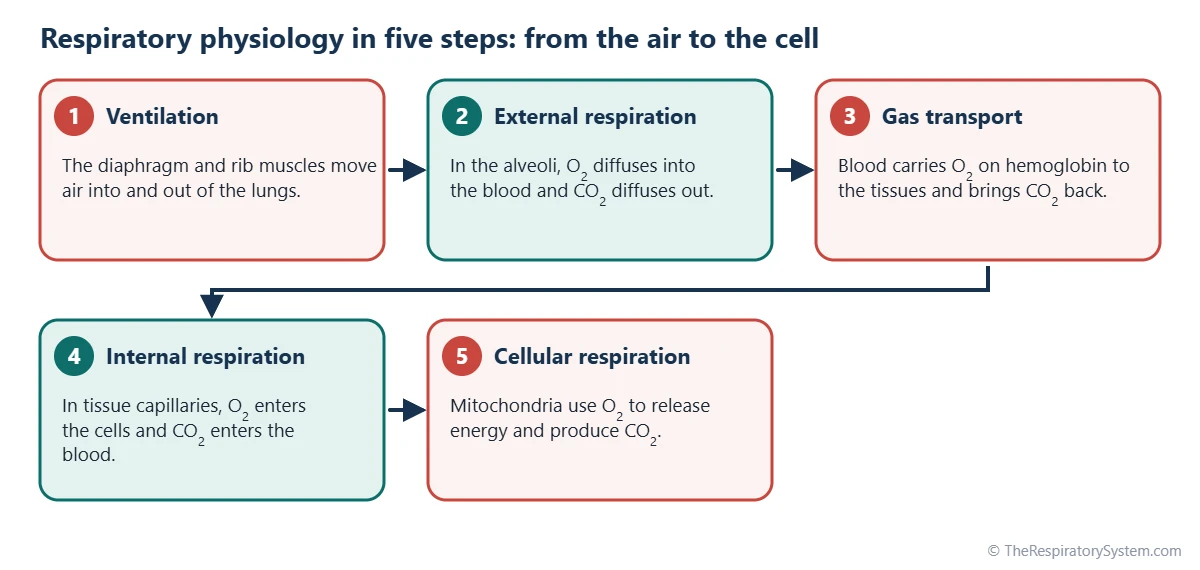
Respiration in the body happens in four linked processes: pulmonary ventilation, external respiration, gas transport and internal respiration. Each one hands the gases on to the next, and a problem at any step reduces the oxygen that finally reaches the cells.
- Pulmonary ventilation: breathing air into and out of the lungs, described in mechanics of breathing and inhalation and exhalation.
- External respiration: gas exchange in the lungs, where oxygen diffuses from the alveoli into the blood and carbon dioxide diffuses out.
- Gas transport: the blood carries oxygen, mostly bound to hemoglobin, to the tissues and carries carbon dioxide back to the lungs.
- Internal respiration: gas exchange between the blood in the tissue capillaries and the body's cells; compare the two in external and internal respiration.
Inside the cells, a fifth process, cellular respiration, uses the oxygen to release energy from food and produces the carbon dioxide that the whole system must remove. The word respiration can mean any of these steps, which is why breathing and respiration are not quite the same thing; see breathing vs respiration.
| Process | Where it happens | What it does | Guide |
|---|---|---|---|
| Pulmonary ventilation | Airways, lungs, diaphragm and chest wall | Moves air into and out of the alveoli | Mechanics of breathing |
| Inhalation and exhalation | Chest cavity and pleura | The two phases of each breath, driven by pressure changes | Inhalation and exhalation |
| External respiration | Alveoli and pulmonary capillaries | Oxygen into the blood, carbon dioxide out | Gas exchange |
| Oxygen transport | Red blood cells, mostly on hemoglobin | Carries oxygen from the lungs to the tissues | Oxygen transport |
| Carbon dioxide transport | Plasma and red blood cells | Carries carbon dioxide, mostly as bicarbonate, to the lungs | Carbon dioxide transport |
| Internal respiration | Tissue capillaries and body cells | Oxygen into the cells, carbon dioxide into the blood | External and internal respiration |
| Ventilation-perfusion matching | Every region of both lungs | Matches airflow to blood flow for efficient exchange | Ventilation-perfusion ratio |
| Control of breathing | Medulla oblongata and pons | Sets the rhythm and depth of breathing | Control of breathing |
| Chemical sensing | Medulla, carotid bodies and aortic bodies | Detects carbon dioxide, pH and oxygen levels | Respiratory chemoreceptors |
| Protective reflexes | Nose, larynx, trachea and bronchi | Clear the airway by coughing and sneezing | Cough reflex |
| Source: Standard physiology, our editors | |||
How Does Breathing Work?
Breathing works by changing the volume of the chest: when the chest gets bigger, the pressure inside the lungs falls below the air pressure outside and air flows in, and when the chest gets smaller, the pressure rises and air flows out. This link between volume and pressure is known as Boyle's law.
During a quiet breath in, the diaphragm contracts and flattens and the external intercostal muscles lift the ribs, enlarging the thoracic cavity. The lungs follow the chest wall because the two layers of the pleura are held together by a thin film of fluid. A quiet breath out is mostly passive: the muscles relax and the elastic lungs recoil. During exercise, extra muscles of respiration help in both directions.
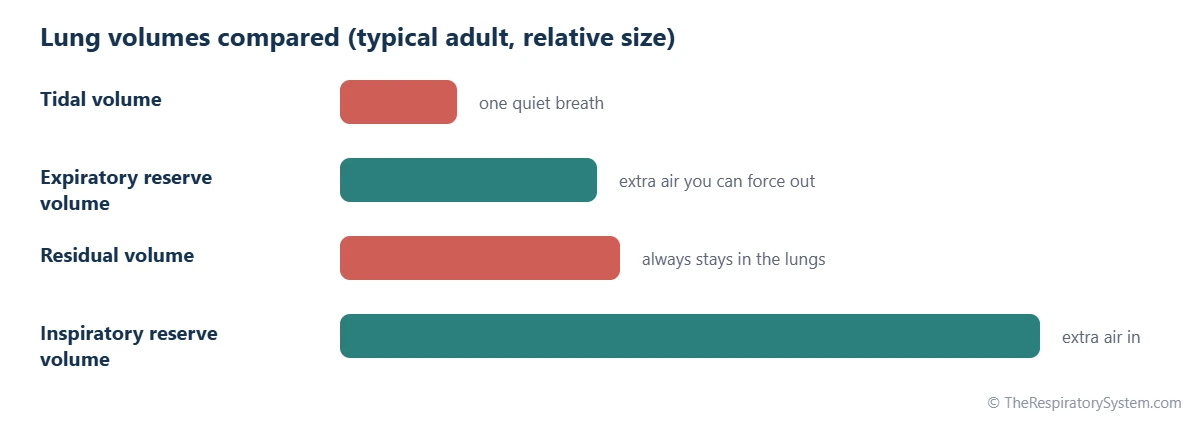
The amount of air moved is measured in lung volumes. A normal quiet breath, the tidal volume, is about 500 mL in an adult, of which about 150 mL stays in the conducting airways as dead space. The largest breath a person can breathe out after a full breath in is the vital capacity, and these values are measured with spirometry.
How Are Oxygen and Carbon Dioxide Carried in the Blood?
Oxygen is carried mainly bound to hemoglobin inside red blood cells, and carbon dioxide is carried mainly as bicarbonate dissolved in the plasma. Only a small fraction of either gas travels simply dissolved in the blood.
- Oxygen: about 98 to 99% rides on hemoglobin and the rest is dissolved. How readily hemoglobin loads and unloads oxygen is shown by the oxygen-hemoglobin dissociation curve; see also oxygen transport.
- Carbon dioxide: about 70% travels as bicarbonate, roughly 20% is bound to proteins such as hemoglobin and the rest is dissolved; see carbon dioxide transport.
- The two help each other: carbon dioxide and acid in working tissues make hemoglobin release oxygen (the Bohr effect), and oxygen loading in the lungs helps blood release carbon dioxide (the Haldane effect).
Each gas moves according to its own partial pressure. Alveolar air has an oxygen partial pressure of about 100 mmHg, while blood returning from the body has about 40 mmHg, so oxygen flows into the blood. How well air and blood flow are matched in each part of the lung is measured by the ventilation-perfusion ratio.
How Is Breathing Controlled?
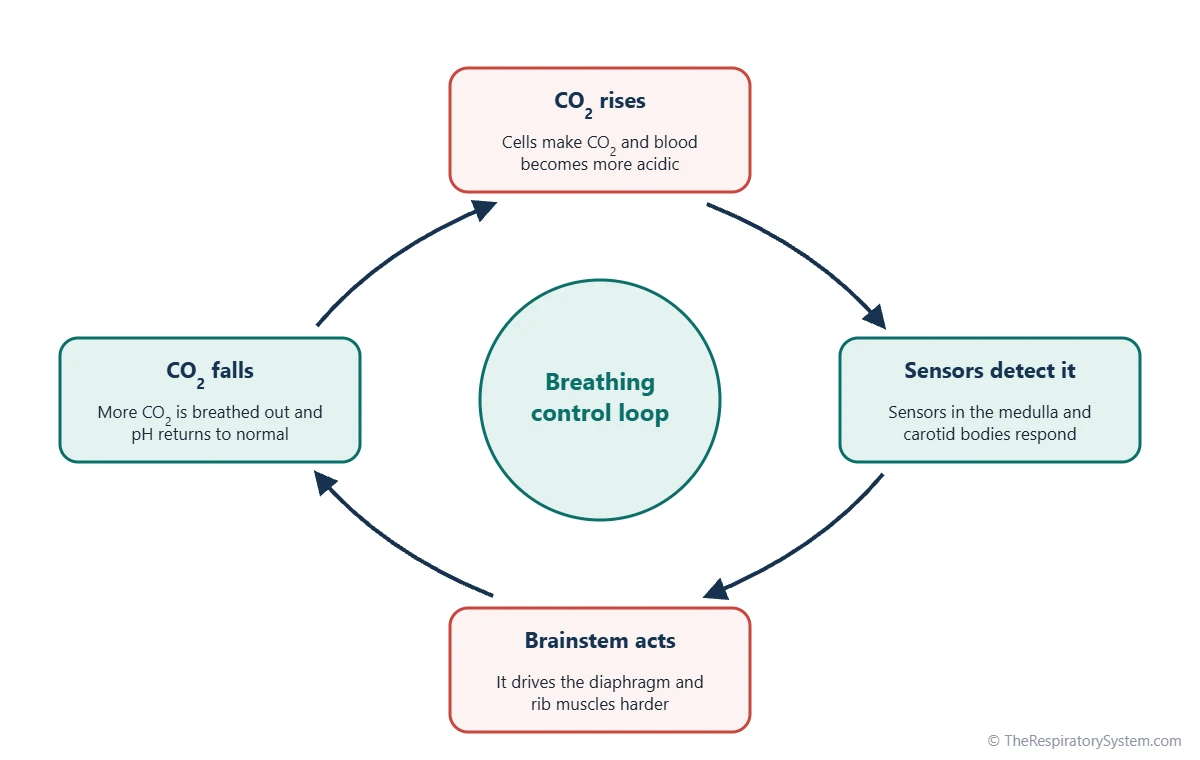
Breathing is controlled automatically by groups of neurons in the medulla oblongata and pons, which set the rhythm and adjust it mainly according to the level of carbon dioxide in the blood. You can override this control for a short time, for example to speak, sing or hold your breath, but the automatic system always takes over again.
The main signals come from respiratory chemoreceptors. Central chemoreceptors near the medulla respond to a rise in carbon dioxide through the acid it forms, and peripheral chemoreceptors in the carotid and aortic bodies also respond to low oxygen. Stretch receptors in the lungs, which trigger the Hering-Breuer reflex, help limit very deep breaths. The full feedback loop is explained on our control of breathing page.
Because breathing sets the level of carbon dioxide, it also helps keep blood pH stable, a key part of respiratory system homeostasis. Breathing too much or too little for the body's needs is described in hyperventilation and hypoventilation, and the normal range of breaths per minute is on our respiratory rate page.
What Is a Respiratory Physiology Test?
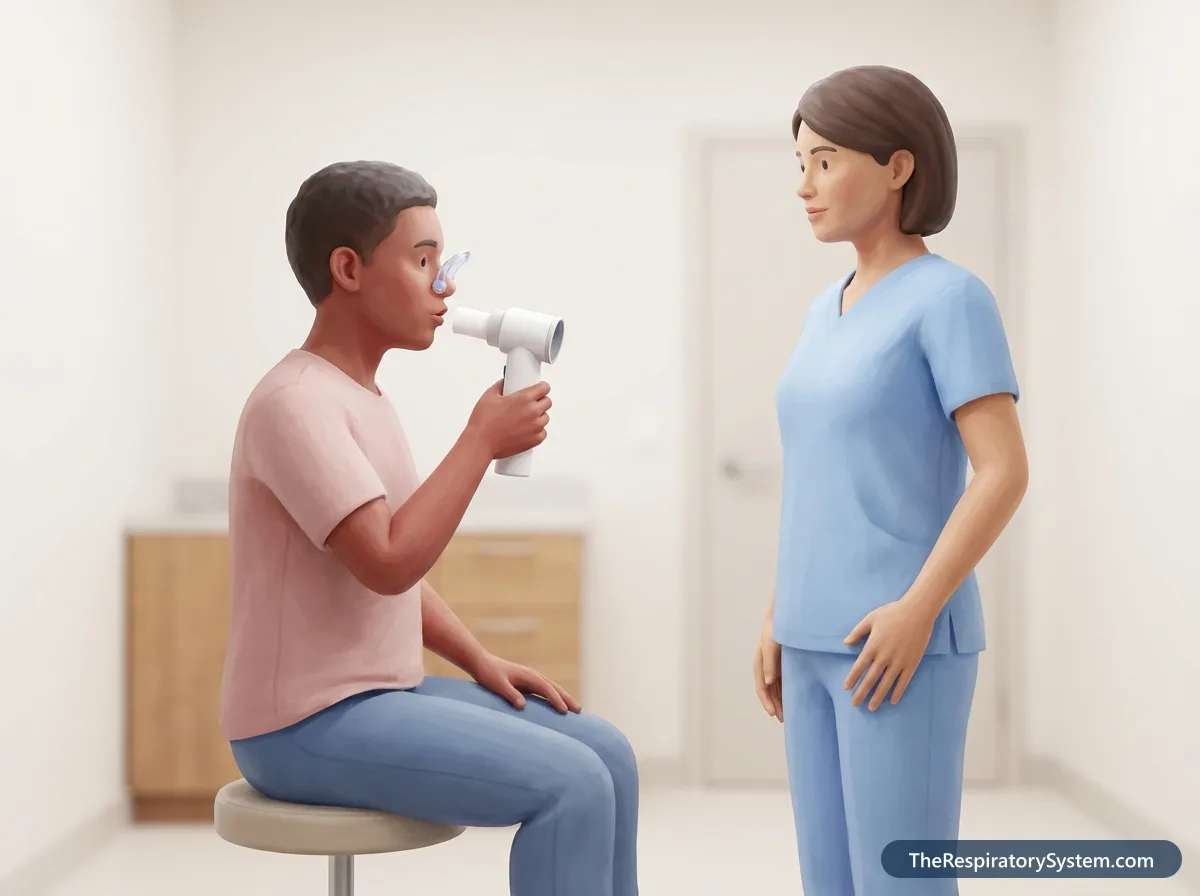
A respiratory physiology test, often called a lung function or pulmonary function test, measures how well the lungs move air and transfer oxygen into the blood. In many hospitals these tests are carried out by respiratory physiologists or respiratory scientists in a respiratory physiology service or clinic, usually on referral from a doctor.
Common measurements include spirometry, which records how much air a person can breathe out and how fast; lung volume tests, which estimate the total amount of air the lungs hold; and gas transfer tests, which estimate how easily gas passes from the alveoli into the blood. Others measure blood oxygen with a finger sensor (see oxygen saturation), breathing during sleep or the body's response to exercise. Results are compared with typical values for a person's age, height and sex, and are interpreted by the care team, not on their own.
Key Facts
- Respiratory physiology studies how the respiratory system works, from breathing to the use of oxygen by cells.
- The four processes of respiration are pulmonary ventilation, external respiration, gas transport and internal respiration.
- Air moves into the lungs because the chest expands and lowers the pressure inside them, following Boyle's law.
- A quiet adult breath, the tidal volume, is about 500 mL, and an adult breathes about 12 to 20 times a minute at rest.
- About 98 to 99% of oxygen in the blood travels on hemoglobin, while most carbon dioxide travels as bicarbonate.
- The level of carbon dioxide, not oxygen, is the main signal that drives breathing from moment to moment.
- Breathing helps control blood pH because carbon dioxide forms carbonic acid in the blood.
Frequently Asked Questions
What is the difference between respiratory anatomy and respiratory physiology?
Respiratory anatomy describes the structures of the respiratory system: their shape, position, parts and tissues, such as the trachea, bronchi and alveoli. Respiratory physiology describes how those structures work: how air moves, how gases cross into the blood, how they are carried and how breathing is controlled. Anatomy answers what and where; physiology answers how and why.
What is breathing physiology?
Breathing physiology is the part of respiratory physiology that deals with pulmonary ventilation, the movement of air into and out of the lungs. It covers the breathing muscles, the pressure changes inside the chest, lung volumes, airway resistance, lung elasticity and the brain's control of the breathing rhythm. It does not include what happens to the gases once they enter the blood.
What does a respiratory physiologist do?
A respiratory physiologist, also called a respiratory scientist in some countries, is a healthcare scientist who carries out and reports breathing and lung function tests. These include spirometry, lung volume and gas transfer tests, exercise tests and sleep studies. Their reports help doctors understand how well a person's lungs are working; the physiologist does not replace the doctor's assessment.
Why is carbon dioxide more important than oxygen in controlling breathing?
The central chemoreceptors respond to small changes in carbon dioxide through the acid it forms, and they react quickly. Oxygen sensors in the carotid and aortic bodies respond strongly only when oxygen falls well below normal. In everyday life, the oxygen level stays high enough that the carbon dioxide signal sets the breathing rate and depth.
What is the main principle of gas movement in the respiratory system?
Gases always move from an area of higher pressure to an area of lower pressure. Air flows into the lungs when the pressure inside them drops below the outside air pressure, and each gas diffuses between air, blood and tissue according to its own partial pressure. No active pumping of oxygen or carbon dioxide across cell membranes is needed.
How does respiratory physiology change with exercise?
During exercise, working muscles use more oxygen and make more carbon dioxide. Breathing becomes deeper and faster, more blood flows through the lungs, and the gas exchange surface is used more fully. In healthy people the lungs usually keep up easily, and the limit to hard exercise is set mainly by the heart and muscles rather than by breathing.
Keep Exploring


