At a Glance
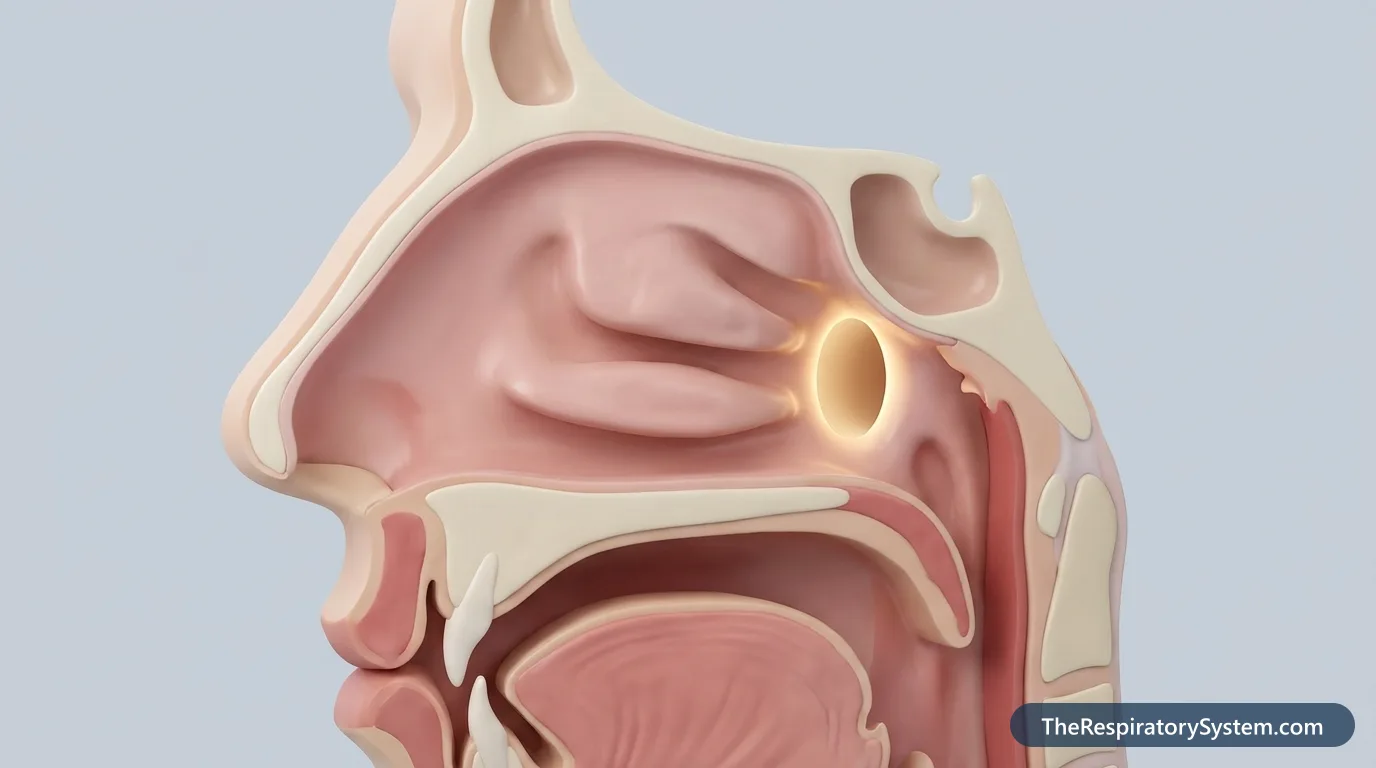
The choanae (singular: choana) are the 2 posterior nasal openings that connect the nasal cavity with the nasopharynx. Each is bounded by the vomer, the palatine bone, the sphenoid and the medial pterygoid plate, and in adults measures roughly 2.5 cm high and 1.3 cm wide. A choana that fails to open before birth causes choanal atresia.
- Location
- Back of the nasal cavity, at the top of the throat above the soft palate
- Function
- Pass air between the nasal cavity and the nasopharynx; carry mucus and aromas to the throat
- Tissue
- Bony frame lined with ciliated respiratory mucosa
- Size
- About 2.5 cm high and 1.3 cm wide each in adults
- Connects to
- Nasal cavity in front, nasopharynx behind
- Part of
- Nasal cavity, upper respiratory tract
On this page
What Are the Choanae?
The choanae are the paired openings through which the nasal cavity opens backward into the nasopharynx. One choana serves each half of the nose, so air from the right and left nasal passages flows through separate openings before it mixes in the throat. This term belongs to our respiratory system glossary.
The name comes from the Greek word for funnel. The choanae have several other names: internal nares, posterior nares and posterior nasal apertures. The word nares links them with the nostrils, which are the external or anterior nares at the front of the nose.
Explained simply
If the nostrils are the front doors of the nose, the choanae are its back doors. Air walks in through the front doors, travels along the hallway of the nasal cavity, and leaves through the back doors into the throat. You cannot see the back doors from outside, because they open behind the roof of your mouth.
Where Are the Choanae Located?
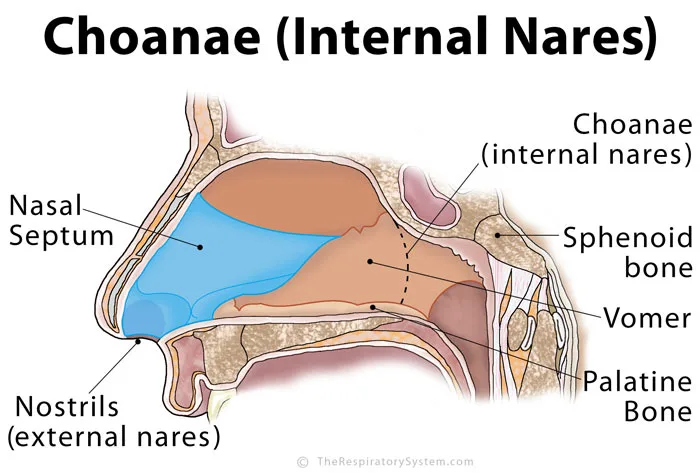
The choanae are located at the back end of the nasal cavity, just above the soft palate and roughly in line with the rear edge of the hard palate. They lie behind the back ends of the nasal conchae and directly in front of the nasopharynx.
Looking forward from the throat, a doctor using a small mirror or endoscope sees the two choanae side by side, separated by the back edge of the septum, with the rear tips of the inferior and middle conchae visible inside them. To each side, a short distance behind them, are the openings of the auditory (Eustachian) tubes, and on the back wall of the nasopharynx above lie the adenoids. Below the choanae, the soft palate separates the nasopharynx from the oral cavity.
Choanae Anatomy: Borders and Size
Each choana is a rigid, roughly oval or rectangular opening framed by four bones: the vomer in the middle, the palatine bone below, the medial pterygoid plate on the outer side and the sphenoid above. This bony ring keeps the back of the airway open at all times.
- Medial border: the back edge of the vomer, the thin, flat bone that forms the lower back part of the nasal septum and divides the two choanae.
- Inferior border (floor): the back edge of the horizontal plate of the palatine bone, where the hard palate ends.
- Lateral border: the medial plate of the pterygoid process of the sphenoid bone.
- Superior border (roof): the underside of the body of the sphenoid, overlapped by the wing-like alae of the vomer and small processes of the palatine and pterygoid bones.
In adults each choana is about 2.5 cm tall and about 1.3 cm wide, taller than it is wide. In a living person the bony frame is covered by mucous membrane, the same ciliated respiratory lining found in the rest of the nasal cavity, which continues without a break into the lining of the nasopharynx.
| Feature | Choanae | Details |
|---|---|---|
| Medial border | Vomer | Divides the right and left choanae |
| Inferior border | Horizontal plate of the palatine bone | Back edge of the hard palate |
| Lateral border | Medial pterygoid plate of the sphenoid | Forms the outer wall of each opening |
| Superior border | Body of the sphenoid with the alae of the vomer | Roof of the opening |
| Adult size | About 2.5 cm high and 1.3 cm wide | Taller than wide |
| Lining | Ciliated respiratory mucosa | Continuous with the nasal cavity and nasopharynx |
| Number | 2, one for each nasal passage | Same as the nostrils |
| Compared with nostrils | Internal (posterior) nares | Nostrils are the external (anterior) nares |
| Compared with conchae | Openings at the back of the nose | Conchae are curled bony shelves on the side walls |
| Source: Typical adult anatomy, our editors | ||
What Do the Choanae Do?
The main function of the choanae is to pass air between the nasal cavity and the throat: inhaled air leaves the nose through them, and exhaled air enters the nose through them on its way out.
- Breathing in: air drawn through the nostrils is filtered, warmed and moistened in the nasal cavity, then flows through the choanae into the nasopharynx, down the pharynx and through the larynx, trachea and bronchi to the lungs.
- Breathing out: air rich in carbon dioxide travels the same way in reverse and leaves through the nose.
- Mucus clearance: cilia sweep mucus from the nasal cavity and sinuses back through the choanae into the throat, where it is swallowed.
- Flavor: aromas from food in the mouth rise through the choanae to the smell receptors in the roof of the nose, which is why flavor fades when the nose is blocked.
- Voice: when the soft palate lowers for the sounds m, n and ng, air from the larynx passes forward through the choanae into the nasal cavity.
During swallowing, the soft palate rises and presses against the back wall of the throat, closing the space below the choanae so food and drink do not enter the nose.

Choanae vs Conchae, Nares and Nasopharynx
The choanae are openings, while the conchae are scroll-shaped shelves of bone; the two are easily confused because their names sound alike.
Choanae vs conchae
The nasal conchae, also called turbinates, are three curled projections on the outer wall of each nasal passage, and they make air swirl so it can be cleaned and warmed. The choanae are at the very back of the nasal cavity and do not stick out at all; they are simply the exits into the throat.
Choanae vs nasopharynx
The nasopharynx is a chamber, the uppermost part of the throat, while the choanae are the doorways into it. Air passes through the choanae and then fills the nasopharynx.
Choanae vs fauces
The fauces are the opening between the mouth and the oropharynx, bounded by the arches beside the tonsils. They are the back door of the mouth, just as the choanae are the back door of the nose.
Choanae in other animals
In mammals, the choanae sit far back, behind a complete bony palate. In birds, the choana is a long slit in the roof of the mouth that links the nasal cavity and mouth. Internal nostrils are a hallmark of land vertebrates, and they first appeared in the fish ancestors of the earliest four-legged animals.
Common Conditions That Affect the Choanae
The best-known condition of the choanae is choanal atresia, a blockage present from birth, but the openings can also be narrowed or plugged by tissue growing near them. Our respiratory diseases section covers airway disorders more broadly.
Choanal atresia
Choanal atresia is a congenital condition in which one or both choanae are blocked by bone, membrane or both, because the passage at the back of the nose did not open properly before birth. It affects roughly 1 in every 5,000 to 8,000 newborns, and its exact causes are not fully known, with both genetic and environmental factors thought to play a part. It occurs on one side more often than both and can be part of a wider syndrome such as CHARGE syndrome.
Because newborns breathe mainly through the nose, blockage of both choanae is potentially life-threatening, and babies typically struggle to breathe when calm or feeding but breathe better when crying through the mouth. A blockage on one side may go unnoticed until later in childhood, when it shows up as a one-sided blocked or runny nose.
Other conditions
- Choanal stenosis: a narrowing rather than a complete blockage of one or both choanae.
- Enlarged adenoids: in children, swollen adenoid tissue on the back wall of the nasopharynx can block the choanae and force mouth breathing.
- Antrochoanal polyp: a polyp that starts in the maxillary sinus and grows back through a choana into the nasopharynx.
Key Facts
- The choanae are the internal or posterior nares, the back openings of the nasal cavity.
- They lead into the nasopharynx, the uppermost part of the throat.
- The vomer separates the two choanae, and the palatine bone forms their floor.
- Each adult choana measures about 2.5 cm high and 1.3 cm wide.
- Choanal atresia, a blockage present from birth, affects roughly 1 in 5,000 to 8,000 newborns.
- Choanae are openings, while the conchae are curled shelves of bone on the side walls of the nose.
Quick Quiz: Test What You Know About the Choanae
6 questions. Tap an answer to check it.
What is another name for the choanae?
The choanae are the internal or posterior nares; the nostrils are the external nares.
Into which space do the choanae open?
The choanae open from the nasal cavity into the nasopharynx.
Which bone separates the two choanae?
The back edge of the vomer forms the medial border of each choana.
What forms the floor of each choana?
The horizontal plate of the palatine bone, the back edge of the hard palate, forms the floor.
What is choanal atresia?
Choanal atresia is a congenital blockage of one or both choanae by bone or membrane.
How do the choanae differ from the conchae?
The choanae are the back openings of the nose, while the conchae project from its side walls.
Frequently Asked Questions
Are the choanae the same as the posterior nasal apertures?
Yes, the terms are used for the same pair of openings. Posterior nasal aperture is the name often used for the bony opening seen on a dry skull, while choana is used both for that opening and for the soft-tissue-lined passage in a living person. Both describe the back openings of the nasal cavity, bounded by the vomer, palatine bone, sphenoid and medial pterygoid plates.
What is the difference between nares and choanae?
Nares is the general term for the openings of the nose. The anterior or external nares are the nostrils at the front of the nose, which you can see on the face. The posterior or internal nares are the choanae at the back of the nasal cavity, which open into the throat and are hidden behind the soft palate. Air passes through both on every nasal breath.
Can you see the choanae?
Not from the outside, and not by looking into the open mouth, because the soft palate hides them. Doctors view the choanae with a thin flexible or rigid endoscope passed through the nose, or with a small angled mirror placed at the back of the mouth. They also appear clearly on CT scans of the nose, which are used to confirm choanal atresia in newborns.
Why are the choanae important in newborns?
For the first months of life, babies breathe mainly through the nose and are less able to switch to mouth breathing, especially while feeding. If both choanae are blocked, as in bilateral choanal atresia, air cannot reach the throat through the nose, and the baby has trouble breathing except when crying. That is why newborns are often checked for open nasal passages soon after birth.
Does mucus pass through the choanae?
Yes. The nose and sinuses produce mucus all the time, and the cilia lining the nasal cavity sweep it backward through the choanae into the nasopharynx, from where it slides down the throat and is swallowed, usually without being noticed. When the mucus is thicker or more abundant than usual, for example during a cold, it may be felt running down the back of the throat.
Where are the choanae on a skull?
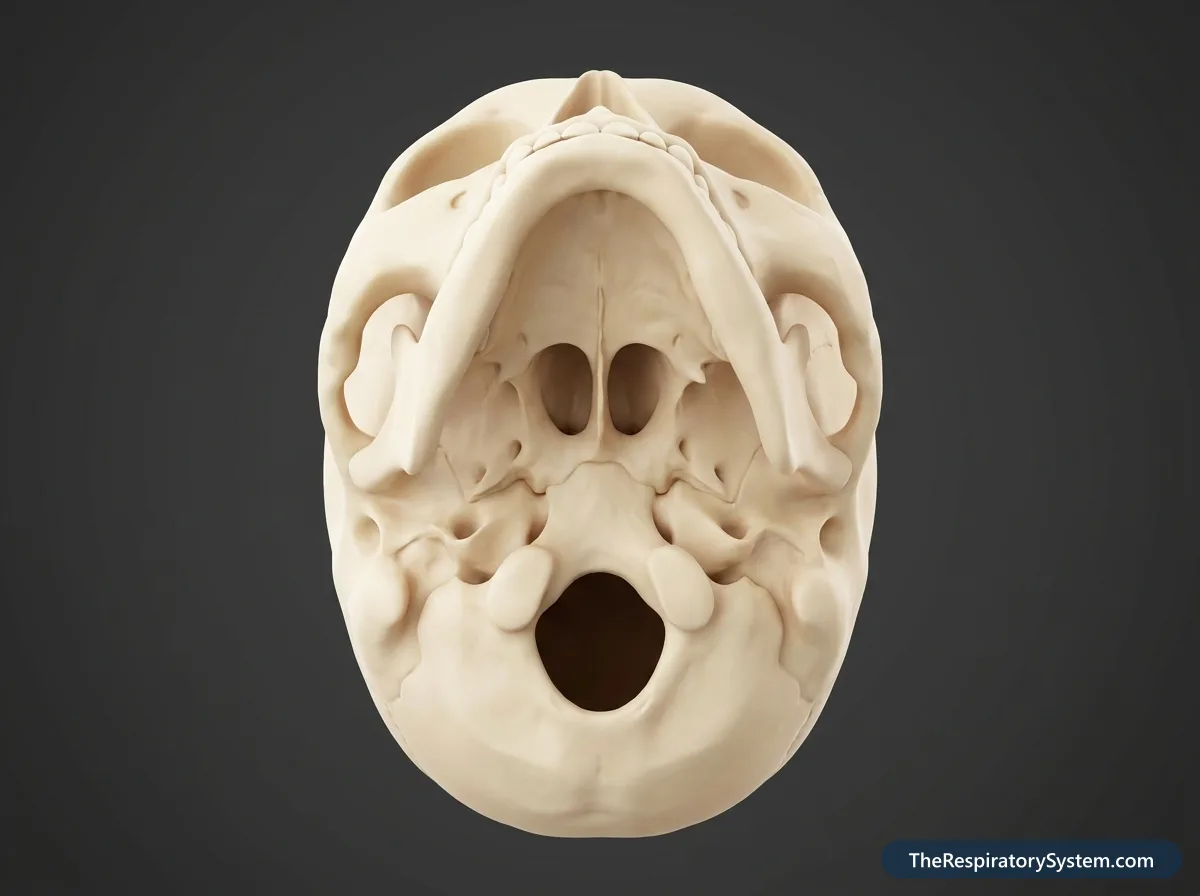
On the underside of a skull, the choanae appear as two openings just above and behind the back edge of the hard palate. They are divided by the thin vomer and framed on each side by the medial pterygoid plates of the sphenoid bone. Viewed from below, they sit in front of the base of the skull and above the area where the soft palate attaches in life.
Do birds have choanae?
Yes, but they look different. In birds the choana is a long slit in the roof of the mouth that connects the nasal cavity directly with the mouth, because birds lack the complete bony palate of mammals. In humans and other mammals, the palate separates the nose from the mouth, so the choanae open farther back, into the nasopharynx, instead of into the mouth.
Keep Exploring


