At a Glance
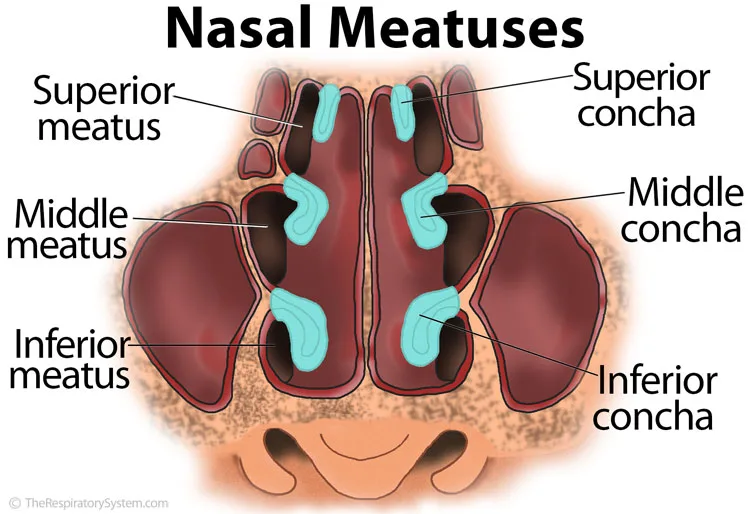
The nasal meatuses are three grooved air channels on the lateral wall of each nasal cavity, one under each concha. The superior meatus is the smallest and drains the posterior ethmoid cells; the middle meatus drains the frontal sinus, maxillary sinus and anterior and middle ethmoid cells; the inferior meatus is the largest and receives the nasolacrimal (tear) duct.
- Location
- Lateral (side) wall of each nasal cavity, beneath the superior, middle and inferior conchae
- Function
- Guide and condition inhaled air; drain the paranasal sinuses and the tear duct into the nose
- Type / tissue
- Bony grooves lined by respiratory mucosa (pseudostratified ciliated columnar epithelium with goblet cells)
- Number
- 3 on each side (superior, middle, inferior), plus the common and nasopharyngeal meatus
- Connects to
- Paranasal sinuses, nasolacrimal duct, sphenopalatine foramen and, at the back, the nasopharynx
- Part of
- Nasal cavity, upper respiratory tract
On this page
- What Is the Nasal Meatus?
- Where Is the Nasal Meatus Located?
- Nasal Meatus Anatomy: Superior, Middle and Inferior Meatus
- What Drains Into Each Nasal Meatus?
- What Is the Function of the Nasal Meatus?
- Nasal Meatus vs Conchae: How Do They Work Together?
- Common Conditions That Affect the Nasal Meatus
- Key Facts
- Quiz
- FAQ
What Is the Nasal Meatus?
The nasal meatus is any of the long, narrow air passages that run from the front to the back of the lateral wall of the nasal cavity, each lying in the space beneath a nasal concha. The word meatus comes from Latin and simply means passage or channel, and anatomists use the plural meatuses (or meatus). Each half of the nose contains three of them, which differ in size and in the openings they hold.
- Superior meatus: the smallest, under the superior concha.
- Middle meatus: the busiest drainage area, under the middle concha.
- Inferior meatus: the largest, under the inferior concha, just above the floor of the nose.
The meatuses cannot be understood without the bony shelves above them. The nasal conchae (turbinates) project from the side wall like curled scrolls, and the meatus is the groove each scroll overhangs. In other words, the concha is the bump and the meatus is the channel underneath it.
Explained simply
Imagine the inside wall of each nostril as a bookshelf with three curved shelves stacked one above the other. The shelves are the conchae, and the tunnels of space under each shelf are the meatuses. Air slides along these tunnels on its way to the throat, and several small drainpipes from the sinuses and the eyes empty into them.
Where Is the Nasal Meatus Located?
The nasal meatuses are located on the lateral wall of each nasal cavity, stacked from top to bottom beneath the superior, middle and inferior conchae, between the nostrils in front and the choanae at the back. They sit on the outer side of each air chamber, facing the nasal septum across the midline.
Borders of the meatus region
- Above: the roof of the nasal cavity and the sphenoethmoidal recess, a small pocket above and behind the superior concha.
- Below: the floor of the nasal cavity, formed by the hard palate, which also forms the roof of the oral cavity.
- Medially: the free curled edges of the conchae and, beyond them, the nasal septum.
- Laterally: the bones of the side wall: the maxilla, the ethmoid labyrinth, the lacrimal bone, the inferior concha, the perpendicular plate of the palatine bone and the medial pterygoid plate.
- Behind: the choanae, the paired openings into the nasopharynx.
Air enters through the nostrils, passes the vestibule and then fans out across the meatuses before it gathers again behind the conchae and flows through the choanae into the throat. Because the maxillary sinus lies just outside the lateral wall and the orbit lies above it, the meatuses are the natural meeting point for sinus and tear drainage.
Nasal Meatus Anatomy: Superior, Middle and Inferior Meatus
Nasal meatus anatomy is built around three main passages, each named after the concha that roofs it, plus two shared spaces called the common meatus and the nasopharyngeal meatus. The three main meatuses grow in size from top to bottom.
What is the superior nasal meatus?
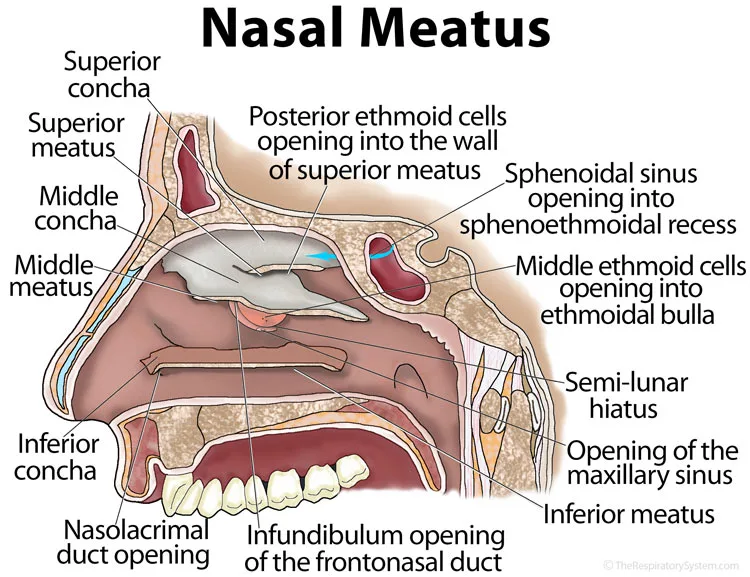
The superior meatus is the smallest and shortest meatus, a narrow slit between the superior concha and the middle concha in the back part of the lateral wall. The posterior ethmoidal air cells open into its front part. Near its back end lies the sphenopalatine foramen, an opening that links the nasal cavity with the pterygopalatine fossa and lets the sphenopalatine artery and the nerves of the nasal mucosa enter. Above and behind the superior concha, the sphenoid sinus drains into the sphenoethmoidal recess rather than into the meatus itself.
What is the middle nasal meatus?
The middle meatus lies beneath the middle concha and above the inferior concha, and it runs along the length of the concha that roofs it. Lifting the middle concha reveals a small landscape of named features:
- Ethmoidal bulla: a rounded bony bulge formed by the middle ethmoidal air cells, which open on or above it.
- Uncinate process: a thin, hook-shaped plate of the ethmoid bone that curves down and back below the bulla.
- Semilunar hiatus (hiatus semilunaris): the half-moon-shaped gap between the bulla and the uncinate process.
- Ethmoidal infundibulum: a funnel-shaped channel lateral to the uncinate process that opens through the hiatus and leads up toward the frontal sinus.
What is the inferior nasal meatus?
The inferior meatus is the largest and longest meatus, lying between the inferior concha and the floor of the nasal cavity and running along almost the whole length of the lateral wall. Its main opening is the lower end of the nasolacrimal duct, found in its front part under the anterior end of the inferior concha. A small fold of mucosa at this opening, often called the valve of Hasner, helps stop air and mucus from being pushed up into the tear duct when we blow the nose.
What is the common nasal meatus?
The common nasal meatus is the narrow, vertical slit between the free edges of the conchae and the nasal septum, which joins all three meatuses on the inner side. Much of the airflow in quiet breathing passes through this central channel. Behind the back ends of the conchae, the space narrows into the nasopharyngeal meatus, which leads through the choanae into the nasopharynx.
| Passage | Where it lies | Size | What opens into it |
|---|---|---|---|
| Sphenoethmoidal recess | Above and behind the superior concha | Small pocket | Sphenoid sinus |
| Superior meatus | Between the superior and middle conchae | Smallest and shortest | Posterior ethmoid cells; sphenopalatine foramen near its back end |
| Middle meatus | Between the middle and inferior conchae | Medium | Frontal sinus, maxillary sinus, anterior and middle ethmoid cells |
| Inferior meatus | Between the inferior concha and the nasal floor | Largest and longest | Nasolacrimal (tear) duct |
| Common meatus | Between the free edges of the conchae and the nasal septum | Tall, narrow slit | Joins all three meatuses; no sinus openings |
| Nasopharyngeal meatus | Behind the back ends of the conchae | Short | Leads through the choanae to the nasopharynx |
| Source: Typical adult anatomy, our editors | |||
What Drains Into Each Nasal Meatus?
Each nasal meatus receives the drainage of specific paranasal sinuses or the tear duct: the posterior ethmoid cells drain into the superior meatus, the frontal, maxillary and anterior and middle ethmoid sinuses drain into the middle meatus, and the nasolacrimal duct opens into the inferior meatus. The sphenoid sinus drains just above them, into the sphenoethmoidal recess.
Middle meatus openings
The middle meatus collects drainage from three of the four paranasal sinuses, which makes it the most important drainage area of the nose. The frontal sinus empties through the frontonasal duct or frontal recess into the front of the ethmoidal infundibulum. The maxillary sinus opens into the back part of the semilunar hiatus, and the anterior ethmoid cells open into the hiatus and infundibulum nearby. Some people also have small accessory openings of the maxillary sinus a little further back in the middle meatus.
The ostiomeatal complex
Surgeons and radiologists group the uncinate process, ethmoidal infundibulum, semilunar hiatus, ethmoidal bulla, maxillary sinus opening and frontal recess into one functional unit, the ostiomeatal complex (also spelled osteomeatal). Because so many sinuses share this narrow corridor, a small swelling here can block several sinuses at once. On a coronal CT scan of the sinuses, the standard view for nasal meatus anatomy in radiology, this corridor is one of the first areas checked.
Why the sinuses drain where they do
The drainage pattern is a leftover from development. Before birth, the lateral nasal wall forms a series of ridges, the future conchae, separated by grooves, the future meatuses. The paranasal sinuses grow as small pouches of lining that bud outward from these grooves into the surrounding bones, so each sinus keeps its opening in the meatus it grew from.
| Opening | Meatus or recess | Exact site |
|---|---|---|
| Frontal sinus (frontonasal duct) | Middle meatus | Front of the ethmoidal infundibulum |
| Maxillary sinus | Middle meatus | Back part of the semilunar hiatus |
| Anterior ethmoid cells | Middle meatus | Semilunar hiatus and ethmoidal infundibulum |
| Middle ethmoid cells | Middle meatus | On or above the ethmoidal bulla |
| Posterior ethmoid cells | Superior meatus | Front part of the meatus |
| Sphenoid sinus | Sphenoethmoidal recess | Above and behind the superior concha |
| Nasolacrimal duct | Inferior meatus | Front part, under the anterior end of the inferior concha |
| Sphenopalatine foramen | Superior meatus | Back end; passage for vessels and nerves, not drainage |
| Source: Typical adult anatomy, our editors | ||
What Is the Function of the Nasal Meatus?
The function of the nasal meatus is to guide inhaled air over a large, moist, warm surface so it is filtered, warmed and humidified, and to give the sinuses and the tear duct a path to drain into the nose. These jobs make the meatuses a small but busy part of the airway described in our overview of respiratory system functions.
Nasal meatus function in the respiratory system
- Air conditioning: together with the conchae, the meatuses greatly increase the area of mucosa that air touches. Warm blood flowing just under the lining heats the air, and moisture from the mucus humidifies it before it reaches the pharynx and lungs.
- Filtering: the curved channels make airflow swirl, so dust, pollen and microbes are thrown against the sticky mucus and trapped.
- Mucus clearance: cilia on the lining beat toward the back of the nose, carrying the mucus blanket out of the meatuses to the nasopharynx, where it is swallowed.
- Sinus drainage: mucus made inside the sinuses is swept through their small openings into the meatuses and joins the same stream.
- Tear drainage: tears from the surface of the eye drain through the nasolacrimal duct into the inferior meatus.
Superior, middle and inferior nasal meatus function
The superior meatus drains the posterior ethmoid cells and lies close to the olfactory area at the roof of the nose, so air reaching it brings odor molecules near the smell receptors. The middle meatus is the main drainage gateway for the frontal, maxillary and anterior ethmoid sinuses. The inferior meatus carries a large share of the airflow along the floor of the nose and receives the tear duct.
Lining, blood supply and nerves
All the meatuses are lined by respiratory mucosa: pseudostratified ciliated columnar epithelium with mucus-making goblet cells over a layer of glands and blood vessels. Blood arrives mainly from branches of the sphenopalatine artery, a branch of the maxillary artery, with help from the anterior and posterior ethmoidal arteries. Sensation is carried by small nasal branches of the maxillary nerve and by the anterior ethmoidal nerve, both parts of the trigeminal nerve.
Nasal Meatus vs Conchae: How Do They Work Together?
The nasal conchae are the curled bony shelves on the side wall of the nose, while the nasal meatuses are the air channels underneath them, so the two always work as a pair. Turbinate is simply another name for a concha, so nasal meatus vs turbinate is the same comparison: one is a channel and the other is the projection that forms its roof.
How the conchae shape the meatuses
The superior and middle conchae are thin plates of the ethmoid bone, while the inferior concha is a separate bone of its own. Over each concha lies thick mucosa packed with venous spaces, a kind of erectile tissue that can fill with blood and swell. When the mucosa swells, the meatus below it narrows; when it shrinks, the meatus widens.
The nasal cycle
In most people the lining of one side of the nose swells while the other side shrinks, then the two sides swap every few hours, a rhythm called the nasal cycle. During the congested phase, the meatuses on that side narrow and less air passes through them. People rarely notice the cycle unless one side is already narrowed for another reason.
How the meatuses change with age
In a newborn the nasal cavity is short and low, the conchae fill much of it, and the meatuses are small slits, which is one reason babies breathe mainly through the nose and are easily stuffed up. The meatuses lengthen and deepen as the face grows and the maxillary sinus expands. In older adults the mucosa often becomes thinner and drier.
Common Conditions That Affect the Nasal Meatus
Conditions of the nasal meatus usually involve narrowing or blockage of one of its channels or openings, which can trap mucus in the sinuses or tears in the eye. Our respiratory diseases section covers airway conditions in more depth, and anyone with lasting nasal symptoms should see a doctor.
- Sinusitis: inflammation of the sinus lining. Swelling around the ostiomeatal complex in the middle meatus can block drainage from the frontal, maxillary and anterior ethmoid sinuses at the same time.
- Nasal polyps: soft, noncancerous growths of inflamed lining, which often arise around the ethmoid sinuses and the middle meatus and can fill the channel.
- Turbinate hypertrophy: long-term enlargement of a concha, most often the inferior one, which narrows the meatus beneath it and the common meatus beside it.
- Concha bullosa: an air cell inside the middle concha that enlarges it and may crowd the middle meatus.
- Deviated nasal septum: a septum bent toward one side narrows the common meatus on that side.
- Nasolacrimal duct obstruction: a blocked tear duct, often at its opening in the inferior meatus, causing a watery eye. In newborns a thin membrane at this opening is a common cause.
Key Facts
- Each side of the nose has three nasal meatuses, superior, middle and inferior, each lying under the concha of the same name.
- The superior meatus is the smallest and drains the posterior ethmoid air cells.
- The middle meatus drains the frontal sinus, the maxillary sinus and the anterior and middle ethmoid cells through the semilunar hiatus and nearby openings.
- The inferior meatus is the largest meatus and receives the nasolacrimal duct, which is why crying makes the nose run.
- The sphenoid sinus drains into the sphenoethmoidal recess above the superior concha, not into a meatus.
- The common nasal meatus is the narrow space between the conchae and the nasal septum that links all three meatuses.
- Mucus from the meatuses is swept by cilia back to the nasopharynx and swallowed.
Quick Quiz: Test What You Know About the Nasal Meatus
6 questions. Tap an answer to check it.
Which nasal meatus is the largest?
The inferior meatus, between the inferior concha and the nasal floor, is the largest and longest of the three.
What opens into the inferior nasal meatus?
The nasolacrimal duct carries tears from the eye and opens into the front part of the inferior meatus.
Where does the sphenoid sinus drain?
The sphenoid sinus opens into the sphenoethmoidal recess, a small pocket above and behind the superior concha.
What is the semilunar hiatus?
The semilunar hiatus lies in the middle meatus and receives the maxillary sinus, anterior ethmoid cells and, through the infundibulum, the frontal sinus.
Which meatus drains the posterior ethmoid air cells?
The posterior ethmoid cells open into the front part of the superior meatus.
What lies directly above each nasal meatus?
Each meatus is the channel beneath a concha: the superior, middle or inferior concha forms its roof.
Frequently Asked Questions
What is the difference between a nasal meatus and a nasal concha?
A nasal concha is a thin, curled shelf of bone covered with mucosa that sticks out from the side wall of the nose. A nasal meatus is the air channel directly underneath that shelf. There are three of each on every side, and each meatus takes its name from the concha that forms its roof. Turbinate is another name for a concha.
How many nasal meatuses are there?
There are three main nasal meatuses on each side of the nose, six in total: a superior, a middle and an inferior meatus on the left and on the right. Anatomists also describe a common nasal meatus between the conchae and the septum, and a nasopharyngeal meatus behind the conchae. A few people have a tiny fourth concha with its own small supreme meatus.
Which nasal meatus is the most important for sinus drainage?
The middle meatus is the most important, because the frontal sinus, the maxillary sinus and the anterior and middle ethmoid cells all drain into it. Its narrow drainage corridor, the ostiomeatal complex, is shared by several sinuses, so swelling there can affect more than one sinus at a time. That is why this area gets close attention on sinus CT scans.
What is the plural of nasal meatus?
The usual English plural is meatuses, as in the nasal meatuses. Because meatus is a Latin word of the fourth declension, its Latin plural is also meatus, so both forms appear in anatomy books. The word comes from the Latin verb meaning to go or pass, which fits a structure whose job is to give air and fluids a passage.
How is the nasal meatus seen on a CT scan?
On a coronal CT scan of the sinuses, which slices the head from front to back, the meatuses appear as dark air-filled channels under the gray, curled conchae. Radiologists use these images to check whether the middle meatus and ostiomeatal complex are open, to look for polyps or thickened lining, and to map the anatomy before sinus surgery. Bone shows as white, air as black.
Why does my nose run when I cry?
Tears constantly wash the surface of the eye and drain away through small openings at the inner corner of the eyelids. From there they flow down the nasolacrimal duct, which opens into the inferior nasal meatus. When we cry, much more fluid enters this system than usual, so the extra tears flow into the nose and come out as a runny nose.
Is the nasal meatus the same as the external acoustic meatus?
No. Meatus is a general anatomical word for a passage, so several unrelated structures share it. The nasal meatuses are air channels inside the nose. The external acoustic meatus is the ear canal leading to the eardrum, and the internal acoustic meatus is a bony canal in the skull that carries nerves to the inner ear. Only the nasal meatuses belong to the respiratory system.
What is the sphenoethmoidal recess?
The sphenoethmoidal recess is a small pocket in the upper back corner of the nasal cavity, above and behind the superior concha, between the ethmoid bone and the front of the sphenoid bone. The sphenoid sinus opens into it. It is sometimes grouped with the meatuses because it also drains a sinus, but it is not roofed by a concha.
Keep Exploring


