At a Glance
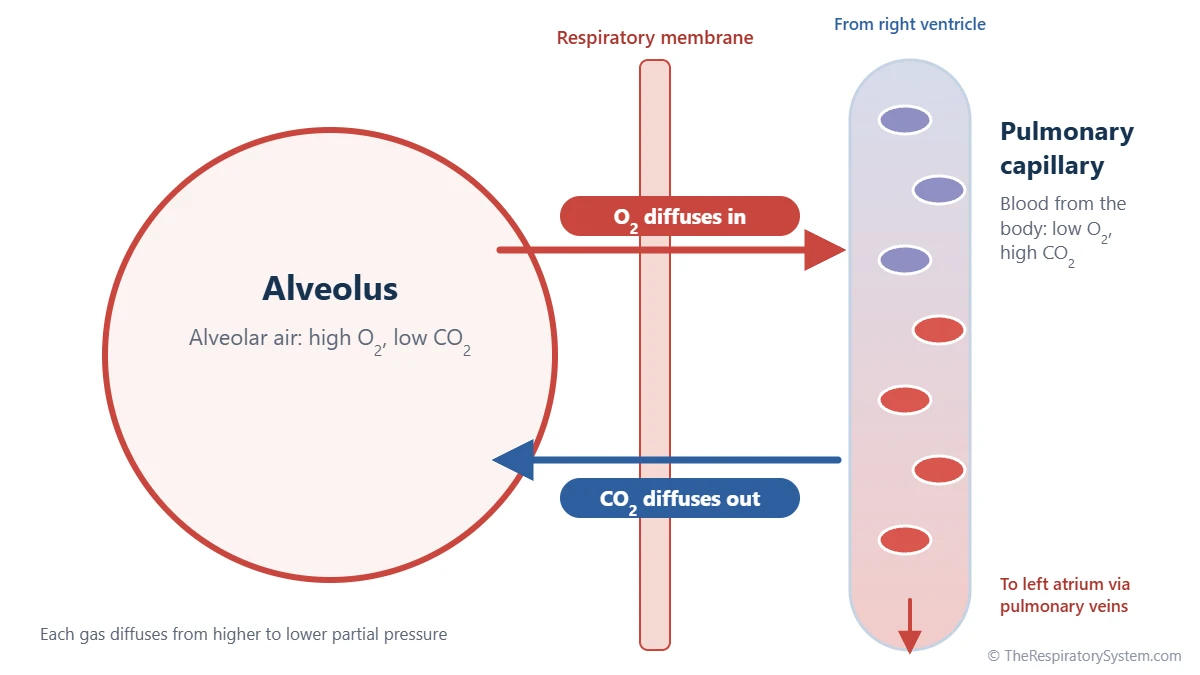
Gas exchange in the lungs, also called external respiration, is the diffusion of oxygen from the alveoli into the pulmonary capillary blood and of carbon dioxide from the blood into the alveoli. It works because alveolar air has a higher oxygen partial pressure (about 100 mmHg) than the blood arriving from the heart (about 40 mmHg), across a membrane only about 0.5 micrometer thick with a surface of roughly 50 to 75 square meters.
- Where
- Alveoli and the pulmonary capillaries wrapped around them, in the respiratory zone of both lungs
- What moves
- Oxygen from air into blood; carbon dioxide from blood into air
- How
- Passive diffusion down partial pressure gradients, with no energy used
- Barrier
- Respiratory membrane: alveolar wall, fused basement membranes and capillary wall, about 0.5 micrometer thick
- Surface area
- About 50 to 75 square meters in an adult
- Part of
- External respiration, the lung half of breathing and blood gas transport
On this page
- What Is Gas Exchange in the Lungs?
- Where Does Gas Exchange Take Place in the Lungs?
- Gas Exchange Process: What Happens Step by Step?
- Why Do Oxygen and Carbon Dioxide Move Across the Membrane?
- What Is Gas Exchange in the Lungs Facilitated By?
- What Happens to Oxygen and Carbon Dioxide in the Blood?
- How Is Gas Exchange in the Lungs Different From Gas Exchange in the Tissues?
- How Does Gas Exchange Work in Plants and Other Animals?
- Common Conditions That Affect Gas Exchange
- Key Facts
- Quiz
- FAQ
What Is Gas Exchange in the Lungs?
Gas exchange in the lungs is the swap of two gases between the air in the alveoli and the blood in the capillaries around them: oxygen moves into the blood, and carbon dioxide moves out of it. Every cell in the body burns fuel with oxygen and releases carbon dioxide as waste, so the blood must be reloaded with oxygen and cleared of carbon dioxide on every trip through the lungs. Breathing moves the air, the heart moves the blood, and gas exchange is the moment where the two meet.
Gas exchange definition
In biology, gas exchange is the movement of oxygen and carbon dioxide across a moist, thin surface between an organism and its surroundings, driven by diffusion. In humans that surface is the lining of the alveoli, the tiny air sacs at the ends of the airways. Plants, fish and insects use other surfaces, such as leaves, gills and air tubes, but the physical rule is the same: each gas moves from where its pressure is higher to where it is lower.
What is gas exchange in the lungs called?
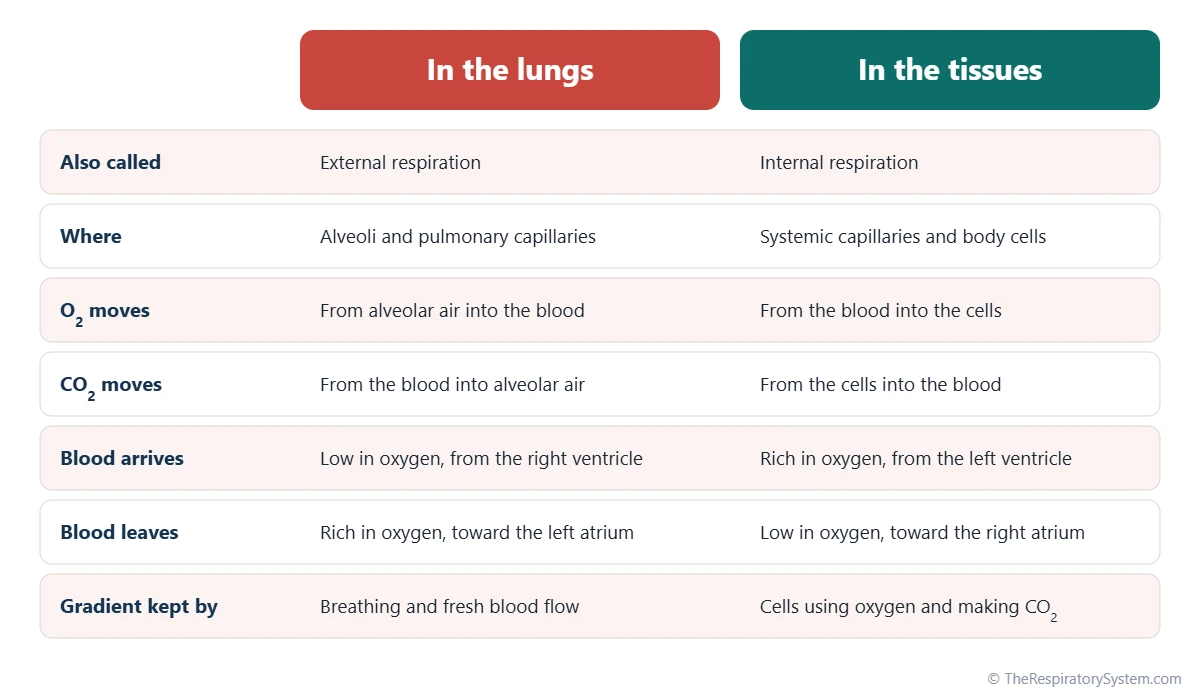
Gas exchange in the lungs is called external respiration, or pulmonary gas exchange. The matching exchange between the blood and the body's cells is called internal respiration, or systemic gas exchange. Neither should be confused with cellular respiration, the chemical process inside mitochondria that actually uses the oxygen; our page on breathing vs respiration sorts out these terms.
Explained simply
Think of each alveolus as a tiny room full of fresh air, with blood rushing past in narrow hallways just outside its wall. The wall is so thin that oxygen can drift straight through it into the blood, the way a smell drifts from a crowded room into an empty one. At the same moment, carbon dioxide drifts the other way, out of the blood and into the room, and the next breath out sweeps it away.
Where Does Gas Exchange Take Place in the Lungs?
Gas exchange takes place in the respiratory zone of the lungs, mainly across the walls of the alveoli, where each air sac is wrapped in a dense net of pulmonary capillaries. The airways before this point, from the trachea through the bronchi to the terminal bronchioles, only conduct air and take no part in the exchange.
Gas exchange in the alveoli
The respiratory zone begins with the respiratory bronchioles, which have a few alveoli budding from their walls, and continues through the alveolar ducts and alveolar sacs. An adult has about 300 to 500 million alveoli, and almost all gas exchange happens across their walls. The conducting zone vs respiratory zone guide shows exactly where one ends and the other begins.
The respiratory membrane
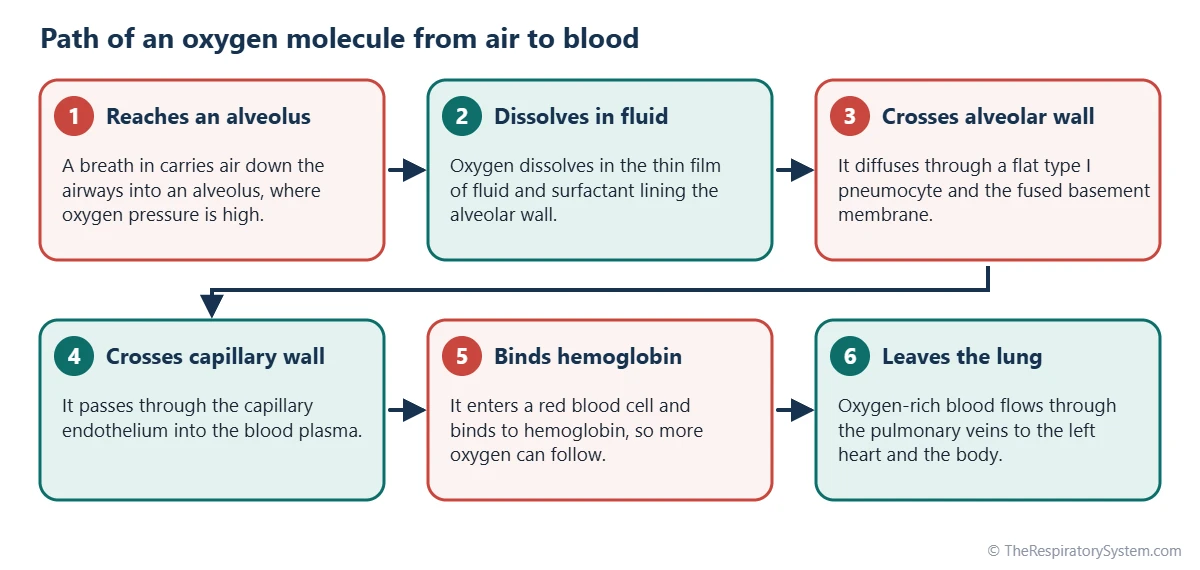
The barrier a gas molecule must cross is called the respiratory membrane, or blood-air barrier. In most places it is only about 0.5 micrometer thick, roughly a hundredth of the width of a human hair. From the air side to the blood side it is made of:
- A thin fluid film lining the alveolus, containing pulmonary surfactant.
- The alveolar epithelium, formed mostly by very flat type I pneumocytes.
- The epithelial basement membrane.
- A narrow interstitial space, often so thin that the two basement membranes fuse into one.
- The capillary basement membrane.
- The capillary endothelium, a single layer of flat cells.
After these six layers, oxygen still has to cross a little blood plasma and the membrane of a red blood cell before it can bind to hemoglobin.
The capillary network
The capillaries around the alveoli are so close together that the blood spreads over the alveolar walls almost like a thin sheet rather than flowing through separate tubes. They are so narrow that red blood cells pass through them in single file, often squeezed against the wall, which shortens the distance oxygen has to travel. This blood arrives through the pulmonary arteries from the right ventricle and leaves through the pulmonary veins, as described on our pulmonary circulation page.
Gas Exchange Process: What Happens Step by Step?
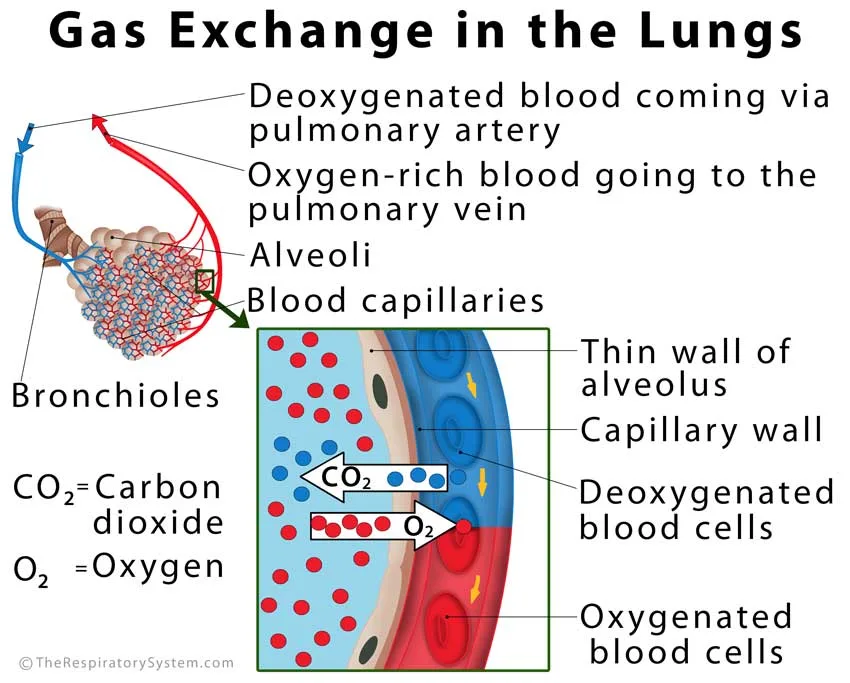
The gas exchange process is a continuous cycle in which breathing refreshes the alveolar air while the heart pushes oxygen-poor blood through the lung capillaries, so that oxygen enters the blood and carbon dioxide leaves it with every heartbeat. The steps below follow one breath and one passing red blood cell.
- A breath brings in fresh air. During inhalation, air travels down the airways and mixes with the air already in the alveoli, raising its oxygen level and lowering its carbon dioxide level.
- Oxygen-poor blood arrives. Blood returning from the body is pumped by the right ventricle through the pulmonary arteries into the capillaries around the alveoli. It is low in oxygen and high in carbon dioxide.
- Oxygen diffuses into the blood. Oxygen dissolves in the fluid lining the alveolus, crosses the respiratory membrane and the plasma, and enters the red blood cells.
- Hemoglobin binds the oxygen. Inside each red blood cell, hemoglobin picks up oxygen, which keeps the dissolved oxygen level low and lets more oxygen keep flowing in.
- Carbon dioxide diffuses out. At the same time, carbon dioxide is released from its carrier forms in the blood, crosses the membrane in the opposite direction and enters the alveolar air.
- Blood leaves oxygen-rich. The reloaded blood flows into the pulmonary veins, then to the left atrium and left ventricle, which pump it to the rest of the body.
- A breath out removes the waste. During exhalation, air rich in carbon dioxide leaves the alveoli and the body, keeping the gradient ready for the next cycle.
How fast does gas exchange happen?
At rest, a red blood cell spends only about three-quarters of a second in a lung capillary, and it is usually fully loaded with oxygen long before it leaves. That built-in spare time matters during exercise, when the heart pumps faster and each cell's trip through the lungs becomes shorter. In healthy lungs the blood still reaches balance with the alveolar air, so the oxygen level of arterial blood barely changes even during hard work.
Why Do Oxygen and Carbon Dioxide Move Across the Membrane?
Oxygen and carbon dioxide move across the respiratory membrane because each gas diffuses from a region of higher partial pressure to a region of lower partial pressure, and breathing and blood flow keep those differences in place. No pump or carrier protein is needed, and the cells of the membrane spend no energy on it.
Partial pressure in plain terms
The partial pressure of a gas is the share of the total pressure of a gas mixture that comes from that one gas. At sea level, air presses down with about 760 mmHg, and because oxygen makes up about 21% of dry air, its partial pressure (PO2) is about 160 mmHg. In a liquid such as blood, partial pressure describes how strongly the dissolved gas tends to escape, so it can be compared directly with the air in the alveoli.
The two gradients
Alveolar air has a PO2 of about 100 mmHg, while blood arriving from the body has a PO2 of about 40 mmHg, so oxygen is pushed into the blood by a gradient of about 60 mmHg. For carbon dioxide the gradient is much smaller and runs the other way: about 45 mmHg in the arriving blood versus about 40 mmHg in the alveoli. Carbon dioxide still keeps pace with oxygen because it dissolves in water about 20 times more readily, so it crosses the wet membrane far more easily.
Why alveolar air is not the same as outside air
Alveolar air holds less oxygen than the air outside for three reasons. Inhaled air is warmed and filled with water vapor on the way in, which dilutes the other gases. Each breath also mixes with the stale air that always stays in the lungs, and the blood is constantly taking oxygen out while adding carbon dioxide. The table below follows both gases from the outside air to the tissues and back.
| Where | PO2 (mmHg) | PCO2 (mmHg) | What it means |
|---|---|---|---|
| Dry outside air at sea level | About 160 | About 0.3 | Oxygen is about 21% of the air; carbon dioxide is only a trace |
| Air in the trachea (warmed and humidified) | About 150 | About 0.3 | Water vapor dilutes the other gases slightly |
| Alveolar air | About 100 | About 40 | Mixed with air left in the lungs; constantly losing oxygen to the blood |
| Blood entering the lung capillaries | About 40 | About 45 | Back from the body, low in oxygen and loaded with carbon dioxide |
| Blood leaving the lung capillaries | About 100 | About 40 | Has come into balance with the alveolar air |
| Arterial blood reaching the body | About 95 | About 40 | Slightly lower because a little oxygen-poor blood mixes in |
| Tissue cells at rest | About 40 or lower | About 45 or higher | Cells use oxygen and make carbon dioxide all the time |
| Exhaled air | About 116 | About 32 | Alveolar air mixed with dead-space air on the way out |
| Source: Typical values for a healthy adult at rest at sea level, our editors | |||
What Is Gas Exchange in the Lungs Facilitated By?
Gas exchange in the lungs is facilitated by a huge alveolar surface area, an extremely thin and moist respiratory membrane, steep partial pressure gradients maintained by breathing and blood flow, and a close match between the air and the blood reaching each part of the lung. Physiologists sum this up with Fick's law of diffusion: the amount of gas that crosses a membrane rises with the surface area and the pressure difference, and falls as the membrane gets thicker.
Large surface, thin barrier
Hundreds of millions of alveoli give the lungs a combined inner surface of about 50 to 75 square meters, roughly the floor of a small apartment, packed into the chest. Spread across that surface is a barrier usually about half a micrometer thick. Because the walls are moist, the gases can dissolve before they diffuse, and surfactant made by type II pneumocytes keeps the small air sacs open so the surface is not lost at the end of each breath out.
Constant renewal on both sides
A gradient only drives diffusion if something keeps renewing it. Breathing brings fresh air into the alveoli and removes carbon dioxide, while the heart keeps sending new, oxygen-poor blood through the capillaries. Hemoglobin adds a third trick: by locking up oxygen inside red blood cells, it keeps the dissolved oxygen level in the plasma low, so oxygen keeps flowing in until the hemoglobin is nearly full.
Matching air and blood
Gas exchange works best where the air reaching an area of lung matches the blood flowing past it, a balance described by the ventilation-perfusion ratio. When part of the lung is poorly ventilated, its small arteries constrict and send blood to better-aired regions, a response called hypoxic pulmonary vasoconstriction. Air that never reaches working alveoli, such as the air filling the trachea and bronchi, is called dead space and takes no part in the exchange.
| Factor | In healthy lungs | What lowers or limits it |
|---|---|---|
| Surface area | About 50 to 75 square meters of alveolar wall | Loss of alveolar walls in emphysema; removal of lung tissue |
| Membrane thickness | About 0.5 micrometer in most places | Fluid (pulmonary edema) or scar tissue (fibrosis) in the interstitium |
| Oxygen pressure gradient | About 60 mmHg (100 in the alveoli vs 40 in arriving blood) | Low oxygen in inhaled air, as at high altitude; shallow breathing |
| Carbon dioxide pressure gradient | About 5 mmHg (45 in arriving blood vs 40 in the alveoli) | Poor ventilation lets carbon dioxide build up in the alveoli |
| Gas solubility | Carbon dioxide dissolves about 20 times more readily than oxygen | Set by the gas itself, which is why oxygen uptake fails first |
| Blood flow (perfusion) | The whole output of the right ventricle, about 5 liters per minute at rest | A clot blocking a pulmonary artery (pulmonary embolism) |
| Ventilation-perfusion match | Overall ratio about 0.8 at rest | Areas that get air but no blood, or blood but no air |
| Time in the capillary | About 0.75 second per red blood cell at rest | Very fast blood flow combined with a thickened membrane |
| Hemoglobin | Each molecule carries up to 4 oxygen molecules | Anemia, or carbon monoxide occupying the oxygen binding sites |
| Source: Typical adult values, our editors | ||
What Happens to Oxygen and Carbon Dioxide in the Blood?
Once in the blood, almost all oxygen rides bound to hemoglobin inside red blood cells, while carbon dioxide travels mostly as bicarbonate dissolved in the plasma. These carrier forms are what let the blood hold far more of each gas than could simply dissolve in it.
Oxygen loading
About 98 to 99% of the oxygen in arterial blood is bound to hemoglobin, and only about 1 to 2% is dissolved in the plasma. Each hemoglobin molecule can carry up to four oxygen molecules, and binding one makes it easier to bind the next, which gives the S-shaped oxygen-hemoglobin dissociation curve. Our oxygen transport page follows the oxygen from the lungs to the tissues.
Carbon dioxide unloading
Carbon dioxide reaches the lungs in three forms: about 70% as bicarbonate ions, about 20% bound to proteins such as hemoglobin (carbaminohemoglobin) and about 7 to 10% dissolved in plasma. In the lung capillaries the enzyme carbonic anhydrase in the red blood cells runs its reaction in reverse, turning bicarbonate back into carbon dioxide gas that can diffuse into the alveoli. The full story is on our carbon dioxide transport page.
How the two gases help each other
Oxygen and carbon dioxide affect each other's loading. In the lungs, as hemoglobin picks up oxygen it releases carbon dioxide and hydrogen ions more easily, a link known as the Haldane effect. In the tissues, more carbon dioxide and acid make hemoglobin let go of oxygen more readily, which is the Bohr effect, so each gas helps the other move in the right direction.
How Is Gas Exchange in the Lungs Different From Gas Exchange in the Tissues?
Gas exchange in the lungs loads the blood with oxygen and unloads carbon dioxide, while gas exchange in the tissues does the reverse, unloading oxygen into the cells and picking up their carbon dioxide. Both follow the same physics of diffusion down partial pressure gradients; only the direction of each gradient changes.
In the tissues, cells use oxygen continuously in cellular respiration, so their PO2 is about 40 mmHg or lower, while the oxygen-rich arterial blood reaching them has a PO2 of about 95 to 100 mmHg. Oxygen therefore leaves the systemic capillaries and enters the cells, and carbon dioxide, which builds up in working cells, moves into the blood. A muscle at hard work uses more oxygen, so its gradient becomes steeper and it takes more oxygen from each passing red blood cell.
The two exchanges are linked by the circulation into one loop, which is why the respiratory and circulatory systems are best understood together. Our guide to external and internal respiration compares the two stages in more detail, and the respiratory system functions page shows where gas exchange fits among the other jobs of the airways and lungs.
How Does Gas Exchange Work in Plants and Other Animals?
All living things exchange gases by diffusion across a thin, moist surface, but plants and many animals use structures other than lungs to do it.
Gas exchange process in plants
Plants exchange gases mainly through stomata, tiny pores in the surface of leaves, each opened and closed by a pair of guard cells. Inside the leaf, gases diffuse through air spaces between the spongy mesophyll cells. In daylight, photosynthesis takes in carbon dioxide and releases oxygen, but plant cells also respire all the time, using oxygen and releasing carbon dioxide, which is the only exchange that continues at night. Woody stems exchange small amounts of gas through raised pores called lenticels.
Gas exchange in animals
- Fish: gills extract dissolved oxygen from water, which flows across the gill filaments in the opposite direction to the blood, a countercurrent system that keeps a gradient along the whole surface.
- Insects: a network of air tubes called tracheae carries air from openings in the body wall, the spiracles, directly to the tissues, as described on our insect respiratory system page.
- Frogs: adults breathe with simple lungs and also exchange a large share of their gases through their thin, moist skin.
- Birds: air sacs keep air flowing in one direction through rigid lung tubes called parabronchi, a highly efficient design explained on the bird respiratory system page.
For a wider tour, see respiration in animals and our comparison of lungs vs gills.
Common Conditions That Affect Gas Exchange
Gas exchange is impaired when the alveolar surface is lost, the respiratory membrane thickens, the alveoli fill with fluid, air or blood fails to reach part of the lung, or the inhaled air itself holds too little oxygen. Our respiratory diseases section covers these conditions in more depth, and anyone with breathing symptoms should see a doctor.
- Emphysema: the walls between alveoli break down into larger, fewer air spaces, shrinking the surface available for exchange. It is a main form of COPD.
- Pulmonary fibrosis: scar tissue builds up in the interstitium, thickening the respiratory membrane and stiffening the lungs.
- Pneumonia: infection fills alveoli with fluid and inflammatory cells, so air cannot reach the membrane in the affected areas.
- Pulmonary edema: fluid leaks into the interstitium and alveoli, often because of heart failure, and lengthens the path gases must cross.
- Pulmonary embolism: a clot blocks a pulmonary artery, so ventilated alveoli receive no blood to exchange gases with.
- Acute respiratory distress syndrome (ARDS): widespread injury makes the alveolar-capillary barrier leaky and floods many air sacs at once.
- High altitude: the air has a lower partial pressure of oxygen, so the gradient driving oxygen into the blood is smaller; see breathing at high altitude.
When gas exchange cannot keep up, the oxygen level of the blood falls, a state known as hypoxemia, which can be estimated with a pulse oximeter as oxygen saturation.
Key Facts
- Gas exchange in the lungs, called external respiration, moves oxygen from the alveoli into the blood and carbon dioxide from the blood into the alveoli.
- Both gases move by simple diffusion, from higher to lower partial pressure, and the lung cells spend no energy on the exchange.
- The respiratory membrane is usually only about 0.5 micrometer thick, while the alveolar surface covers about 50 to 75 square meters.
- Oxygen is driven into the blood by a gradient of about 60 mmHg, while carbon dioxide needs only about 5 mmHg because it dissolves about 20 times more readily.
- A red blood cell spends about three-quarters of a second in a lung capillary at rest and is usually fully loaded with oxygen well before it leaves.
- About 98 to 99% of the oxygen in arterial blood is carried by hemoglobin, as explained on our oxygen transport page.
- The trachea, bronchi and terminal bronchioles only conduct air; gas exchange begins at the respiratory bronchioles.
Quick Quiz: Test What You Know About the Gas Exchange in the Lungs
6 questions. Tap an answer to check it.
Where does gas exchange take place in the lungs?
Gas exchange happens across the thin walls of the alveoli and the capillaries around them. The trachea and bronchi only conduct air.
By what process do oxygen and carbon dioxide cross the respiratory membrane?
Both gases move by simple diffusion, from higher to lower partial pressure, with no energy used.
What is the typical partial pressure of oxygen in alveolar air?
Alveolar PO2 is about 100 mmHg, compared with about 40 mmHg in the blood arriving at the lungs.
What is gas exchange in the lungs called?
Exchange between alveolar air and blood is external respiration; exchange between blood and body cells is internal respiration.
Why does carbon dioxide cross the membrane easily despite a small pressure gradient?
Carbon dioxide is far more soluble in water than oxygen, so a gradient of only about 5 mmHg is enough.
Which vessels carry blood to the lung capillaries for gas exchange?
The pulmonary arteries bring oxygen-poor blood from the right ventricle; the pulmonary veins return oxygen-rich blood to the left atrium.
Frequently Asked Questions
What is the difference between gas exchange and breathing?
Breathing, or pulmonary ventilation, is the movement of air into and out of the lungs, powered by the diaphragm and the muscles between the ribs. Gas exchange is what happens once that air reaches the alveoli: oxygen and carbon dioxide diffuse between the air and the blood. Breathing keeps the alveolar air fresh, and gas exchange uses it, so the two depend on each other but are separate steps.
Is gas exchange active or passive?
Gas exchange is passive. Oxygen and carbon dioxide cross the respiratory membrane by simple diffusion, moving from higher to lower partial pressure without carrier proteins or energy from the cells. Energy is spent indirectly, by the breathing muscles that refresh the alveolar air and by the heart that keeps blood flowing, because both are needed to keep the pressure differences that drive diffusion in place.
Does gas exchange happen in the trachea or bronchi?
No. The trachea, bronchi and bronchioles down to the terminal bronchioles have walls too thick for meaningful diffusion and form the conducting zone, often called anatomical dead space. In an adult it holds about 150 milliliters of air that is breathed in and out without ever reaching the alveoli. Gas exchange starts only at the respiratory bronchioles, where the first alveoli appear in the airway walls.
Does gas exchange continue when you hold your breath?
Yes. Blood keeps flowing through the lungs and keeps exchanging gases with the air already inside them. As the breath hold goes on, the oxygen level in the alveoli falls and carbon dioxide builds up, so the gradients that drive exchange shrink. The rising carbon dioxide level, sensed by chemoreceptors, is the main reason the urge to breathe becomes so strong.
How is gas exchange measured?
Doctors use several tests. A pulse oximeter clipped to a finger estimates how saturated the hemoglobin is with oxygen. An arterial blood gas test measures the oxygen and carbon dioxide pressures and the pH of blood taken from an artery. A diffusing capacity test, often written DLCO, measures how easily a small amount of carbon monoxide crosses from the lungs into the blood.
How does smoking affect gas exchange?
Smoking affects gas exchange in two main ways. Carbon monoxide in tobacco smoke binds to hemoglobin more than 200 times more strongly than oxygen does, taking up sites that should carry oxygen. Over years, smoke also damages the alveolar walls, which can break down into fewer, larger air spaces in emphysema, and that loss of surface area permanently reduces how much gas the lungs can exchange.
What would happen if gas exchange stopped?
If gas exchange stopped, the blood would quickly run low on oxygen and build up carbon dioxide and acid. The brain is the most sensitive organ, and consciousness is usually lost within a minute or two once its oxygen supply falls sharply. Without restored oxygen delivery, brain cells begin to be damaged within minutes, which is why breathing and circulation come first in emergency care.
Why are the lungs so good at gas exchange?
The lungs combine every feature that speeds diffusion. Hundreds of millions of alveoli give an enormous moist surface, the barrier between air and blood is a fraction of a micrometer thick, and breathing and blood flow keep both pressure gradients steep. Red blood cells pass in single file through capillaries pressed against the alveolar walls, so each one is close enough to load oxygen in well under a second.
