At a Glance
The right lung is the lung in the right side of the chest. It has 3 lobes (superior, middle and inferior), separated by the oblique and horizontal fissures, and 10 bronchopulmonary segments. It is shorter but wider than the left lung, because the liver pushes the right dome of the diaphragm higher, and it holds roughly 55 percent of total lung volume.
- Location
- Right side of the thoracic cavity, beside the mediastinum and heart, resting on the right dome of the diaphragm
- Lobes
- Three: superior (upper), middle and inferior (lower)
- Fissures
- Two: oblique and horizontal
- Segments
- Ten bronchopulmonary segments, each with its own segmental bronchus
- Connects to
- Trachea by the right main bronchus; heart by the right pulmonary artery and two right pulmonary veins
- Part of
- Lower respiratory tract
On this page
What Is the Right Lung?
The right lung is the cone-shaped, spongy organ that fills the right half of the chest and exchanges oxygen and carbon dioxide between the air and the blood. It is one of the two lungs of the lower respiratory tract, and it mirrors the left lung in most of its structure, with a few important differences in lobes, shape and airways. Our main lungs page covers what both lungs share; this page looks only at the right one.
Right lung definition
In anatomy, the right lung is defined as the respiratory organ in the right pleural cavity, supplied with air by the right main bronchus and with blood by the right pulmonary artery. It is wrapped in its own layer of pleura and works independently of the left lung, so one lung can keep breathing even when the other collapses.
Explained simply
Picture the chest as a box with the heart sitting a little left of center. The right lung has more free room, so it grows wider and is split into three big pieces called lobes, while the left lung has to share its side with the heart and has only two. Underneath, the large liver pushes the floor up on the right, so the right lung ends up shorter and wider, a bit like a sponge pressed down from below.
Where Is the Right Lung Located?
The right lung is located in the right side of the thoracic cavity, between the rib cage on the outside and the mediastinum on the inside, with its rounded apex in the root of the neck and its base resting on the right dome of the diaphragm. It lies in its own right pleural cavity, separated from the left lung by the mediastinum.
Where is the right lung apex?
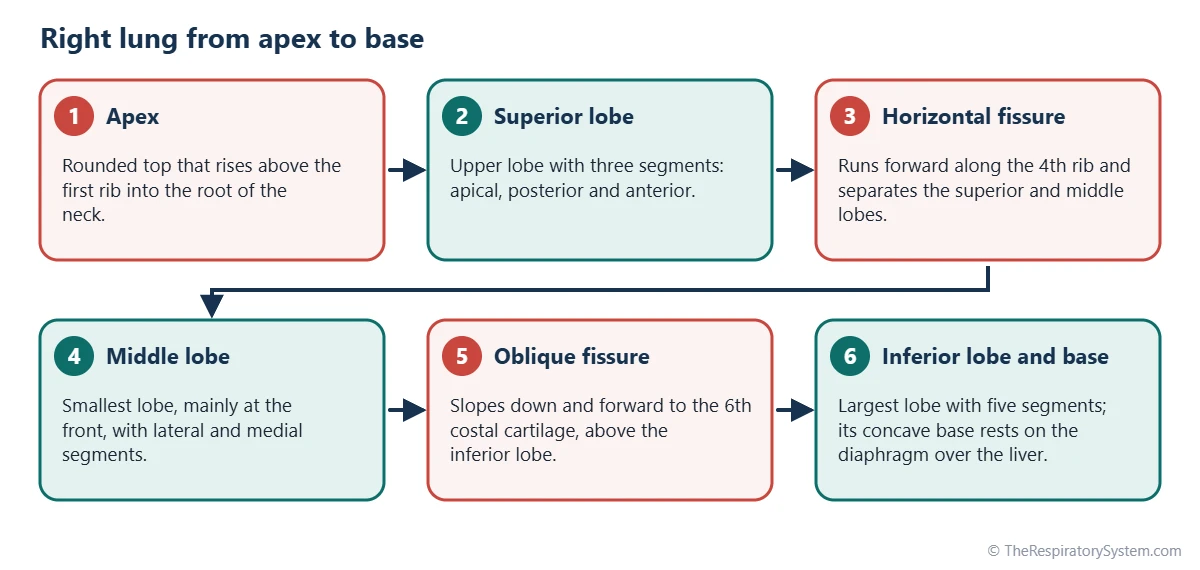
The apex of the right lung is its rounded top, which rises through the upper opening of the rib cage to about 2 to 3 cm above the inner third of the right collarbone. It is covered by the dome of pleura (cervical pleura) and sits close to the right subclavian artery, the lowest roots of the brachial plexus and the first rib, which leaves a shallow groove on it.
Base and borders
- Base: deeply concave, because the liver lifts the right dome of the diaphragm higher than the left. This is the main reason the right lung is shorter than the left.
- Costal surface: faces the ribs and intercostal muscles at the front, side and back.
- Mediastinal surface: faces the heart, the superior vena cava and the esophagus, and holds the hilum.
- Anterior border: almost straight, running down close to the midline behind the breastbone, with no cardiac notch.
Seen from the front, most of the right lung below the 4th rib is middle lobe, while from the back almost everything below the shoulder blade is inferior lobe. That layout explains why a doctor listens to the right middle lobe from the front and side of the chest, and to the right lower lobe from the back.
What Are the 3 Lobes of the Right Lung?
The 3 lobes of the right lung are the superior (upper) lobe, the middle lobe and the inferior (lower) lobe, separated by two deep clefts called the oblique fissure and the horizontal fissure. Each lobe has its own lobar bronchus and is wrapped in visceral pleura that dips into the fissures, so the lobes can slide slightly against each other during breathing. The lung lobes guide compares the lobes of both lungs.
The two fissures
- Oblique fissure: runs from the back of the lung at about the level of the 4th thoracic vertebra, downward and forward, to the 6th costal cartilage at the front. It separates the inferior lobe from the superior and middle lobes.
- Horizontal fissure: leaves the oblique fissure at the side of the chest and runs forward along the 4th rib and its cartilage. It separates the superior lobe from the middle lobe and exists only in the right lung.
Both fissures are often incomplete, so neighboring lobes can be partly fused at their deep ends. The lung fissures page describes their course and common variations.
Superior, middle and inferior lobes
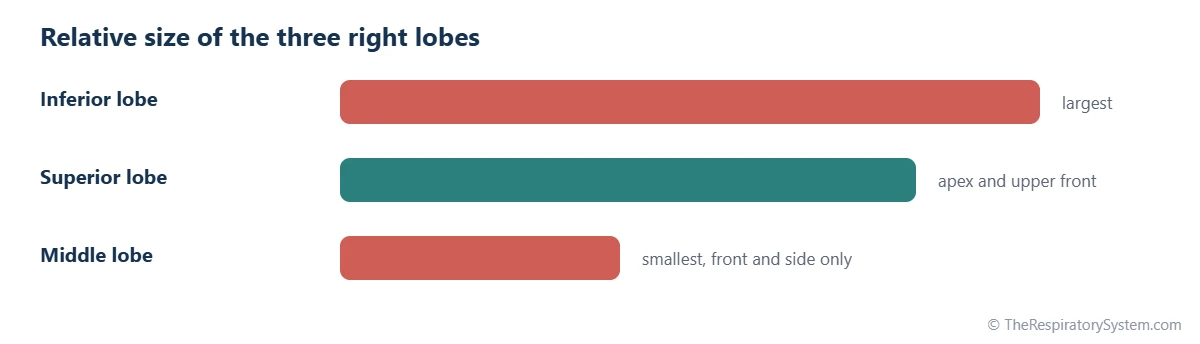
The superior lobe forms the apex and the upper front of the lung. The middle lobe is the smallest lobe, a wedge that lies mainly at the front and side, behind the lower breastbone and the 4th to 6th ribs. The inferior lobe is the largest, filling the back and the base of the lung down to the diaphragm.
Bronchopulmonary segments
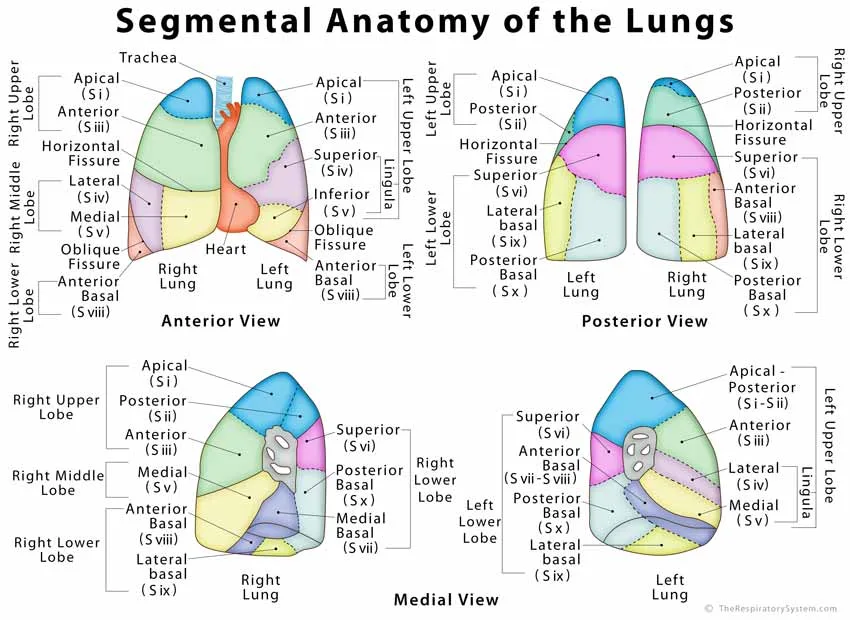
The three lobes are divided into 10 bronchopulmonary segments: 3 in the superior lobe, 2 in the middle lobe and 5 in the inferior lobe. Each segment is a pyramid-shaped unit with its own segmental bronchus and branch of the pulmonary artery, which is why a surgeon can remove one segment and leave the rest of the lobe working. The table below lists all ten.
| Segment | Lobe | Where it lies |
|---|---|---|
| Apical | Superior lobe | Top of the lung, in the dome of pleura above the first rib |
| Posterior | Superior lobe | Upper back of the lung, near the shoulder blade |
| Anterior | Superior lobe | Upper front of the lung, behind the upper ribs |
| Lateral | Middle lobe | Outer side of the middle lobe, toward the armpit |
| Medial | Middle lobe | Inner front of the middle lobe, next to the heart |
| Superior | Inferior lobe | Top of the inferior lobe, at the back below the oblique fissure |
| Medial basal | Inferior lobe | Inner part of the base, beside the heart and inferior vena cava |
| Anterior basal | Inferior lobe | Front part of the base, on the diaphragm |
| Lateral basal | Inferior lobe | Outer part of the base, toward the side of the chest |
| Posterior basal | Inferior lobe | Back part of the base, lowest part of the lung beside the spine |
| Source: Typical adult anatomy, our editors | ||
Right Lung Anatomy: Hilum, Airways and Impressions
The anatomy of the right lung is set by its root at the hilum, its own pattern of airways, and the grooves that neighboring organs press into its mediastinal surface. These features are what tell the right lung apart from the left lung on a specimen or a scan.
The right main bronchus
The right main bronchus leaves the trachea at the carina and is shorter (about 2.5 cm), wider and more vertical than the left. Its first branch, the bronchus to the superior lobe, arises even before it enters the lung and runs above the right pulmonary artery, so it is called the eparterial bronchus. The rest continues as the bronchus intermedius, which splits into the middle lobe and inferior lobe bronchi. The bronchi page follows these airways in detail.
What passes through the right hilum?
The hilum is the doorway on the mediastinal surface where the root of the lung enters. At the right hilum the eparterial bronchus lies highest and toward the back, the right pulmonary artery lies in front of the main airway, and the two right pulmonary veins sit lowest and most anterior. Bronchial vessels, lymph vessels and nerves of the pulmonary plexus pass through as well. Below the hilum, a fold of pleura called the pulmonary ligament hangs down toward the diaphragm.
Impressions on the mediastinal surface
Because a fixed lung is soft, the organs beside it leave shallow grooves that are clear on preserved specimens. On the right lung, the azygos vein arches over the hilum to reach the superior vena cava, the heart's right atrium makes a shallow cardiac impression, and the esophagus leaves a groove behind the hilum. The second table on this page lists the main impressions and what makes each one.
| Structure | Where it touches the right lung | What it leaves or does |
|---|---|---|
| Right atrium of the heart | Front of the mediastinal surface | Shallow cardiac impression |
| Superior vena cava | Above and in front of the hilum | Vertical groove running up toward the apex |
| Azygos vein | Arching over the top of the hilum | Curved groove above the root of the lung |
| Esophagus | Behind the hilum and pulmonary ligament | Long vertical groove on the back of the mediastinal surface |
| Inferior vena cava | Lowest part of the mediastinal surface | Short groove just above the diaphragm |
| Trachea and right vagus nerve | Above the hilum, behind the superior vena cava | Narrow groove on the upper mediastinal surface |
| Right subclavian artery | Arching over the front of the apex | Groove near the apex |
| Right dome of the diaphragm and liver | Under the base | Deeply concave base; the lung is shorter than the left |
| Source: Typical adult anatomy, our editors | ||
What Is the Function of the Right Lung?
The function of the right lung is to bring air into close contact with blood so that oxygen can enter the bloodstream and carbon dioxide can leave it, and because it is the larger lung it handles roughly 55 percent of this work. Its role in the respiratory system is the same as the left lung's; only the share differs.
Every breath in, air flows down the right main bronchus, through the branching bronchial tree and into millions of alveoli, where gas exchange takes place across a very thin wall. Deoxygenated blood reaches those alveoli through the right pulmonary artery, and oxygen-rich blood returns to the left atrium of the heart through the two right pulmonary veins. Step by step, the whole process is described on our how do the lungs work page.
Other jobs of the right lung
- Cleaning the air: its airways are lined with cilia and mucus that trap dust and microbes and sweep them up toward the throat.
- Filtering the blood: its capillary network catches small clots and bubbles before they reach the arteries of the body.
- Helping balance acid: by breathing out carbon dioxide, it helps keep the blood's pH stable.
- Supporting the voice: air pushed out of both lungs drives the vocal cords during speech.
Right lung lobes and their function
All three lobes do the same job of gas exchange; none is specialized. In an upright person, the lower parts of the right lung receive more blood flow and more fresh air per breath than the apex, so the inferior lobe exchanges the largest share of gas. Splitting the lung into lobes and segments also contains damage, because an infection or a blocked airway is often limited to one lobe or segment.
Why Does the Right Lung Have 3 Lobes?
The right lung has 3 lobes because, during development, the right lung bud branches into three lobar buds while the left branches into only two, a pattern set by the left-right asymmetry of the whole chest. The heart is tilted toward the left, so the right side has room for a third lobe, while the left lung's space is shared with the heart.
Around the fifth week of development, the right and left lung buds each sprout secondary buds that will become the lobar bronchi: three on the right and two on the left. These lobar buds keep dividing to form the segmental bronchi and, eventually, the full bronchial tree, as explained on our development of the respiratory system page. The left lung's lingula, a tongue-shaped part of its superior lobe, grows in the same position as the right middle lobe and is treated as its counterpart.
Rare people with situs inversus, a mirror-image arrangement of the chest and abdominal organs, have a three-lobed lung on the left and a two-lobed lung on the right. This shows that the lobe count follows the body's left-right plan, not a fixed rule about one side.
Common Conditions That Affect the Right Lung
The right lung can be affected by the same diseases as the left, but a few problems show up on the right more often because of its wider, steeper main bronchus and its middle lobe. The respiratory diseases section explains each condition in more depth, and anyone with breathing symptoms should see a doctor.
- Aspiration: inhaled food, fluid or small objects most often enter the right main bronchus, so pneumonia after aspiration is more common in the right lower lobe.
- Right middle lobe syndrome: repeated collapse or infection of the middle lobe, whose long, narrow bronchus is easily blocked.
- Pleural effusion: fluid collecting between the pleural layers around the right lung, which presses on the lung from outside.
- Pneumothorax: air leaking into the right pleural cavity, letting the lung partly or fully collapse.
- Apical tumors: a growth at the apex can press on the nearby nerves of the arm and neck because of the apex's position above the first rib.
Key Facts
- The right lung has 3 lobes (superior, middle and inferior), 2 fissures (oblique and horizontal) and 10 bronchopulmonary segments.
- It is the larger lung, holding roughly 55 percent of total lung volume, but it is shorter than the left because the liver raises the right dome of the diaphragm.
- The horizontal fissure is found only in the right lung and runs along the 4th rib at the front of the chest.
- The right main bronchus is about 2.5 cm long, wider and more vertical than the left, so inhaled objects usually enter the right lung.
- Its superior lobe bronchus runs above the right pulmonary artery and is called the eparterial bronchus.
- The middle lobe is the smallest lobe and lies mostly at the front, while the inferior lobe fills the back of the lung.
- The azygos vein arches over the root of the right lung, just as the aortic arch does over the root of the left lung.
Quick Quiz: Test What You Know About the Right Lung
6 questions. Tap an answer to check it.
How many lobes does the right lung have?
The right lung has three lobes: superior, middle and inferior. The left lung has two.
Which fissure is found only in the right lung?
The horizontal fissure separates the superior and middle lobes and exists only on the right. Both lungs have an oblique fissure.
Why is the right lung shorter than the left lung?
The liver sits under the right half of the diaphragm and lifts it, so the right lung is shorter but wider.
How many bronchopulmonary segments does the right lung usually have?
The right lung has 10 segments: 3 in the superior lobe, 2 in the middle lobe and 5 in the inferior lobe.
Which vein arches over the root of the right lung?
The azygos vein arches over the right hilum to drain into the superior vena cava.
Which is the smallest lobe of the right lung?
The middle lobe is the smallest. The lingula belongs to the left lung.
Frequently Asked Questions
Is the right lung bigger than the left lung?
Yes. The right lung is the larger of the two, with roughly 55 percent of total lung volume, and it is usually a little heavier. It is wider because the heart lies toward the left, but shorter because the liver pushes the right side of the diaphragm up. The left lung is narrower and slightly longer. Our page on which lung is bigger explains the reasons in full.
Why do inhaled objects usually go into the right lung?
The right main bronchus is wider, shorter and more in line with the trachea than the left, which bends sharply under the arch of the aorta. Anything inhaled by mistake, such as a peanut or a small toy part, tends to follow the straighter path into the right lung. In an upright person it often reaches the lower lobe, while lying down it may lodge in the upper part of the lower lobe.
Can a person live with only the right lung?
Yes. Many people live for years after the left lung is removed in an operation called a pneumonectomy. The remaining right lung handles all gas exchange, and at rest one healthy lung supplies enough oxygen for normal daily activity. The ability to exercise hard is usually reduced, and the space left by the removed lung slowly fills with fluid and fibrous tissue while the heart and mediastinum shift toward it.
Does the right lung have a lingula or cardiac notch?
No. The lingula and the cardiac notch are features of the left lung's superior lobe, where they make room for the heart. The right lung has a middle lobe instead, which develops in the same position as the lingula and is considered its counterpart. The anterior border of the right lung runs almost straight down behind the breastbone, without the curved notch seen on the left.
Which lobe of the right lung is the largest?
The inferior, or lower, lobe is the largest lobe of the right lung. It fills most of the back of the lung and the whole base resting on the diaphragm, and it contains five of the ten bronchopulmonary segments. Because more blood and air reach the lower lung when a person is upright, the inferior lobe also does the largest share of gas exchange in the right lung.
Where can the right middle lobe be heard with a stethoscope?
The right middle lobe lies at the front and side of the chest, roughly between the 4th and 6th ribs, so it is heard on the right front of the chest and under the armpit. It barely reaches the back, which is almost entirely covered by the upper and lower lobes. That is why a full chest exam listens to the front, the sides and the back.
Is the right lung the same in men and women?
The right lung has the same three lobes, two fissures and ten segments in men and women. On average, men have larger lungs and lung volumes than women of the same height, mainly because of a larger chest, but the shape and internal layout are the same. Lung size also depends on height, age and fitness.
Does the right lung work harder than the left lung?
Not harder, but it does more of the total work. Both lungs use the same breathing muscles and the same type of tissue, so each part of either lung works the same way. Because the right lung is larger and has more alveoli, it receives a little more air and blood and carries out roughly 55 percent of all gas exchange, while the left lung handles the rest.
Keep Exploring


