At a Glance
The lungs work like bellows linked to a gas exchanger. The diaphragm and rib muscles enlarge the chest so air flows in through the airways to about 300 to 500 million alveoli, where oxygen diffuses into the blood and carbon dioxide diffuses out. The heart pumps the oxygen-rich blood to the body, and the lungs breathe out the carbon dioxide, about 12 to 20 times a minute at rest in an adult.
- What drives breathing
- The diaphragm and intercostal muscles, not the lungs themselves
- Where gas exchange happens
- Alveoli, the tiny air sacs at the ends of the airways
- What moves
- Oxygen into the blood, carbon dioxide out of it
- Resting rate
- About 12 to 20 breaths per minute in adults
- Controlled by
- Breathing centers in the brainstem, mostly automatic
- Works with
- The heart and blood vessels of the circulatory system
On this page
How Do Lungs Work?
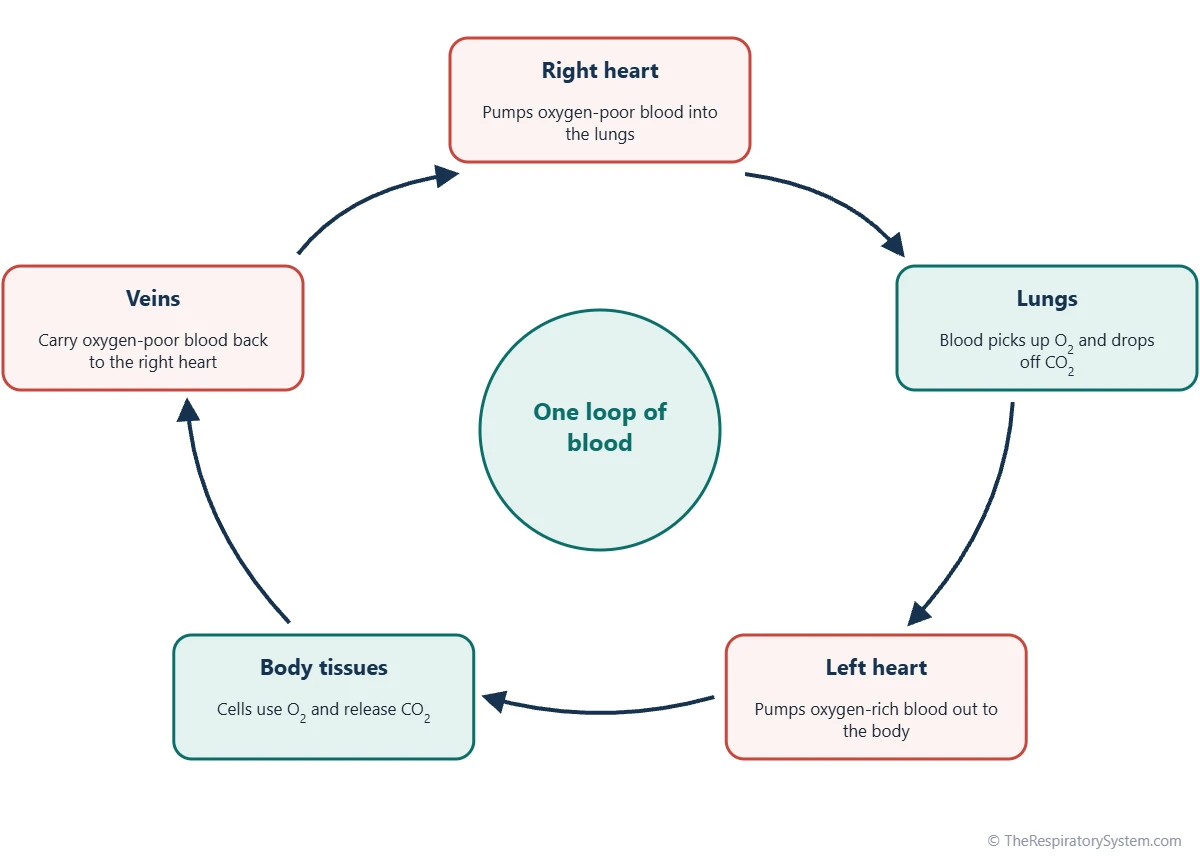
Lungs work by doing two jobs at once: moving air in and out, which is called ventilation, and swapping gases between that air and the blood, which is called gas exchange. The lungs have no muscles of their own for breathing; they inflate and deflate because the chest around them grows and shrinks.
Each lung is a spongy organ made of branching airways that end in clusters of microscopic air sacs, the alveoli. Every air sac is wrapped in a mesh of tiny blood vessels, so air and blood come within a fraction of a micrometer of each other. Oxygen slips across that thin wall into the blood, and carbon dioxide slips the other way to be breathed out.
Explained simply
Imagine a sponge inside a sealed box. When the floor of the box is pulled down and the walls move out, the sponge stretches and sucks air in; when they move back, air is squeezed out. Now picture every hole in that sponge lined with tiny blood tubes that grab oxygen from the air as it passes. That is a lung: a pump made by the chest, and a trading post made by the air sacs.
Both the right lung and the left lung work exactly the same way, side by side, each sealed inside its own pleural sac.
How Does the Respiratory System Work Step by Step?
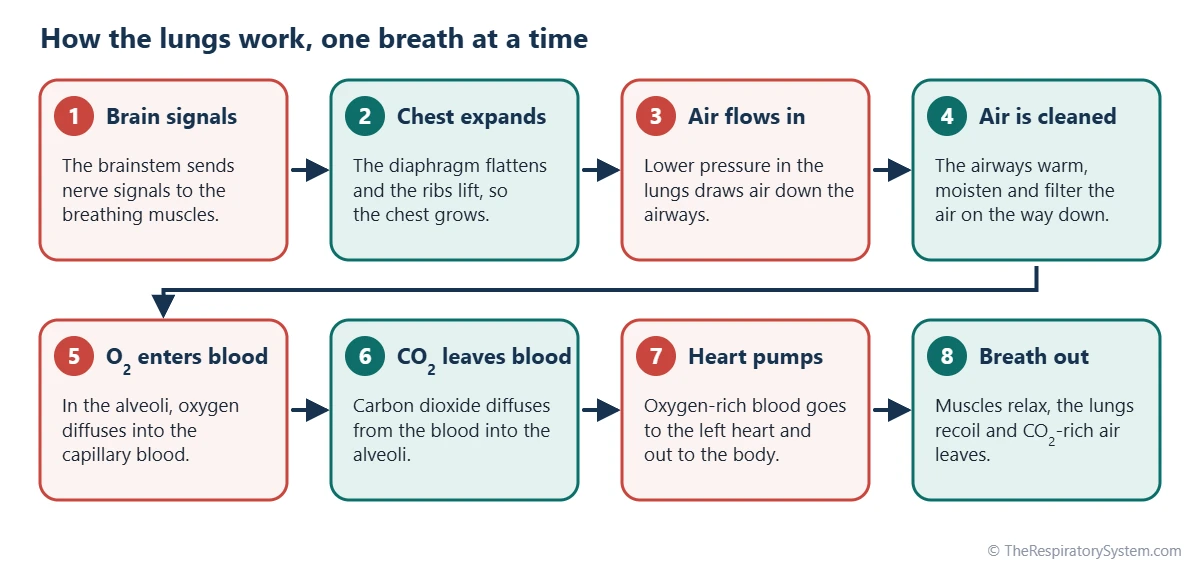
The respiratory system works in a repeating sequence: a signal from the brain, a breath in, air cleaning, gas exchange in the alveoli, blood transport by the heart, and a breath out. The steps below follow one breath; each one links to the page that explains it in depth.
- The brain sends a signal. Breathing centers in the brainstem fire nerve impulses down the phrenic nerves to the diaphragm and through other nerves to the rib muscles.
- The chest gets bigger. The diaphragm contracts and flattens while the external intercostal muscles lift the ribs. The lungs, held to the chest wall by a thin film of pleural fluid, stretch with it, and pressure inside them falls slightly below the air outside. The physics is covered on our mechanics of breathing page.
- Air flows in. Air enters through the nose or mouth and travels down the pathway of air: pharynx, larynx, trachea and the branching bronchi and bronchioles.
- The air is cleaned and conditioned. On the way down it is warmed to body temperature, moistened and filtered, so the alveoli receive clean, damp air.
- Gas exchange happens. In the alveoli, oxygen diffuses into the blood in the surrounding capillaries and carbon dioxide diffuses out of it, as described step by step on the gas exchange page.
- The heart carries the oxygen away. Oxygen-rich blood flows through the pulmonary veins to the left side of the heart, which pumps it out to the body.
- The breath goes out. The diaphragm and rib muscles relax, the elastic lungs recoil, and air rich in carbon dioxide is pushed out. The differences between the two phases are on our inhalation and exhalation page.
At rest the whole cycle repeats about 12 to 20 times a minute in an adult, and a quiet breath moves only about half a liter of air.
| Stage | Where it happens | What happens |
|---|---|---|
| Signal | Brainstem (medulla and pons) | Nerve impulses tell the breathing muscles to contract |
| Chest expands | Diaphragm and rib cage | The chest gets bigger and pressure in the lungs falls |
| Air enters | Nose or mouth | Air is drawn in, filtered, warmed and moistened |
| Air is conducted | Pharynx, larynx and trachea | Air passes the throat and voice box into the windpipe |
| Air is distributed | Bronchi and bronchioles | Branching airways spread air to every part of both lungs |
| Gas exchange | Alveoli and pulmonary capillaries | Oxygen enters the blood; carbon dioxide leaves it |
| Transport | Pulmonary veins, heart and arteries | Oxygen-rich blood is pumped to the body's tissues |
| Breath out | Whole lung and airways | Muscles relax, lungs recoil and air rich in carbon dioxide leaves |
| Source: Typical adult physiology at rest, our editors | ||
How Do the Lungs Work With the Heart?
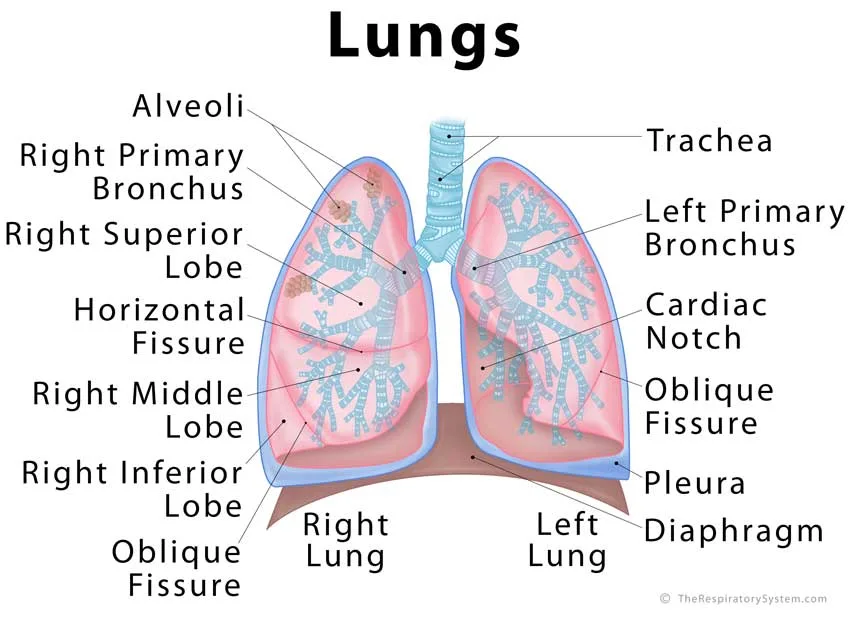
The lungs work with the heart as two halves of one loop: the right side of the heart pumps oxygen-poor blood into the lungs, and the left side of the heart pumps the oxygen-rich blood from the lungs out to the body. Every drop of blood passes through the lungs once on each trip around the body.
Blood returning from the body is low in oxygen and loaded with carbon dioxide. The right ventricle sends it through the pulmonary arteries to the capillaries around the alveoli, where it reloads with oxygen and drops off carbon dioxide. The pulmonary veins then carry it to the left atrium and left ventricle, which push it into the aorta. This short circuit through the lungs is the pulmonary circulation.
The partnership is tight. At rest the heart sends about 5 liters of blood through the lungs every minute, and during exercise both the heart rate and the breathing rate rise together to keep oxygen supply matched to demand. Our page on how the respiratory and circulatory systems work together covers this teamwork in detail.
How Do We Breathe Without Thinking?
We breathe without thinking because groups of nerve cells in the brainstem, in the medulla oblongata and the pons, set the rhythm of breathing automatically, much like a built-in pacemaker. They keep working whether we are awake, asleep or concentrating on something else.
These breathing centers adjust each breath using information from sensors. Chemoreceptors in the brainstem track the level of carbon dioxide and the acidity of the fluid around the brain, while others in the carotid arteries and the aorta respond mainly to falling oxygen. When carbon dioxide rises, the centers make breaths deeper and faster until the level drops again. The details are on our control of breathing and respiratory chemoreceptors pages.
We can also take conscious control, for example to speak, sing or sniff, because the cerebral cortex can send its own signals to the breathing muscles. The automatic system always takes over again, which is why the urge to breathe becomes overwhelming after a short time.
How do we breathe when we sleep?
During sleep, the brainstem keeps breathing going on its own. In deep, non-dreaming sleep, breaths become slow, regular and slightly shallower. In dream (REM) sleep they turn more irregular, and most skeletal muscles relax, but the diaphragm keeps working. The muscles of the throat also relax, which is why the airway can narrow and cause snoring or, in some people, sleep apnea.
How Do the Lungs Keep Themselves Clean?
The lungs keep themselves clean with a moving layer of mucus, millions of beating cilia, immune cells inside the air sacs and protective reflexes such as coughing. Together they remove most of the dust, pollen and microbes that enter with every breath.
- Mucus and cilia: sticky mucus in the airways traps particles, and hair-like cilia beat in waves to sweep it up toward the throat, where it is swallowed. This conveyor belt is described on our cilia and mucus page.
- Alveolar macrophages: roaming immune cells in the air sacs swallow particles and bacteria that get past the airways; see alveolar macrophages.
- Coughing and sneezing: fast reflex blasts of air clear larger irritants from the lower and upper airways; read about the cough reflex.
- Nasal filtering: hairs and folds inside the nose catch larger particles before they reach the lungs at all.
How Does the Respiratory System Work With Other Systems?
The respiratory system works with other body systems by supplying the oxygen every cell needs, removing the carbon dioxide they produce and relying on muscles, nerves and blood to do it. No part of the process happens in the lungs alone.
- Circulatory system: carries oxygen from the lungs to the tissues and carbon dioxide back.
- Muscular system: the diaphragm and intercostal muscles power every breath.
- Nervous system: the brainstem sets the rhythm and adjusts it to the body's needs.
- Cells of every organ: use the oxygen in cellular respiration to release energy from food, producing the carbon dioxide the lungs remove.
- Acid-base balance: by changing how fast carbon dioxide is breathed out, the lungs help keep the blood's pH in a narrow, healthy range.
Our page on how the respiratory system works with other body systems goes through each partnership, and the respiratory rate page shows how breathing speed changes with age and activity.
Key Facts
- The lungs have no breathing muscles of their own; the diaphragm and rib muscles enlarge the chest and the lungs follow.
- Air flows in because pressure inside the lungs drops slightly below the pressure of the outside air.
- Oxygen and carbon dioxide are exchanged by diffusion in about 300 to 500 million alveoli.
- An adult at rest breathes about 12 to 20 times a minute, moving about half a liter of air per quiet breath.
- The right side of the heart pumps blood into the lungs, and the left side pumps the oxygen-rich blood to the body.
- Breathing is set automatically by the brainstem, which responds mainly to the level of carbon dioxide in the blood.
- Mucus, cilia and alveolar macrophages keep the lungs clean of most inhaled dust and microbes.
Frequently Asked Questions
How many times do we breathe in a day?
An adult at rest breathes about 12 to 20 times a minute, which adds up to roughly 17,000 to 29,000 breaths a day, often rounded to about 20,000. The number rises during exercise, illness or stress and falls during deep sleep. Babies and young children breathe faster than adults, because their lungs are smaller and their bodies use oxygen more quickly for their size.
Do the lungs have muscles?
The lungs have no skeletal muscle and cannot inflate themselves. Their airways do contain smooth muscle, which can tighten or relax to change how wide the bronchi and bronchioles are, but it does not pump air. The work of breathing is done by the diaphragm and the intercostal muscles between the ribs, with help from neck and abdominal muscles during hard breathing.
How much air can the lungs hold?
The lungs of an average adult man hold about 6 liters of air after the deepest possible breath, and the average for women is somewhat smaller. A normal quiet breath uses only about half a liter of that. About 1 to 1.5 liters always stays in the lungs, even after breathing out as hard as possible, which keeps the air sacs from collapsing.
Do both lungs work at the same time?
Yes. Both lungs expand and empty together with every breath, because the same diaphragm and rib cage move around them. Each lung sits in its own sealed pleural sac, though, so they work independently. If air leaks into one sac and that lung collapses, the other lung keeps working, which is why a person can survive the loss of a lung.
Why do we breathe faster during exercise?
Working muscles burn more fuel, so they use more oxygen and make more carbon dioxide. Rising carbon dioxide and signals from the moving muscles and joints tell the brainstem to make breaths deeper and faster, and the heart speeds up at the same time. Together they can move many times more air and blood than at rest, keeping the blood's oxygen level steady.
How do the lungs work in a baby before birth?
Before birth, the lungs are filled with fluid and do not exchange gases. The baby gets oxygen from the mother's blood through the placenta and umbilical cord, and most blood bypasses the lungs through two shortcuts in the heart and great vessels. With the first breaths after birth, the fluid is pushed out and absorbed, the lungs fill with air and the shortcuts begin to close.
Why is the air we breathe out warm and moist?
On the way in, the lining of the nose and airways warms the air to body temperature and saturates it with water vapor, protecting the delicate alveoli from drying out. When the air is breathed out, it carries that heat and moisture with it. That is why breath fogs a cold window or mirror, and why the body loses some water with every breath.
Keep Exploring


