At a Glance
Respiratory rate is the number of breaths taken per minute. A typical resting respiratory rate for a healthy adult is about 12 to 20 breaths per minute; newborns breathe about 30 to 60 times per minute, and the rate falls gradually through childhood. Respiratory rate multiplied by tidal volume gives minute ventilation, about 6 liters of air per minute at rest.
- Definition
- Number of breaths per minute; one in plus one out counts as one breath
- Typical adult at rest
- About 12 to 20 breaths per minute
- Typical newborn
- About 30 to 60 breaths per minute
- Set by
- Breathing centers in the medulla and pons of the brainstem
- Main chemical driver
- The level of carbon dioxide in the blood
- Part of
- The vital signs, with heart rate, blood pressure and body temperature
On this page
- What Is Respiratory Rate?
- What Is a Normal Respiratory Rate?
- What Is the Breathing Rate While Sleeping?
- How Is Respiratory Rate Controlled? The Respiratory Rate Process
- What Changes Your Breathing Rate?
- How Is Respiratory Rate Measured?
- Tachypnea, Bradypnea and Other Breathing Rate Terms
- Respiratory Rate vs Heart Rate
- Common Conditions That Affect Respiratory Rate
- Key Facts
- Quiz
- FAQ
What Is Respiratory Rate?
Respiratory rate is the number of complete breaths a person takes in one minute, where each breath is one inhalation followed by one exhalation. It is written in breaths per minute, often abbreviated RR or f, and it is one of the main vital signs recorded alongside heart rate, blood pressure and temperature.
Respiratory rate definition
In physiology, respiratory rate is defined as the frequency of the breathing cycle, the rhythm of inhalation and exhalation produced by the breathing muscles. Breathing rate means the same thing in everyday language. It describes how often air is moved in and out of the lungs, not how much air each breath moves; that is the tidal volume.
Rate, depth and minute ventilation
Rate and depth together decide how much air the lungs move. Minute ventilation equals respiratory rate multiplied by tidal volume, so an adult breathing 12 times a minute with breaths of about 500 mL moves about 6 liters of air per minute. Because the first 150 mL or so of each breath only fills the airways, the dead space, a fast rate with very shallow breaths delivers less fresh air to the alveoli than the same total from slower, deeper breaths.
Explained simply
Respiratory rate is simply how many times a person breathes in one minute. Counting the rise and fall of the chest gives the number. At rest an adult breathes slowly and steadily, a little more often than once every five seconds, while a small baby breathes about twice as fast.
What Is a Normal Respiratory Rate?
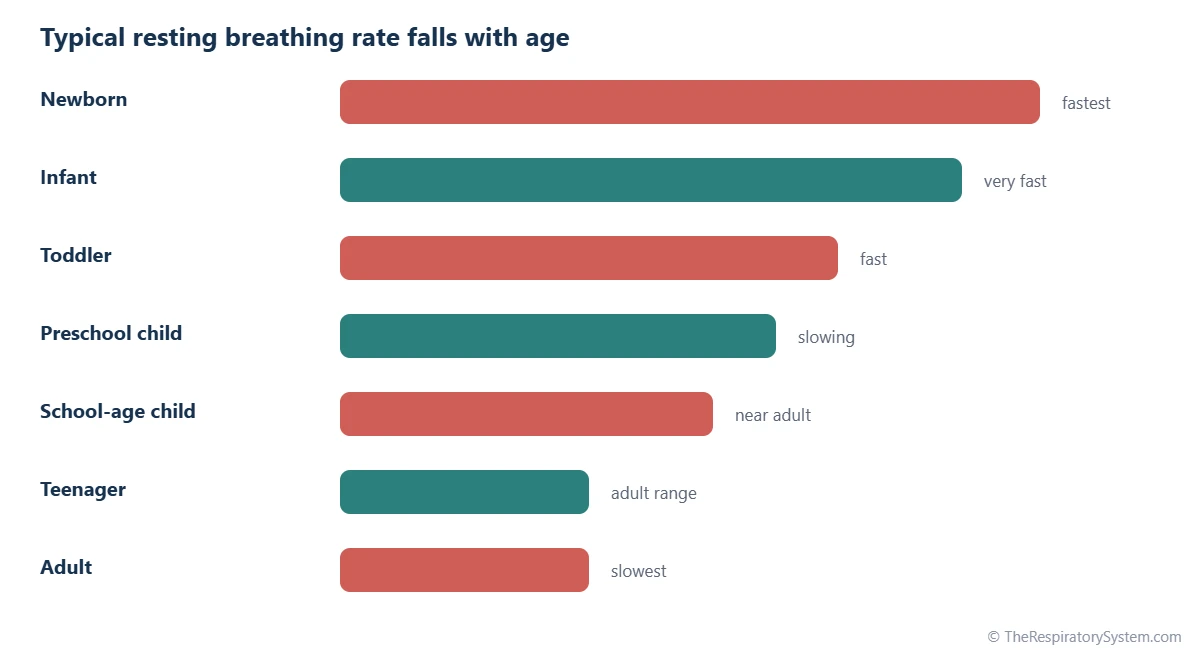
A normal respiratory rate for a healthy adult at rest is typically about 12 to 20 breaths per minute, and many relaxed adults sit near the lower half of that range. Children breathe faster, and the typical range narrows and slows steadily from birth to the teenage years.
The table below lists typical textbook ranges by age. Different medical references draw the boundaries a little differently, so these numbers describe common values for healthy people at rest, not strict cutoffs. A single count also depends on the moment: talking, eating, moving or feeling nervous all change it.
Breathing rate per minute and per day
At 12 to 20 breaths per minute, an adult takes roughly 17,000 to 29,000 breaths a day without thinking about any of them. Each quiet breath cycle lasts about 3 to 5 seconds, and in quiet breathing the exhalation usually lasts a little longer than the inhalation, often with a short natural pause at the end of the breath out.
Older adults
In healthy older adults the resting breathing rate is usually similar to that of younger adults. What changes with age is the reserve: the lungs lose some elastic recoil and the chest wall stiffens, so breathing has less room to deepen during exertion and may rely a little more on rate.
| Age group | Typical breaths per minute at rest | Notes |
|---|---|---|
| Newborn (birth to 1 month) | About 30 to 60 | Irregular rhythm; short pauses in breathing are common |
| Infant (1 to 12 months) | About 30 to 50 | Breathes mainly with the diaphragm, so the belly moves most |
| Toddler (1 to 3 years) | About 24 to 40 | Rate slows as the lungs and chest grow |
| Preschool child (3 to 5 years) | About 22 to 34 | Rate rises quickly with play and crying |
| School-age child (6 to 12 years) | About 18 to 30 | Approaches adult values by the end of this period |
| Teenager (13 to 18 years) | About 12 to 20 | Similar to adults |
| Adult | About 12 to 20 | Many relaxed adults breathe about 12 to 16 times a minute |
| Older adult | About 12 to 20 | Usually similar to younger adults at rest |
| Source: Typical resting ranges from standard pediatric and physiology references; exact limits differ slightly between sources, our editors | ||
What Is the Breathing Rate While Sleeping?
The breathing rate while sleeping is usually a little slower than the waking resting rate, and in deep non-REM sleep it becomes especially slow and regular. During REM sleep, the dreaming stage, breathing becomes faster and more irregular, with small changes in both rate and depth.
Several things change at sleep onset. The brain's waking drive to breathe switches off, the breathing centers become slightly less sensitive to carbon dioxide, and the muscles of the throat relax, which narrows the upper airway a little. As a result, blood carbon dioxide rises slightly during sleep, a normal change in healthy people.
Babies during sleep
Newborns and young infants often breathe in a pattern called periodic breathing, with bursts of breaths separated by short pauses of a few seconds, especially during sleep. This pattern is common in healthy newborns and usually fades over the first months as the breathing centers mature. Breathing patterns in sleep are covered further on our breathing patterns and sleep apnea pages.
How Is Respiratory Rate Controlled? The Respiratory Rate Process
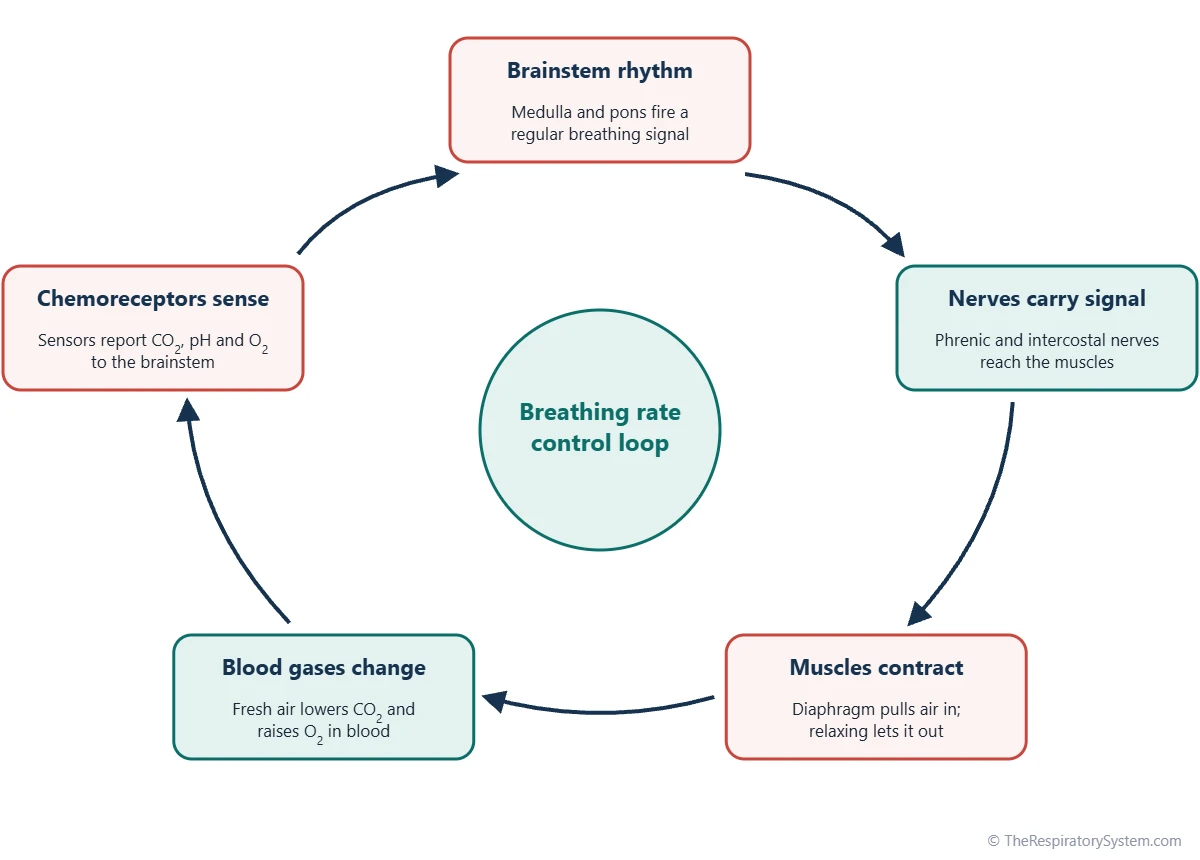
Respiratory rate is controlled by groups of nerve cells in the brainstem that fire in a repeating rhythm, adjusted moment to moment by signals about carbon dioxide, oxygen and acid in the blood. The process works as a feedback loop, shown in the diagram at the top of the page, and is described in full on our control of breathing page.
- The rhythm starts in the medulla. A small cluster of neurons in the medulla oblongata, the pre-Bötzinger complex, acts as the main rhythm generator. The dorsal and ventral respiratory groups around it turn that rhythm into signals for inhalation and, when needed, active exhalation.
- The pons smooths the pattern. The pontine respiratory group fine-tunes the switch between breathing in and breathing out, which helps set the rate and makes the rhythm smooth.
- Nerves carry the signal. The phrenic nerve carries the signal to the diaphragm, and the intercostal nerves carry it to the muscles between the ribs.
- The muscles move air. The diaphragm contracts and air flows in; when the signal stops, the muscles relax and the lungs recoil, pushing air out.
- Sensors check the result. Central chemoreceptors in the medulla respond to carbon dioxide and acidity in the fluid around the brain, and peripheral chemoreceptors in the carotid and aortic bodies respond mainly to low oxygen. Stretch receptors in the lungs add information through the Hering-Breuer reflex.
- The brainstem adjusts. If carbon dioxide rises, breathing speeds up and deepens; if it falls, breathing slows until the level returns to normal.
Carbon dioxide, not oxygen, is the main signal at rest. The role of the sensors is explained on our respiratory chemoreceptors page. The upper brain can also override the rhythm for a while, which is why people can hold a note, speak or pause their breath, but rising carbon dioxide soon forces breathing to restart.
What Changes Your Breathing Rate?
Breathing rate changes whenever the body's demand for oxygen or its production of carbon dioxide changes, and also with emotions, temperature, altitude, sleep and some medicines. Most changes are normal and temporary.
- Exercise: working muscles produce more carbon dioxide, and both rate and depth rise; in hard exercise the rate can reach two to three times its resting value. See how exercise affects the respiratory system.
- Body temperature: fever raises the body's metabolic rate, and breathing speeds up to remove the extra carbon dioxide.
- Emotions and pain: stress, fear, excitement and pain activate the sympathetic nervous system and quicken breathing, sometimes to the point of hyperventilation.
- Altitude: thinner air with less oxygen pressure stimulates the peripheral chemoreceptors, so people breathe faster and deeper, as explained on breathing at high altitude.
- Acid in the blood: when the blood becomes more acidic for metabolic reasons, the body breathes deeper and faster to blow off carbon dioxide and raise the pH.
- Sleep: the rate slows slightly in deep sleep and becomes irregular in REM sleep.
- Medicines and substances: some sedating medicines and alcohol can slow breathing by depressing the brainstem.
- Age: the rate is fastest in newborns and slows through childhood.
- Voluntary actions: talking, singing, eating and laughing change the rhythm for short periods.
In each case the body is usually adjusting breathing to keep blood carbon dioxide and oxygen within narrow limits, part of how the respiratory system maintains homeostasis.
How Is Respiratory Rate Measured?
Respiratory rate is usually measured by counting how many times the chest or abdomen rises in a set period while the person is at rest. Health workers often count for 30 seconds and double the number, or count for a full 60 seconds when breathing is irregular and in babies.
Counting by observation
Because people change their breathing as soon as they know it is being watched, the count is often taken quietly, for example right after measuring the pulse. One rise and one fall of the chest count as one breath. In infants, who breathe mostly with the diaphragm, the movement of the belly is often easier to see than the chest.
Measuring with devices
- Capnography measures carbon dioxide in each exhaled breath and gives a breath-by-breath rate, often used during anesthesia.
- Impedance pneumography uses the electrodes of a heart monitor to detect the small electrical changes as the chest expands.
- Spirometers and ventilators record every breath directly from airflow, as described on our spirometry page.
- Wearable sensors estimate breathing rate from chest movement or from small changes in the pulse signal, mainly during sleep.
Respiratory rate is one of the simplest vital signs to measure, yet it is often called the neglected vital sign because it is easy to estimate instead of count, which is why careful counting over a full interval is stressed in training.
Tachypnea, Bradypnea and Other Breathing Rate Terms
Doctors and physiologists use a set of standard terms to describe breathing rate and depth: eupnea is normal breathing, tachypnea is a faster-than-normal rate, bradypnea is a slower-than-normal rate and apnea is a pause in breathing. These words describe what is observed; they do not name a cause.
Some terms describe rate, some describe depth and some describe the feeling of breathing. Hyperpnea means deeper, faster breathing that matches a higher demand, as in exercise, while hyperventilation means breathing more than the body needs, which lowers blood carbon dioxide. Dyspnea is not a rate at all but the unpleasant feeling of being short of breath. The table below summarizes the most common terms, and our page on breathing patterns covers rhythms such as Cheyne-Stokes and Kussmaul breathing.
| Term | Meaning | Common examples |
|---|---|---|
| Eupnea | Normal, quiet breathing at rest | Relaxed breathing while sitting or reading |
| Tachypnea | Breathing rate above the normal range for age | Fever, exercise, pneumonia |
| Bradypnea | Breathing rate below the normal range for age | Deep sleep in some people, sedating medicines |
| Apnea | A temporary stop in breathing | Sleep apnea, a voluntary breath hold |
| Hyperpnea | Deeper and faster breathing matched to higher demand | Exercise |
| Hyperventilation | Breathing more than needed, which lowers blood CO2 | Anxiety, panic, high altitude |
| Hypoventilation | Breathing too little, which raises blood CO2 | Oversedation, breathing muscle weakness |
| Dyspnea | The feeling of shortness of breath | Hard exercise, many heart and lung conditions |
| Source: Standard physiology terms, our editors | ||
Respiratory Rate vs Heart Rate
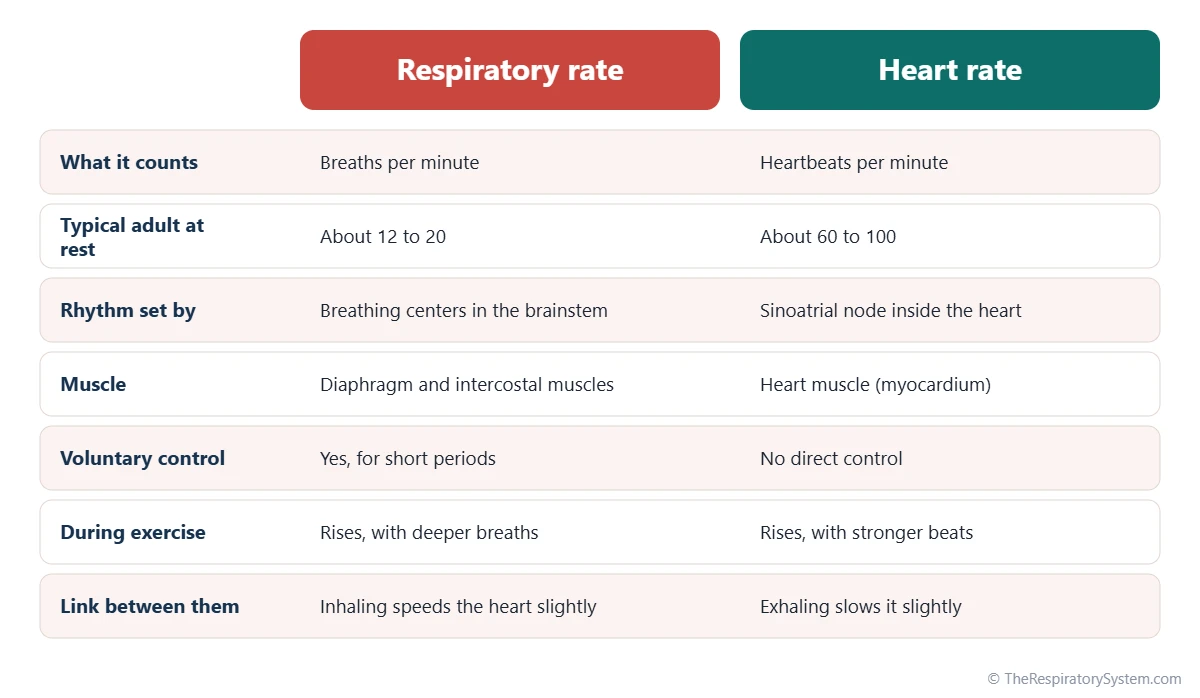
Respiratory rate counts breaths per minute, while heart rate counts heartbeats per minute; at rest an adult's heart beats about 60 to 100 times a minute, roughly four to five beats for every breath. Both rise during exercise, fever and stress, because the respiratory and circulatory systems work together to deliver oxygen and remove carbon dioxide.
Different pacemakers
The two rhythms are set in different places. Breathing is generated by neurons in the brainstem and depends entirely on nerve signals, which is why it can be paused or changed on purpose. The heartbeat is generated inside the heart itself by the sinoatrial node, so it keeps beating without any signal from the brain, which only speeds it up or slows it down.
How breathing changes the heart rate
The two rates are linked breath by breath. In healthy people, especially children and young adults, the heart rate speeds up slightly during each inhalation and slows slightly during each exhalation, a normal pattern called respiratory sinus arrhythmia. It reflects the vagus nerve easing its brake on the heart while breathing in, and it tends to become less marked with age.
Common Conditions That Affect Respiratory Rate
Many lung, heart, nervous system and metabolic conditions change respiratory rate, most often by making breathing faster, and some medicines and brain conditions make it slower. A change in breathing rate is a sign, not a diagnosis, and anyone with breathing symptoms should see a doctor. Our respiratory diseases section describes the conditions in more detail.
- Lung infections: pneumonia fills alveoli with fluid and usually makes breathing faster and shallower.
- Airway diseases: flare-ups of asthma and COPD narrow the airways and often raise the rate.
- Blood clots in the lungs: a pulmonary embolism commonly causes sudden fast breathing.
- Low oxygen: any cause of hypoxemia, including high altitude, stimulates faster breathing.
- Metabolic acidosis: conditions that make the blood acidic, such as diabetic ketoacidosis, can cause deep, rapid Kussmaul breathing.
- Anxiety and panic: can trigger fast breathing and hyperventilation.
- Slow breathing: sedating medicines, some head injuries and severe hypothermia can slow the rate.
Key Facts
- Respiratory rate is the number of breaths per minute; one inhalation plus one exhalation counts as one breath.
- A typical resting adult breathes about 12 to 20 times per minute, while a newborn breathes about 30 to 60 times per minute.
- Minute ventilation equals respiratory rate times tidal volume, about 6 liters per minute at rest.
- The breathing rhythm is generated in the medulla, mainly by the pre-Bötzinger complex, and refined by the pons.
- Carbon dioxide is the main chemical signal that sets breathing rate at rest, sensed by central chemoreceptors.
- Breathing usually slows and becomes very regular in deep sleep and turns irregular in REM sleep.
- Heart rate rises slightly with each breath in and falls with each breath out, a normal pattern called respiratory sinus arrhythmia.
Quick Quiz: Test What You Know About the Respiratory Rate
6 questions. Tap an answer to check it.
What is a typical resting respiratory rate for a healthy adult?
Healthy adults at rest usually breathe about 12 to 20 times per minute; 30 to 60 is typical of newborns, and 60 to 100 is a resting heart rate.
Which part of the brain generates the basic breathing rhythm?
The rhythm comes from neurons in the medulla, especially the pre-Bötzinger complex, with fine-tuning from the pons.
What is the main chemical signal that controls breathing rate at rest?
A rise in carbon dioxide, sensed mainly by central chemoreceptors, is the strongest drive to breathe at rest.
What is tachypnea?
Tachypnea means a breathing rate above the normal range for age; bradypnea is slower than normal and apnea is a pause.
Which group usually has the fastest resting breathing rate?
Newborns breathe about 30 to 60 times per minute, and the rate slows gradually through childhood.
Which nerve carries the breathing signal to the diaphragm?
The phrenic nerve, from the neck, supplies the diaphragm; the intercostal nerves supply the muscles between the ribs.
Frequently Asked Questions
Does one breath in and one breath out count as one breath?
Yes. When respiratory rate is measured, one complete cycle of inhalation followed by exhalation counts as a single breath. Counting each rise and each fall separately would double the result. In practice, the observer counts each time the chest or abdomen rises over 30 or 60 seconds and converts the count to breaths per minute.
Why do babies breathe faster than adults?
Babies breathe faster because they have small lungs, so each breath moves only a small volume of air, while their bodies use more oxygen per kilogram than an adult's. Their chest walls are also soft and their airways narrow, which makes deep breaths less efficient. Breathing more often is the simplest way for a baby to move enough air, and the rate slows as the lungs and chest grow.
Is a low breathing rate always a problem?
Not always. Many healthy adults breathe near the bottom of the typical range at rest, and the rate falls further in deep sleep. Some well-trained endurance athletes also breathe slowly at rest. A slow rate becomes important when it comes with other signs, such as drowsiness or low oxygen, so doctors judge breathing rate together with depth, oxygen levels and the person's overall condition.
Can you control your breathing rate?
Partly. The upper brain can take over the breathing muscles for a while, which is how people speak, sing, blow out candles or pause their breathing. This control is limited, though. As carbon dioxide builds up in the blood, the automatic drive from the brainstem grows stronger and eventually overrides the voluntary command, so breathing always returns to its automatic rhythm.
Does anxiety change breathing rate?
Yes. Anxiety and fear activate the sympathetic nervous system, which speeds up both breathing and heart rate. Breathing may become fast and shallow, and if it goes beyond what the body needs, carbon dioxide in the blood falls. Low carbon dioxide can cause lightheadedness and tingling in the fingers or around the mouth, which are typical features of hyperventilation.
What is the breathing rate during exercise?
During exercise, breathing rate rises along with the depth of each breath. In light activity the rate may climb only a little, while in hard exercise it can reach two to three times the resting rate, often 40 or more breaths per minute in fit adults at maximum effort. After exercise the rate falls back gradually as the extra carbon dioxide is cleared.
Does body temperature change breathing rate?
Yes. A fever raises the body's metabolic rate, so cells use more oxygen and make more carbon dioxide, and breathing speeds up to keep pace. Very low body temperature does the opposite and slows metabolism and breathing. Some animals, such as dogs, also use fast, shallow panting to lose heat, but humans rely mainly on sweating instead.
How is respiratory rate different from minute ventilation?
Respiratory rate only counts how many breaths are taken each minute. Minute ventilation is the total volume of air moved per minute, found by multiplying the rate by the tidal volume. Two people with the same rate can have very different minute ventilation if one breathes deeply and the other shallowly, so physiologists usually look at rate and depth together.
Keep Exploring


