At a Glance
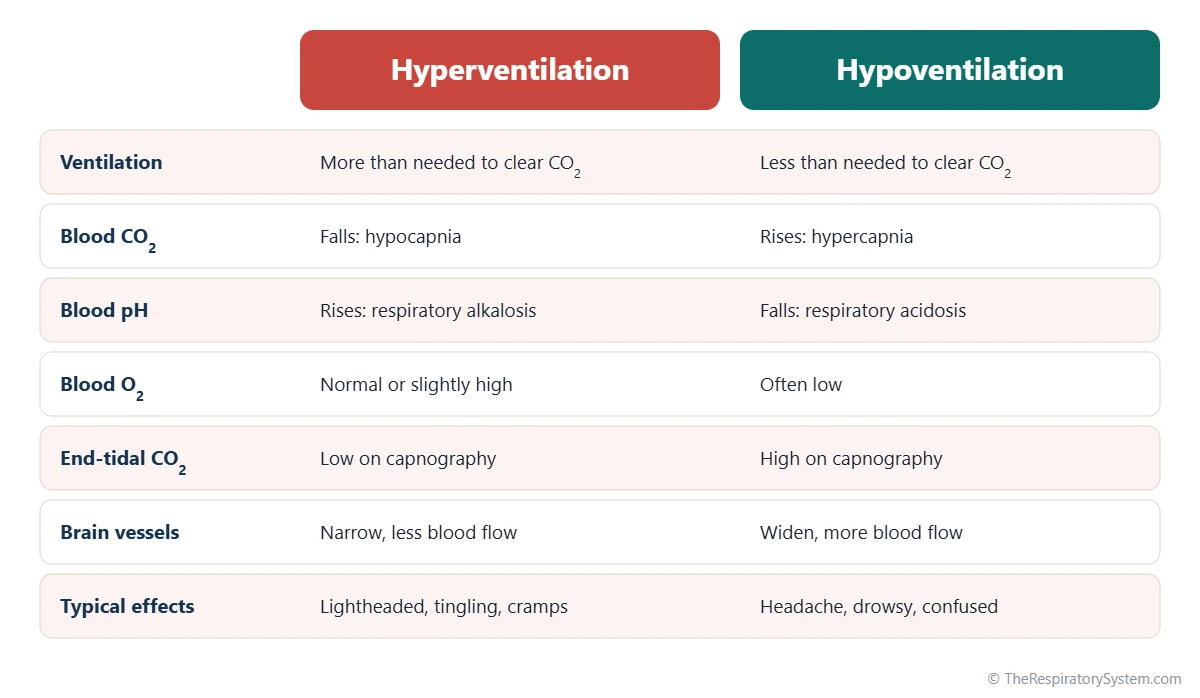
Hyperventilation means alveolar ventilation is higher than needed for the body's carbon dioxide production, so arterial PCO2 falls below the normal range of about 35 to 45 mmHg and pH rises (respiratory alkalosis). Hypoventilation means ventilation is too low, so arterial PCO2 rises above about 45 mmHg and pH falls (respiratory acidosis), often with a drop in blood oxygen.
- Hyperventilation
- Too much alveolar ventilation for the CO2 being made: PaCO2 below about 35 mmHg
- Hypoventilation
- Too little alveolar ventilation for the CO2 being made: PaCO2 above about 45 mmHg
- Normal range
- Arterial PCO2 about 35 to 45 mmHg and pH about 7.35 to 7.45
- Effect on pH
- Hyperventilation raises pH (respiratory alkalosis); hypoventilation lowers it (respiratory acidosis)
- Measured by
- Arterial blood gas (ABG) test and, breath by breath, capnography
- Controlled by
- Brainstem breathing centers and chemoreceptors that sense CO2 and pH
On this page
- What Is the Difference Between Hyperventilation and Hypoventilation?
- What Is Hyperventilation?
- What Is Hypoventilation?
- Hyperventilation vs Hypoventilation: CO2 and pH
- Hyperventilation vs Hypoventilation Side by Side
- Hypoventilation vs Hyperventilation on an ABG and Capnography
- Ventilation-Perfusion Mismatch vs Hypoventilation
- What Do Hyperventilation and Hypoventilation Have in Common?
- What Causes Hyperventilation and Hypoventilation?
- Key Facts
- Quiz
- FAQ
What Is the Difference Between Hyperventilation and Hypoventilation?
The difference between hyperventilation and hypoventilation is which way blood carbon dioxide moves: hyperventilation removes carbon dioxide faster than the body makes it, so the level falls, while hypoventilation removes it more slowly than it is made, so the level rises. Every other difference, in blood pH, oxygen and symptoms, follows from that one change.
Physiologists judge ventilation by the arterial partial pressure of carbon dioxide, written PaCO2, because it reflects the balance between the carbon dioxide cells produce and the amount the lungs remove. Normal PaCO2 is about 35 to 45 mmHg. A value below that range means hyperventilation, and a value above it means hypoventilation, whatever the breathing looks like from the outside.
The verdict in one line
Hyperventilation lowers carbon dioxide and makes the blood alkaline; hypoventilation raises carbon dioxide and makes the blood acidic.
Explained simply
Think of carbon dioxide as smoke from a fire in a room, and breathing as an exhaust fan. If the fan runs too fast for the size of the fire, the room is cleared of smoke and becomes too clean. If the fan runs too slowly, smoke builds up. Hyperventilation is the fan running too fast; hypoventilation is the fan running too slowly.
What Is Hyperventilation?
Hyperventilation is breathing at a level of alveolar ventilation greater than the body's metabolic need, which drives arterial carbon dioxide below about 35 mmHg, a state called hypocapnia. The breaths may be faster, deeper or both.
Hyperventilation is not the same as fast breathing
Fast breathing alone is called tachypnea, and deeper, increased breathing is called hyperpnea. During exercise, breathing rises a great deal, but because the muscles make more carbon dioxide at the same time, PaCO2 stays close to normal; this is hyperpnea, not hyperventilation. Rapid, shallow breaths can even fail to raise alveolar ventilation, because much of each small breath only fills the dead space of the airways.
What hyperventilation does in the body
Low carbon dioxide narrows the blood vessels of the brain, which reduces brain blood flow and can cause lightheadedness. The alkaline blood also makes more calcium bind to blood proteins, lowering the free, ionized calcium that nerves and muscles depend on. This explains the classic tingling around the mouth and in the fingers, and in stronger cases muscle cramps or spasms of the hands and feet.
What Is Hypoventilation?
Hypoventilation is breathing at a level of alveolar ventilation too low for the body's metabolic need, which lets arterial carbon dioxide rise above about 45 mmHg, a state called hypercapnia. Breaths may be too slow, too shallow or both.
Why oxygen usually falls too
When less fresh air reaches the alveoli, carbon dioxide accumulates there and takes up a larger share of the alveolar gas, so the oxygen pressure in the alveoli falls. Less oxygen then reaches the blood, which is why hypoventilation in room air usually causes hypoxemia as well as hypercapnia, as described on our hypoxia and hypoxemia page.
What hypoventilation does in the body
High carbon dioxide widens the blood vessels of the brain and skin, which can cause a headache and warm, flushed skin. As the level climbs further it has a sedating effect, leading to drowsiness and confusion, a state sometimes called carbon dioxide narcosis. The acidic blood also affects the heart and many enzymes, which is why marked hypoventilation is treated as serious.
Hyperventilation vs Hypoventilation: CO2 and pH
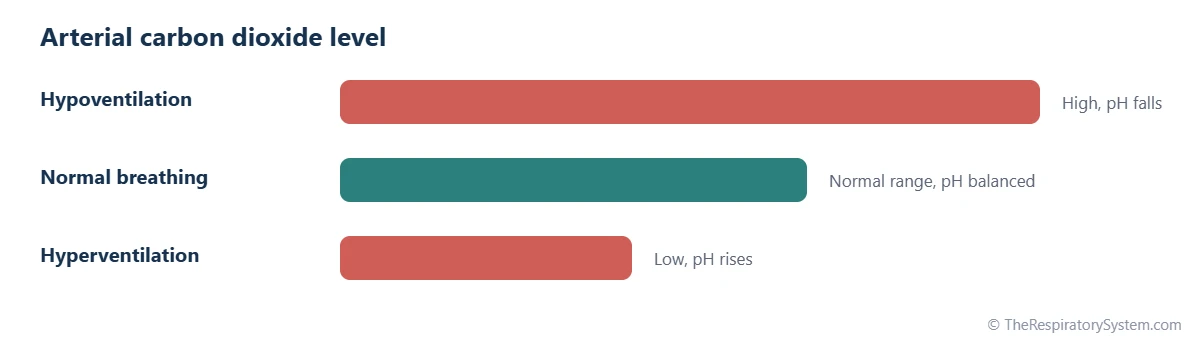
Hyperventilation vs hypoventilation follows a simple rule for carbon dioxide and pH: arterial PCO2 moves in the opposite direction to alveolar ventilation, and blood pH moves in the opposite direction to PCO2. More breathing means less carbon dioxide and a higher pH; less breathing means more carbon dioxide and a lower pH.
The ventilation and CO2 link
If the body's carbon dioxide production stays the same, doubling alveolar ventilation roughly halves PaCO2, and halving ventilation roughly doubles it. This inverse relationship is one of the most useful equations in physiology, because it lets a single blood carbon dioxide value describe how well the lungs are ventilating overall.
The CO2 and pH link
Carbon dioxide reacts with water in the blood to form carbonic acid, which splits into hydrogen ions and bicarbonate, a reaction sped up by the enzyme carbonic anhydrase in red blood cells. More carbon dioxide pushes the reaction toward more hydrogen ions, so pH falls; less carbon dioxide pulls it back, so pH rises. Normal arterial pH is about 7.35 to 7.45, and this bicarbonate buffer system is explained in more depth on our carbon dioxide transport page and our guide to respiratory system homeostasis.
Hyperventilation vs Hypoventilation Side by Side
Side by side, hyperventilation and hypoventilation are mirror images: one gives low carbon dioxide, high pH and normal or high oxygen, while the other gives high carbon dioxide, low pH and often low oxygen. The table below compares them feature by feature.
Both can be short-lived or long-lasting. A sudden change is called acute; a change that lasts days or longer is called chronic, and in chronic cases the kidneys partly correct the pH by keeping or getting rid of bicarbonate, a slow process called renal compensation.
| Feature | Hyperventilation | Hypoventilation |
|---|---|---|
| Alveolar ventilation | Higher than the body's CO2 production requires | Lower than the body's CO2 production requires |
| Arterial PCO2 | Below about 35 mmHg (hypocapnia) | Above about 45 mmHg (hypercapnia) |
| Blood pH | Rises above about 7.45 | Falls below about 7.35 |
| Acid-base name | Respiratory alkalosis | Respiratory acidosis |
| Arterial oxygen | Normal or slightly raised | Often lowered (hypoxemia) in room air |
| End-tidal CO2 (capnography) | Low | High |
| Brain blood vessels | Narrow, reducing brain blood flow | Widen, increasing brain blood flow |
| Typical effects | Lightheadedness, tingling, muscle cramps | Headache, flushed skin, drowsiness, confusion |
| Kidney compensation (chronic) | Kidneys excrete more bicarbonate | Kidneys retain more bicarbonate |
| Breathing appearance | Often fast and deep, but can look normal | Often slow or shallow, but can look normal |
| Typical triggers | Anxiety, pain, fever, altitude, some lung conditions | Sedating drugs, muscle weakness, chest wall disease, severe COPD |
| Source: Typical adult values at sea level, our editors | ||
Hypoventilation vs Hyperventilation on an ABG and Capnography
On an arterial blood gas (ABG), hypoventilation shows a high PaCO2 with a low or low-normal pH, and hyperventilation shows a low PaCO2 with a high or high-normal pH; on capnography, the end-tidal CO2 reading rises with hypoventilation and falls with hyperventilation. These two tests are how clinicians confirm which problem is present.
Reading the ABG pattern
An ABG measures pH, PaCO2, PaO2 and bicarbonate in a sample of arterial blood. A primary breathing problem changes PaCO2 first and pH follows in the opposite direction; if the pH change is smaller than expected, the kidneys have had time to compensate. A low PaCO2 can also be the lungs' response to a metabolic acid problem rather than the cause, as in the deep Kussmaul breathing described on our breathing patterns page.
What capnography adds
Capnography measures the carbon dioxide in each exhaled breath and draws it as a waveform. The value at the end of a breath, the end-tidal CO2, normally lies about 35 to 45 mmHg and in healthy lungs sits a few mmHg below arterial PCO2. A rising end-tidal value warns of hypoventilation breath by breath, and a falling value points to hyperventilation, although lung disease can widen the gap between the two measurements.
| Pattern | PaCO2 | pH | Bicarbonate |
|---|---|---|---|
| Normal ventilation | About 35 to 45 mmHg | About 7.35 to 7.45 | About 22 to 26 mEq/L |
| Acute hyperventilation | Low | High | Normal or slightly low |
| Chronic hyperventilation | Low | Near normal or slightly high | Low (kidneys excrete bicarbonate) |
| Acute hypoventilation | High | Low | Normal or slightly high |
| Chronic hypoventilation | High | Near normal or slightly low | High (kidneys retain bicarbonate) |
| Breathing in response to metabolic acidosis | Low | Low | Low (the primary problem) |
| Source: Typical adult reference ranges, our editors | |||
Ventilation-Perfusion Mismatch vs Hypoventilation
Ventilation-perfusion mismatch and hypoventilation can both lower blood oxygen, but hypoventilation always raises carbon dioxide, while a mismatch often leaves carbon dioxide normal or even low. The difference lies in whether the problem is the total amount of air reaching the alveoli or how well that air is matched to blood flow.
Hypoventilation: the whole lung gets too little air
In pure hypoventilation the lungs themselves may be healthy, and every alveolus simply receives too little fresh air. Oxygen falls in the alveoli and in the blood by about the same amount, so the gap between alveolar and arterial oxygen, called the A-a gradient, stays normal.
Mismatch: air and blood go to different places
In a ventilation-perfusion mismatch, some regions get blood but too little air, and others get air but too little blood, as in pneumonia or COPD. Blood from poorly aired regions leaves the lung low in oxygen, so arterial oxygen falls well below alveolar oxygen and the A-a gradient widens. Carbon dioxide is often kept normal, because the breathing centers increase ventilation of the healthy regions, which clear carbon dioxide well but cannot add much extra oxygen to blood that is already nearly saturated.
What Do Hyperventilation and Hypoventilation Have in Common?
Hyperventilation and hypoventilation are both failures of the same balance, the match between how much carbon dioxide the body makes and how much the lungs remove, and the same control system normally prevents both. They share these features:
- Both are defined by arterial PCO2, not by how fast or deep breathing looks.
- Both disturb blood pH, one toward alkalosis and the other toward acidosis.
- Both can be acute or chronic, and in both the kidneys partly correct the pH over days.
- Both can arise in the brain, the chest or the blood chemistry, not only in the lungs.
- Both are measured the same way, with an ABG and capnography.
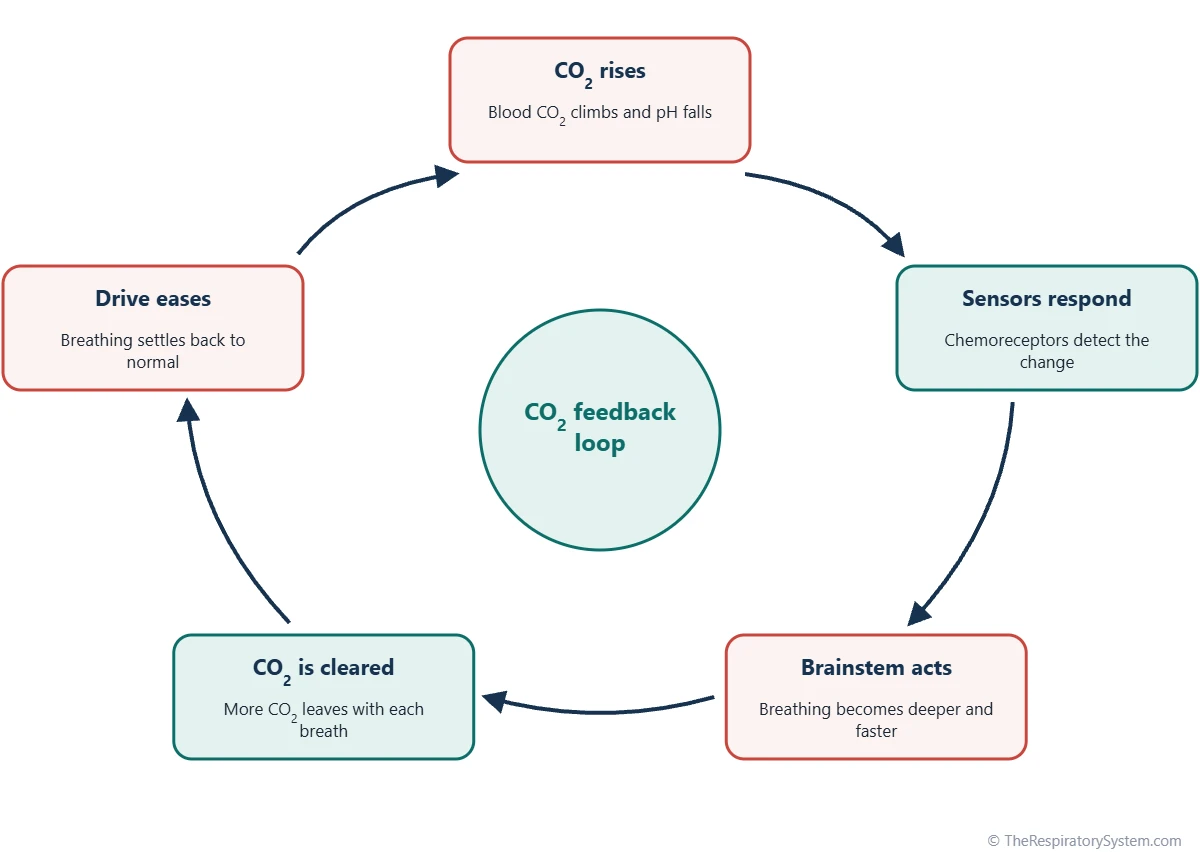
How the body keeps ventilation on target
Central chemoreceptors in the medulla and peripheral chemoreceptors in the carotid and aortic bodies sense carbon dioxide, pH and oxygen, as described on our respiratory chemoreceptors page. When carbon dioxide rises, they drive the brainstem to increase breathing; when it falls, the drive to breathe eases. This negative feedback loop, covered in our guide to the control of breathing, normally holds PaCO2 within a few mmHg of 40 from moment to moment.
What Causes Hyperventilation and Hypoventilation?
Hyperventilation is usually caused by something that stimulates the breathing centers, while hypoventilation is caused by something that depresses those centers or weakens the pump of nerves, muscles and chest wall that moves air. Anyone with breathing symptoms should see a doctor, since the same change can have very different causes.
Common causes of hyperventilation
- Anxiety, panic, pain and fever, which increase the drive to breathe.
- Low oxygen in the air, as during breathing at high altitude.
- Lung conditions that stimulate stretch and irritant receptors, such as an early asthma attack or a pulmonary embolism.
- Pregnancy, in which hormones mildly lower the normal PaCO2.
- Some poisonings that stimulate the brainstem breathing centers directly.
Common causes of hypoventilation
- Sedating drugs that depress the brainstem breathing centers.
- Nerve and muscle diseases that weaken the diaphragm and other muscles of respiration.
- Chest wall problems, such as severe curvature of the spine, and obesity hypoventilation syndrome.
- Advanced lung disease, such as severe COPD, and breathing problems during sleep such as sleep apnea.
Key Facts
- Hyperventilation and hypoventilation are defined by arterial carbon dioxide, not by breathing rate: below about 35 mmHg is hyperventilation and above about 45 mmHg is hypoventilation.
- Hyperventilation causes respiratory alkalosis (high pH); hypoventilation causes respiratory acidosis (low pH).
- With steady carbon dioxide production, doubling alveolar ventilation roughly halves arterial PCO2.
- Hypoventilation in room air usually lowers blood oxygen too, because carbon dioxide takes up more of the alveolar gas.
- Breathing harder during exercise is hyperpnea, not hyperventilation, because carbon dioxide output rises at the same time.
- Chemoreceptors in the medulla and the carotid and aortic bodies normally keep arterial PCO2 close to 40 mmHg.
- In chronic cases the kidneys partly correct the pH by excreting or retaining bicarbonate over several days.
Quick Quiz: Test What You Know About the Hyperventilation and Hypoventilation
6 questions. Tap an answer to check it.
What defines hyperventilation?
Hyperventilation is ventilation greater than metabolic need, shown by a PaCO2 below about 35 mmHg.
What happens to blood pH in hypoventilation?
Carbon dioxide builds up and forms more carbonic acid, so pH falls in respiratory acidosis.
Which acid-base disturbance does hyperventilation cause?
Low carbon dioxide reduces carbonic acid in the blood, raising pH: respiratory alkalosis.
On capnography, what does a rising end-tidal CO2 suggest?
End-tidal CO2 rises when ventilation falls behind carbon dioxide production, which is hypoventilation.
Why is heavy breathing during exercise not called hyperventilation?
Muscles make more carbon dioxide, and ventilation rises to match, so PaCO2 stays near normal: this is hyperpnea.
Which finding helps tell pure hypoventilation from a ventilation-perfusion mismatch?
In pure hypoventilation alveolar and arterial oxygen fall together, so the A-a gradient stays normal while PaCO2 rises.
Frequently Asked Questions
Can you hyperventilate without breathing fast?
Yes. Hyperventilation is about alveolar ventilation compared with carbon dioxide production, not about the number of breaths. Slightly deeper breaths at a normal rate, or frequent sighs, can lower arterial carbon dioxide enough to count as hyperventilation. This is why some people with chronic hyperventilation appear to breathe normally, and why the diagnosis rests on a blood gas or end-tidal measurement rather than on watching the chest.
Can hypoventilation happen during sleep?
Yes. During sleep the brainstem responds less strongly to carbon dioxide, and the muscles that keep the upper airway open relax, so ventilation normally falls a little and PaCO2 rises by a few mmHg. In people with obesity, nerve or muscle disease, chest wall problems or severe lung disease, this nightly drop can become marked hypoventilation that is often worst during REM sleep.
Why does hyperventilation make your fingers tingle?
When carbon dioxide falls, the blood becomes more alkaline and more calcium binds to blood proteins such as albumin. The free, ionized calcium level drops, and nerves become more excitable. That extra excitability is felt as pins and needles around the mouth and in the fingers and toes, and in stronger cases as muscle cramps or a spasm that curls the hands and feet.
Is hypoventilation the same as hypoxia?
No. Hypoventilation is too little ventilation, shown by a high arterial carbon dioxide. Hypoxia is too little oxygen in the tissues, and hypoxemia is too little oxygen in the blood. Hypoventilation is one cause of hypoxemia, but low oxygen can also come from high altitude, a ventilation-perfusion mismatch, thickened lung tissue or problems with the blood, none of which necessarily raise carbon dioxide.
What is the normal PaCO2 range?
In a healthy adult at rest, arterial PCO2 normally lies about 35 to 45 mmHg, with 40 mmHg as the usual midpoint. Values below this range indicate hyperventilation, and values above it indicate hypoventilation. The range applies to adults at sea level; it is slightly lower during pregnancy and in people who have adapted to living at high altitude, because both breathe a little more.
How do the kidneys respond to hyperventilation and hypoventilation?
The kidneys are the slow partners of the lungs in acid-base balance. In chronic hypoventilation they keep more bicarbonate and excrete more acid, which pulls the low pH back toward normal. In chronic hyperventilation they excrete more bicarbonate, which lowers a high pH. This renal compensation takes several days to develop fully, so acute changes in ventilation show much larger pH shifts than chronic ones.
Is Kussmaul breathing hyperventilation?
Kussmaul breathing is deep, labored breathing that lowers arterial carbon dioxide, so by the blood gas definition it is a form of hyperventilation. It is not the cause of the acid-base problem, though. It is the lungs' compensation for a metabolic acidosis, such as diabetic ketoacidosis, in which extra acid builds up in the blood and breathing off carbon dioxide helps limit the fall in pH.
Does holding your breath cause hypoventilation?
A breath hold is a brief, voluntary stop in ventilation, so during it carbon dioxide rises and oxygen falls, just as in hypoventilation. The rising carbon dioxide stimulates the chemoreceptors until the urge to breathe overrides the hold. Clinicians use the term hypoventilation for a sustained reduction in ventilation from disease or drugs rather than for a short voluntary pause.
Keep Exploring


