At a Glance
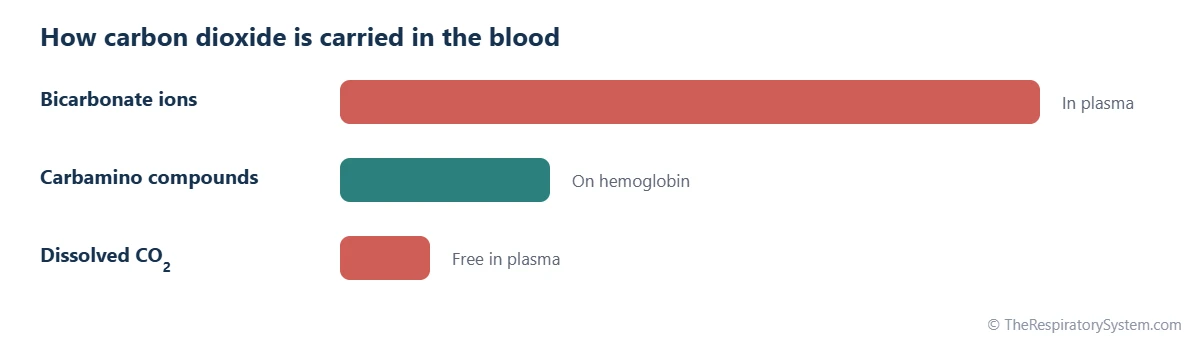
Carbon dioxide is transported in the blood in three ways: about 70% as bicarbonate ions (HCO3-) in the plasma, about 20 to 23% bound to hemoglobin and plasma proteins as carbamino compounds, and about 7 to 10% dissolved in plasma. Bicarbonate is made inside red blood cells by the enzyme carbonic anhydrase and then exchanged for chloride ions across the cell membrane, a step called the chloride shift.
- Main form
- Bicarbonate ions in the plasma, about 70% of the total
- Other forms
- Carbaminohemoglobin and other carbamino compounds (about 20 to 23%); dissolved CO2 (about 7 to 10%)
- Key enzyme
- Carbonic anhydrase inside red blood cells
- Key exchange
- Chloride shift: bicarbonate out of red cells, chloride in, via band 3 protein
- Linked effect
- Haldane effect: oxygen-poor hemoglobin carries more carbon dioxide
- Part of
- Internal respiration, blood gas transport and acid-base balance
On this page
- What Is Carbon Dioxide Transport?
- What Ways Is Carbon Dioxide Transported in the Blood?
- How Does Carbon Dioxide Become Bicarbonate?
- What Is the Chloride Shift?
- Carbon Dioxide Transport Process: What Happens Step by Step?
- How Does Oxygen Affect Carbon Dioxide Transport?
- How Does Carbon Dioxide Transport Affect Blood pH?
- Common Conditions That Affect Carbon Dioxide Transport
- Key Facts
- Quiz
- FAQ
What Is Carbon Dioxide Transport?
Carbon dioxide transport is the carriage of carbon dioxide by the blood from the body's cells, where it is produced, to the lungs, where it is released into the air and exhaled. It is the mirror image of oxygen transport, which carries oxygen in the opposite direction on the same journey.
Every cell makes carbon dioxide as it breaks down glucose and fats for energy in cellular respiration. A resting adult produces roughly 200 milliliters of carbon dioxide every minute, and much more during exercise. If it were not removed, it would combine with water to form acid and quickly lower the pH of the body fluids. The blood therefore has to pick it up continuously and deliver it to the lungs, where gas exchange passes it into the alveoli.
Why the blood needs special carrier forms
Carbon dioxide dissolves in water about 20 times more readily than oxygen, but even so, simple solution could carry only a small part of what the body makes. Most of it is therefore converted to other forms: bicarbonate ions and carbamino compounds. These forms let each 100 milliliters of blood hold about 50 milliliters of carbon dioxide, far more than dissolved gas alone, and release it again in the lungs within the second or so a red blood cell spends there.
Explained simply
Think of carbon dioxide as trash from your cells. A little floats loose in the blood, some is clipped onto the outside of red blood cells' hemoglobin, and most is turned into a different form, bicarbonate, that dissolves easily in the watery plasma. When the blood reaches the lungs, everything is turned back into carbon dioxide gas and breathed out.
What Ways Is Carbon Dioxide Transported in the Blood?
Carbon dioxide is transported in the blood in three ways: as bicarbonate ions in the plasma (about 70%), as carbamino compounds bound to hemoglobin and plasma proteins (about 20 to 23%), and as dissolved carbon dioxide (about 7 to 10%). These are typical textbook shares for venous blood, and they shift a little with activity and oxygen level.
1. Dissolved in plasma (about 7 to 10%)
A small amount of carbon dioxide simply dissolves in the plasma, like the gas in a soft drink. The amount depends on the partial pressure of carbon dioxide and its solubility. Although it is the smallest share, dissolved carbon dioxide matters most for sensing, because it sets the partial pressure that the respiratory chemoreceptors respond to, and it is the form that actually diffuses across membranes.
2. Bound to hemoglobin as carbaminohemoglobin (about 20 to 23%)
Carbon dioxide can attach to the free amino groups at the ends of the protein chains of hemoglobin, forming carbaminohemoglobin. It binds to the globin protein, not to the iron-containing heme groups where oxygen binds, so the two gases do not compete for the same site. Plasma proteins form carbamino compounds too, but in much smaller amounts. Deoxygenated hemoglobin binds carbon dioxide more readily than oxygenated hemoglobin, which is one reason venous blood carries more.
3. As bicarbonate ions (about 70%)
Most carbon dioxide enters red blood cells and is converted into bicarbonate ions, which then move out into the plasma. This is the main route because bicarbonate is very soluble and the conversion is extremely fast inside red cells. The next two sections explain how bicarbonate is made and why chloride ions move in return.
How Does Carbon Dioxide Become Bicarbonate?
Carbon dioxide becomes bicarbonate when it combines with water to form carbonic acid, which then splits into a hydrogen ion and a bicarbonate ion; inside red blood cells the first step is speeded up enormously by the enzyme carbonic anhydrase. The reaction can be written as:
CO2 + H2O ⇌ H2CO3 ⇌ H+ + HCO3-
The double arrows matter: the same reaction runs forward in the tissues, where carbon dioxide is plentiful, and backward in the lungs, where carbon dioxide is being removed. Which way it runs depends only on the concentrations on each side.
The role of carbonic anhydrase
In plasma, carbon dioxide combines with water only slowly, because plasma has almost no carbonic anhydrase. Red blood cells are packed with it, and it is one of the fastest enzymes known, speeding the reaction by thousands of times. That is why bicarbonate is made almost entirely inside red cells, even though most of it ends up carried in the plasma.
What happens to the hydrogen ions
Each bicarbonate ion made also releases a hydrogen ion, which on its own would make the blood much more acidic. Most of these hydrogen ions are picked up by hemoglobin, which acts as a buffer. Hemoglobin that has just given up its oxygen in the tissues is a better buffer than oxygenated hemoglobin, so the unloading of oxygen and the loading of carbon dioxide help each other. This binding of hydrogen ions also lowers hemoglobin's grip on oxygen, the Bohr effect.
What Is the Chloride Shift?
The chloride shift is the exchange of bicarbonate ions leaving red blood cells for chloride ions entering them, which keeps the electrical charge of the cell balanced while carbon dioxide is converted to bicarbonate. It is also called the Hamburger shift, after the Dutch physiologist Hartog Jakob Hamburger, who first described it.
Bicarbonate builds up inside the red cell as carbonic anhydrase works, so it diffuses out into the plasma, where it is carried to the lungs. If negative ions simply left the cell, the inside would become positively charged and the process would stall. Instead, a membrane protein called band 3, also known as anion exchanger 1, swaps one bicarbonate ion out for one chloride ion in. Band 3 is one of the most abundant proteins in the red cell membrane, so the exchange is very fast.
Effects of the chloride shift
- Venous red blood cells contain more chloride than arterial ones, and the plasma of venous blood contains a little less.
- The extra ions inside venous red cells draw in some water, so they are slightly larger than arterial red cells.
- Removing bicarbonate from the red cell keeps the carbonic anhydrase reaction running forward, so more carbon dioxide can be loaded.
The reverse chloride shift in the lungs
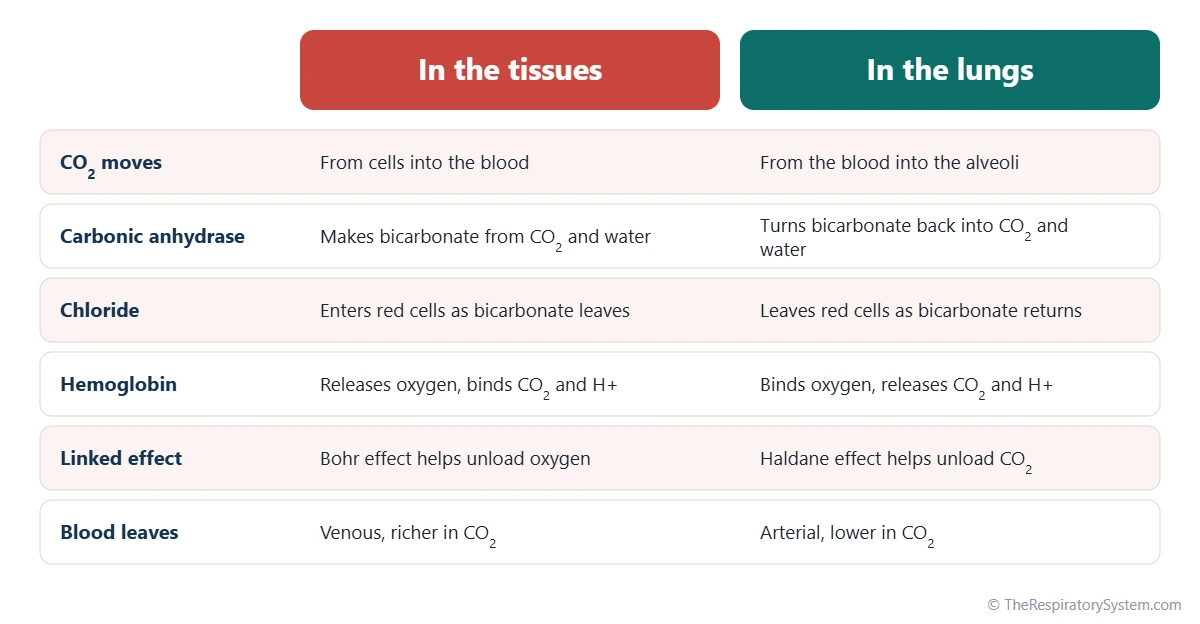
In the lung capillaries everything runs the other way. Bicarbonate re-enters the red cells in exchange for chloride, which leaves for the plasma. Inside the cell, bicarbonate combines with hydrogen ions released from hemoglobin to form carbonic acid, and carbonic anhydrase turns it back into water and carbon dioxide, which diffuses into the alveoli.
| Component | Where it is found | Role in carbon dioxide transport |
|---|---|---|
| Dissolved carbon dioxide | Plasma and red cell fluid | About 7 to 10% of the total; sets the partial pressure and diffuses across membranes |
| Bicarbonate ion (HCO3-) | Mostly plasma, made in red cells | About 70% of the total; the main carrier form |
| Carbaminohemoglobin | Red blood cells | About 20 to 23% together with other carbamino compounds; CO2 bound to globin chains |
| Carbamino plasma proteins | Plasma | A small extra share of carbamino carriage |
| Carbonic anhydrase | Inside red blood cells | Enzyme that speeds the reaction of carbon dioxide with water thousands of times |
| Carbonic acid (H2CO3) | Red cells, briefly | Short-lived step between carbon dioxide and bicarbonate |
| Hydrogen ions | Red cells | Released when bicarbonate forms; mostly buffered by hemoglobin |
| Deoxygenated hemoglobin | Red blood cells | Buffers hydrogen ions and binds more carbon dioxide (Haldane effect) |
| Band 3 protein | Red cell membrane | Exchanges bicarbonate for chloride (chloride shift) |
| Chloride ions | Plasma and red cells | Move into red cells in the tissues and out again in the lungs |
| Source: Typical textbook values for venous blood at rest, our editors | ||
Carbon Dioxide Transport Process: What Happens Step by Step?
The carbon dioxide transport process has two halves: loading in the tissue capillaries, where carbon dioxide enters the blood and is converted to carrier forms, and unloading in the lung capillaries, where the carrier forms are turned back into gas and exhaled. The steps below follow one red blood cell around the circuit.
Loading in the tissues
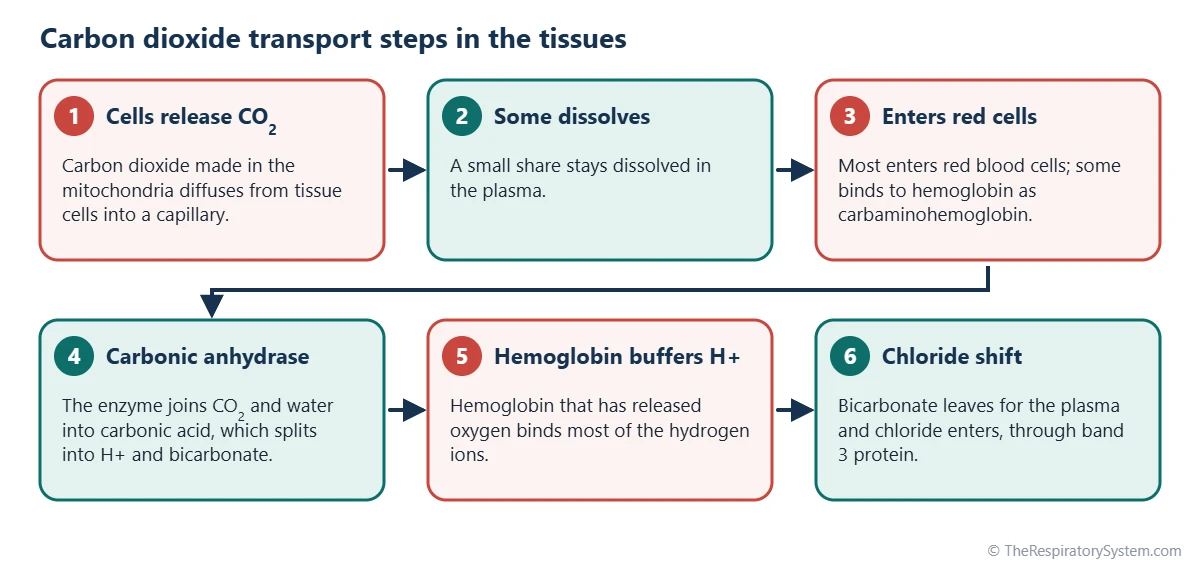
- Diffusion out of the cell. Carbon dioxide made in the mitochondria diffuses out of the tissue cell, through the fluid around it and into a systemic capillary, down its partial pressure gradient.
- Some stays dissolved. A small share remains dissolved in the plasma.
- Entry into red cells. Most diffuses into red blood cells, where some binds to hemoglobin as carbaminohemoglobin.
- Conversion to bicarbonate. Carbonic anhydrase turns the rest into carbonic acid, which splits into hydrogen ions and bicarbonate.
- Buffering. Hemoglobin, which is releasing oxygen at the same time, binds most of the hydrogen ions.
- Chloride shift. Bicarbonate leaves the red cell for the plasma in exchange for chloride.
Unloading in the lungs
- Diffusion into the alveoli. Dissolved carbon dioxide diffuses from the plasma across the respiratory membrane into the alveoli, lowering the plasma level.
- Release from hemoglobin. As hemoglobin picks up oxygen, it releases its carbon dioxide and hydrogen ions.
- Reverse chloride shift. Bicarbonate re-enters red cells as chloride leaves.
- Back to gas. Bicarbonate and hydrogen ions form carbonic acid, which carbonic anhydrase turns into carbon dioxide and water.
- Exhalation. The carbon dioxide diffuses into the alveoli and leaves the body with the next breath out, as described on our inhalation and exhalation page.
Blood flows from the tissues to the lungs through the veins, the right side of the heart and the pulmonary arteries, the route described on our pulmonary circulation page.
How Does Oxygen Affect Carbon Dioxide Transport?
Oxygen affects carbon dioxide transport through the Haldane effect: hemoglobin that has released its oxygen can carry more carbon dioxide and hydrogen ions, while hemoglobin that is loading oxygen releases them. This makes the blood pick up carbon dioxide better in the tissues and give it up better in the lungs.
The effect works in two ways. Deoxygenated hemoglobin forms carbaminohemoglobin more easily, and it binds hydrogen ions more strongly, which pulls the carbonic anhydrase reaction toward more bicarbonate. When the blood reaches the lungs and hemoglobin fills with oxygen, both effects reverse, pushing carbon dioxide out of the blood. Our glossary entry on the Haldane effect explains it in more depth.
Haldane effect and Bohr effect together
The Haldane effect describes how oxygen changes carbon dioxide carriage, while the Bohr effect describes the reverse: how carbon dioxide and acid change oxygen carriage, shifting the oxygen-hemoglobin dissociation curve to the right. In the tissues, carbon dioxide helps unload oxygen and oxygen loss helps load carbon dioxide; in the lungs, both effects run backward. The two gases therefore help each other move in the right direction at both ends of the trip.
The carbon dioxide dissociation curve
Unlike the S-shaped curve for oxygen, the curve relating blood carbon dioxide content to its partial pressure is fairly straight across the normal range and does not level off. There are in fact two curves, one for oxygenated and one for deoxygenated blood, and the gap between them is the Haldane effect. Because the curve stays steep, small changes in breathing change blood carbon dioxide noticeably.
How Does Carbon Dioxide Transport Affect Blood pH?
Carbon dioxide transport affects blood pH because every molecule converted to bicarbonate releases a hydrogen ion, so the more carbon dioxide the blood holds, the more acidic it tends to be. The lungs and kidneys together keep arterial pH in a narrow range, about 7.35 to 7.45.
The bicarbonate made during carbon dioxide transport is also the body's most important chemical buffer in the blood. The balance between dissolved carbon dioxide and bicarbonate sets the pH, which gives the body two levers: the lungs adjust carbon dioxide within minutes by changing ventilation, and the kidneys adjust bicarbonate over hours to days. Venous blood, which carries more carbon dioxide, is therefore slightly more acidic than arterial blood.
When breathing changes
- Breathing too little lets carbon dioxide build up, so the blood becomes more acidic, a state called respiratory acidosis.
- Breathing too much removes extra carbon dioxide, so the blood becomes more alkaline, called respiratory alkalosis.
- Acid from other sources, such as a buildup of lactic acid during very hard exercise, uses up bicarbonate, and faster breathing removes carbon dioxide to limit the fall in pH.
This link between carbon dioxide and pH is why carbon dioxide is the main signal used by the control of breathing, and it is a central part of how the respiratory system maintains homeostasis. Our page on hyperventilation and hypoventilation describes both extremes.
Common Conditions That Affect Carbon Dioxide Transport
Carbon dioxide transport is disturbed mainly when the lungs cannot remove carbon dioxide fast enough, when breathing is too fast or too slow for the body's needs, or when the acid-base balance of the blood is upset. Our respiratory diseases section covers lung conditions in more depth, and anyone with breathing symptoms should see a doctor.
- COPD: in severe cases, damaged airways and alveoli limit how much carbon dioxide can be breathed out, and its level in the blood rises over time.
- Hypoventilation: slow or shallow breathing from drug effects, weakness of the breathing muscles or severe obesity lets carbon dioxide accumulate.
- Sleep apnea: repeated pauses in breathing during sleep cause short rises in carbon dioxide and falls in oxygen.
- Hyperventilation: breathing faster than needed, for example during anxiety, lowers blood carbon dioxide and can cause tingling and lightheadedness.
- Asthma attacks: narrowed airways make breathing out harder; a rising carbon dioxide level during a severe attack is a warning sign doctors watch for.
- Ventilation-perfusion mismatch: when air and blood flow are poorly matched in parts of the lung, both oxygen uptake and carbon dioxide removal suffer; see the ventilation-perfusion ratio.
Doctors measure carbon dioxide in arterial blood with a blood gas test, and in exhaled air with a sensor called a capnograph.
Key Facts
- Carbon dioxide is carried in the blood in three forms: about 70% as bicarbonate, about 20 to 23% as carbamino compounds and about 7 to 10% dissolved.
- The enzyme carbonic anhydrase inside red blood cells converts carbon dioxide and water into carbonic acid thousands of times faster than in plasma.
- In the chloride shift, band 3 protein swaps bicarbonate leaving the red cell for chloride entering it.
- Carbon dioxide binds to the globin chains of hemoglobin, not to the heme iron, so it does not compete directly with oxygen.
- The Haldane effect lets oxygen-poor hemoglobin carry more carbon dioxide, which is released when hemoglobin reloads oxygen in the lungs.
- A resting adult produces roughly 200 milliliters of carbon dioxide per minute, all of which must be exhaled by the lungs.
- Because every bicarbonate ion made releases a hydrogen ion, carbon dioxide transport is tightly linked to blood pH.
Quick Quiz: Test What You Know About the Carbon Dioxide Transport in the Blood
6 questions. Tap an answer to check it.
In which form is most carbon dioxide transported in the blood?
About 70% of carbon dioxide is carried as bicarbonate ions, mostly in the plasma.
Which enzyme speeds the conversion of carbon dioxide to carbonic acid in red blood cells?
Carbonic anhydrase, abundant in red blood cells, speeds the reaction of carbon dioxide with water enormously.
What moves into red blood cells during the chloride shift in the tissues?
Chloride enters the red cell as bicarbonate leaves, keeping the electrical charge balanced.
Where does carbon dioxide bind on the hemoglobin molecule?
Carbon dioxide forms carbaminohemoglobin by binding to amino groups on the globin chains, not to the heme iron.
What does the Haldane effect describe?
Deoxygenated hemoglobin carries more carbon dioxide and hydrogen ions; loading oxygen in the lungs releases them.
About what share of carbon dioxide is carried dissolved in plasma?
Only about 7 to 10% travels dissolved; most is converted to bicarbonate or carbamino compounds.
Frequently Asked Questions
How is carbon dioxide transported in the blood simply?
In simple terms, carbon dioxide made by your cells enters the blood and travels to the lungs in three ways. A little dissolves in the liquid part of the blood. Some sticks to hemoglobin inside red blood cells. Most is changed inside red blood cells into bicarbonate, which dissolves easily in the plasma. In the lungs all of it is changed back into gas and breathed out.
Why is most carbon dioxide carried as bicarbonate?
Bicarbonate is the main carrier form because it is very soluble in plasma and because red blood cells contain large amounts of carbonic anhydrase, which converts carbon dioxide to bicarbonate almost instantly. This lets the blood hold far more carbon dioxide than could dissolve as gas. Bicarbonate also doubles as the blood's main chemical buffer, so carrying carbon dioxide this way helps control pH at the same time.
Is carbon dioxide carried by red blood cells or plasma?
Both. Red blood cells do most of the chemical work: they contain the carbonic anhydrase that makes bicarbonate, and their hemoglobin carries carbon dioxide as carbaminohemoglobin and buffers hydrogen ions. Most of the bicarbonate they make is then moved out into the plasma by the chloride shift, so in terms of where carbon dioxide actually travels, the plasma carries the largest share.
Does carbon dioxide compete with oxygen for hemoglobin?
Not directly. Oxygen binds to the iron atoms in the four heme groups of hemoglobin, while carbon dioxide binds to amino groups on the protein chains. The two do influence each other indirectly: carbon dioxide and acid lower hemoglobin's grip on oxygen, the Bohr effect, and oxygen loading lowers hemoglobin's ability to hold carbon dioxide, the Haldane effect. Carbon monoxide, unlike carbon dioxide, does compete for the oxygen site.
What is the difference between carbon dioxide and carbon monoxide in the blood?
Carbon dioxide is a normal waste product of metabolism, carried to the lungs mainly as bicarbonate and exhaled with every breath. Carbon monoxide is a poisonous gas from incomplete burning of fuels. It binds to the heme sites on hemoglobin far more tightly than oxygen does, so it blocks oxygen transport. The two gases have different chemistry and are carried in completely different ways.
Why is venous blood more acidic than arterial blood?
Venous blood carries more carbon dioxide picked up from the tissues. Each carbon dioxide molecule converted to bicarbonate releases a hydrogen ion, and although hemoglobin buffers most of them, a small rise in acidity remains. As a result venous blood has a slightly lower pH than arterial blood. When the blood passes through the lungs and loses carbon dioxide, its pH rises again.
What happens to carbon dioxide when you hold your breath?
During a breath-hold, cells keep producing carbon dioxide but none is exhaled, so it builds up in the alveoli and in the blood. Blood carbon dioxide and acidity rise steadily, and chemoreceptors in the brainstem sense the change. This growing chemical signal, rather than the fall in oxygen, is the main cause of the strong urge to breathe that eventually ends a breath-hold.
What is carbaminohemoglobin?
Carbaminohemoglobin is hemoglobin with carbon dioxide attached to the free amino groups at the ends of its protein chains. It carries roughly a fifth of the carbon dioxide in the blood. Hemoglobin that has released its oxygen forms carbaminohemoglobin more easily, so it picks up carbon dioxide in the tissues and lets it go in the lungs, where it fills with oxygen again.
Keep Exploring


