At a Glance
The partial pressure of a gas is the pressure that gas alone contributes to a mixture, equal to its fraction of the mixture multiplied by the total pressure (Dalton's law). In a healthy adult at sea level, arterial blood has a partial pressure of oxygen (PaO2) of about 75 to 100 mmHg and a partial pressure of carbon dioxide (PaCO2) of about 35 to 45 mmHg. Each gas diffuses from higher to lower partial pressure.
- Definition
- The pressure contributed by one gas in a mixture of gases
- Rule
- Dalton's law: partial pressure = fraction of the gas × total pressure
- Units
- mmHg or kPa (1 kPa is about 7.5 mmHg)
- Normal PaO2
- About 75 to 100 mmHg (about 10 to 13.3 kPa) in arterial blood
- Normal PaCO2
- About 35 to 45 mmHg (about 4.7 to 6.0 kPa) in arterial blood
- Measured with
- Arterial blood gas test
On this page
- What Is Partial Pressure of Gases?
- What Is Partial Pressure of Oxygen?
- What Is Partial Pressure of Carbon Dioxide?
- How Does the Partial Pressure of Oxygen Change From Air to Cells?
- Why Do Gases Move From High to Low Partial Pressure?
- Partial Pressure of Oxygen vs Oxygen Saturation
- How Do Altitude and Diving Change Partial Pressure?
- How Is Partial Pressure Measured in the Body?
- Common Conditions That Affect Blood Partial Pressures
- Key Facts
- Quiz
- FAQ
What Is Partial Pressure of Gases?
The partial pressure of a gas is the pressure that one gas in a mixture would exert if it alone filled the whole space, and the total pressure of the mixture is the sum of all the partial pressures. This rule is Dalton's law of partial pressures, and it is the starting point for understanding how the lungs load and unload gases.
Dalton's law in air
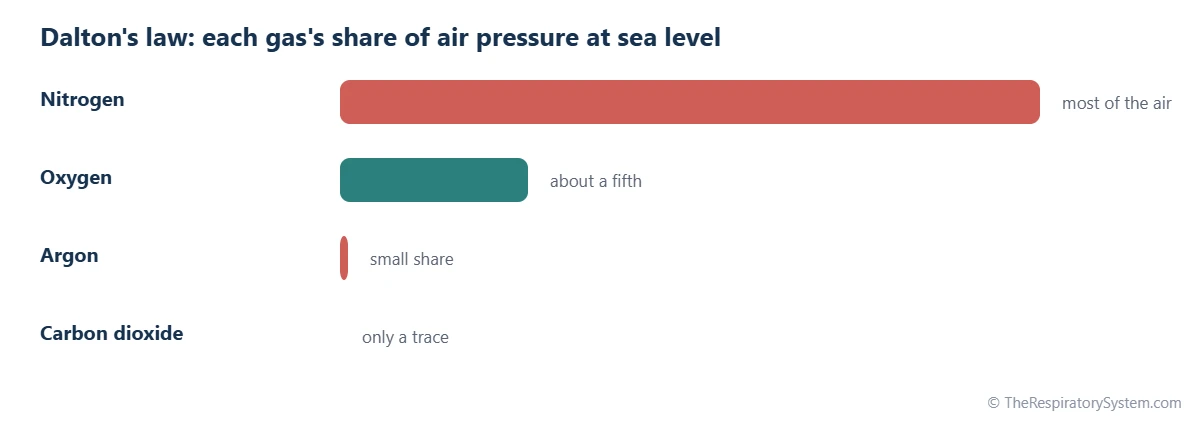
To find a partial pressure, multiply the fraction of the gas by the total pressure. At sea level, air presses with about 760 mmHg, and oxygen makes up about 20.9% of dry air, so the partial pressure of oxygen (PO2) is about 0.209 × 760 ≈ 159 mmHg, usually rounded to 160. Nitrogen, at about 78%, contributes most of the rest, while carbon dioxide is only a trace of about 0.3 mmHg. The table below lists each gas.
Partial pressure in a liquid
Gases also dissolve in liquids such as blood plasma, and partial pressure describes how strongly a dissolved gas tends to escape. By Henry's law, the amount of gas that dissolves equals its partial pressure multiplied by its solubility in that liquid. When blood and alveolar air reach balance, the gas has the same partial pressure in both, even though the amounts are very different, which is why partial pressures in air and blood can be compared directly.
Explained simply
Imagine a crowded room where everyone is pushing on the walls. The total push is the air pressure, and the share of the push that comes from one group of people, say everyone wearing red, is that group's partial pressure. Oxygen makes up about a fifth of the crowd, so it supplies about a fifth of the push, and like people leaving a packed room, gas always drifts toward where its own crowd is thinner.
| Gas | Share of dry air | Partial pressure (mmHg) | Partial pressure (kPa) |
|---|---|---|---|
| Nitrogen (N2) | About 78.1% | About 593 | About 79.1 |
| Oxygen (O2) | About 20.9% | About 159 | About 21.2 |
| Argon (Ar) | About 0.93% | About 7 | About 0.9 |
| Carbon dioxide (CO2) | About 0.04% | About 0.3 | About 0.04 |
| Water vapor in the airways at 37 °C | Added as air is humidified | About 47 | About 6.3 |
| Total (all gases) | 100% | About 760 | About 101.3 |
| Source: Standard values for dry air at sea level, our editors | |||
What Is Partial Pressure of Oxygen?
The partial pressure of oxygen (PO2) is the pressure produced by oxygen alone in air or in a liquid; in the arteries it is written PaO2 and is normally about 75 to 100 mmHg in a healthy adult at sea level. It measures the oxygen dissolved in the plasma, which is the oxygen that drives loading of hemoglobin and diffusion into the tissues.
Reading the symbols
Physiology uses a short code for where a value is measured. A capital P means pressure; a capital A means alveolar air, as in PAO2; a small a means arterial blood, as in PaO2; and a small v means venous blood, as in PvO2. A capital I means inspired air, as in PIO2. Mixing up PAO2 and PaO2 is one of the most common mistakes, because they differ by just one letter.
The alveolar gas equation
Alveolar PO2 is lower than the PO2 of outside air, and the alveolar gas equation shows why. Inhaled air is first humidified, and water vapor at body temperature has a pressure of about 47 mmHg, so inspired PO2 becomes 0.21 × (760 - 47) ≈ 150 mmHg. Carbon dioxide arriving from the blood then takes up part of the alveolar space, so PAO2 ≈ 150 - PaCO2 ÷ 0.8 = 150 - 40 ÷ 0.8 = 100 mmHg, where 0.8 is the typical ratio of carbon dioxide made to oxygen used.
Normal values and age
Arterial PO2 is a little lower than alveolar PO2, by about 5 to 10 mmHg in young adults, because a small amount of blood bypasses ventilated alveoli and because ventilation and blood flow are never perfectly matched. This gap, the alveolar-arterial (A-a) gradient, widens with age, so normal PaO2 drifts downward in older adults. Mixed venous blood returning to the lungs has a PO2 of about 40 mmHg.
What Is Partial Pressure of Carbon Dioxide?
The partial pressure of carbon dioxide (PCO2) is the pressure produced by carbon dioxide alone; in arterial blood it is written PaCO2 and is normally about 35 to 45 mmHg, with about 40 mmHg as the textbook value. Blood returning from the body has a PCO2 of about 45 to 46 mmHg, and alveolar air holds about 40 mmHg.
A mirror of ventilation
PaCO2 is set almost entirely by how much air reaches the alveoli. It is inversely proportional to alveolar ventilation: if alveolar ventilation doubles while carbon dioxide production stays the same, PaCO2 roughly halves, and if ventilation halves, PaCO2 roughly doubles. A high PaCO2, called hypercapnia, means breathing is not keeping up, while a low PaCO2, called hypocapnia, means the person is breathing more than needed, as described on hyperventilation and hypoventilation.
Carbon dioxide and blood pH
Carbon dioxide reacts with water to form carbonic acid, so PaCO2 directly affects the acidity of the blood. A rise in PaCO2 lowers pH, and a fall raises it. Most carbon dioxide travels in the blood as bicarbonate, as explained on our carbon dioxide transport page.
The main signal for breathing
Because PaCO2 tracks ventilation so closely, it is the main chemical signal the brain uses to set breathing. Central chemoreceptors in the medulla respond to the acidity that carbon dioxide creates in the fluid around the brain, and even a small rise in PaCO2 increases breathing. Oxygen plays a smaller role at rest: the peripheral chemoreceptors of the carotid and aortic bodies respond strongly only when PaO2 falls below about 60 mmHg. The whole system is described on control of breathing.
| Measure | Where | Typical value (mmHg) | Typical value (kPa) |
|---|---|---|---|
| PIO2 | Humidified inspired air in the trachea | About 150 | About 20 |
| PAO2 | Alveolar air | About 100 | About 13.3 |
| PACO2 | Alveolar air | About 40 | About 5.3 |
| PaO2 | Arterial blood | About 75 to 100 | About 10 to 13.3 |
| PaCO2 | Arterial blood | About 35 to 45 | About 4.7 to 6.0 |
| PvO2 | Mixed venous blood returning to the lungs | About 40 | About 5.3 |
| PvCO2 | Mixed venous blood returning to the lungs | About 45 to 46 | About 6.0 to 6.1 |
| PO2 in mitochondria | Inside working cells | Only a few mmHg | Below 1 |
| Source: Typical adult values at rest at sea level, our editors | |||
How Does the Partial Pressure of Oxygen Change From Air to Cells?
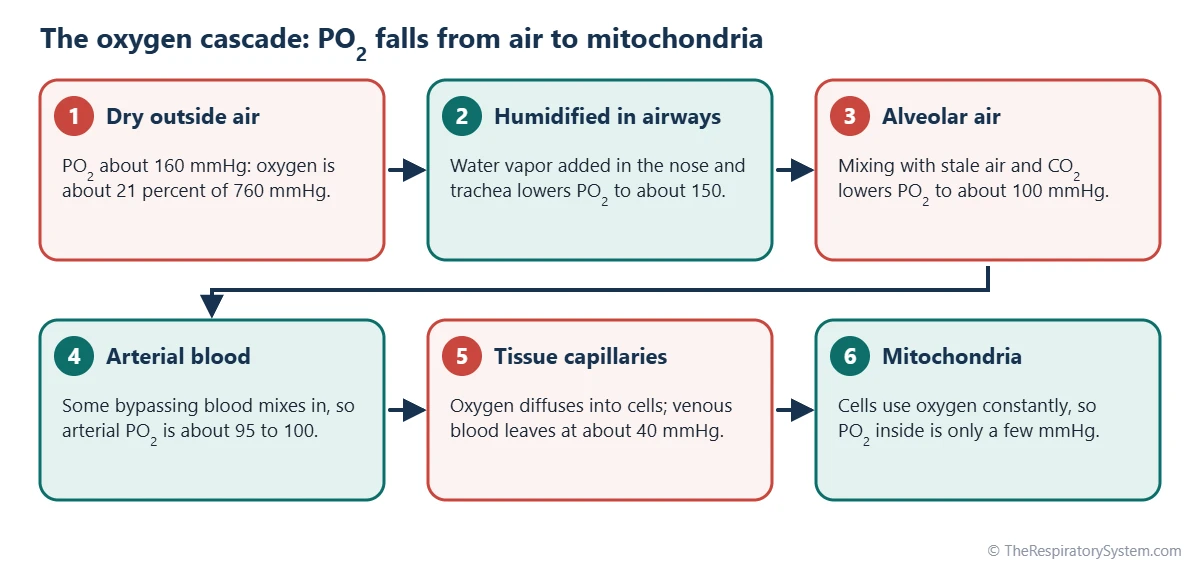
The partial pressure of oxygen falls step by step from about 160 mmHg in outside air to only a few mmHg inside the mitochondria of working cells, a downhill path called the oxygen cascade. Each drop has a physical cause, and the slope of the cascade is what keeps oxygen moving toward the cells, as shown in the diagram at the top of the page.
- Humidification: air warmed and moistened in the nose and trachea gains water vapor, which dilutes oxygen from about 160 to about 150 mmHg.
- Mixing in the alveoli: fresh air mixes with the air left in the lungs and with carbon dioxide arriving from the blood, so PO2 falls to about 100 mmHg in the alveoli.
- Into arterial blood: blood leaving the lungs is nearly in balance with alveolar air, but a little blood that bypassed the alveoli mixes in, so PaO2 is about 95 to 100 mmHg.
- Into the tissues: in the systemic capillaries, oxygen diffuses into the cells, and blood leaves with a PO2 of about 40 mmHg.
- Inside the cells: mitochondria use oxygen continuously in cellular respiration, so the PO2 there is only a few mmHg.
Carbon dioxide follows the reverse path. It is made in the cells, where its partial pressure is highest, diffuses into the blood at about 45 to 46 mmHg, crosses into alveolar air at about 40 mmHg and is breathed out into air that holds almost none.
Why Do Gases Move From High to Low Partial Pressure?
Gases move from high to low partial pressure because their molecules are in constant random motion, and more molecules cross from the crowded side to the less crowded side than the other way, until the partial pressures are equal. This net movement is diffusion, and it needs no energy from the cells.
In the lungs, the oxygen gradient between alveolar air (about 100 mmHg) and the blood arriving from the body (about 40 mmHg) is about 60 mmHg. The carbon dioxide gradient is much smaller, about 5 mmHg, but carbon dioxide still crosses easily because it dissolves in water about 20 times more readily than oxygen. The full process across the respiratory membrane is described on our gas exchange page, and the matching exchange in the tissues on external and internal respiration.
Why so little oxygen is dissolved
Oxygen dissolves poorly in plasma: at a PaO2 of 100 mmHg, only about 0.3 mL of oxygen dissolves in each 100 mL of blood. Hemoglobin solves the problem by binding oxygen inside red blood cells, so the same blood carries about 20 mL of oxygen per 100 mL, roughly 65 times more. The dissolved oxygen is small in amount but sets the PaO2, and the PaO2 in turn decides how full the hemoglobin becomes, as described on our oxygen transport page.
Partial Pressure of Oxygen vs Oxygen Saturation
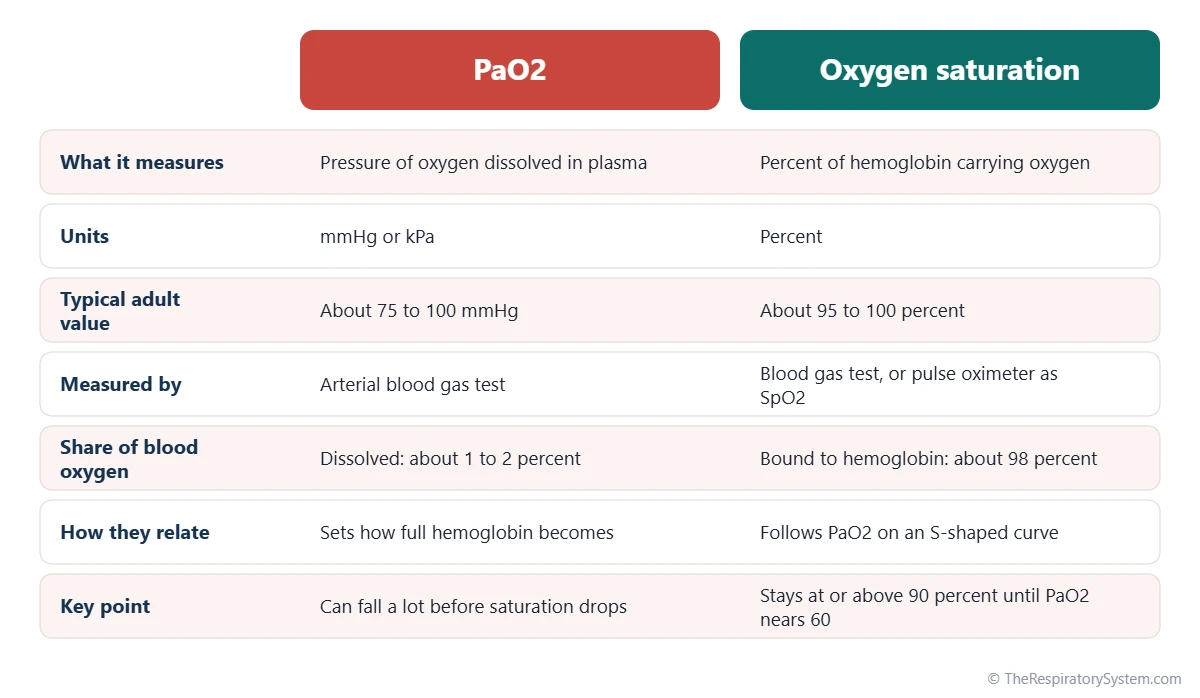
Partial pressure of oxygen (PaO2) measures the pressure of oxygen dissolved in arterial plasma, in mmHg, while oxygen saturation (SaO2, or SpO2 when measured with a pulse oximeter) measures the percentage of hemoglobin binding sites that carry oxygen. PaO2 is the cause and saturation is the result: the higher the PaO2, the more hemoglobin is loaded, up to nearly 100%.
The S-shaped link
The two values are linked by the oxygen-hemoglobin dissociation curve, which is S-shaped rather than straight. Typical points on the curve for normal adult blood are:
- PaO2 about 100 mmHg: saturation about 97 to 98%.
- PaO2 about 60 mmHg: saturation still about 90%.
- PaO2 about 40 mmHg: saturation about 75%, typical of venous blood at rest.
- PaO2 about 27 mmHg: saturation about 50%, a point called the P50.
Why the difference matters
Because the top of the curve is flat, PaO2 can fall from 100 to about 60 mmHg while saturation drops only from about 98% to about 90%. Below that point the curve is steep, and small further drops in PaO2 cause large falls in saturation. Saturation also says nothing about how much hemoglobin there is, so a person with anemia can have a normal PaO2 and saturation yet carry less oxygen in total. Our oxygen saturation page explains pulse oximetry.
How Do Altitude and Diving Change Partial Pressure?
Altitude lowers the partial pressure of oxygen because the total air pressure falls while oxygen stays at about 21% of the air, and diving raises it because the pressure of the surrounding water adds to the pressure of the breathing gas. In both cases the percentage of oxygen does not change; only the total pressure does.
High altitude
At about 5,500 meters (18,000 feet), air pressure is about half of its sea-level value, so inspired PO2 is roughly halved too. On the summit of Mount Everest, barometric pressure is about 253 mmHg, which gives an inspired PO2 of only about 43 mmHg after humidification. The body responds by breathing faster and deeper, which lowers PaCO2 and lets alveolar PO2 rise a little, as explained on breathing at high altitude.
Diving
Under water, every 10 meters (about 33 feet) of seawater adds roughly one more atmosphere of pressure. At 10 meters a diver breathing compressed air has about twice the sea-level partial pressure of every gas in it. High partial pressures of nitrogen can cause nitrogen narcosis, and very high partial pressures of oxygen can be toxic to the nervous system and lungs, which is why divers' breathing gases are planned around partial pressure rather than percentage.
How Is Partial Pressure Measured in the Body?
The partial pressures of oxygen and carbon dioxide in blood are measured with an arterial blood gas (ABG) test, in which a small sample of blood, usually from the radial artery at the wrist, is run through an analyzer within minutes. The same test reports pH and bicarbonate, giving a picture of both breathing and acid-base balance.
How the analyzer works
Blood gas analyzers use electrodes that respond to each gas. An oxygen electrode measures PO2 from the tiny electrical current produced as oxygen is reduced at its surface, while a carbon dioxide electrode measures PCO2 from the change in pH it causes in a thin layer of solution behind a gas-permeable membrane. Results are reported in mmHg in the United States and in kPa in many other countries.
Other measurements
- End-tidal CO2 (capnography) measures carbon dioxide at the end of each exhaled breath; in healthy lungs it is normally about 35 to 45 mmHg, a few mmHg below PaCO2.
- Venous blood gases are easier to collect and give a useful pH and PCO2, but venous PO2 does not reflect arterial oxygen.
- Transcutaneous monitors estimate PO2 and PCO2 through warmed skin, mainly in newborns.
- Pulse oximeters estimate saturation, not partial pressure, from the color of blood under the skin.
Common Conditions That Affect Blood Partial Pressures
A low PaO2 (hypoxemia), a high PaCO2 (hypercapnia) or a low PaCO2 (hypocapnia) can result from problems with the air breathed, the breathing drive, the airways, the alveoli or the blood flow through the lungs. Our respiratory diseases section covers these conditions, and anyone with breathing symptoms should see a doctor.
Five physiological causes of low PaO2
- Low inspired oxygen: as at high altitude.
- Hypoventilation: too little air reaches the alveoli, so PaCO2 rises and PaO2 falls together, as with oversedation or breathing muscle weakness.
- Ventilation-perfusion mismatch: air and blood do not reach the same parts of the lung, the most common cause, seen in COPD, asthma and pneumonia; see ventilation-perfusion ratio.
- Diffusion limitation: a thickened respiratory membrane, as in pulmonary fibrosis, slows oxygen transfer, especially during exercise.
- Shunt: blood passes through lung that gets no air at all, such as fully collapsed or fluid-filled alveoli.
A high PaCO2 usually means alveolar ventilation is too low, as in severe COPD or depressed breathing, while a low PaCO2 means breathing is faster or deeper than needed. The effects of low oxygen on the body are covered on our hypoxia and hypoxemia page.
Key Facts
- Partial pressure is the pressure contributed by one gas in a mixture, equal to its fraction times the total pressure (Dalton's law).
- At sea level, dry air has a PO2 of about 160 mmHg, inspired air in the trachea about 150 mmHg and alveolar air about 100 mmHg.
- Normal arterial PaO2 is about 75 to 100 mmHg, and normal PaCO2 is about 35 to 45 mmHg.
- Oxygen and carbon dioxide always diffuse from higher to lower partial pressure, which drives gas exchange in the lungs and tissues.
- PaCO2 rises and falls inversely with alveolar ventilation and is the main signal the brainstem uses to set breathing.
- PaO2 and saturation are linked by the S-shaped oxygen-hemoglobin dissociation curve; a PaO2 of about 60 mmHg still gives about 90% saturation.
- At high altitude the percentage of oxygen stays about 21%, but its partial pressure falls with the total air pressure.
Quick Quiz: Test What You Know About the Partial Pressure of Oxygen and Carbon Dioxide
6 questions. Tap an answer to check it.
Which law states that the total pressure of a gas mixture equals the sum of the partial pressures?
Dalton's law of partial pressures says each gas contributes to the total pressure in proportion to its share of the mixture.
What is the approximate partial pressure of oxygen in dry air at sea level?
Oxygen is about 21% of 760 mmHg, so its partial pressure is about 160 mmHg; 760 mmHg is the total air pressure.
What is a normal arterial PaCO2 in a healthy adult?
Normal PaCO2 is about 35 to 45 mmHg; 75 to 100 mmHg is the normal range for PaO2.
What does the lowercase a in PaO2 stand for?
A small a means arterial blood; a capital A, as in PAO2, means alveolar air.
At high altitude, what happens to the oxygen in the air?
The air is still about 21% oxygen, but the total pressure is lower, so the partial pressure of oxygen falls.
A PaO2 of about 60 mmHg corresponds to an oxygen saturation of about:
Because the top of the dissociation curve is flat, a PaO2 of about 60 mmHg still gives about 90% saturation.
Frequently Asked Questions
What is the difference between PaO2 and PAO2?
PAO2, with a capital A, is the partial pressure of oxygen in alveolar air, normally about 100 mmHg at sea level. PaO2, with a small a, is the partial pressure of oxygen in arterial blood, normally about 75 to 100 mmHg. The small gap between them, the A-a gradient, reflects blood that bypasses ventilated alveoli and uneven matching of air and blood flow.
Why is partial pressure measured in mmHg?
Millimeters of mercury come from the mercury barometer, which measures air pressure by how high it pushes a column of mercury; sea-level air supports about 760 mm. The unit stayed in medicine, especially in the United States, for blood pressure and blood gases. Many other countries report blood gases in kilopascals, where 1 kPa equals about 7.5 mmHg.
Does the percentage of oxygen in air change at high altitude?
No. Air contains about 21% oxygen from sea level to the top of the highest mountains. What changes is the total air pressure, which falls with height, so the partial pressure of oxygen falls in step with it. At about 5,500 meters the air pressure is roughly half of sea level, so each breath delivers roughly half the oxygen pressure.
What is the partial pressure of oxygen in venous blood?
Mixed venous blood returning to the right side of the heart has a PO2 of about 40 mmHg at rest, which corresponds to a hemoglobin saturation of about 75%. That means the tissues remove only about a quarter of the oxygen delivered at rest, leaving a large reserve that working muscles can draw on during exercise.
Does breathing pure oxygen raise PaO2?
Yes. Raising the fraction of oxygen in the inhaled gas raises its partial pressure in the alveoli and the arteries. At sea level, breathing 100% oxygen can raise PaO2 in healthy lungs to over 600 mmHg. Saturation, however, cannot rise much above 100%, so the extra oxygen is carried mainly dissolved in plasma, which is why oxygen content rises only modestly.
What is end-tidal CO2?
End-tidal CO2 is the partial pressure of carbon dioxide in the last part of an exhaled breath, measured breath by breath by a capnograph. Because that air comes from the alveoli, it closely tracks arterial PaCO2 in healthy lungs and is normally about 35 to 45 mmHg. It is widely used during anesthesia and in emergency care to follow breathing continuously.
Can PaO2 be normal when the blood carries too little oxygen?
Yes. PaO2 reflects only the dissolved oxygen, not how much hemoglobin is available to carry it. In anemia, PaO2 and saturation can both be normal while total oxygen content is low. In carbon monoxide poisoning, PaO2 can also be normal, because carbon monoxide occupies hemoglobin binding sites without changing the pressure of dissolved oxygen.
What does a low PaCO2 mean?
A low PaCO2, called hypocapnia, means a person is breathing more than needed to remove the carbon dioxide the body makes. It happens with hyperventilation from anxiety, pain or high altitude, and as a compensation when the blood is acidic for metabolic reasons. Low carbon dioxide makes the blood more alkaline and narrows blood vessels in the brain, which can cause lightheadedness.
Keep Exploring


