At a Glance
At high altitude the air still contains about 21 percent oxygen, but the total air pressure falls, so the partial pressure of oxygen in each breath drops: at about 5,500 meters (18,000 feet) it is roughly half the sea-level value. The carotid bodies sense the lower blood oxygen and drive faster, deeper breathing, which lowers blood carbon dioxide and causes respiratory alkalosis; over days to weeks the kidneys, blood and lungs adjust in a process called acclimatization.
- Main problem
- Lower air pressure, so a lower partial pressure of oxygen in every breath
- Oxygen percentage
- Unchanged, about 21 percent at every altitude
- First response
- Faster, deeper breathing driven by the carotid bodies
- Blood chemistry
- Low carbon dioxide and respiratory alkalosis, slowly corrected by the kidneys
- Long-term change
- More red blood cells and hemoglobin over several weeks
- Part of
- Respiratory physiology: control of breathing and gas exchange
On this page
- What Happens to Breathing at High Altitudes?
- Why Is It Harder to Breathe at High Altitudes?
- Partial Pressure of Oxygen vs Altitude: How Fast Does It Fall?
- How Does the Body Sense Low Oxygen at High Altitude?
- Why Does High Altitude Cause Respiratory Alkalosis?
- How Does the Body Acclimatize to Breathing at Higher Altitudes?
- What Are the High Altitude Effects on the Lungs and Pulmonary Circulation?
- What Does Breathing at High Altitude Feel Like?
- How Do People Who Live at High Altitude Breathe?
- Common Conditions Linked to High Altitude
- Key Facts
- Quiz
- FAQ
What Happens to Breathing at High Altitudes?
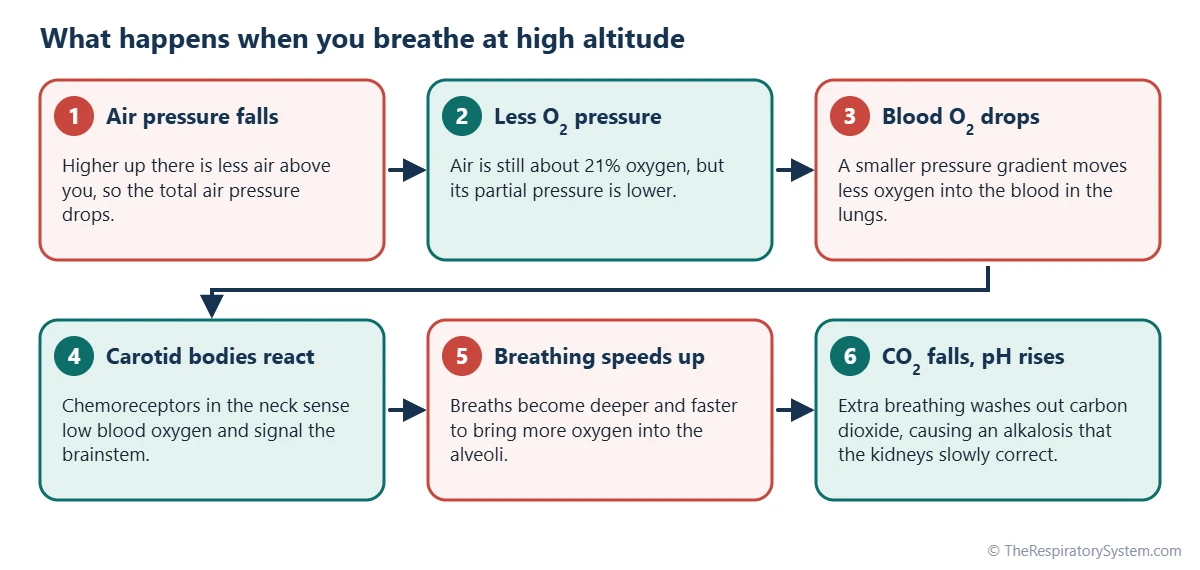
At high altitudes you breathe faster and more deeply, because each breath brings less oxygen pressure into the lungs and the body tries to make up for it with more air. This happens within minutes of arriving, before any other change in the body.
Physiologists usually divide altitude into bands. High altitude is about 1,500 to 3,500 meters (roughly 5,000 to 11,500 feet), very high altitude is 3,500 to 5,500 meters, and extreme altitude is anything above that. The effects on breathing grow steadily through these bands.
The response follows a clear chain:
- Lower air pressure means a lower partial pressure of oxygen in the air you inhale.
- Less oxygen moves across the alveolar wall during gas exchange, so blood oxygen falls.
- Sensors in the neck detect the drop and signal the brainstem.
- Breathing becomes deeper and faster, which raises oxygen but also blows off carbon dioxide.
- Over days and weeks, the kidneys, blood and blood vessels adjust so the body copes better.
This chain links almost every topic in breathing physiology, from partial pressure of gases to oxygen transport in the blood.
Why Is It Harder to Breathe at High Altitudes?
It is harder to breathe at high altitudes because there is less air pressure pushing oxygen into the lungs and blood, not because the air contains a smaller percentage of oxygen. Oxygen makes up about 21 percent of dry air everywhere in the lower atmosphere, at sea level and on the highest peaks.
Air pressure comes from the weight of the air above you. The higher you go, the less air is stacked overhead, so the total pressure falls. Because oxygen's share stays the same, its partial pressure, the part of the total pressure due to oxygen, falls in step. Gas diffusion depends on partial pressure, so a lower oxygen pressure in the alveoli means a weaker push of oxygen into the blood.
There is one more loss. Air is warmed and fully moistened as it enters the airways, and water vapor takes up a fixed pressure of about 47 mmHg at body temperature. At sea level that hardly matters, but at extreme altitude it takes a much bigger share of the shrinking total.
Explained simply: the air on a mountain is "thinner." Every breath you take holds fewer molecules of everything, including oxygen, so your lungs have to work harder to collect the same amount.
Partial Pressure of Oxygen vs Altitude: How Fast Does It Fall?
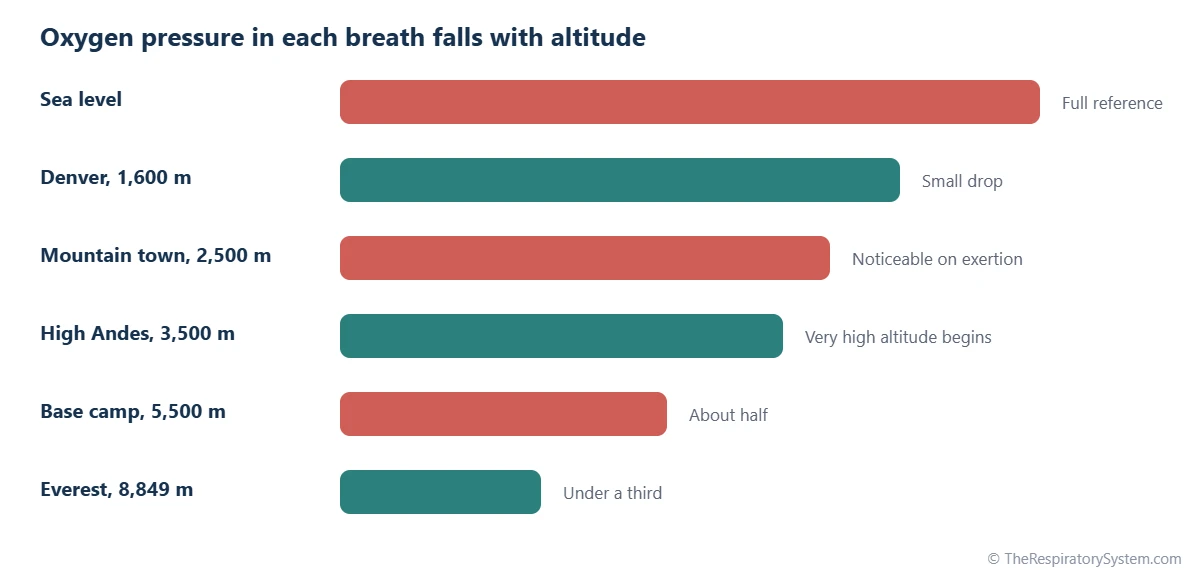
The partial pressure of oxygen falls by about half between sea level and roughly 5,500 meters (18,000 feet), and to under a third of its sea-level value at the summit of Mount Everest. The drop is gradual at first and is not a straight line, because air pressure falls in a curve with height.
What matters for the body is the oxygen pressure in the alveoli, which is lower again than in the inhaled air because the alveoli also hold carbon dioxide. The link between that pressure and the oxygen carried by hemoglobin is shown by the oxygen-hemoglobin dissociation curve. Its flat upper part means that at moderate altitude, blood oxygen saturation falls only a little. Once alveolar oxygen pressure drops toward about 60 mmHg, the curve becomes steep and saturation falls quickly.
This is why many people notice little at rest at moderate altitude, while the same small climb higher up can make a large difference.
| Altitude | Example | Air pressure (mmHg) | Inspired PO2 (mmHg) | What it means |
|---|---|---|---|---|
| Sea level | Coastal cities | About 760 | About 150 | Reference value for comparison |
| About 1,600 m (5,300 ft) | Denver, Colorado | About 625 | About 120 | Most people notice little at rest |
| About 2,500 m (8,200 ft) | Many mountain towns and ski areas | About 560 | About 105 | Breathlessness on exertion becomes common |
| About 3,500 m (11,500 ft) | Towns of the high Andes and Tibet | About 490 | About 95 | Start of very high altitude |
| About 5,500 m (18,000 ft) | High mountain base camps | About 380 | About 70 | Roughly half the sea-level value |
| 8,849 m (29,032 ft) | Summit of Mount Everest | About 250 | About 43 | Under a third of the sea-level value |
| Source: Typical values for the standard atmosphere, inspired air warmed and humidified at body temperature; our editors | ||||
How Does the Body Sense Low Oxygen at High Altitude?
The body senses low oxygen mainly through the carotid bodies, small clusters of sensor cells at the fork of each carotid artery in the neck. They are the most important of the peripheral respiratory chemoreceptors, and they fire faster when the oxygen pressure of arterial blood falls.
Their signals travel to the breathing centers in the brainstem, which increase the depth and rate of breathing. This is called the hypoxic ventilatory response, and it starts within seconds to minutes of exposure to low oxygen. The full picture of how these centers work is on our control of breathing page.
The central chemoreceptors in the medulla, which respond mainly to carbon dioxide and acidity rather than oxygen, act as a brake at first. As faster breathing lowers carbon dioxide, they reduce their drive, so the first rise in breathing is smaller than the oxygen sensors alone would produce. This brake is gradually released over the following days.
Why Does High Altitude Cause Respiratory Alkalosis?
High altitude causes respiratory alkalosis because the extra breathing removes carbon dioxide from the blood faster than the body produces it, and less carbon dioxide means less carbonic acid, so blood pH rises. This is a form of hyperventilation driven by low oxygen, not by anxiety.
The body corrects it in steps:
- Kidneys: over several days they excrete more bicarbonate in the urine, which brings blood pH back toward normal.
- Brain fluid: bicarbonate in the fluid around the brain also falls, so the central chemoreceptors stop braking breathing.
- Breathing: with the brake released, ventilation rises further. This slow climb over days is called ventilatory acclimatization.
The low carbon dioxide also affects how hemoglobin holds oxygen. Alkalosis shifts the dissociation curve to the left, helping hemoglobin load oxygen in the lungs, while a rise in a red-cell chemical called 2,3-BPG pushes it the other way and helps unloading in the tissues. These shifts relate to the Bohr effect and to how carbon dioxide transport links breathing to blood acidity.
How Does the Body Acclimatize to Breathing at Higher Altitudes?
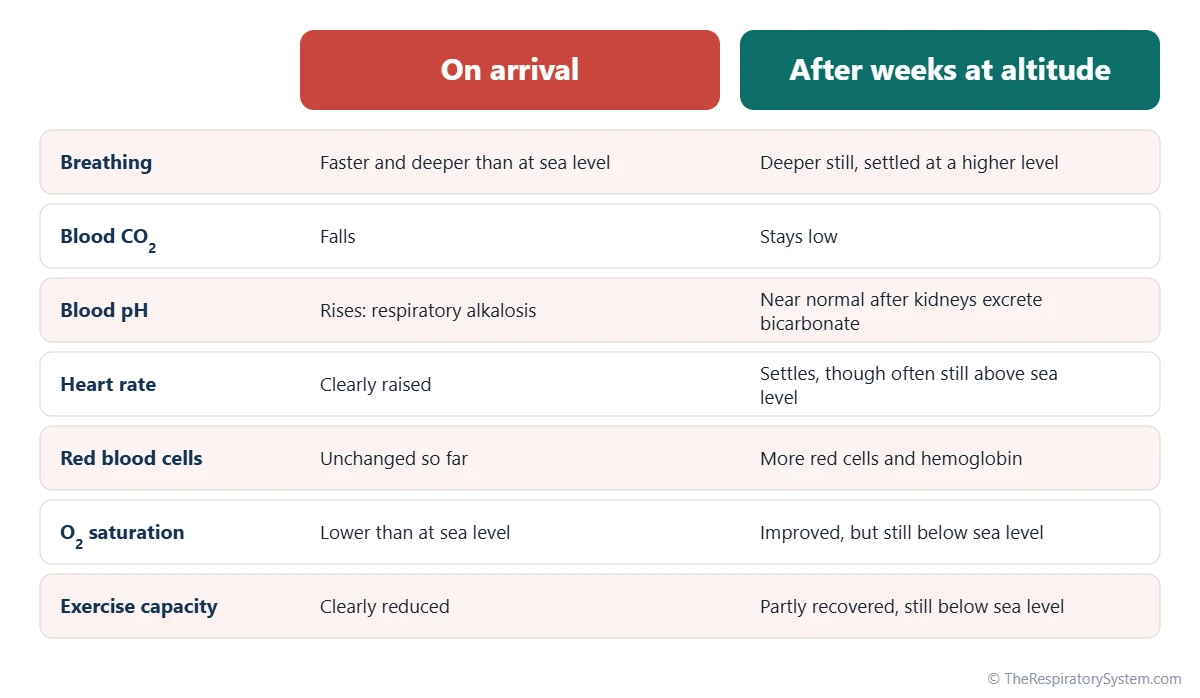
The body acclimatizes to higher altitudes through a sequence of changes in breathing, blood and blood vessels that unfold over minutes, days and weeks. Together they raise the amount of oxygen the blood can pick up and deliver, although they never fully restore sea-level performance.
Minutes to hours
Breathing and heart rate rise, and the heart pumps more blood each minute. The kidneys begin releasing more erythropoietin (EPO), the hormone that tells the bone marrow to make red blood cells.
Days
The kidneys correct the alkalosis, breathing climbs further, and the amount of 2,3-BPG in red blood cells increases. Plasma volume falls, which raises the concentration of hemoglobin in each liter of blood even before new cells appear.
Weeks
New red blood cells enter the circulation, so the total amount of hemoglobin increases and the blood can carry more oxygen. The step-by-step timeline is shown in the table below.
All of these changes are part of how the body keeps its internal balance, a theme explored on our respiratory system homeostasis page.
| When | What changes | Effect on oxygen supply |
|---|---|---|
| Seconds to minutes | Carotid bodies detect low arterial oxygen | Breathing becomes deeper and faster |
| Minutes | Heart rate and cardiac output rise | More oxygen delivered to the tissues each minute |
| Minutes to hours | Small pulmonary arteries constrict | Pressure in the pulmonary circulation rises |
| Hours | Kidneys release more erythropoietin (EPO) | Bone marrow starts making more red blood cells |
| First days | Kidneys excrete more bicarbonate | Blood pH returns toward normal and breathing rises further |
| First days | Plasma volume falls | Hemoglobin concentration in the blood rises |
| Days | More 2,3-BPG in red blood cells | Hemoglobin releases oxygen to the tissues more easily |
| Weeks | Total red blood cell mass increases | Blood can carry more oxygen |
| Source: Typical physiology, our editors | ||
What Are the High Altitude Effects on the Lungs and Pulmonary Circulation?
At high altitude the small arteries of the lungs constrict, the air reaching the lungs is colder and drier, and diffusion of oxygen becomes a limiting step during exercise. Each of these effects comes from the low oxygen pressure or the thin air.
In normal lungs, small arteries narrow in any region that has low oxygen, which sends blood toward better-ventilated areas and keeps the ventilation-perfusion ratio balanced. At altitude the whole lung has low oxygen, so this hypoxic pulmonary vasoconstriction happens everywhere at once, and the pressure in the pulmonary circulation rises.
Gas exchange also changes. At sea level, blood picks up its full load of oxygen in the first part of its short trip through a lung capillary. At altitude the pressure gradient across the respiratory membrane is smaller, so loading is slower, and during hard exercise the blood may leave the capillary before it is fully loaded.
The thin air has one advantage: it is less dense, so it flows through the airways with less resistance. On the other hand, cold, dry mountain air draws more water from the airway lining with every breath.
What Does Breathing at High Altitude Feel Like?
Breathing at high altitude feels like being out of breath more easily: climbing stairs or walking uphill makes you pant sooner, and even at rest you may notice deeper, faster breaths. Many people also feel the dry air in the throat and nose.
Exercise is affected most. The body's maximum oxygen uptake falls as altitude rises, so the same effort takes a bigger share of a person's capacity, as explained on our page on how exercise affects the respiratory system.
Sleep can feel different too. Many visitors to high altitude develop periodic breathing at night, a cycle in which breaths grow deeper, then shallower, then pause briefly before starting again. It happens because the low carbon dioxide and the sensitive oxygen sensors make the breathing control loop overshoot. This pattern is one of the breathing patterns doctors recognize, and it usually lessens as the body acclimatizes.
How Do People Who Live at High Altitude Breathe?
People whose families have lived at high altitude for many generations, such as Andean, Tibetan and Ethiopian highlanders, breathe and carry oxygen in ways that differ from lowland visitors. Their adaptations are inherited, not only acquired during a stay.
- Andean highlanders tend to have higher hemoglobin levels and large chests with big lung volumes.
- Tibetan highlanders tend to breathe more air at rest and keep hemoglobin closer to sea-level values, and many carry gene variants, such as one in the EPAS1 gene, that limit the rise in red blood cells.
- Ethiopian highlanders show yet another pattern, which suggests that human populations solved the same problem in different ways.
Animals offer more examples. Llamas have hemoglobin that binds oxygen especially well, and some geese fly over the highest mountains, helped by hemoglobin that grips oxygen tightly and the efficient one-way airflow of the bird respiratory system, part of the wide range of respiration in animals.
Common Conditions Linked to High Altitude
The main altitude-related conditions are acute mountain sickness, high-altitude pulmonary edema and high-altitude cerebral edema, all caused by low oxygen when the body has not yet adapted. They are described here only to show how they relate to breathing physiology.
- Acute mountain sickness is the most common form, a general reaction to hypoxia in the first days at altitude.
- High-altitude pulmonary edema (HAPE) is fluid leaking into the air spaces of the lungs, linked to uneven, very high pressure in the pulmonary arteries.
- High-altitude cerebral edema (HACE) is swelling of the brain, the most serious of the three.
These conditions are covered with other lung problems on our respiratory diseases page. Breathing problems or feeling unwell at altitude are a reason to see a doctor.
Key Facts
- Air is about 21 percent oxygen at every altitude; what falls is the total air pressure and so the partial pressure of oxygen.
- At about 5,500 meters (18,000 feet) the oxygen pressure of each breath is roughly half the sea-level value.
- The carotid bodies are the main oxygen sensors that drive faster breathing at altitude, as described on our respiratory chemoreceptors page.
- Extra breathing lowers blood carbon dioxide and causes respiratory alkalosis, which the kidneys correct over several days.
- Low oxygen makes the small arteries of the whole lung constrict, raising pressure in the pulmonary circulation.
- Red blood cell production rises over weeks, driven by erythropoietin from the kidneys.
- Periodic breathing during sleep is common at high altitude and usually lessens with acclimatization.
Quick Quiz: Test What You Know About the Breathing at High Altitude
6 questions. Tap an answer to check it.
What stays the same as you climb to high altitude?
Air is about 21 percent oxygen at every altitude. The total pressure falls, so the partial pressure of oxygen falls with it.
Which sensors detect low blood oxygen and drive faster breathing at altitude?
The carotid bodies are peripheral chemoreceptors that respond to low arterial oxygen. The central chemoreceptors respond mainly to carbon dioxide and acidity.
Why does blood pH rise during the first days at high altitude?
Faster, deeper breathing removes carbon dioxide, so less carbonic acid forms and the blood becomes more alkaline. This is respiratory alkalosis.
Which organ releases erythropoietin (EPO) in response to low oxygen?
The kidneys release EPO, which signals the bone marrow to make more red blood cells over the following weeks.
How do the small pulmonary arteries respond to the low oxygen of high altitude?
Hypoxic pulmonary vasoconstriction narrows the small lung arteries. At altitude this happens throughout the lungs, so pulmonary artery pressure rises.
At about 5,500 meters, the oxygen pressure of each breath is roughly what fraction of the sea-level value?
Air pressure at about 5,500 meters is close to half of sea-level pressure, so the oxygen pressure of each breath is roughly halved.
Frequently Asked Questions
At what altitude does breathing become harder?
Most people start to notice the change during exercise somewhere between about 1,500 and 2,500 meters (5,000 to 8,200 feet), the range physiologists call high altitude. Above about 3,500 meters, very high altitude, breathlessness on exertion is almost universal, and above 5,500 meters, extreme altitude, the body cannot fully adapt for long periods.
Is there less oxygen in the air at high altitude?
The proportion of oxygen is the same, about 21 percent, but each liter of mountain air contains fewer molecules of every gas because the air is at lower pressure. So with each breath you take in fewer oxygen molecules, and they are pushed into the blood with less pressure. That is what people mean when they call mountain air thin.
What helps breathing at high altitudes?
From a physiology point of view, the main thing that helps is time. Over days and weeks the body raises its breathing, corrects its blood pH, increases red blood cells and adjusts its blood vessels. These steps of acclimatization restore much, though never all, of the ability to take up oxygen that was lost on arrival at altitude.
Why do people breathe irregularly when sleeping at high altitude?
At altitude the oxygen sensors are very active while carbon dioxide is low. During sleep this makes the breathing control loop unstable: a few deep breaths lower carbon dioxide so much that breathing pauses, then oxygen falls and breathing restarts strongly. The result is periodic breathing, a waxing and waning pattern that usually eases as acclimatization progresses.
Why do you lose more water at high altitude?
Mountain air is usually cold and dry, and the airways must warm and moisten every breath, so each exhaled breath carries away water. Faster breathing at altitude increases this loss. In addition, as the kidneys excrete bicarbonate to correct the alkalosis, they also pass more urine in the first days, a change known as altitude diuresis.
Is an airplane cabin like being at high altitude?
Yes, to a moderate degree. Airliner cabins are pressurized, but not to sea level; US rules allow a cabin altitude of up to 8,000 feet (about 2,400 meters). Passengers therefore breathe air with a lower oxygen pressure than at sea level, similar to a mountain town, and their blood oxygen saturation is slightly lower during the flight.
Can people live permanently at high altitude?
Yes. Millions of people live permanently at high altitude in the Andes, the Tibetan Plateau and the Ethiopian Highlands, and some towns lie above 4,000 meters. Populations that have lived there for many generations carry inherited adaptations in breathing and oxygen transport that help them thrive where lowland visitors struggle.
Does high altitude affect the lungs of children differently?
Children go through the same basic responses as adults: faster breathing, lower blood oxygen and gradual acclimatization. Children born and raised at high altitude may also develop larger lung volumes and chests, which shows that growing up in thin air shapes the lungs as they develop, as outlined on our respiratory system development page.
Keep Exploring


