At a Glance
Vital capacity (VC) is the maximum amount of air that can be exhaled after a maximal inhalation. It is calculated as VC = IRV + TV + ERV, or as total lung capacity minus residual volume. Typical textbook values are about 4.8 liters in a young adult man and about 3.1 liters in a young adult woman, measured in liters with a spirometer.
- Definition
- The most air that can be breathed out after the deepest breath in
- Formula
- IRV + TV + ERV, or total lung capacity minus residual volume
- Typical adult value
- About 4.8 L in young adult men, about 3.1 L in young adult women
- Measured in
- Liters (or milliliters), with a spirometer
- Does not include
- Residual volume, the air that always stays in the lungs
- Part of
- Lung volumes and capacities; standard lung function tests
On this page
- What Is Vital Capacity?
- What Is the Vital Capacity Formula?
- What Is the Vital Capacity of the Lungs in a Healthy Adult?
- What Is Vital Capacity Measured In?
- What Is the Function of Vital Capacity?
- What Affects Vital Capacity?
- Vital Capacity vs Total Lung Capacity and Forced Vital Capacity
- Common Conditions That Affect Vital Capacity
- Key Facts
- Quiz
- FAQ
What Is Vital Capacity?
Vital capacity is the greatest amount of air that can be moved out of the lungs in one breath, measured from the fullest possible inhalation to the most complete possible exhalation. It shows the usable range of the lungs and chest together, and it is one of the four standard capacities described in our overview of lung volumes and capacities.
Vital capacity definition in anatomy
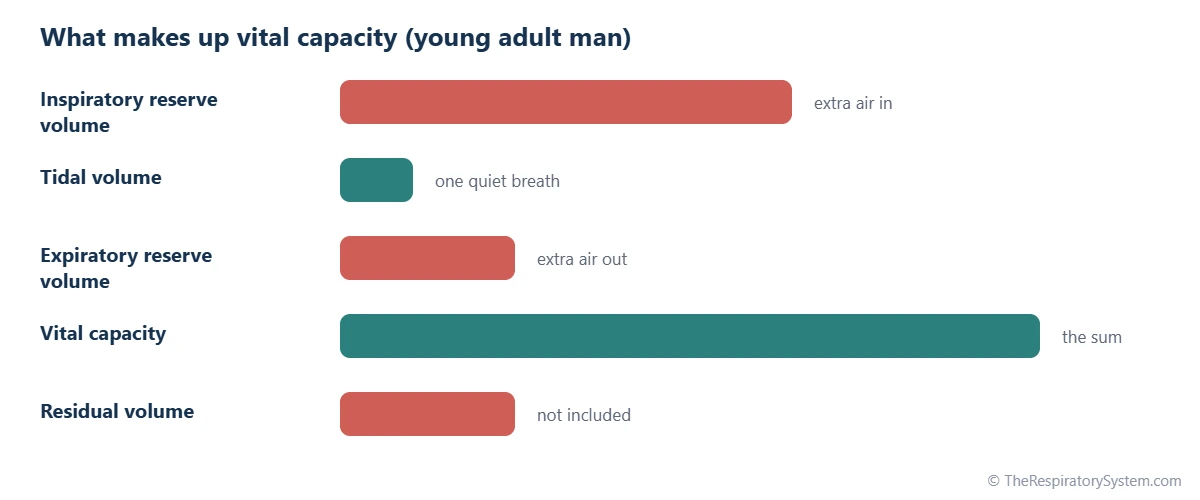
In anatomy and physiology, vital capacity is defined as the sum of three lung volumes: the inspiratory reserve volume, the tidal volume and the expiratory reserve volume. It does not include the residual volume, the air that stays in the alveoli and airways even after the hardest exhalation. Because it depends on the lungs, the rib cage and the breathing muscles at once, it measures the whole breathing apparatus rather than any one organ.
How school biology defines it
High school and NCERT biology textbooks describe vital capacity in two equivalent ways: the most air a person can breathe in after a forced exhalation, or the most air a person can breathe out after a forced inhalation. Both describe the same range, from completely full to as empty as the lungs can be made. Those courses also list it as expiratory reserve volume plus tidal volume plus inspiratory reserve volume.
Explained simply
Think of the lungs as a balloon inside a box that can never be squeezed totally flat. Vital capacity is the amount of air the balloon can take in from its emptiest to its fullest. The small bit of air that can never be pushed out, the residual volume, keeps the balloon from collapsing completely.
What Is the Vital Capacity Formula?
The vital capacity formula is VC = IRV + TV + ERV: inspiratory reserve volume plus tidal volume plus expiratory reserve volume. Because these three volumes lie end to end, the formula can be written in three equivalent ways.
- VC = IRV + TV + ERV, adding the three volumes that can be moved by breathing.
- VC = IC + ERV, where the inspiratory capacity (IC) is tidal volume plus inspiratory reserve volume.
- VC = TLC - RV, total lung capacity minus the residual volume that cannot be breathed out.
Worked example
Using standard textbook values for a young adult man, an inspiratory reserve volume of about 3,100 mL, a tidal volume of about 500 mL and an expiratory reserve volume of about 1,200 mL give a vital capacity of 3,100 + 500 + 1,200 = 4,800 mL, or 4.8 liters. For a young adult woman, about 1,900 + 500 + 700 = 3,100 mL. Checking the other route, a total lung capacity of 6,000 mL minus a residual volume of 1,200 mL also gives 4,800 mL.
Why residual volume is left out
Residual volume is left out because no breath can move it. The chest wall cannot shrink past a certain point, and the smallest airways close before the alveoli empty, trapping the last 1 to 1.2 liters of air. That trapped air keeps the alveoli from collapsing and keeps gas exchange going between breaths, so it matters to the body even though it never enters or leaves.
| Volume or capacity | What it is | Young adult man | Young adult woman |
|---|---|---|---|
| Tidal volume (TV) | Air moved in one quiet breath | About 500 mL | About 500 mL |
| Inspiratory reserve volume (IRV) | Extra air breathed in after a normal inhalation | About 3,100 mL | About 1,900 mL |
| Expiratory reserve volume (ERV) | Extra air pushed out after a normal exhalation | About 1,200 mL | About 700 mL |
| Residual volume (RV) | Air left in the lungs after the fullest exhalation | About 1,200 mL | About 1,100 mL |
| Vital capacity (VC = IRV + TV + ERV) | Most air that can be breathed out after the deepest breath in | About 4,800 mL | About 3,100 mL |
| Inspiratory capacity (IC = TV + IRV) | Most air that can be breathed in from the resting level | About 3,600 mL | About 2,400 mL |
| Functional residual capacity (FRC = ERV + RV) | Air left in the lungs after a quiet exhalation | About 2,400 mL | About 1,800 mL |
| Total lung capacity (TLC = VC + RV) | All the air in the lungs after the deepest breath in | About 6,000 mL | About 4,200 mL |
| Source: Typical young adult values from standard physiology textbooks, our editors | |||
What Is the Vital Capacity of the Lungs in a Healthy Adult?
The vital capacity of the lungs in a healthy young adult is typically about 4 to 5 liters in men and about 3 to 4 liters in women, with textbook averages of about 4.8 and 3.1 liters. Individual values vary widely, so a result is judged against a predicted value for the same age, height and sex rather than against a single number.
Predicted values
Predicted vital capacity comes from reference equations built from measurements of large groups of healthy, non-smoking people. The equations use age, height and sex, and they produce both an average value and a lower limit of normal, the level below which only about 5% of healthy people fall. Results are often reported as a percent of predicted; a value of about 80% of predicted or more has long been treated as within the normal range, although modern reports prefer the lower limit of normal.
Peak and decline
Vital capacity grows through childhood and the teenage years with the size of the chest, reaches its highest level in the early to mid-20s, and then declines slowly for the rest of life. The decline comes from stiffening of the rib cage, a gradual loss of elastic recoil in the lungs and some weakening of the muscles of respiration. At the same time residual volume rises, so total lung capacity changes much less than vital capacity does.
What Is Vital Capacity Measured In?
Vital capacity is measured in liters, or sometimes milliliters, of air, and it is recorded with a spirometer during a lung function test. Volumes are corrected to body conditions, meaning body temperature and full humidity, because air expands as it warms inside the chest.
How the test is done
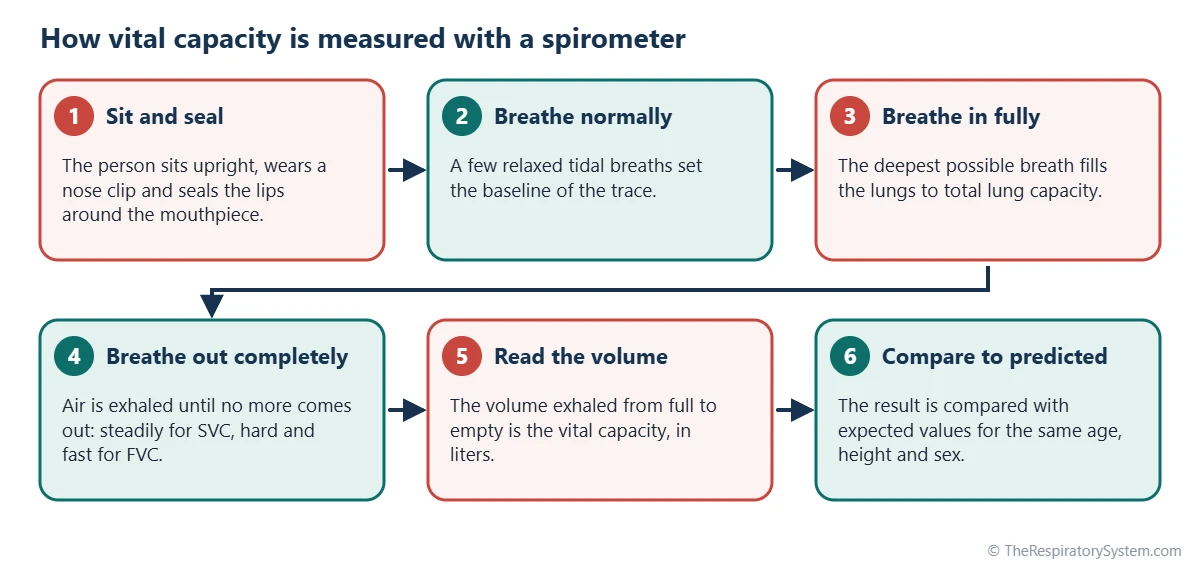
For the test, the person sits upright, wears a nose clip and seals the lips around a mouthpiece connected to the spirometer. After a few normal breaths, they breathe in as deeply as possible and then breathe out until no more air will come. The test is repeated to make sure the results agree, and the best values are kept. Our spirometry page explains the trace, called a spirogram, in detail.
Slow and forced vital capacity
There are two versions of the test. In slow vital capacity (SVC), the person breathes out steadily at a relaxed pace. In forced vital capacity (FVC), the person blows out as hard and fast as possible, and the machine also records how much air leaves in the first second, the FEV1. In healthy lungs the two values are nearly the same, but in narrowed airways the forced value is often smaller, because fast exhalation squeezes the airways shut and traps air.
What Is the Function of Vital Capacity?
Vital capacity has no single job of its own; it is the full working range of breathing, and its function is to provide the reserve that lets ventilation rise far above the resting level. A quiet breath uses only about a tenth of it, so the rest is available whenever the body needs more air.
Room for exercise
During hard exercise, tidal volume can grow to around half of the vital capacity, while the breathing rate also climbs. A larger vital capacity therefore means more room to deepen each breath before the breathing rate has to carry the extra load. The effect of training on this reserve is described on how exercise affects the respiratory system.
Coughing, speech and singing
An effective cough starts with a deep breath in, so a cough needs a good share of the vital capacity to build enough pressure and airflow to clear mucus. Long sentences, shouting and singing also draw on the reserve, since the vocal cords are powered by a steady flow of exhaled air.
A window on lung health
Because it depends on the lungs, the chest wall, the breathing muscles and the nerves that drive them, vital capacity is a simple overall test of the breathing system. A reduced value does not say which part is affected, but it shows that the usable range has shrunk, and doctors then use other tests to find out why.
What Affects Vital Capacity?
Vital capacity is affected mainly by body size, age and sex, and to a lesser degree by posture, fitness, the environment people grow up in and health conditions of the lungs and chest. Height is the strongest single predictor, because taller people have longer chests and larger lungs.
- Height: vital capacity rises steadily with standing height in both sexes.
- Sex: at the same height, men have larger lungs and a larger vital capacity on average than women.
- Age: it peaks in early adulthood and declines slowly after that.
- Posture: it is a little larger sitting or standing than lying flat, because lying down lets the abdominal organs push the diaphragm upward and draws more blood into the chest.
- Fitness and sport: some athletes, especially swimmers, have above-average values, partly because of body build; in adults, training changes vital capacity only modestly.
- Altitude: people born and raised at high altitude tend to have larger lungs for their size, an adaptation described on breathing at high altitude.
- Pregnancy: vital capacity stays about the same, because the rib cage widens while the diaphragm is pushed upward.
- Body weight: severe obesity lowers vital capacity by limiting how far the chest and diaphragm can move.
Vital Capacity vs Total Lung Capacity and Forced Vital Capacity
Vital capacity differs from total lung capacity by the residual volume: total lung capacity is all the air the lungs hold when full, about 6 liters in a young adult man, while vital capacity is only the part of it that can be breathed out, about 4.8 liters.
Total lung capacity
Total lung capacity (TLC) equals vital capacity plus residual volume. A spirometer cannot measure TLC on its own, because it only records air that moves in and out; the trapped residual air has to be measured with body plethysmography or a gas dilution test. When people talk loosely about "lung capacity," they usually mean vital capacity, the part that can actually be measured with a mouthpiece.
Forced vital capacity and FEV1
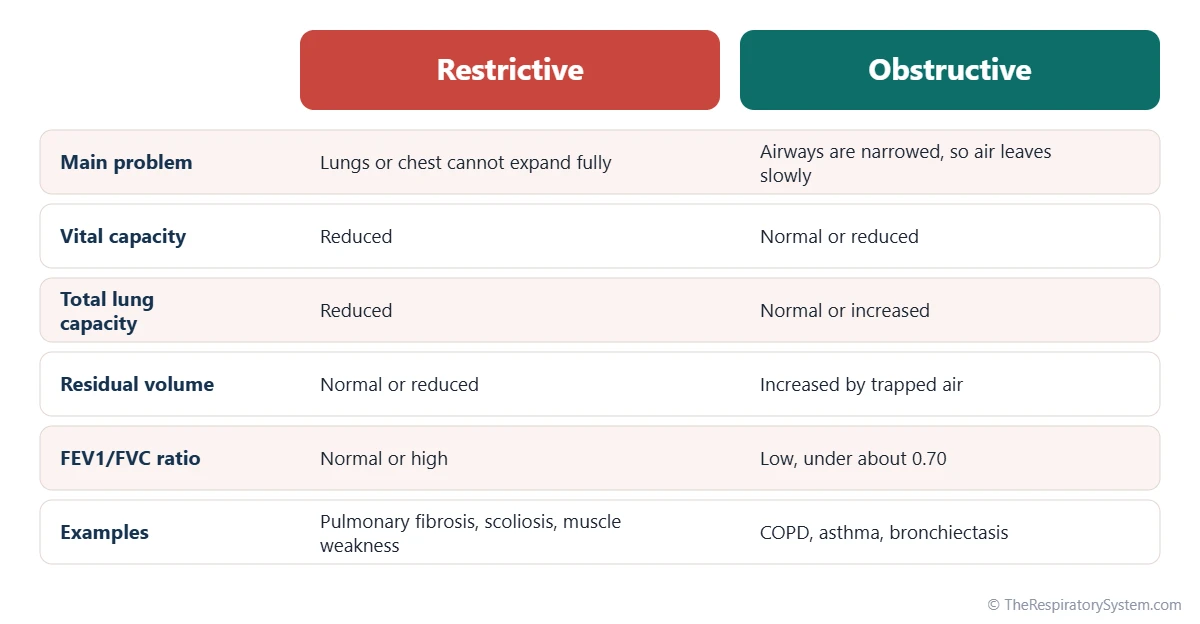
Forced vital capacity is the vital capacity blown out as hard as possible, and the FEV1 is the share of it that leaves in the first second. Healthy young adults blow out about 75 to 85% of their FVC in that first second, so the FEV1/FVC ratio is about 0.75 to 0.85. A ratio below about 0.70 in an adult points to airway narrowing, while a low FVC with a normal or high ratio points to lungs or a chest that cannot expand fully.
Inspiratory capacity
Inspiratory capacity is the part of the vital capacity above the resting level: tidal volume plus inspiratory reserve volume, about 3.6 liters in a young man. The rest of the vital capacity, the expiratory reserve volume, lies below the resting level, the functional residual capacity.
Common Conditions That Affect Vital Capacity
Vital capacity falls in conditions that stop the lungs or chest from expanding fully, called restrictive conditions, and it can also fall in airway diseases that trap air, called obstructive conditions. Our respiratory diseases section explains these in more depth, and anyone with breathing symptoms should see a doctor.
- Pulmonary fibrosis: scar tissue makes the lungs stiff, so they cannot fill as far, and vital capacity and total lung capacity both fall.
- Chest wall problems: a severe curve of the spine (scoliosis), a rigid rib cage or severe obesity limit how far the chest can move.
- Neuromuscular conditions: weakness of the diaphragm and chest muscles, as in some nerve and muscle diseases, lowers vital capacity, so it is often tracked over time to follow breathing muscle strength.
- Pleural conditions: fluid in a pleural effusion or air in a pneumothorax takes up space that the lung would otherwise fill.
- COPD and asthma: narrowed airways close early during exhalation, trapping air, so residual volume rises and vital capacity can fall even though total lung capacity may be normal or high.
The two patterns are compared in the diagram below and in more detail on obstructive vs restrictive lung disease.
Key Facts
- Vital capacity is the most air that can be breathed out after the deepest possible breath in.
- The vital capacity formula is VC = IRV + TV + ERV, which also equals total lung capacity minus residual volume.
- Typical textbook values are about 4.8 liters in a young adult man and about 3.1 liters in a young adult woman.
- A quiet tidal volume of about 500 mL uses only about a tenth of the vital capacity.
- Vital capacity is measured in liters with a spirometer, as described on our spirometry page.
- Height, age and sex are the main predictors; vital capacity peaks in the early to mid-20s and then slowly declines.
- Restrictive conditions such as pulmonary fibrosis lower vital capacity by stopping the lungs from expanding fully.
Quick Quiz: Test What You Know About the Vital Capacity
6 questions. Tap an answer to check it.
Which formula gives vital capacity?
Vital capacity is the sum of inspiratory reserve volume, tidal volume and expiratory reserve volume.
Which lung volume is NOT part of vital capacity?
Residual volume can never be breathed out, so it is part of total lung capacity but not of vital capacity.
What is a typical vital capacity for a young adult man?
Standard textbook values give about 4.8 L for a young adult man and about 3.1 L for a young adult woman.
Which instrument is used to measure vital capacity?
A spirometer records the volume of air breathed in and out through a mouthpiece.
Which factor is the strongest predictor of vital capacity?
Taller people have larger chests and lungs, so height is the strongest single predictor, along with age and sex.
In a restrictive condition such as pulmonary fibrosis, vital capacity is usually:
Stiff lungs cannot expand fully, so vital capacity and total lung capacity both fall.
Frequently Asked Questions
What is a good vital capacity?
There is no single good number, because vital capacity depends on age, height and sex. A result is judged against the predicted value for a person of the same build. Values at or above the lower limit of normal, the level that only about 5% of healthy people fall below, are considered within the normal range; older reports used about 80% of predicted instead. A tall young man and a short older woman can both be normal with very different results.
Can vital capacity be increased?
In adults, vital capacity is set mostly by body size, sex and age, and regular training changes it only modestly. Exercise mainly makes the breathing muscles stronger and more efficient at using the existing reserve. Children who grow taller gain vital capacity as their chests enlarge, and some athletes, such as swimmers, have above-average values partly because of their body build.
Why is vital capacity lower in women?
Women have a smaller vital capacity on average mainly because they are, on average, shorter and have a smaller chest. Even at the same height, women's lungs tend to be slightly smaller than men's, with smaller airways. Reference equations therefore give separate predicted values for men and women, so a lower number does not mean weaker lungs once size is taken into account.
Is vital capacity the same as lung capacity?
Not exactly. In everyday speech, lung capacity usually means vital capacity, the amount of air that can be blown out after a full breath. In physiology, total lung capacity is larger: it adds the residual volume, about 1 to 1.2 liters, that always stays in the lungs. So total lung capacity is about 6 liters in a young man, while his vital capacity is about 4.8 liters.
Does smoking affect vital capacity?
Yes, over time. Long-term smoking damages the airways and the alveolar walls, which speeds up the normal decline of lung function with age. The FEV1 usually falls first, as the airways narrow, and as air becomes trapped behind them, residual volume rises and vital capacity can fall. Quitting slows the rate of decline back toward that of non-smokers.
How does vital capacity change with age?
Vital capacity rises through childhood as the chest grows, peaks in the early to mid-20s and then falls slowly each year. The decline comes from a stiffer rib cage, lungs with less elastic recoil and slightly weaker breathing muscles. Total lung capacity changes little, because the air that can no longer be breathed out simply adds to the residual volume.
Why is vital capacity lower when lying down?
When a person lies flat, the abdominal organs press up against the diaphragm, so the lungs cannot expand downward as far. More blood also pools in the chest, taking up a little space that air would otherwise fill. Together these effects make vital capacity slightly smaller lying down than sitting or standing, which is why the test is usually done sitting upright.
What is the difference between FVC and slow vital capacity?
Both measure the air exhaled from a full breath in to a complete breath out. In slow vital capacity the air is breathed out steadily, while in forced vital capacity it is blown out as hard and fast as possible. In healthy lungs they are almost equal, but with narrowed airways the forced value is often lower, because fast exhalation squeezes the airways and traps air.
Keep Exploring


