At a Glance
The cough reflex is a protective reflex that clears the larynx, trachea and large bronchi. Sensory receptors in the airway lining detect irritants and send signals mainly through the vagus nerve to the medulla of the brainstem, which triggers three stages: a deep breath in, a compression stage with the glottis closed and pressure building in the chest, and an explosive breath out when the glottis suddenly opens. The carina, where the trachea divides, is one of its most sensitive trigger points.
- Type
- Protective airway reflex that can also be started or held back voluntarily
- Trigger sites
- Larynx, trachea, carina and large bronchi; also the ear canal and pharynx
- Sensory nerve
- Vagus nerve (cranial nerve X), including the superior and recurrent laryngeal branches
- Control center
- Medulla oblongata of the brainstem, starting in the nucleus tractus solitarius
- Muscles used
- Diaphragm, intercostals, abdominal muscles and laryngeal muscles
- Stages
- Inspiratory, compressive and expulsive
On this page
- What Is the Cough Reflex?
- Where Does the Cough Reflex Originate?
- What Is the Cough Reflex Pathway?
- What Are the Stages of the Cough Reflex?
- How Does a Cough Clear the Airways?
- Can You Control the Cough Reflex?
- Cough Reflex vs Gag Reflex: What Is the Difference?
- Common Conditions That Affect the Cough Reflex
- Key Facts
- Quiz
- FAQ
What Is the Cough Reflex?
The cough reflex is an automatic, protective sequence in which the body detects something irritating in the airways and expels it with a sudden, forceful breath out. It keeps the larynx, trachea and large bronchi clear of mucus, dust, food, fluids and microbes, and it is one of the most important ways the lungs protect themselves.
Reflex and voluntary at the same time
Most reflexes, such as the knee-jerk, cannot be started on purpose. Coughing is unusual because it can be triggered in two ways: as a true reflex, when receptors in the airway are irritated, and as a voluntary act, when a person decides to clear the throat or cough. The two share the same muscles and the same brainstem circuits, but the voluntary version starts in the cerebral cortex.
Why the body needs a cough
The airways already have a constant cleaning system, the mucociliary escalator, in which beating cilia carry a sheet of mucus up toward the throat, as described on our cilia and mucus page. Coughing is the backup. It takes over when too much mucus builds up, when the cilia are damaged, or when something enters the airway suddenly, such as a crumb or a drop of water that goes down the wrong way.
Explained simply
Think of the windpipe as a hallway with a door at the top, the glottis. When something is stuck inside, the body first takes a big breath to fill the hallway with air, then shuts the door and squeezes hard. When the door bursts open, the rush of air blows the unwanted thing up and out, like a puff that sends dust flying off a table.
Where Does the Cough Reflex Originate?
The cough reflex originates in sensory nerve endings in the lining of the larynx, trachea and large bronchi, with the greatest sensitivity at the larynx and at the carina, the ridge where the trachea divides into the two main bronchi. Smaller airways have far fewer cough receptors, and the alveoli have none.
Main trigger sites
- Larynx: the most sensitive site; touching the area around the vocal cords triggers an immediate, strong cough.
- Trachea and carina: the lining of the windpipe, and especially the carina, responds strongly to mechanical irritation.
- Large bronchi: receptors are concentrated at the points where the airways branch, where inhaled particles tend to land.
- Other sites: the pharynx, the external ear canal, the pleura and the esophagus can also trigger coughing through nerves that share connections with the vagus nerve.
Types of cough receptors
Two broad groups of sensory nerve fibers start a cough. Mechanically sensitive fibers respond within milliseconds to touch, particles and mucus moving across the airway lining, and they are best placed to catch objects that are breathed in. Chemically sensitive fibers, including slow C-fibers, respond to substances such as acid, smoke, cold air and chemicals released during inflammation. Inflammation can make both groups more sensitive, which is why the airways feel irritable during and after a cold.
The ear cough reflex
A small branch of the vagus nerve, often called Arnold's nerve, supplies part of the external ear canal. In some people, touching the ear canal, for example during an ear examination, sets off a brief cough. This shows how widely the vagus nerve's sensory network spreads beyond the lungs.
What Is the Cough Reflex Pathway?
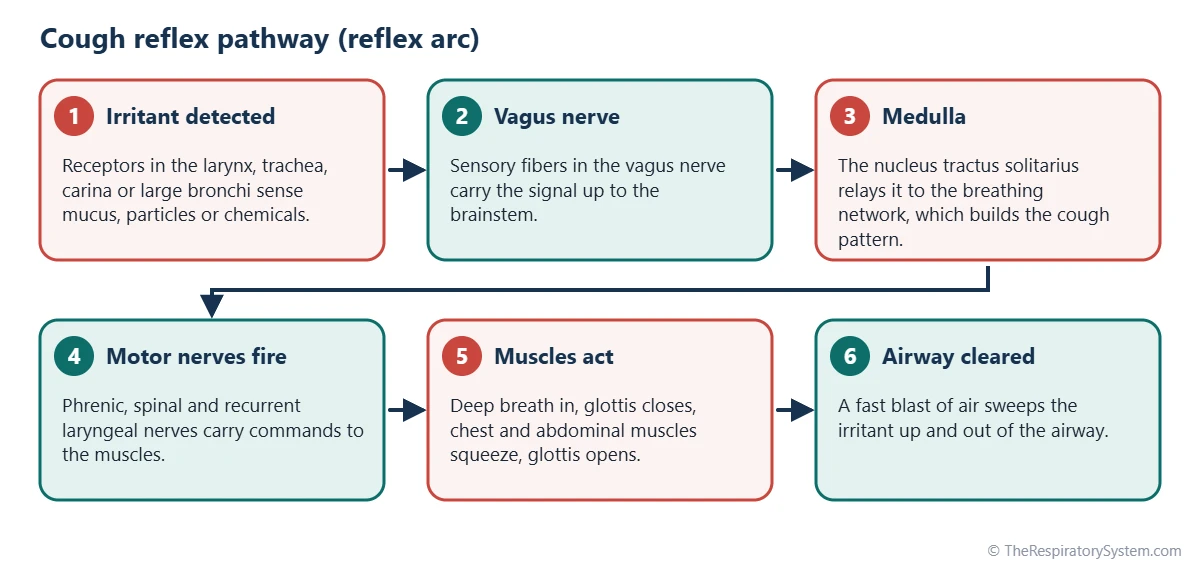
The cough reflex pathway is a reflex arc of five parts: airway receptors detect the irritant, sensory fibers in the vagus nerve carry the signal to the medulla, brainstem circuits generate the cough pattern, motor nerves carry commands to the breathing and laryngeal muscles, and those muscles produce the cough.
Cough reflex pathway nerves
The sensory (afferent) limb runs almost entirely in the vagus nerve, the tenth cranial nerve. Signals from the larynx above the vocal cords travel in the internal branch of the superior laryngeal nerve, while those from below the vocal cords and from the trachea travel in the recurrent laryngeal nerve, and those from the bronchi travel in the pulmonary branches of the vagus. The cell bodies of these sensory neurons sit in the nodose and jugular ganglia, just below the skull. The glossopharyngeal nerve carries signals from the pharynx.
The brainstem center
The vagal fibers end in the nucleus tractus solitarius, a relay station in the medulla oblongata. From there, signals pass to the brainstem's breathing network, the same groups of neurons that set the normal rhythm described on our control of breathing page. These neurons reorganize their usual rhythm into the cough pattern: a deep breath, a hold and a blast. Higher brain regions also receive the signal, producing the conscious urge to cough.
The motor limb
The motor (efferent) limb uses several nerves at once. The phrenic nerve drives the diaphragm during the deep breath in. Spinal nerves activate the intercostal muscles and the abdominal muscles that create the pressure. The recurrent laryngeal nerve closes and then opens the glottis, and vagal fibers to the airways can narrow the bronchi slightly and increase mucus secretion.
| Part of the arc | Structure | Role |
|---|---|---|
| Receptors | Sensory nerve endings in the larynx, trachea, carina and large bronchi | Detect touch, particles, mucus and irritant chemicals |
| Sensory nerve (larynx above the vocal cords) | Internal branch of the superior laryngeal nerve (vagus) | Carries signals from the upper larynx |
| Sensory nerve (below the vocal cords) | Recurrent laryngeal nerve and pulmonary branches (vagus) | Carry signals from the lower larynx, trachea and bronchi |
| Sensory ganglia | Nodose and jugular ganglia | Hold the cell bodies of the vagal sensory neurons |
| Relay center | Nucleus tractus solitarius in the medulla | Receives and filters incoming signals |
| Pattern generator | Brainstem respiratory neuron network | Turns the normal rhythm into the cough sequence |
| Motor nerve to the diaphragm | Phrenic nerve | Drives the deep breath in |
| Motor nerves to the chest and abdomen | Intercostal and other spinal nerves | Contract the expiratory muscles to build pressure |
| Motor nerve to the larynx | Recurrent laryngeal nerve | Closes and then opens the glottis |
| Higher centers | Cerebral cortex | Produce the urge to cough and voluntary control |
| Source: Our editors, from standard anatomy and physiology | ||
What Are the Stages of the Cough Reflex?
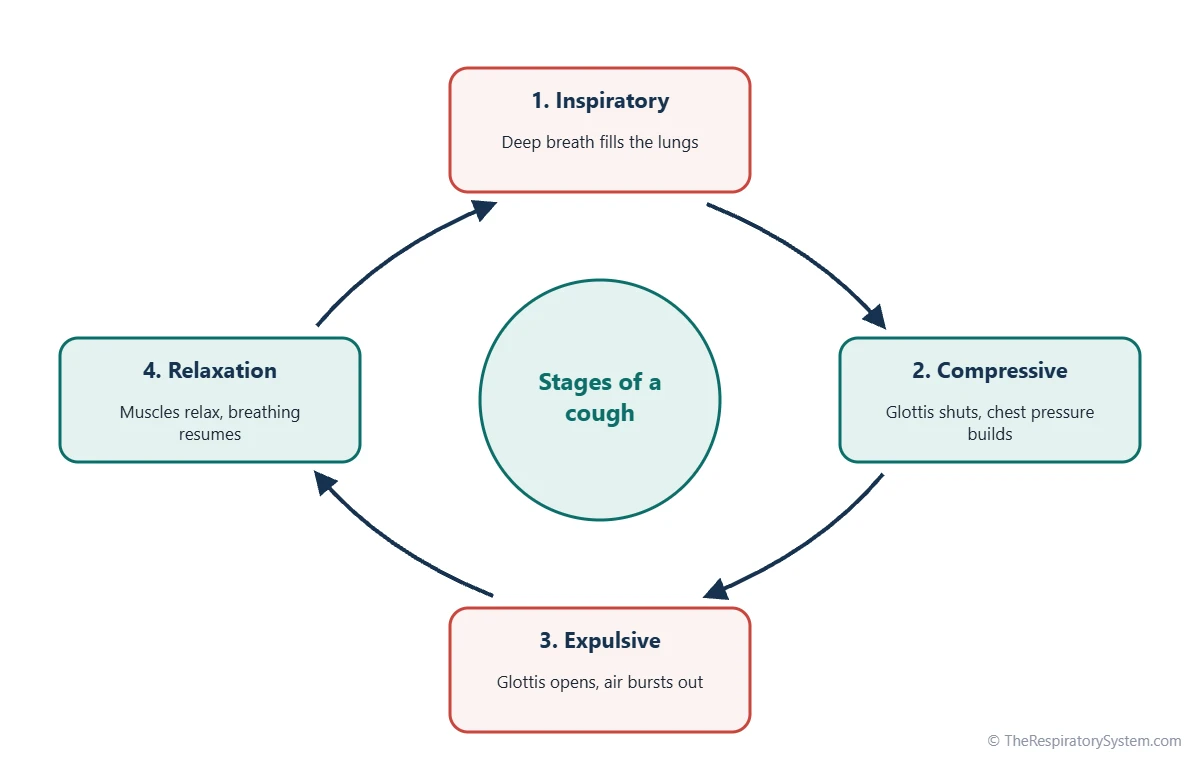
The cough reflex has three main stages: the inspiratory stage, in which a deep breath fills the lungs; the compressive stage, in which the glottis closes and the breathing muscles squeeze the chest; and the expulsive stage, in which the glottis opens and air bursts out. A short relaxation phase follows before normal breathing returns.
Cough reflex steps
- Inspiratory stage: the diaphragm and external intercostals draw in a breath that is usually deeper than normal. The extra volume stretches the breathing muscles to a more powerful length and gives the cough more air to work with.
- Compressive stage: the vocal folds snap shut and the epiglottis helps seal the larynx. For about 0.2 seconds, the abdominal and internal intercostal muscles contract hard against the closed airway, and pressure in the chest can rise to 100 mmHg or more.
- Expulsive stage: the glottis opens suddenly. Air rushes out at very high speed, carrying mucus and particles toward the mouth. The vibrating vocal folds and airway walls produce the familiar sound of a cough.
- Relaxation: the expiratory muscles relax, and breathing returns to normal or a new cough begins.
Single coughs and bouts
Coughs often come in bouts, with several expulsive blasts after a single deep breath, each starting from a smaller lung volume. Successive coughs from lower volumes squeeze progressively smaller airways, helping move mucus up from deeper in the bronchial tree. The function of the glottis in this process is explained on our glottis vs epiglottis page.
| Stage | What happens | Main structures | Result |
|---|---|---|---|
| Inspiratory | A deep breath in | Diaphragm, external intercostals | More air and stronger muscle stretch |
| Compressive | Glottis closes while expiratory muscles contract | Vocal folds, abdominal muscles, internal intercostals | Chest pressure rises sharply |
| Expulsive | Glottis opens suddenly and air bursts out | Glottis, trachea, large bronchi | Mucus and particles are swept upward |
| Relaxation | Muscles relax and breathing resumes | Breathing muscles, brainstem | Normal breathing or another cough |
| Source: Our editors, from standard respiratory physiology | |||
How Does a Cough Clear the Airways?
A cough clears the airways by creating a short burst of very fast airflow that shears mucus and particles off the airway walls and carries them upward, a process made more powerful by the narrowing of the trachea and large bronchi under high chest pressure.
Dynamic compression
During the expulsive stage, the high pressure around the airways squeezes the trachea and large bronchi. The flexible back wall of the trachea, made of the trachealis muscle rather than cartilage, bulges inward and narrows the tube. For the same flow of air, a narrower tube means higher speed, just as water speeds up when a hose nozzle is partly covered. This fast-moving air drags mucus along the airway wall.
Working with the mucus layer
A cough works best when mucus is present in the right amount and consistency. A thin layer of mucus can be swept along by the airflow, while very thin, watery secretions or very thick, sticky mucus are cleared less efficiently. The respiratory epithelium produces this mucus, and the cilia bring it into the large airways, where coughing is most effective.
Where a cough is effective
Because the speed of air is highest in the large central airways, a cough mainly clears the larynx, trachea and the first few generations of bronchi. It does little in the small bronchioles, where airflow is slow and clearing relies on cilia and on alveolar macrophages. Particles that reach the alveoli are removed by these cells, not by coughing.
The cough and the spread of germs
A cough propels droplets and smaller aerosol particles from the airways into the air. This protects the person coughing but can carry infectious microbes to others, which is how many respiratory infections, including tuberculosis and whooping cough, spread.
Can You Control the Cough Reflex?
Yes, partly. Because the cough pathway connects to the cerebral cortex, people can start a cough on purpose, and they can often delay or hold back a reflex cough for a while, although a strong stimulus in the larynx usually overrides voluntary control.
The urge to cough
Before most reflex coughs, people feel an urge to cough, a tickling or irritating sensation in the throat or chest. This sensation comes from signals that reach higher brain regions in parallel with the brainstem reflex. It allows the brain to weigh whether to cough, which is why someone can often hold back a cough during a quiet performance.
Cough during sleep
The cough reflex is strongly damped during sleep. Most coughs at night happen after the person has briefly woken up, even if they do not remember it. This is one reason why liquids that enter the airway during deep sleep are less likely to cause an immediate cough.
Changes across life
In newborns, especially premature babies, irritation of the larynx tends to cause a pause in breathing and swallowing rather than a strong cough, and the adult-type cough reflex matures over the first months of life. In older adults the reflex may become less sensitive and the cough less forceful, and conditions affecting the brain, such as stroke, can weaken it further. A weak cough makes it harder to clear material that enters the airway, which increases the risk of aspiration.
Cough Reflex vs Gag Reflex: What Is the Difference?
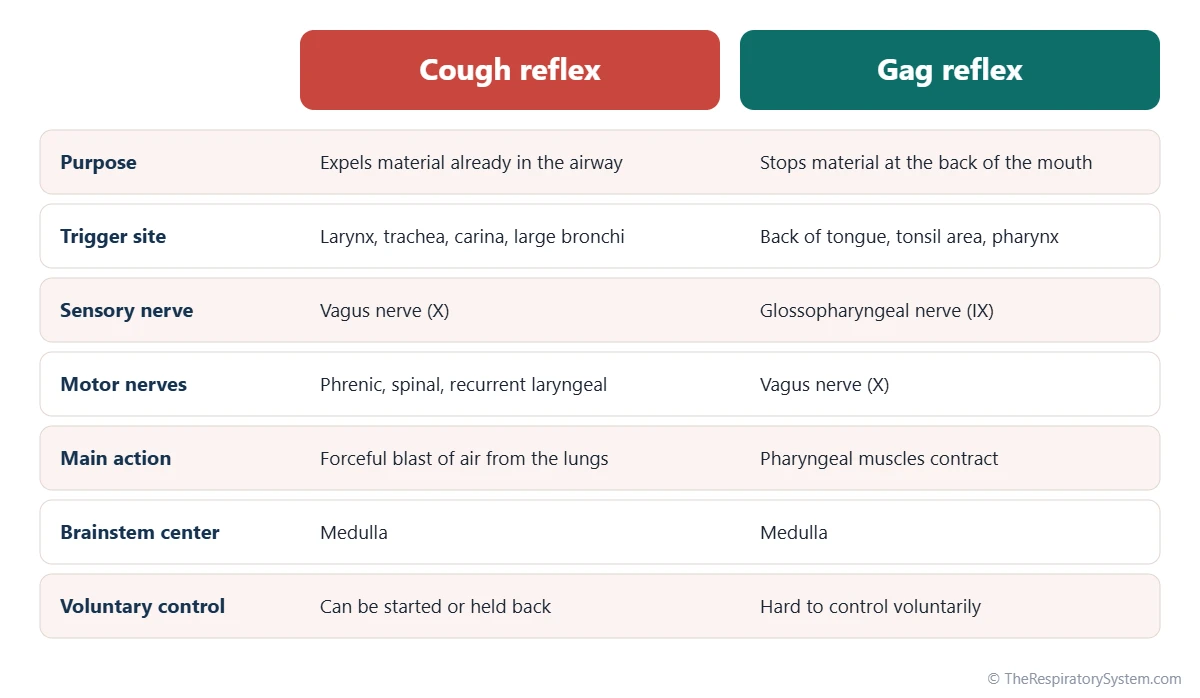
The cough reflex expels material that has already entered the airway by blasting air out of the lungs, while the gag reflex stops material at the back of the mouth by contracting the throat muscles, preventing it from being swallowed. Both protect the airway, but they use different triggers, nerves and muscles.
The gag reflex
The gag, or pharyngeal, reflex is triggered by touching the back of the tongue, the tonsil area or the back wall of the pharynx. Its sensory signals travel mainly in the glossopharyngeal nerve (cranial nerve IX), and its motor commands travel in the vagus nerve (cranial nerve X) to the muscles of the pharynx and soft palate, which contract to push the object forward. Its strength varies widely between people, and some healthy people have very little gag reflex.
The sneeze reflex
The sneeze is a close relative of the cough. It also uses a deep breath in, a build-up of pressure and a sudden blast out, but it is triggered by irritation of the nasal lining through the trigeminal nerve, and much of the air is directed through the nose to clear the nasal cavity. Our page on why we sneeze explains it in detail.
Other protective reflexes
- Laryngeal closure: the vocal folds snap shut when liquid or food touches the larynx, sealing the airway even before a cough starts.
- Expiration reflex: a sharp breath out without a deep breath first, triggered from the vocal folds to push material out before it can be breathed further in.
- Swallowing: the epiglottis folds down and the larynx rises, guiding food into the esophagus rather than the trachea; see trachea vs esophagus.
Common Conditions That Affect the Cough Reflex
Many conditions affect the cough reflex, either by stimulating it too often, as in infections and airway diseases, or by weakening it, as in some nerve and muscle disorders. Our respiratory diseases section covers these conditions, and a cough that lasts for weeks, brings up blood or comes with breathing difficulty should be checked by a doctor.
Acute, subacute and chronic cough
Doctors often group coughs by how long they last. In adults, an acute cough lasts less than 3 weeks and is most often caused by a cold or other respiratory infection. A subacute cough lasts 3 to 8 weeks, often lingering after an infection. A chronic cough lasts longer than 8 weeks.
Conditions linked to frequent coughing
- Infections: colds, bronchitis, pneumonia, croup and whooping cough inflame the airway lining and sensitize cough receptors.
- Asthma and COPD: inflamed, narrowed airways and extra mucus trigger frequent coughing.
- Postnasal drip and reflux: mucus from the nose and sinuses, or acid from the stomach, can irritate the throat and larynx.
- Smoke and pollutants: tobacco smoke and irritant gases stimulate the chemically sensitive fibers.
Conditions linked to a weak cough
Stroke, Parkinson's disease, muscle diseases, spinal cord injury and heavy sedation can weaken the cough by reducing sensation, coordination or muscle strength. A weak cough lets mucus and inhaled material collect in the airways and raises the risk of chest infections.
Key Facts
- The cough reflex clears the larynx, trachea and large bronchi of mucus, particles and inhaled material.
- The most sensitive trigger points are the larynx and the carina, where the trachea divides.
- Signals travel to the brainstem mainly in the vagus nerve and are processed in the nucleus tractus solitarius of the medulla.
- A cough has three main stages: inspiratory, compressive and expulsive.
- During the compressive stage the glottis stays closed for about 0.2 seconds while chest pressure can rise to 100 mmHg or more.
- High chest pressure narrows the trachea during a cough, which speeds up the airflow and helps shear mucus off the airway walls.
- Unlike most reflexes, a cough can also be started or held back voluntarily, as with clearing the throat.
Quick Quiz: Test What You Know About the Cough Reflex
6 questions. Tap an answer to check it.
Which nerve carries most sensory signals of the cough reflex?
The vagus nerve (cranial nerve X), including its laryngeal and pulmonary branches, carries the sensory signals to the brainstem.
Where in the brain is the cough reflex coordinated?
Signals arrive in the nucleus tractus solitarius of the medulla, where breathing networks generate the cough pattern.
What happens during the compressive stage of a cough?
With the glottis closed, the abdominal and internal intercostal muscles build up pressure in the chest.
Which site is among the most sensitive triggers of a cough?
The carina, where the trachea divides, and the larynx are the most sensitive cough trigger points.
Which nerve carries the sensory signals of the gag reflex?
The gag reflex is triggered through the glossopharyngeal nerve (IX), with motor commands in the vagus nerve (X).
Why does a cough clear the small bronchioles poorly?
Air moves fastest in the large central airways; the small airways rely mainly on cilia and macrophages.
Frequently Asked Questions
What is the purpose of the cough reflex?
The cough reflex protects the lungs by clearing the larynx, trachea and large bronchi. It removes excess mucus, dust, smoke particles, microbes and anything that is accidentally breathed in, such as food or liquid. It also backs up the mucociliary escalator, the constant cleaning system of the airways, when that system is overwhelmed by infection, irritation or a sudden blockage.
What triggers a cough?
A cough is triggered when sensory nerve endings in the airway lining are stimulated. Mechanical triggers include mucus, food, dust and anything touching the larynx or carina. Chemical triggers include smoke, acid, cold air and substances released during inflammation. Infections make the receptors more sensitive, so even normal breathing or talking can trigger coughing during a cold.
Is coughing voluntary or involuntary?
Coughing can be both. The reflex cough is involuntary and is triggered automatically through the vagus nerve and the brainstem when the airway is irritated. A voluntary cough, such as clearing the throat, starts in the cerebral cortex but uses the same muscles and brainstem circuits. People can often hold back a mild reflex cough for a while, but a strong stimulus usually wins.
What is the difference between a dry and a wet cough?
A wet, or productive, cough brings up mucus or phlegm from the airways and is common when the lining is inflamed and producing extra secretions, as in bronchitis or pneumonia. A dry, or non-productive, cough brings up little or nothing and is often caused by irritation or increased sensitivity of the cough receptors, for example after a cold or from smoke.
Why do we cough when food goes down the wrong way?
When food or liquid slips past the epiglottis toward the larynx, it touches the most sensitive cough receptors in the airway. The vocal folds snap shut to seal the airway, and the cough reflex fires immediately, producing forceful coughs that push the material back up into the throat. This combination of laryngeal closure and coughing is one of the body's most important protections against choking and aspiration.
How fast is a cough?
A cough is very fast. The compressive stage lasts only about 0.2 seconds, and the expulsive blast that follows produces the highest airflow speeds of any breathing action. Exact figures vary between people and depend on how they are measured, but the narrowing of the trachea during a cough concentrates the airflow into a fast jet that can carry droplets well beyond the mouth.
Can the cough reflex be lost?
The cough reflex can be weakened but is rarely lost completely in conscious people. Deep sedation, general anesthesia, stroke, some nerve and muscle diseases and spinal cord injury can reduce the sensation that triggers a cough or the muscle power that drives it. A weakened cough makes it harder to clear mucus and inhaled material, which increases the risk of chest infections.
Why does coughing get worse at night?
Several things can make coughing more noticeable at night. Lying flat can let mucus from the nose drip down the throat and can make stomach acid reach the throat more easily. Airway narrowing in asthma tends to be greater in the early morning hours. Most night coughs happen during brief awakenings, because the cough reflex is strongly damped during deep sleep.
Keep Exploring


