At a Glance
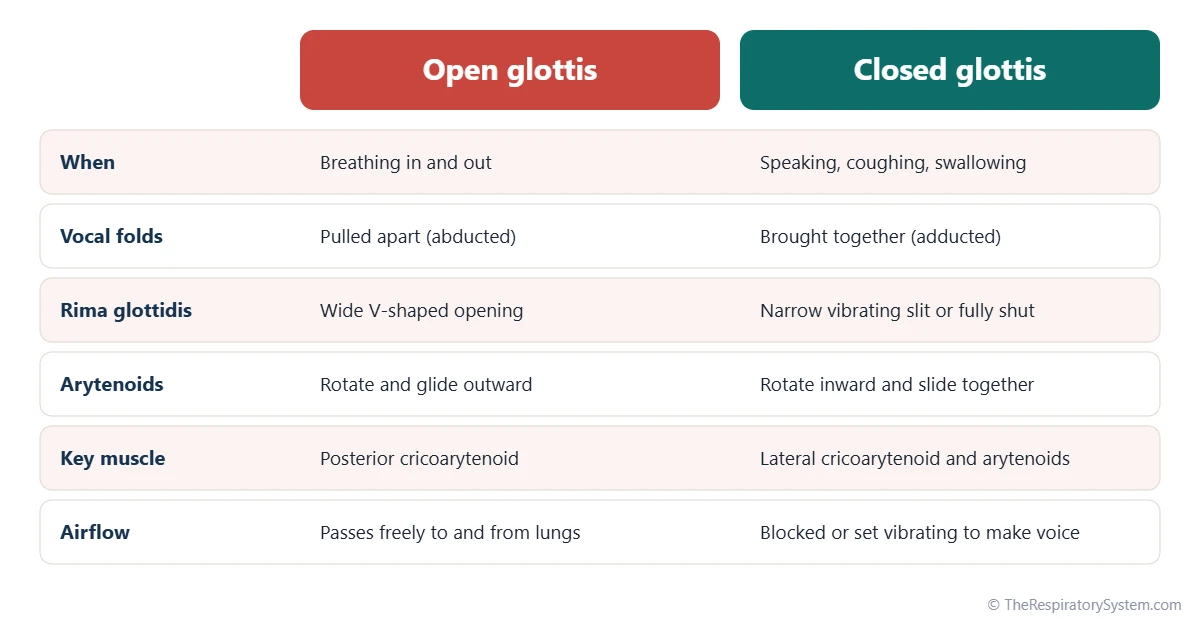
The glottis is the middle level of the larynx, formed by the two true vocal folds and the gap between them, the rima glottidis, which is the narrowest part of the adult airway. Muscles that rotate the arytenoid cartilages open it for breathing and close it for speech, coughing and swallowing; the posterior cricoarytenoid is the only muscle that opens it.
- Location
- Middle level of the larynx, behind the thyroid cartilage (Adam's apple)
- Made of
- The two true vocal folds plus the rima glottidis between them
- Function
- Lets air in and out, protects the airway, builds pressure for coughing and makes the voice
- Opened by
- Posterior cricoarytenoid muscles, the only abductors of the vocal folds
- Nerve supply
- Recurrent laryngeal nerve, plus the superior laryngeal nerve for the cricothyroid muscle
- Part of
- Larynx, in the upper respiratory tract
On this page
- What Is the Glottis?
- Where Is the Glottis Located?
- What Is the Rima Glottidis?
- Glottis Anatomy: Cartilages, Muscles and Nerves
- What Is the Function of the Glottis in the Respiratory System?
- What Is the Glottis Function in Frogs and Other Animals?
- How Does the Glottis Change With Age?
- Common Conditions That Affect the Glottis
- Key Facts
- Quiz
- FAQ
What Is the Glottis?
The glottis is the vocal apparatus of the larynx: the pair of true vocal cords (vocal folds) together with the variable opening between them. It is the valve that every breath, every spoken word and every cough must pass through.
Glottis definition in anatomy
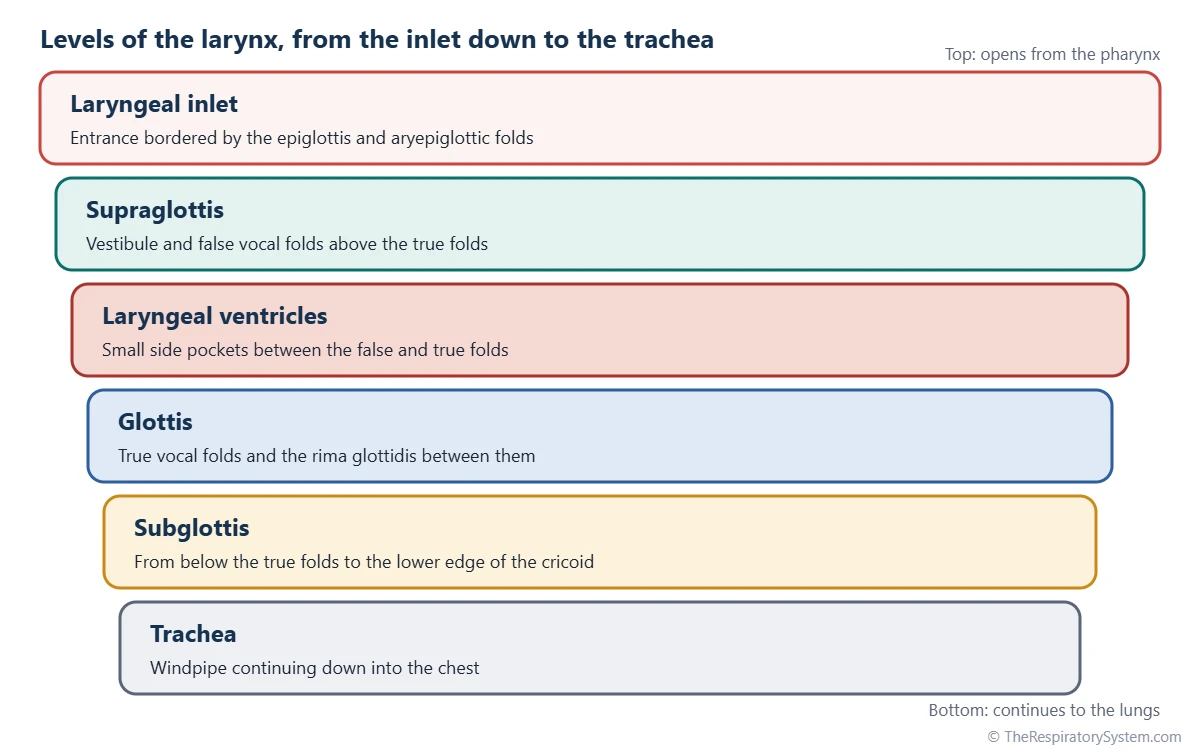
In anatomy, the glottis is defined as the vocal folds, their attachments to the arytenoid cartilages, and the rima glottidis, the space between them. Some books use the word in a narrower sense, for the opening alone. In both uses, the glottis marks the middle level of the larynx, between the supraglottis above and the subglottis below.
Glottis meaning
The word comes from the ancient Greek glottis, the mouthpiece of a reed pipe, which in turn comes from glotta, a word for tongue. The comparison fits: like a reed, the vocal folds vibrate in a stream of air to make sound. The related term epiglottis simply means "upon the glottis," since the epiglottis sits above it.
Explained simply
Think of the glottis as a pair of curtains across the top of your windpipe. When you breathe, the curtains are pulled apart so air can pass. When you speak, they are drawn together and flutter in the air flowing up from the lungs. When you swallow, they are pulled tightly shut so food and drink cannot get in.
Where Is the Glottis Located?
The glottis is located inside the larynx in the front of the neck, behind the thyroid cartilage at about the level of the Adam's apple, below the epiglottis and above the trachea. It lies at the boundary between the upper and lower airways.
The inside of the larynx is divided into three levels. The supraglottis runs from the laryngeal inlet, guarded by the epiglottis, down to the false vocal folds and the small side pockets below them called the laryngeal ventricles. The glottis is the level of the true vocal folds. The subglottis runs from just below the true folds to the lower edge of the cricoid cartilage, where the trachea begins. Air reaching the glottis has already passed the laryngopharynx, the lowest part of the pharynx.
Because the names are so close, the glottis and the epiglottis are often mixed up. They are separate structures with different jobs, and our page on glottis vs epiglottis compares them point by point.
What Is the Rima Glottidis?
The rima glottidis is the opening between the two true vocal folds and, behind them, between the arytenoid cartilages. Its size and shape change constantly, and it is the narrowest part of the adult airway.
Two parts of the rima glottidis
- Intermembranous part: the longer front part, lying between the vocal folds themselves. This is the part that vibrates during speech.
- Intercartilaginous part: the shorter back part, lying between the vocal processes and bodies of the two arytenoid cartilages. It stays open during whispering.
At the front, the two vocal folds meet at a single point on the inside of the thyroid cartilage, so the opening is always narrowest there. At the back, the folds are attached to the movable arytenoid cartilages, which is why the rima glottidis opens like a V with its point at the front.
Rima glottidis vs glottis
The rima glottidis is only the gap, while the glottis is the whole valve: the gap plus the vocal folds that border it. A simple way to remember it is that rima means slit in Latin. When a textbook says the glottis "opens," it means the rima glottidis is widening as the folds move apart.
Glottis Anatomy: Cartilages, Muscles and Nerves
The glottis is moved by small intrinsic muscles of the larynx that rotate and slide the arytenoid cartilages, and it is controlled almost entirely by the recurrent laryngeal nerves. Its shape at any moment depends on the balance between muscles that open it and muscles that close it.
Cartilages
Each vocal fold stretches from the inside of the thyroid cartilage at the front to the vocal process of an arytenoid cartilage at the back. The two arytenoids sit on top of the back of the cricoid cartilage, and they can rotate, tilt and glide toward or away from each other. Our page on the laryngeal cartilages describes each of these in detail.
Muscles that open and close it
- Posterior cricoarytenoid: the only muscle that opens the glottis. It rotates the vocal processes outward.
- Lateral cricoarytenoid: rotates the vocal processes inward, bringing the front parts of the folds together.
- Transverse and oblique arytenoids: pull the two arytenoids together, closing the back part of the gap.
- Cricothyroid: tilts the thyroid cartilage forward, stretching and tensing the folds to raise the pitch.
- Thyroarytenoid and vocalis: lie inside the folds, shortening and fine-tuning them.
Nerves and lining
The recurrent laryngeal nerve, a branch of the vagus nerve, supplies all of these muscles except the cricothyroid, which is supplied by the external branch of the superior laryngeal nerve. Sensation above the folds is carried by the internal branch of the superior laryngeal nerve and below them by the recurrent laryngeal nerve. The free edges of the vocal folds are covered by tough stratified squamous epithelium, which withstands constant vibration, while the rest of the larynx is lined by ciliated respiratory epithelium.
What Is the Function of the Glottis in the Respiratory System?
The function of the glottis in the respiratory system is to control the flow of air between the throat and the lungs: it opens for breathing, closes to protect the airway, seals to build pressure for coughing, and vibrates to produce the voice. The table below shows how its shape changes for each task.
Breathing
During each breath in, the posterior cricoarytenoid muscles contract slightly and widen the rima glottidis, lowering the resistance to airflow. During a breath out, the glottis narrows a little, which slows the outflow of air. During hard breathing, such as in exercise, it opens as wide as it can.
Protecting the airway
When you swallow, the vocal folds close tightly, the false folds close above them, and the larynx is pulled up under the epiglottis. Glottic closure is one of the most important barriers that keep food and liquid out of the lungs. If anything does touch the vocal folds, the cough reflex closes the glottis, builds pressure below it, then opens it suddenly so a blast of air clears the airway.
Making the voice
To speak or sing, the folds are brought together and tensed, and air from the lungs pushes them apart and lets them snap back many times a second. This vibration is the source of the voice, which the throat, mouth and nose then shape into speech, as explained on our page about how the voice is produced.
Effort closure
During heavy lifting, straining or childbirth, the glottis closes firmly and traps air in the lungs. This stiffens the chest and helps the trunk muscles push against a stable base.
| Activity | Vocal fold position | Shape of the rima glottidis | Main muscles at work |
|---|---|---|---|
| Quiet breathing | Moderately apart | Open triangle, point at the front | Posterior cricoarytenoid, lightly active |
| Deep breath in | Pulled wide apart | Wide, almost diamond-shaped opening | Posterior cricoarytenoid, strongly active |
| Speaking or singing | Together, tensed and vibrating | A slit that opens and closes rapidly | Lateral cricoarytenoid, arytenoids, cricothyroid, vocalis |
| Whispering | Front parts together, back parts apart | Small triangle open at the back | Lateral cricoarytenoid, with the arytenoids relaxed |
| Coughing | Shut firmly, then opened suddenly | Closed, then wide open | Closing muscles, then posterior cricoarytenoid |
| Swallowing | Pressed tightly together | Fully closed | Lateral cricoarytenoid and arytenoids, with false folds closing above |
| Straining or lifting | Pressed together | Fully closed, trapping air in the lungs | Closing muscles of the larynx |
| Source: Typical adult larynx, our editors | |||
What Is the Glottis Function in Frogs and Other Animals?
In frogs and many other animals, the glottis is a slit-like opening in the floor of the mouth or throat that leads into the airway and can be opened or shut to let air in or trap it in the lungs. The basic job, guarding the entrance to the lungs, is the same as in humans.
- Frogs: a frog has no diaphragm and fills its lungs by pumping air with the floor of its mouth. It closes its nostrils, opens the glottis and pushes air into the lungs, then closes the glottis to hold it there. Our frog respiratory system page explains this buccal pumping.
- Snakes: the glottis sits far forward in the mouth and can be pushed out to one side, so a snake can keep breathing while it slowly swallows large prey.
- Birds: the glottis is a slit behind the tongue, with no epiglottis in front of it. Birds make sound with a separate organ deeper in the chest, the syrinx, rather than with the larynx; see the bird respiratory system page.
- Whales and dolphins: in toothed whales the larynx reaches up into the nasal passage, keeping breathing and swallowing apart, as described on our page about how whales breathe.
How Does the Glottis Change With Age?
The glottis sits higher and is relatively smaller in infants, grows rapidly at puberty, especially in males, and becomes thinner and less tightly closing in older age. These changes affect both the airway and the voice.
In newborns, the larynx lies higher in the neck, which lets babies breathe and swallow almost at the same time. In young children the narrowest part of the airway has traditionally been described as the subglottis at the level of the cricoid cartilage, while in adults it is the rima glottidis. This is why swelling just below the vocal folds, as in croup, can narrow a child's airway so quickly.
At puberty the larynx grows, and the vocal folds become longer and thicker, more so in males, which lowers the pitch of the voice. In later life, the muscle inside the folds can thin and the folds may bow slightly, leaving a small gap when they close. This can make an older person's voice sound weaker or breathier.
Common Conditions That Affect the Glottis
Conditions of the glottis usually show up as hoarseness, a weak voice, noisy breathing or coughing during meals, because they stop the vocal folds from moving or closing normally. Our respiratory diseases section has more on each one, and a hoarse voice that does not settle should be checked by a doctor.
- Laryngitis: inflammation swells the vocal folds, so they vibrate unevenly and the voice turns hoarse or disappears.
- Vocal fold paralysis: damage to a recurrent laryngeal nerve leaves one fold unable to move, which can cause a breathy voice and a weak cough.
- Laryngospasm: a sudden, involuntary closure of the vocal folds that briefly blocks breathing, often triggered by irritation.
- Vocal fold nodules and polyps: small growths on the fold edges that stop the folds from meeting cleanly.
- Glottic cancer: a cancer of the vocal folds themselves; because even a small growth changes the voice, it is often noticed early.
- Swelling of the larynx: allergic reactions or infection can swell the tissues around the glottis and narrow the airway.
Key Facts
- The glottis is made of the two true vocal folds and the opening between them, the rima glottidis.
- It is the middle level of the larynx, between the supraglottis above and the subglottis below.
- The rima glottidis is the narrowest part of the adult airway.
- The posterior cricoarytenoid is the only muscle that opens the glottis; several other muscles close it.
- All intrinsic muscles of the larynx except the cricothyroid are supplied by the recurrent laryngeal nerve.
- The glottis closes tightly during swallowing and is one of the main barriers keeping food out of the lungs.
- In frogs, opening and closing the glottis lets the animal pump air into its lungs and hold it there.
Quick Quiz: Test What You Know About the Glottis
6 questions. Tap an answer to check it.
What two things make up the glottis?
The glottis is the pair of true vocal folds together with the gap between them, the rima glottidis.
Which muscle is the only one that opens the glottis?
The posterior cricoarytenoid rotates the arytenoid cartilages outward and is the only abductor of the vocal folds.
Which nerve supplies most of the muscles that move the glottis?
The recurrent laryngeal nerve, a branch of the vagus, supplies every intrinsic laryngeal muscle except the cricothyroid.
What is the narrowest part of the adult airway?
In adults the rima glottidis, the gap between the vocal folds, is the narrowest point.
What happens to the glottis during swallowing?
The vocal folds press together during swallowing, helping keep food and liquid out of the trachea.
Which level of the larynx lies directly below the glottis?
The subglottis runs from just below the true vocal folds to the lower edge of the cricoid cartilage.
Frequently Asked Questions
Is the glottis the same as the vocal cords?
Not exactly. The vocal cords, or vocal folds, are the two bands of tissue inside the larynx. The glottis is the whole valve they form: the two folds plus the opening between them. People often use the words loosely, but in anatomy the vocal folds are part of the glottis, and the glottis also includes the changing gap that air passes through.
Is the glottis part of the larynx or the pharynx?
The glottis is part of the larynx, not the pharynx. The pharynx is the shared passage for air and food at the back of the throat. The larynx sits below and in front of its lowest part and contains the vocal folds. Air leaves the pharynx through the laryngeal inlet, passes the supraglottis and then crosses the glottis on its way to the trachea.
Is the glottis the narrowest part of the airway?
In adults, yes. The rima glottidis, the gap between the vocal folds, is the narrowest point of the adult airway. In infants and young children, the region just below the vocal folds, at the ring-shaped cricoid cartilage, has long been described as the narrowest part, although some newer studies suggest the glottis is narrowest at all ages.
What is a glottal stop?
A glottal stop is a speech sound made by closing the glottis completely for a moment and then releasing it, which stops the airflow and lets it burst out again. In English it is heard in the middle of "uh-oh" and in some accents in place of the t in words such as button. Many languages, including Arabic and Hawaiian, use it as a regular consonant.
What does the glottis look like?
Seen from above with a scope or mirror, the glottis looks like an upside-down V. The two true vocal folds appear as smooth, pearly white bands meeting at a point at the front, with the dark opening of the airway between them. During breathing the V opens wide, and during speech the two bands come together into a straight line.
What is glottic closure insufficiency?
Glottic closure insufficiency means the vocal folds do not meet fully when they close, leaving a small gap. It can follow nerve damage, thinning of the folds with age, or growths on their edges. Air leaks through the gap, so the voice may sound breathy or weak and the cough may be less forceful. A small gap at the back is common and normal in many people.
Why does the voice change when you have a cold?
During a cold, inflammation can spread to the larynx and swell the vocal folds. Swollen folds are heavier and less even, so they vibrate more slowly and irregularly, which makes the voice deeper, rougher or hoarse. Extra mucus and coughing add to the irritation. In most people the voice returns to normal as the swelling settles over several days.
Keep Exploring


