At a Glance
The laryngopharynx (hypopharynx) is the bottom part of the throat, between the tip of the epiglottis and the lower border of the cricoid cartilage, at about the level of the fourth to sixth neck vertebrae. It carries both air and food: air passes forward through the laryngeal inlet into the larynx, while swallowed food is steered around the inlet through the piriform recesses into the esophagus.
- Location
- Behind the larynx, from the tip of the epiglottis to the lower edge of the cricoid cartilage
- Also called
- Hypopharynx
- Carries
- Air to the larynx and food to the esophagus
- Lining
- Nonkeratinized stratified squamous epithelium
- Connects to
- Oropharynx above, larynx in front, esophagus below
- Part of
- Pharynx, shared by the upper respiratory tract and the digestive tract
On this page
- What Is the Laryngopharynx?
- Where Is the Laryngopharynx Located?
- Laryngopharynx Anatomy: Walls, Recesses and Lining
- What Is the Function of the Laryngopharynx?
- Larynx vs Laryngopharynx: What Is the Difference?
- How Does the Laryngopharynx Change With Age?
- Common Conditions That Affect the Laryngopharynx
- Key Facts
- Quiz
- FAQ
What Is the Laryngopharynx?
The laryngopharynx is the lowest section of the pharynx, the muscular tube of the throat, and the point where the airway and the food passage separate. It belongs both to the upper respiratory tract and to the digestive tract. Its name joins "larynx" and "pharynx" because it is the part of the pharynx that lies directly behind the larynx.
Laryngopharynx definition
In anatomy, the laryngopharynx is defined as the part of the pharynx that extends from the upper border of the epiglottis to the lower border of the cricoid cartilage, where it becomes continuous with the esophagus. In front it opens into the larynx through the laryngeal inlet. Doctors often use the name hypopharynx for the same region, especially in ear, nose and throat medicine.
Nasopharynx, oropharynx and laryngopharynx
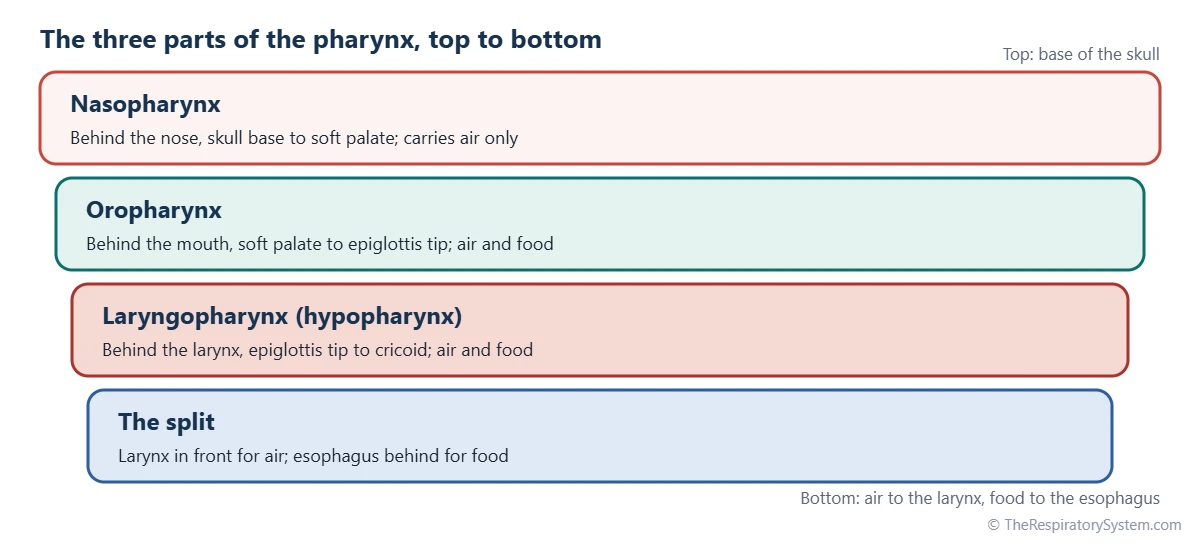
The pharynx is divided into three parts from top to bottom. The nasopharynx sits behind the nose and carries only air; the oropharynx sits behind the mouth and carries air and food; and the laryngopharynx sits behind the larynx, carrying air and food until they part. A full comparison of the three is on our pharynx page.
Explained simply
Think of the throat as a hallway that splits into two doors at the bottom. The front door leads to the voice box and windpipe, for air. The back door leads to the food pipe, for food and drink. The laryngopharynx is the bottom of the hallway, right in front of those two doors.
Where Is the Laryngopharynx Located?
The laryngopharynx is located in the neck, behind the larynx and in front of the cervical vertebrae, at about the level of the fourth to sixth neck vertebrae in an adult. Its upper limit is the tip of the epiglottis, where it continues from the oropharynx, and its lower limit is the lower edge of the cricoid cartilage, where it narrows into the esophagus.
- In front: the laryngeal inlet, and below it the back surfaces of the arytenoid and cricoid laryngeal cartilages.
- Behind: the prevertebral fascia and the bodies of the cervical vertebrae, separated by the loose retropharyngeal space.
- On each side: the thyroid cartilage and the thyrohyoid membrane, which form the outer walls of the piriform recesses.
- Above: the oropharynx, behind the base of the tongue.
- Below: the esophagus, starting at the upper esophageal sphincter.
Because the larynx rises during swallowing and sits lower in adults than in infants, the exact vertebral level of the laryngopharynx shifts slightly with movement and age.
Laryngopharynx Anatomy: Walls, Recesses and Lining
Laryngopharynx anatomy is usually described in three regions: the paired piriform recesses at the sides, the postcricoid area in front, and the posterior pharyngeal wall behind. These are the same subsites that doctors use when describing the hypopharynx.
Piriform recesses
The piriform recesses (piriform sinuses or fossae) are two pear-shaped gutters, one on each side of the laryngeal inlet. Each is bounded on the inside by the aryepiglottic fold and on the outside by the thyroid cartilage and thyrohyoid membrane. The internal laryngeal nerve runs just under their lining, which is why this area is so sensitive to touch.
Postcricoid area and posterior wall
The postcricoid area is the front wall of the lower laryngopharynx, the mucosa covering the back of the cricoid cartilage down to the start of the esophagus. The posterior wall is the back of the tube, lying in front of the vertebrae. When the pharynx is relaxed, the front and back walls of the lower laryngopharynx lie close together and only open widely during a swallow.
Muscles
The walls are made mostly by the inferior pharyngeal constrictor, which has two parts: the thyropharyngeus, attached to the thyroid cartilage, and the cricopharyngeus, attached to the cricoid cartilage. The cricopharyngeus forms the upper esophageal sphincter, which stays closed between swallows. A weaker triangle between the two parts is called Killian's dehiscence. Longitudinal muscles, such as the palatopharyngeus and stylopharyngeus, lift the pharynx and larynx during swallowing.
Lining, nerves and blood supply
The inner surface is covered by nonkeratinized stratified squamous epithelium, a tough, multilayered lining suited to the friction of swallowed food, unlike the ciliated respiratory epithelium of the nose and larynx. Movement is controlled by the vagus nerve through the pharyngeal plexus, while the internal laryngeal nerve carries sensation from the area around the inlet. Blood comes mainly from branches of the superior and inferior thyroid arteries and the ascending pharyngeal artery.
| Part or landmark | What forms it | Notes |
|---|---|---|
| Upper limit | Level of the tip of the epiglottis | Continuous with the oropharynx above |
| Lower limit | Lower border of the cricoid cartilage | Continues as the esophagus |
| Laryngeal inlet | Epiglottis, aryepiglottic folds and arytenoid region | Doorway from the laryngopharynx into the larynx |
| Piriform recesses | Gutters between the aryepiglottic folds and the thyroid cartilage | Food channels on each side of the inlet |
| Postcricoid area | Mucosa over the back of the cricoid cartilage | Front wall of the lowest part |
| Posterior pharyngeal wall | Constrictor muscles in front of the cervical vertebrae | Back wall of the tube |
| Inferior constrictor | Thyropharyngeus and cricopharyngeus muscles | Squeeze food down into the esophagus |
| Upper esophageal sphincter | Cricopharyngeus muscle | Closed at rest, relaxes during a swallow |
| Lining | Nonkeratinized stratified squamous epithelium | Resists friction from food |
| Source: Typical adult anatomy, our editors | ||
What Is the Function of the Laryngopharynx?
The function of the laryngopharynx is to carry air into the larynx and to guide swallowed food and liquid into the esophagus without letting them enter the airway. It is a shared passage, so its main task is sorting traffic.
- Breathing: between swallows the laryngeal inlet is open, so inhaled air flows from the oropharynx forward through the laryngopharynx into the larynx and on to the trachea.
- Swallowing: food and liquid are pushed down its walls, around both sides of the closed inlet through the piriform recesses, and into the esophagus.
- Airway protection: its sensitive lining triggers coughing or swallowing if food or fluid touches the inlet; see the cough reflex.
- Voice: as part of the vocal tract above the vocal cords, its shape helps give the voice resonance.
Hypopharynx function during a swallow
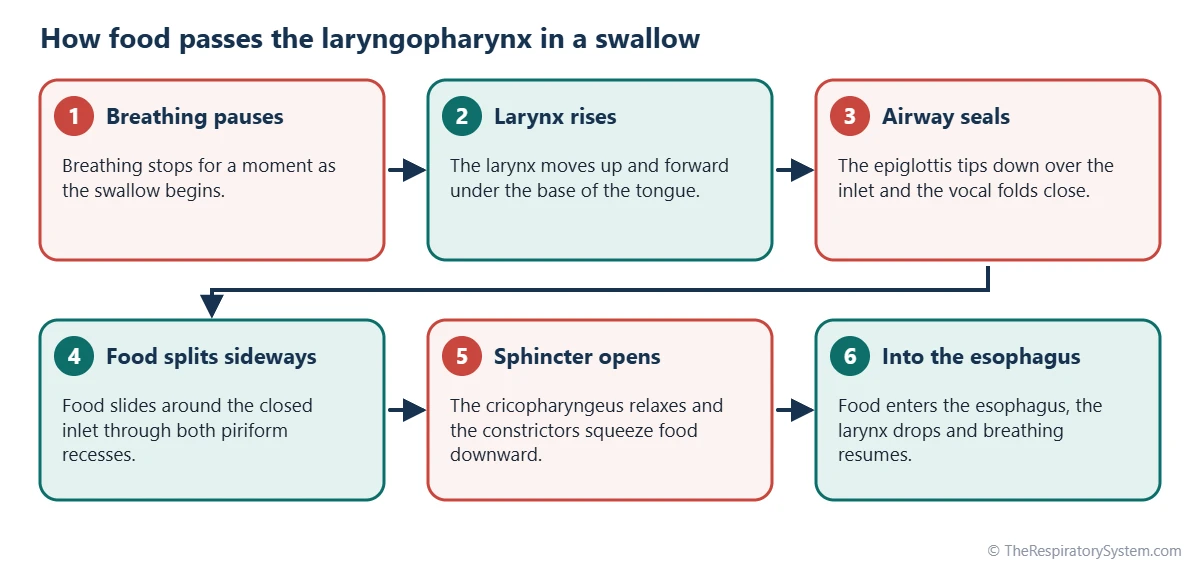
During a swallow, breathing stops for a moment, the larynx rises and moves forward, the epiglottis tips down over the inlet and the vocal folds close. At the same time the cricopharyngeus relaxes and the constrictor muscles squeeze from above, so the food is driven past the closed airway into the open esophagus. The whole sequence lasts about a second, and then the airway opens again for the next breath.
Larynx vs Laryngopharynx: What Is the Difference?
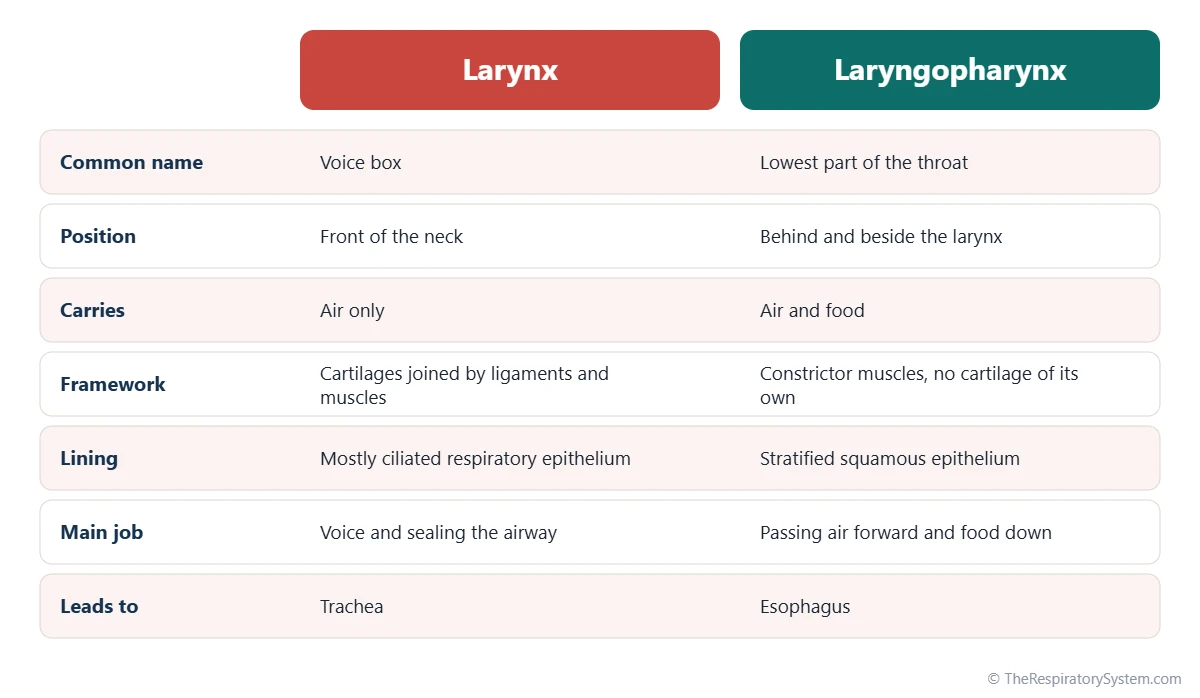
The larynx is the voice box, a framework of cartilages that carries air only, while the laryngopharynx is the muscular part of the throat behind it that carries both air and food. They are neighbors: the laryngopharynx wraps around the back and sides of the larynx, and the laryngeal inlet is the doorway between them.
The larynx is lined mostly by ciliated respiratory epithelium and contains the vocal folds, so it produces voice and seals the airway. The laryngopharynx has a stratified squamous lining and no cartilage of its own, and its job is to move food. For the wider comparison of the two organs, see larynx vs pharynx.
How Does the Laryngopharynx Change With Age?
The laryngopharynx is short in infants and becomes longer as the larynx descends in the neck during childhood. In a newborn the larynx sits high in the neck, so the epiglottis can almost touch the soft palate and the laryngopharynx is small.
As the neck grows and the larynx moves down, the laryngopharynx lengthens and the shared space behind the mouth and larynx enlarges. This change makes speech with a full range of sounds possible but also makes the crossing of air and food more complex. In older adults the muscles of swallowing can become weaker and slower, which is one reason swallowing problems become more common with age. Growth of the airway as a whole is described on our respiratory system development page.
Common Conditions That Affect the Laryngopharynx
The laryngopharynx can be affected by infection, stuck foreign bodies, pouches in its wall and, less often, tumors. These are described for education only; more conditions are listed in our respiratory diseases section.
- Pharyngitis: inflammation of the throat lining, often from a viral infection; see pharyngitis.
- Foreign bodies: small sharp objects such as fish bones can lodge in a piriform recess.
- Laryngopharyngeal reflux: stomach contents rising as far as the throat and larynx.
- Zenker's diverticulum: a pouch that bulges out through Killian's dehiscence, mostly in older adults.
- Hypopharyngeal cancer: an uncommon cancer of the lining, most often in the piriform recesses, strongly linked to tobacco and heavy alcohol use.
Persistent trouble swallowing, a lasting sore throat or a feeling of something stuck should be checked by a doctor.
Key Facts
- The laryngopharynx, or hypopharynx, is the lowest of the three parts of the pharynx, below the oropharynx.
- It extends from the tip of the epiglottis to the lower edge of the cricoid cartilage, at about the fourth to sixth neck vertebrae.
- It opens forward into the larynx through the laryngeal inlet and continues downward as the esophagus.
- Two piriform recesses beside the laryngeal inlet channel food around the airway during a swallow.
- Its lining is nonkeratinized stratified squamous epithelium, built to resist friction from food.
- The cricopharyngeus muscle at its lower end forms the upper esophageal sphincter.
- It carries both air and food, so it belongs to the respiratory and digestive systems.
Quick Quiz: Test What You Know About the Laryngopharynx
6 questions. Tap an answer to check it.
What is another name for the laryngopharynx?
The laryngopharynx is also called the hypopharynx, meaning the lower pharynx.
What marks the upper limit of the laryngopharynx?
The laryngopharynx begins at the level of the tip of the epiglottis, below the oropharynx.
The laryngopharynx continues downward as which structure?
At the lower border of the cricoid cartilage it becomes the esophagus.
Which muscle forms the upper esophageal sphincter?
The cricopharyngeus, the lower part of the inferior constrictor, stays closed between swallows.
What lines the laryngopharynx?
A tough, multilayered squamous lining protects it from the friction of swallowed food.
Where do swallowed fish bones often lodge?
The piriform recesses beside the laryngeal inlet are a common place for small sharp objects to catch.
Frequently Asked Questions
Is the laryngopharynx part of the respiratory or digestive system?
It is part of both. The laryngopharynx carries air from the oropharynx forward into the larynx, so it belongs to the upper respiratory tract, and it carries swallowed food and liquid down into the esophagus, so it is also part of the digestive tract. This shared role is why the throat needs reflexes that close the airway each time we swallow.
What is the difference between the hypopharynx and the laryngopharynx?
There is no difference in location; the two names describe the same region. Laryngopharynx is the term most often used in anatomy textbooks because it names the part of the pharynx behind the larynx. Hypopharynx, meaning lower pharynx, is the term more often used by ear, nose and throat doctors and cancer specialists, who divide it into the piriform recesses, postcricoid area and posterior wall.
Can you see the laryngopharynx by opening your mouth?
No. Looking through the open mouth you can see the back of the oropharynx and the palatine tonsils, but the laryngopharynx lies lower, behind the base of the tongue and the larynx. Doctors view it with a small angled mirror held at the back of the mouth or with a thin flexible endoscope passed through the nose.
Why does food not go into the larynx?
Several actions happen together during a swallow. The larynx rises under the tongue, the epiglottis tips over the inlet, the vocal folds close, and breathing pauses. Food is then pushed around the sealed inlet through the piriform recesses into the esophagus. If a little food or liquid does touch the inlet, its sensitive lining triggers a strong cough to clear it.
What are the piriform sinuses?
The piriform sinuses, also called piriform recesses or fossae, are two small pear-shaped hollows in the laryngopharynx, one on each side of the laryngeal inlet. They sit between the aryepiglottic folds and the inner surface of the thyroid cartilage. During swallowing they act as side channels that lead food around the airway and into the esophagus.
What vertebral level is the laryngopharynx at?
In an adult the laryngopharynx lies roughly in front of the fourth to sixth cervical vertebrae, ending at the lower border of the cricoid cartilage, which is usually at about the sixth cervical vertebra. The level moves upward briefly each time the larynx rises during a swallow, and it is higher in infants, whose larynx sits higher in the neck.
What is the difference between the nasopharynx and the laryngopharynx?
The nasopharynx is the top part of the pharynx, behind the nose, and carries air only; it holds the adenoids and the openings of the Eustachian tubes. The laryngopharynx is the bottom part, behind the larynx, and carries both air and food. The nasopharynx is lined partly by ciliated respiratory epithelium, while the laryngopharynx has a tougher stratified squamous lining.
Does the laryngopharynx help with speaking?
Yes, indirectly. Sound is made by the vocal folds in the larynx, but it is shaped as it travels up through the laryngopharynx, oropharynx, mouth and nose. Changes in the size and shape of these spaces alter the resonance of the voice, so the laryngopharynx is part of the vocal tract even though it does not produce sound itself.
Keep Exploring


