At a Glance
The oropharynx is the middle of the three parts of the pharynx, located behind the oral cavity and extending from the level of the soft palate to the upper edge of the epiglottis, roughly in front of the second and third cervical vertebrae. It carries both air and swallowed food, contains the palatine tonsils and the lingual tonsil, and is lined by non-keratinized stratified squamous epithelium.
- Location
- Behind the mouth, from the soft palate down to the tip of the epiglottis
- Vertebral level
- Roughly in front of the second and third cervical vertebrae
- Lining
- Non-keratinized stratified squamous epithelium
- Contains
- Palatine tonsils, lingual tonsil, base of the tongue, valleculae
- Function
- Shared passage for air and food, swallowing, immune defense, speech resonance
- Part of
- Pharynx; both the respiratory and digestive tracts
On this page
What Is the Oropharynx?
The oropharynx is the part of the throat that lies behind the mouth, the middle section of the pharynx between the nasopharynx above and the laryngopharynx below. Its name joins the Latin for mouth (oro-) with pharynx, the throat. It is what you see at the back of the mouth when you open wide and say "ah".
Oropharynx definition
In anatomy, the oropharynx is defined as the region of the pharynx that extends from the level of the soft palate to the upper border of the epiglottis and opens in front into the oral cavity. It is a crossroads: air from the nose or mouth and food from the mouth both pass through it before going their separate ways.
Oropharynx vs pharynx
The pharynx is the whole muscular tube that runs from the base of the skull to the start of the esophagus, and the oropharynx is just its middle third. The other two parts are the nasopharynx, behind the nose, and the laryngopharynx, behind the larynx.
Explained simply
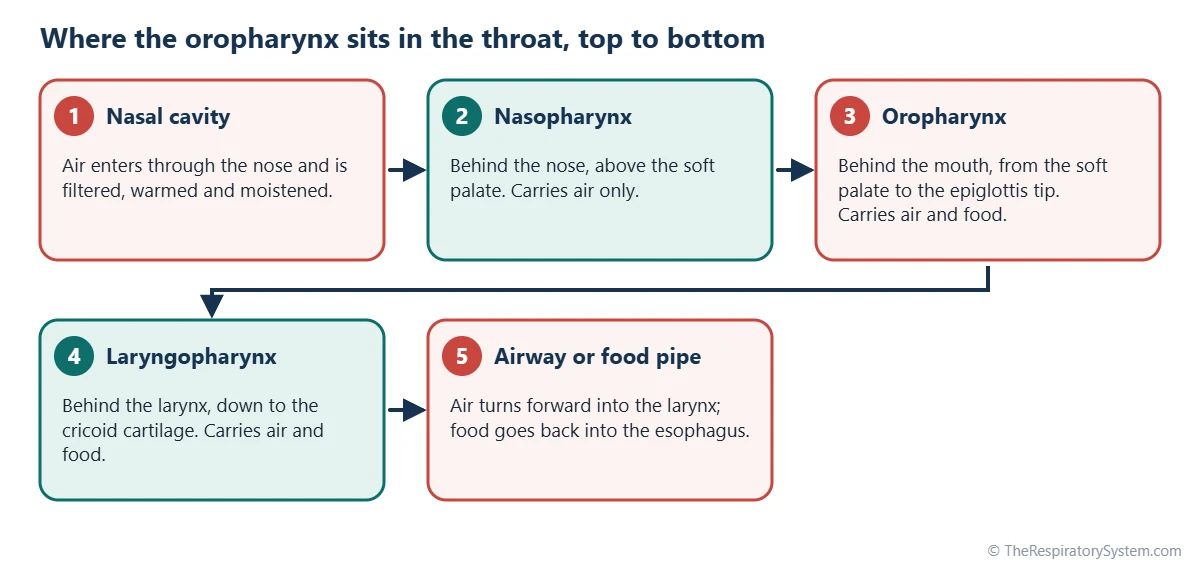
Think of the throat as a three-story elevator shaft. The top floor, behind the nose, carries only air. The middle floor, the oropharynx, is the busy lobby behind the mouth where air and food both pass. The bottom floor sends air forward into the windpipe and food backward into the food pipe.
Where Is the Oropharynx Located?
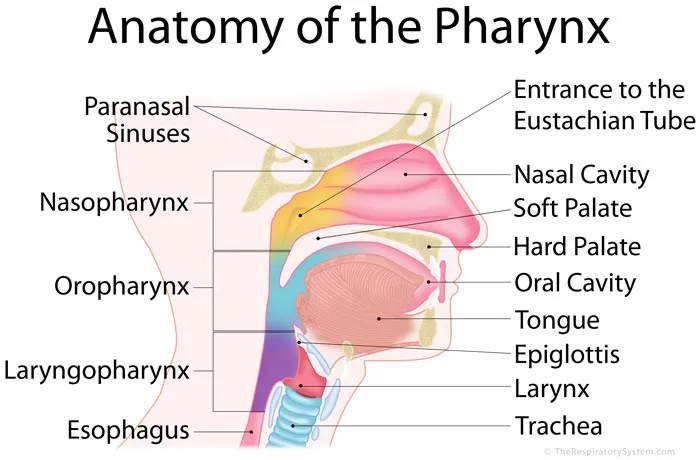
The oropharynx is located behind the oral cavity and the base of the tongue, below the soft palate and above the tip of the epiglottis, in front of the upper cervical vertebrae. Its boundaries are:
- Above: the level of the soft palate, where it opens into the nasopharynx through a gap that the soft palate closes during swallowing.
- Below: the upper border of the epiglottis, where it continues into the laryngopharynx.
- In front: the oropharyngeal isthmus, the opening into the mouth framed by the palatoglossal arches, and below that the base of the tongue.
- Behind: the pharyngeal constrictor muscles lying in front of the second and third cervical vertebrae.
- At the sides: the palatine tonsils, each sitting in a hollow between two folds called the palatoglossal and palatopharyngeal arches.
Nasopharynx, oropharynx and laryngopharynx location
The three parts sit one above the other: the nasopharynx behind the nasal cavity and above the soft palate, the oropharynx behind the mouth, and the laryngopharynx behind the larynx, ending at the lower edge of the cricoid cartilage, where the esophagus begins.
Oropharynx Anatomy: Walls, Tonsils and Landmarks
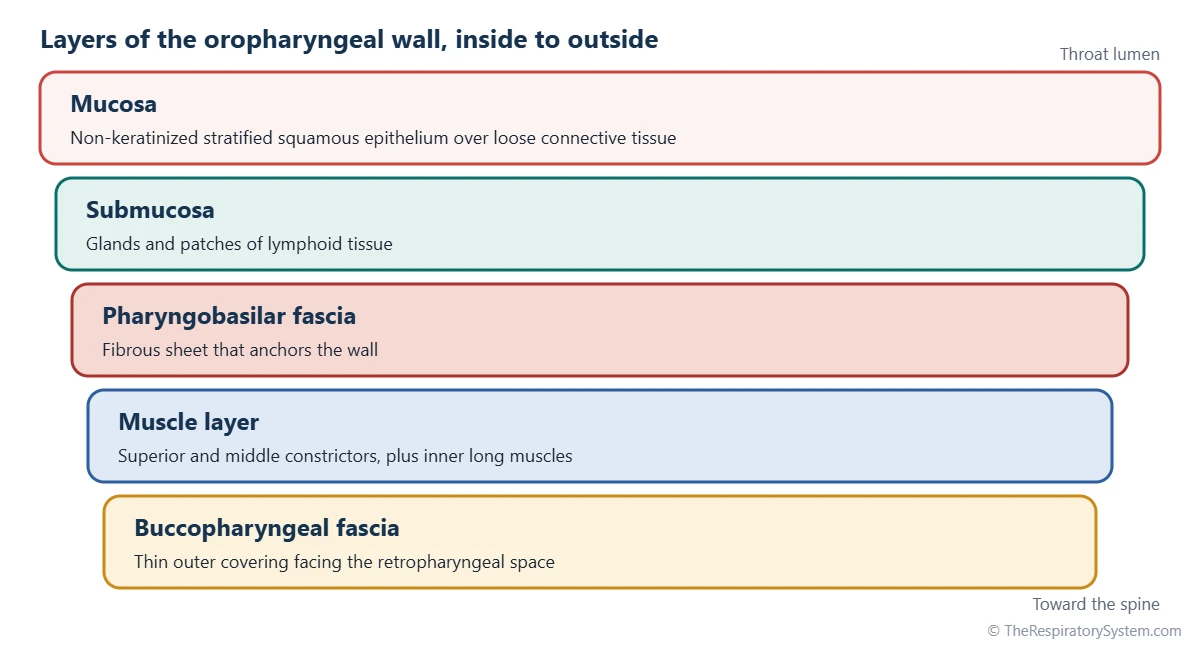
The oropharynx is a short muscular tube whose front wall is the base of the tongue, whose side walls hold the palatine tonsils between two arches, and whose back wall is made of the pharyngeal constrictor muscles. It is lined throughout by a moist, non-keratinized stratified squamous epithelium that stands up to the rubbing of swallowed food.
Front wall and the valleculae
The back third of the tongue forms the front wall and carries the lingual tonsil, a bumpy layer of lymphoid tissue. Between the tongue base and the epiglottis lie two small pockets called the valleculae, separated by a midline fold of mucous membrane. Food and saliva can briefly pool in them before a swallow.
Side walls and the palatine tonsils
On each side, two curtain-like folds run down from the soft palate: the palatoglossal arch in front and the palatopharyngeal arch behind. The palatine tonsils, usually just called "the tonsils", sit in the tonsillar fossa between them. Together with the lingual tonsil and the adenoids, they form a ring of lymphoid tissue around the entrance to the throat, often called Waldeyer's ring.
Roof and back wall
The underside of the soft palate forms the roof, and the uvula hangs down from its middle edge into the oropharynx. The back wall is made mainly of the superior and middle pharyngeal constrictor muscles, which squeeze food downward during swallowing.
Nerves and blood supply
Sensation from the oropharynx is carried mainly by the glossopharyngeal nerve, which also carries taste from the back of the tongue and starts the gag reflex. Most of its muscles are supplied by the vagus nerve through the pharyngeal plexus. Blood comes from branches of the external carotid artery, including the tonsillar branch of the facial artery and the ascending pharyngeal and lingual arteries.
| Wall or landmark | What forms it | Notes |
|---|---|---|
| Upper limit | Level of the soft palate | Opens into the nasopharynx; sealed by the soft palate when swallowing |
| Lower limit | Upper border of the epiglottis | Continues into the laryngopharynx |
| Front opening | Oropharyngeal isthmus between the palatoglossal arches | Doorway from the oral cavity |
| Front wall | Base (back third) of the tongue | Carries the lingual tonsil |
| Back wall | Superior and middle pharyngeal constrictors | Lies in front of the second and third cervical vertebrae |
| Side walls | Palatoglossal and palatopharyngeal arches | Palatine tonsils sit in the fossa between them |
| Roof | Underside of the soft palate | The uvula hangs down from its free edge |
| Valleculae | Pockets between tongue base and epiglottis | Saliva and food can pool here briefly |
| Lining | Non-keratinized stratified squamous epithelium | Resists wear from swallowed food |
| Sensory nerve | Glossopharyngeal nerve | Sensation, taste on the back of the tongue, gag reflex |
| Motor nerve | Vagus nerve via the pharyngeal plexus | Drives the constrictor muscles in swallowing |
| Blood supply | Branches of the external carotid artery | Tonsillar, ascending pharyngeal and lingual arteries |
| Source: Typical adult anatomy, our editors | ||
Oral Cavity vs Oropharynx: Where Does the Mouth End?
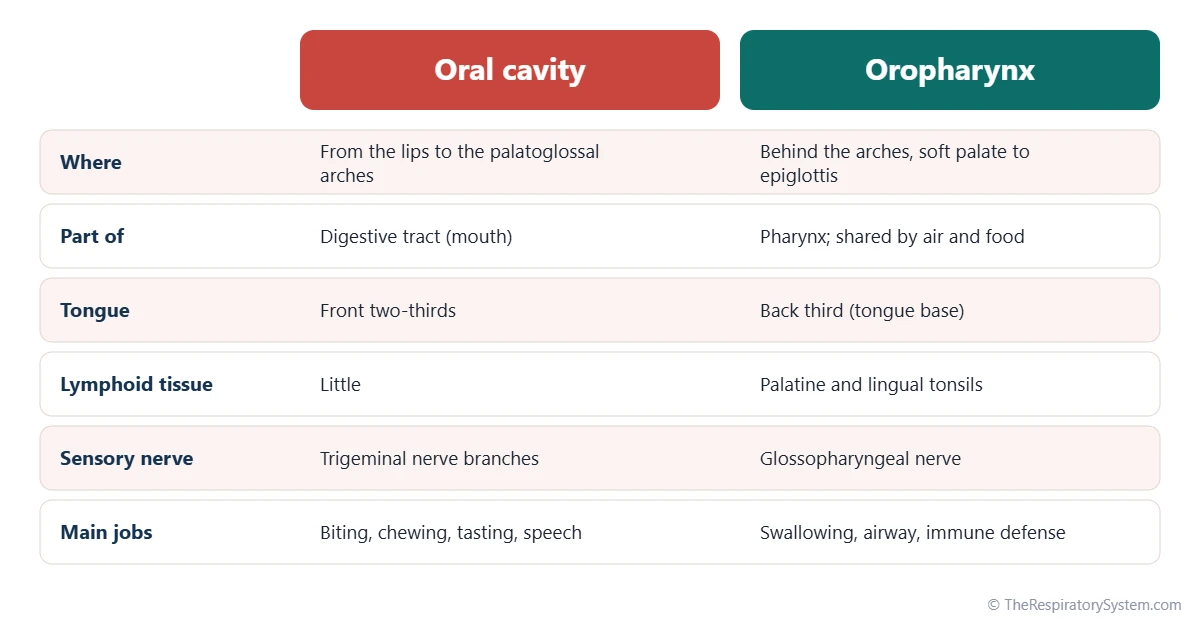
The oral cavity ends and the oropharynx begins at the oropharyngeal isthmus, the archway framed by the soft palate above, the palatoglossal arches at the sides and the back of the tongue below. Everything in front of that line is mouth; everything behind it is throat.
The tongue itself crosses the border. Its front two-thirds belong to the oral cavity, while its back third, the tongue base, belongs to the oropharynx. The two parts are separated by a V-shaped groove behind a row of large taste bumps called the circumvallate papillae. The two regions also differ in nerve supply and in their main jobs, as the comparison below shows.
What Is the Function of the Oropharynx?
The function of the oropharynx is to serve as a shared passage for air and food, to push food toward the esophagus during swallowing, to guard the body with its tonsils, and to help shape the sound of the voice. It is one of the few places where the respiratory and digestive tracts share the same space.
- Air passage: during breathing, air from the nose or mouth flows down through the oropharynx toward the larynx, whichever entrance it used; see nose breathing vs mouth breathing.
- Swallowing: the tongue pushes food back through the isthmus, the soft palate rises to seal off the nasopharynx, and the constrictor muscles squeeze the food downward while breathing pauses for a moment.
- Immune defense: the palatine and lingual tonsils sample germs from food and air and help start immune responses.
- Protective reflexes: touching the back of the oropharynx triggers the gag reflex, which helps stop large objects from being swallowed.
- Speech: the space of the oropharynx acts as a resonating chamber that helps give each voice its tone; see how the voice is produced.
- Taste: the tongue base carries scattered taste buds, and the glossopharyngeal nerve that serves it also carries taste from the circumvallate papillae just in front of it.
During swallowing, the larynx also rises and the epiglottis tips back, so food passes behind the airway rather than into it. The full sequence is part of the pathway of air and food through the throat.
Nasopharynx vs Oropharynx vs Laryngopharynx
The nasopharynx carries only air, while the oropharynx and laryngopharynx carry both air and food; they differ mainly in what they lie behind and how they are lined. The nasopharynx lies behind the nose and is lined largely by ciliated respiratory epithelium, the oropharynx lies behind the mouth, and the laryngopharynx, also called the hypopharynx, lies behind the larynx and leads into the esophagus.
Because food passes through them, the oropharynx and laryngopharynx are lined with stratified squamous epithelium, which resists wear better than the delicate ciliated lining higher up. The detailed side-by-side table of all three parts is on our pharynx page, and our larynx vs pharynx guide explains how the throat and the voice box differ.
Common Conditions That Affect the Oropharynx
Conditions of the oropharynx mostly involve infection or swelling of its lining and tonsils, narrowing of the airway during sleep, or, less often, tumors. Our respiratory diseases section covers these conditions, and a persistent sore throat or trouble swallowing is a reason to see a doctor.
- Pharyngitis: inflammation of the throat lining, usually from a viral infection, which causes a sore throat.
- Tonsillitis: infection and swelling of the palatine tonsils.
- Peritonsillar abscess: a collection of pus beside a tonsil that can push the uvula to one side.
- Obstructive sleep apnea: the soft palate, tongue base and tonsils fall back during sleep and repeatedly narrow the oropharyngeal airway.
- Oropharyngeal cancer: cancer of the tonsils, tongue base or throat walls; in the United States most cases are now linked to human papillomavirus (HPV), while others are linked to tobacco and alcohol.
- Oropharyngeal dysphagia: difficulty moving food from the mouth into the throat, often after a stroke or with nerve and muscle disorders.
Key Facts
- The oropharynx is the middle part of the pharynx, behind the mouth, between the soft palate and the tip of the epiglottis.
- It is shared by the respiratory and digestive tracts, carrying both air and food.
- The palatine tonsils sit in its side walls and the lingual tonsil on the base of the tongue at its front.
- Its lining is non-keratinized stratified squamous epithelium, which resists wear from food, unlike the ciliated lining of the nasopharynx.
- The mouth ends and the oropharynx begins at the palatoglossal arches; the back third of the tongue belongs to the oropharynx.
- Sensation and the gag reflex depend mainly on the glossopharyngeal nerve.
- The oropharynx is a common site of airway narrowing in obstructive sleep apnea.
Quick Quiz: Test What You Know About the Oropharynx
6 questions. Tap an answer to check it.
Which part of the pharynx lies directly behind the mouth?
The oropharynx is the middle part of the pharynx, behind the oral cavity, between the soft palate and the epiglottis.
What marks the lower limit of the oropharynx?
The oropharynx extends down to the upper border of the epiglottis, where the laryngopharynx begins.
Which tonsils sit in the side walls of the oropharynx?
The palatine tonsils lie in the tonsillar fossae between the palatoglossal and palatopharyngeal arches.
What type of epithelium lines the oropharynx?
Because food passes through it, the oropharynx is lined by non-keratinized stratified squamous epithelium.
Which nerve carries sensation from the oropharynx and starts the gag reflex?
The glossopharyngeal nerve supplies sensation to the oropharynx and carries the sensory signal of the gag reflex.
Which part of the tongue belongs to the oropharynx?
The back third of the tongue, the tongue base, forms the front wall of the oropharynx and carries the lingual tonsil.
Frequently Asked Questions
Is the oropharynx part of the respiratory or digestive system?
It is part of both. The oropharynx is a shared passage: air flows through it on the way from the nose or mouth to the larynx, and food and drink pass through it on the way from the mouth to the esophagus. Anatomists place it in the upper respiratory tract and also in the upper digestive tract.
Is the oropharynx the same as the throat?
Not exactly. In everyday speech, the throat usually means the whole pharynx, sometimes together with the larynx. The oropharynx is only the middle section of the pharynx, the part behind the mouth. When people say they have a sore throat, the redness they see in a mirror is usually on the walls and tonsils of the oropharynx.
Can you see your oropharynx in a mirror?
Partly. With the mouth open wide and the tongue pressed down, a mirror shows the back wall of the oropharynx, the palatine tonsils between their arches and the uvula hanging from the soft palate. The base of the tongue, the valleculae and the lower parts are hidden behind the tongue and need an angled mirror or camera to see.
What happens in the oropharynx when you breathe and swallow at the same time?
You cannot truly do both at once. During the throat phase of a swallow, breathing stops for a brief moment while the soft palate seals the nasopharynx, the larynx rises, the vocal cords close and the epiglottis tips back. This short pause, often under a second, lets food cross the oropharynx without entering the airway.
Why is the oropharynx not lined with cilia?
Cilia are delicate and suited to moving mucus over surfaces that only air touches, such as the nasal cavity and nasopharynx. The oropharynx is rubbed by every mouthful of food and drink, so it is lined by layers of flat cells, non-keratinized stratified squamous epithelium, that can be worn away at the surface and constantly replaced from below.
What is an oropharyngeal airway?
An oropharyngeal airway is a curved plastic device used by trained medical staff. Placed in the mouth of an unconscious person, it holds the tongue base forward so that it cannot fall back and block the oropharynx. It is named after the region it keeps open and shows how easily the tongue can obstruct this part of the throat.
Does the oropharynx change with age?
Yes. In young children the palatine tonsils and adenoids are relatively large and can take up much of the space, then they usually shrink after childhood. With aging, the throat muscles and soft tissues can lose some tone, which is one reason snoring and narrowing of the oropharyngeal airway during sleep become more common in later life.
How is the oropharynx different from the nasopharynx?
The nasopharynx lies behind the nose and above the soft palate and carries only air, while the oropharynx lies behind the mouth and carries both air and food. The nasopharynx holds the adenoids and the openings of the Eustachian tubes; the oropharynx holds the palatine and lingual tonsils. Their linings also differ, ciliated versus stratified squamous.


