At a Glance
The uvula (palatine uvula) is a small cone of muscle, connective tissue and glands hanging from the back edge of the soft palate, above the root of the tongue. It is moved by its own tiny muscle, the musculus uvulae, and helps the soft palate close off the nasopharynx during swallowing and speech, while its glands help keep the throat moist.
- Location
- Midline of the back edge of the soft palate, at the entrance to the oropharynx
- Type of tissue
- Muscle (musculus uvulae), loose connective tissue and saliva glands, covered by mucous membrane
- Function
- Helps seal the nasopharynx in swallowing and speech, moistens the throat, shapes uvular sounds
- Nerve supply
- Motor: vagus nerve through the pharyngeal plexus; sensation: palatine branches of the trigeminal nerve and the glossopharyngeal nerve
- Connects to
- Soft palate above, palatine arches on each side, oropharynx behind
- Part of
- The soft palate, on the border between the mouth and the upper respiratory tract
On this page
What Is the Uvula?
The uvula is a small, finger-like or teardrop-shaped projection of soft tissue that hangs down from the center of the soft palate, the muscular back part of the roof of the mouth. Its full anatomical name is the palatine uvula, from the Latin word for "little grape", which describes its rounded tip. It is easy to see in a mirror when the mouth is opened wide and the tongue is held down.
Uvula definition in anatomy
In anatomy, the uvula is defined as the conical midline process of the free lower border of the soft palate. It is part of the palate, not of the throat, but it sits exactly where the oral cavity opens into the oropharynx, the middle part of the pharynx. That position makes it a shared landmark of the digestive and upper respiratory tract.
Explained simply
Picture the roof of your mouth as a ceiling that is hard in the front and soft like a curtain at the back. The uvula is the little tassel hanging from the middle of that curtain. When you swallow, the curtain lifts and the tassel tucks up with it, helping to shut the door between your mouth and the back of your nose.
Where Is the Uvula Located in the Mouth?
The uvula is located at the back of the mouth, hanging from the midline of the soft palate just above the back of the tongue and in front of the throat. On each side of it, two curved folds called the palatine arches run down to the tongue and the side wall of the pharynx, and the palatine tonsils sit in the space between them.
The soft palate and the uvula
The soft palate, also called the velum, is a movable sheet of muscle and connective tissue attached to the back edge of the bony hard palate. Its upper surface faces the nasopharynx and the back openings of the nose, the choanae, while its lower surface faces the mouth. The uvula hangs from its free back edge like a pendant.
Neighbors of the uvula
- Above and behind: the nasopharynx, with the adenoids on its back wall.
- Below: the back of the tongue and, lower still, the epiglottis, whose tip is sometimes visible below the uvula.
- Behind: the back wall of the oropharynx.
- To each side: the palatoglossal and palatopharyngeal arches with the palatine tonsils between them.
What Is the Uvula Made Of?
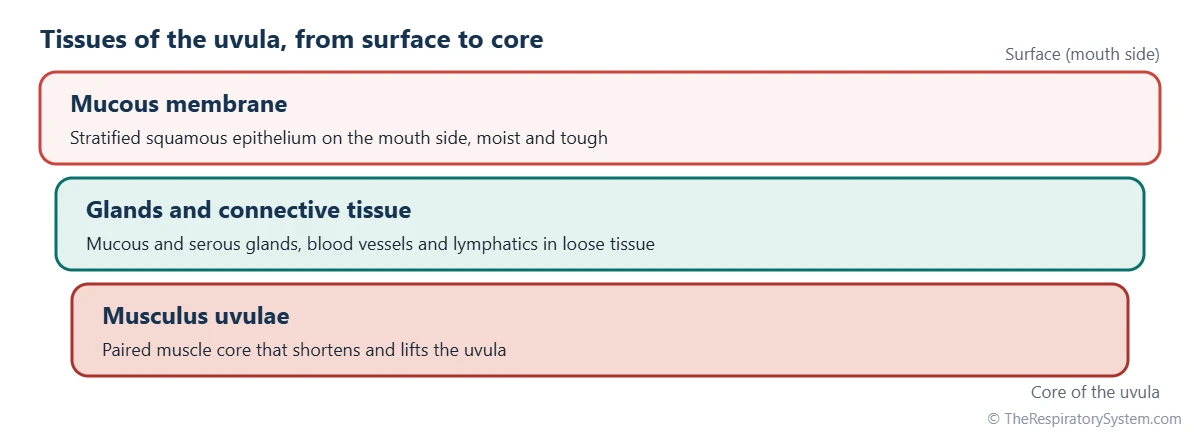
The uvula is made of a core of skeletal muscle, the musculus uvulae, surrounded by loose connective tissue, many small saliva-producing glands and blood vessels, all covered by a moist mucous membrane. It contains no bone or cartilage, which is why it is soft and flexible.
Muscle of the uvula
The musculus uvulae is a paired, slender muscle that starts at the back of the hard palate (the posterior nasal spine) and the tough sheet of tendon inside the soft palate, then runs back into the uvula. When it contracts, it shortens and thickens the uvula and pulls it up and back. Like most muscles of the soft palate, it is controlled by the vagus nerve through the pharyngeal plexus.
Lining and glands
The surface facing the mouth is lined by stratified squamous epithelium, the same tough, many-layered lining found inside the cheeks, which resists rubbing from food. The upper surface of the soft palate, facing the nose, carries respiratory epithelium with cilia. Beneath the lining, the uvula is packed with small mucous and serous glands that add saliva to the back of the mouth. The table below sums up its parts.
| Part | What it is | What it does |
|---|---|---|
| Musculus uvulae | Paired slender skeletal muscle running from the back of the hard palate into the uvula | Shortens, thickens and lifts the uvula |
| Palatine aponeurosis | Sheet of tendon inside the soft palate | Anchors the muscles of the soft palate and uvula |
| Oral mucosa | Stratified squamous epithelium on the mouth side | Resists rubbing from food and drink |
| Nasal surface lining | Ciliated respiratory epithelium on the upper side of the soft palate | Moves mucus toward the throat |
| Glands | Many small mucous and serous glands | Add saliva to moisten the throat |
| Connective tissue | Loose tissue with blood vessels and lymphatics | Gives shape; swells easily when irritated |
| Blood supply | Branches of the lesser palatine, ascending palatine and ascending pharyngeal arteries | Nourish the soft palate and uvula |
| Nerves | Vagus nerve (movement); trigeminal and glossopharyngeal branches (sensation) | Control movement and carry touch signals |
| Source: Standard anatomy, our editors | ||
What Is the Uvula For?
The uvula's main job is to help the soft palate close off the nasal passages during swallowing and speech, and its glands help keep the throat moist. It works as part of the whole soft palate rather than on its own.
Uvula function in swallowing
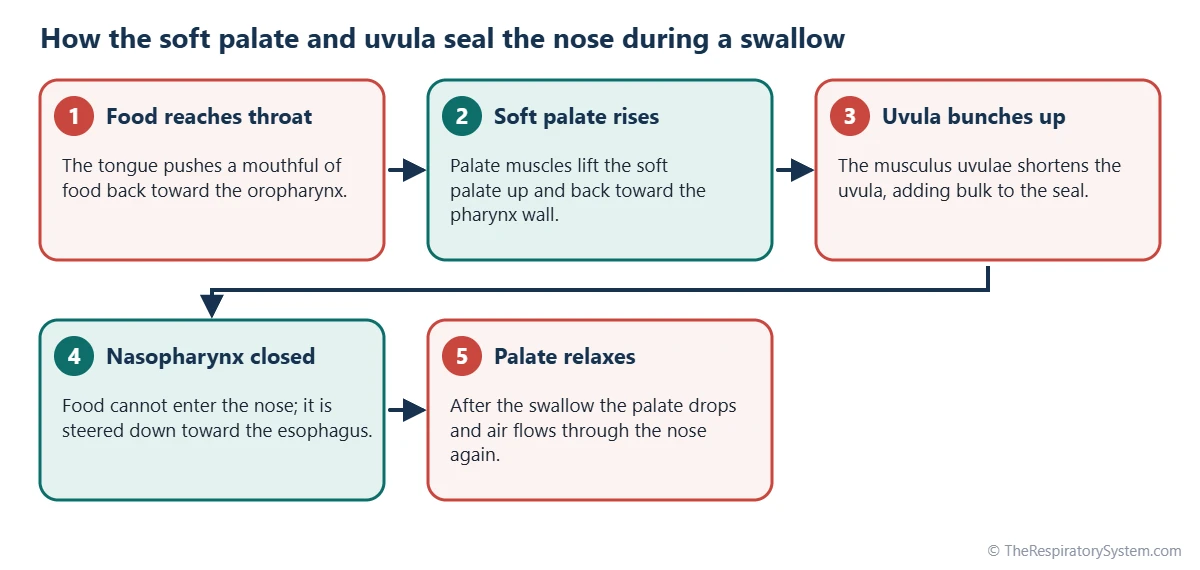
When you swallow, the soft palate rises and presses against the back wall of the pharynx, a movement called velopharyngeal closure. The musculus uvulae bunches the uvula up into the gap and adds bulk to this seal, so food and drink are steered down toward the esophagus instead of up into the nasal cavity. At the same moment, the epiglottis and larynx protect the airway below, a sequence explained on our trachea vs esophagus page.
Uvula function in speech
The soft palate and uvula also decide whether air flows out through the nose or the mouth while you talk. Most English sounds need the palate raised so air leaves through the mouth, while sounds like "m" and "n" need it lowered so air escapes through the nose. In languages such as French, German and Arabic, the back of the tongue touches or vibrates against the uvula to form so-called uvular consonants; our guide to how the voice is produced covers the rest of speech.
Moisture and protection
The glands of the uvula release thin saliva onto the back of the mouth and throat, which helps with swallowing and keeps the lining from drying out, especially during mouth breathing. Sensory nerve endings in and around the soft palate also help trigger the gag reflex, which pushes unwanted objects back out of the throat.
What Is the Difference Between the Epiglottis and the Uvula?
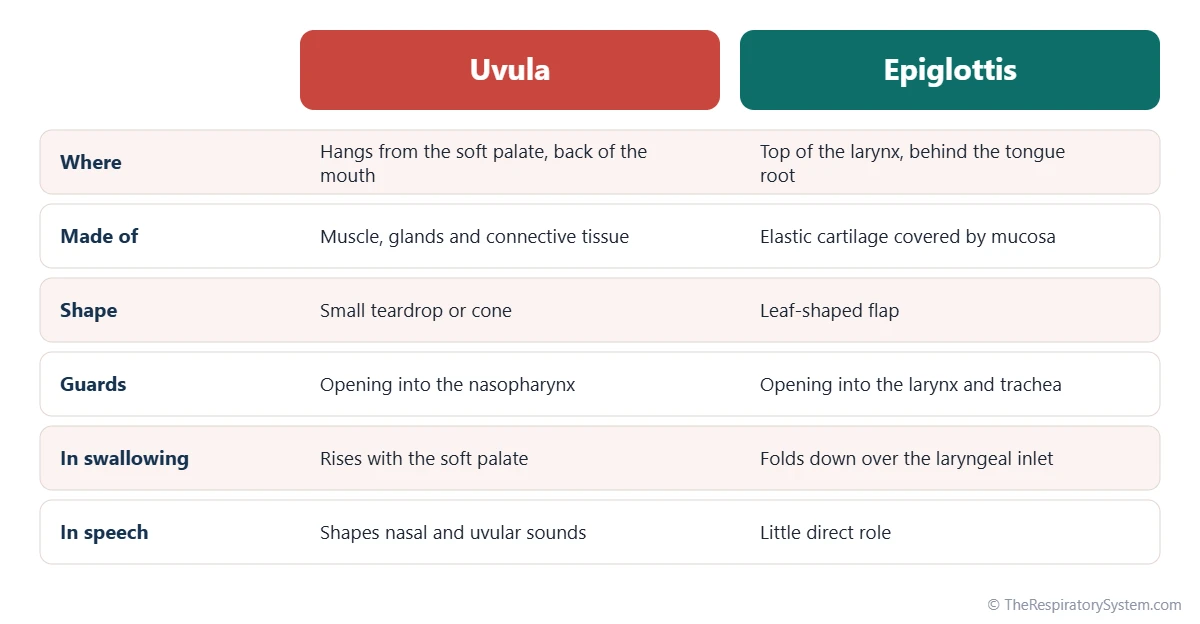
The uvula is a soft, muscular tassel hanging from the soft palate that helps seal off the nose, while the epiglottis is a leaf-shaped flap of elastic cartilage at the top of the larynx that folds down to cover the airway. Both act during swallowing, but they guard different openings.
The uvula sits higher, at the back of the mouth, and protects the route into the nasopharynx. The epiglottis sits lower, behind the root of the tongue, and protects the route into the larynx and trachea. A problem with the soft palate can let liquid come out of the nose, while a problem with the epiglottis seal can let food slip toward the lungs and trigger the cough reflex. The diagram below compares them side by side.
How Does the Uvula Form Before Birth?
The uvula forms as the last part of the palate to close during early fetal development, when two shelves of tissue growing from each side of the upper jaw meet and fuse in the midline. Fusion starts at the front of the mouth and moves backward, finishing with the soft palate and uvula.
Because the uvula is the final part to join, a small failure at the very end of this process leaves a split, or bifid, uvula with two tips instead of one. Larger failures cause a cleft palate. The general timing of these steps is described in our page on development of the respiratory system.
Common Conditions That Affect the Uvula
Conditions that affect the uvula include swelling (uvulitis), a split uvula, an unusually long uvula and its part in snoring, and most of them are linked to the soft palate or throat as a whole. Our respiratory diseases section covers throat conditions in more depth.
- Uvulitis: swelling and redness of the uvula, often with infection of the throat such as pharyngitis or tonsillitis, or with allergic reactions, irritation or dehydration.
- Bifid uvula: a uvula split into two parts. It is usually harmless on its own but is sometimes linked to a hidden cleft in the muscle of the soft palate (submucous cleft palate).
- Elongated uvula: a long or thick uvula can touch the back of the tongue and may add to throat irritation or snoring.
- Snoring and sleep apnea: during sleep, the soft palate and uvula can vibrate or sag into the airway; a narrow airway at this level is one factor in sleep apnea.
- Nerve problems: if the vagus nerve on one side is damaged, the uvula is pulled toward the healthy side when a person says "ah", which is why doctors look at it during a neurological exam.
A sore, swollen uvula that makes swallowing or breathing hard is a reason to see a doctor.
Key Facts
- The uvula is the teardrop-shaped tissue hanging from the middle of the soft palate at the back of the mouth.
- Its name comes from the Latin for "little grape", and its full name is the palatine uvula.
- It contains its own small muscle, the musculus uvulae, but no bone or cartilage.
- During swallowing, the soft palate and uvula rise to close off the nasopharynx so food does not enter the nose.
- Glands in the uvula add thin saliva that keeps the back of the throat moist.
- A split or bifid uvula forms when the two halves of the palate do not fully join at the very end of fetal development.
- The uvula is not the epiglottis: the epiglottis is a cartilage flap lower down that covers the larynx.
Quick Quiz: Test What You Know About the Uvula
6 questions. Tap an answer to check it.
What does the uvula hang from?
The uvula hangs from the midline of the free back edge of the soft palate.
Which muscle lies inside the uvula?
The paired musculus uvulae shortens, thickens and lifts the uvula.
What is the main job of the soft palate and uvula during swallowing?
They rise to seal the nasopharynx so food and drink do not go up into the nose.
What kind of tissue covers the mouth side of the uvula?
Like the inside of the cheeks, the oral surface is lined by tough, many-layered stratified squamous epithelium.
A bifid uvula is a uvula that is:
Bifid means split in two; it forms when the palate does not fully fuse at its very back end.
Which nerve controls the muscle of the uvula?
The musculus uvulae is supplied by the vagus nerve through the pharyngeal plexus.
Frequently Asked Questions
What does uvula mean?
Uvula is a Latin word meaning "little grape", a name chosen because the rounded tip of the tissue looks like a small grape hanging at the back of the mouth. In anatomy the word is also used for a few other small hanging structures, such as a bump in the bladder and a part of the cerebellum, so the throat structure is formally called the palatine uvula.
Can you live without a uvula?
Yes. Some people have part or all of the uvula removed in surgery for other reasons, and most swallow and speak normally afterward because the rest of the soft palate does most of the sealing work. Some may notice a drier throat, small changes in voice resonance or, rarely, liquid entering the nose when swallowing. The uvula helps, but it is not essential for life.
Why does the uvula swell?
The uvula is made largely of loose connective tissue with many glands and blood vessels, so fluid can collect in it quickly. Swelling can follow a throat infection, an allergic reaction, irritation from smoke or very hot food, heavy snoring or dehydration. Because it hangs right at the entrance to the throat, even mild swelling can feel like something is stuck at the back of the mouth.
Does the uvula cause snoring?
The uvula can contribute to snoring but is rarely the only cause. During sleep the muscles of the throat relax, and air rushing past the soft palate and uvula can make them vibrate, producing the snoring sound. A long uvula, a low soft palate, large tonsils or a narrow throat can all add to it. Persistent loud snoring with pauses in breathing can be a sign of sleep apnea.
Does the uvula move when you talk?
Yes. The uvula moves with the soft palate, which rises for most speech sounds to block air from leaving through the nose and lowers for nasal sounds such as "m", "n" and "ng". In some languages the tongue also presses against the uvula or makes it vibrate to produce uvular sounds, such as the throaty "r" heard in French and German.
Do animals have a uvula?
A well-developed uvula hanging from the soft palate is a typical human feature, and most other mammals do not have one. Many mammals, such as dogs and cats, have a soft palate without a hanging uvula. Scientists have suggested that the human uvula may be linked to speech or to the way our upright throat is shaped, but its evolutionary purpose is still debated.
Why is my uvula leaning to one side?
A uvula that sits slightly off center is often just a normal variation in shape. When the uvula is pulled clearly to one side only while saying "ah", it can mean the muscles of the soft palate are weaker on the other side, which can happen when the vagus nerve is affected. Swelling of one tonsil or of the tissue around it can also push the uvula aside.
Is the uvula part of the respiratory system?
The uvula belongs to the soft palate, which is part of the mouth, but it sits at the crossroads of the digestive and respiratory passages. By helping to seal the nasopharynx during swallowing and controlling whether air leaves through the nose or the mouth during speech, it works closely with the upper respiratory tract, which is why it is often studied alongside the pharynx and larynx.
Keep Exploring


