At a Glance
Phonation is the process in which air from the lungs makes the vocal folds in the larynx vibrate, creating the sound source of the voice. In a typical speaking voice the folds open and close roughly 100 to 150 times per second in adult men and about 200 times per second in adult women, and the vocal tract above the larynx filters this buzz into vowels and words.
- Where
- The glottis, the opening between the two vocal folds inside the larynx
- Power source
- Air pushed up from the lungs by the breathing muscles
- Sound source
- Vibration of the vocal folds, driven by air pressure and their own elasticity
- Filter
- The vocal tract: pharynx, mouth and nasal cavity, which shape the tone into vowels
- Nerve control
- Vagus nerve, through the superior and recurrent laryngeal nerves
- Part of
- Voice production, together with resonance and articulation
On this page
- What Is Phonation?
- How Is Sound Produced in the Voice?
- Phonation Process: What Are the Phonation Steps?
- What Path Does Air Take During Voice Production?
- What Controls Pitch, Loudness and Voice Quality?
- Phonation vs Resonance: What Is the Difference?
- How Do the Brain and Nerves Control Phonation?
- How Does the Voice Change With Age?
- Common Conditions That Affect Phonation
- Key Facts
- Quiz
- FAQ
What Is Phonation?
Phonation is the making of voiced sound by the vibration of the vocal folds in the larynx, powered by air breathed out from the lungs. It is the first stage of voice production: the larynx supplies a raw tone, and the spaces above it turn that tone into recognizable speech or song. The anatomy of the folds themselves is covered on our vocal cords page; this page follows the process.
Phonation definition
In anatomy and speech science, phonation is defined as the conversion of a steady stream of exhaled air into a series of rapid air pulses by the opening and closing of the glottis. Each pulse is a small burst of pressure, and the regular train of pulses is a sound wave. Sounds made this way are called voiced sounds, such as every vowel and consonants like z, v, b and m.
Phonation, voice and speech
The three words are related but not identical. Phonation is the sound made at the glottis. Voice is that sound after it has been colored by the throat, mouth and nose. Speech adds articulation, the fast movements of the tongue, lips, jaw and soft palate that turn voice into words.
Explained simply
Stretch the neck of a blown-up balloon and let the air squeak out. The rubber edges flap open and shut many times a second, and that flapping makes a sound. Your vocal folds do the same thing with the air from your lungs, and your mouth then shapes the squeak into words.
How Is Sound Produced in the Voice?
Sound is produced in the voice by three systems working in a row: the lungs supply moving air, the vocal folds turn that air into a vibrating tone, and the vocal tract filters the tone into the sounds of speech. Speech scientists call this the source-filter model of voice production.
- Power source: the lungs, driven by the diaphragm, the intercostal muscles and the abdominal wall, push air upward through the trachea with a controlled, steady pressure.
- Vibrator (source): the two vocal folds in the larynx close across the airway and vibrate as air forces its way between them, creating a buzz rich in overtones.
- Resonator (filter): the pharynx, the oral cavity and, for some sounds, the nasal cavity boost some frequencies of the buzz and damp others.
- Articulators: the tongue, lips, teeth, jaw and soft palate change the shape of the tract from moment to moment to form vowels and consonants.
The key idea is that the source and the filter work separately. The larynx sets the pitch, while the shape of the tract sets which vowel you hear, so you can sing the same note on "ah" and on "ee", or say "ah" on many different notes.
Phonation Process: What Are the Phonation Steps?
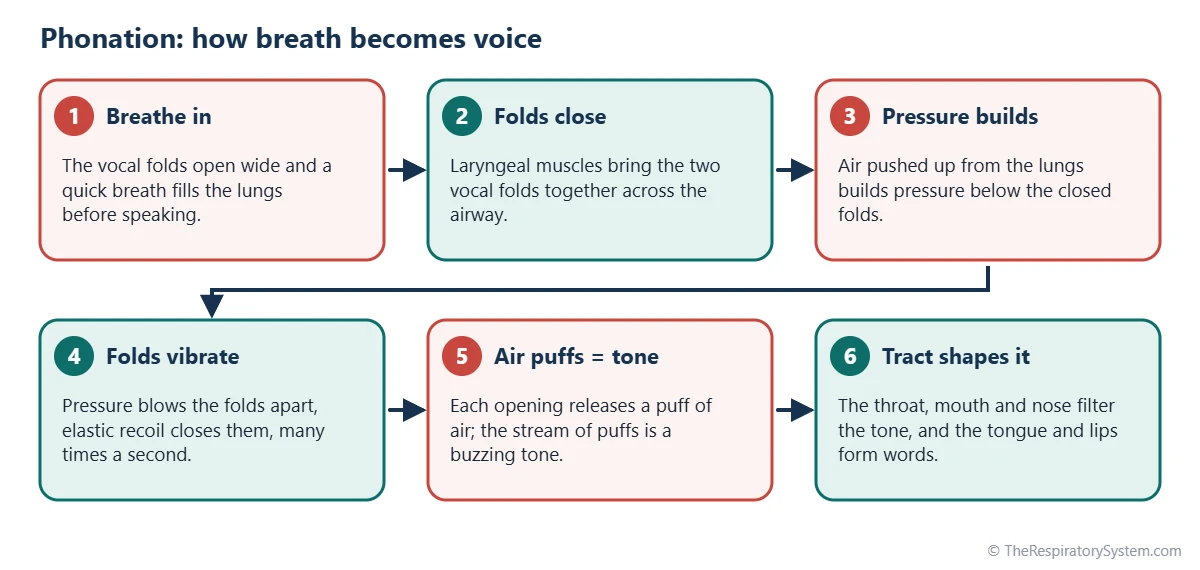
The phonation process begins when muscles bring the vocal folds together, continues as air pressure from the lungs blows them apart, and repeats as the folds spring back and close again, many times per second. The steps below follow one stretch of voiced sound from the first breath to the word you hear.
- A breath in. The vocal folds swing wide apart and air fills the lungs, usually through a quick breath taken between phrases.
- The folds close. Small muscles rotate and slide the arytenoid cartilages so the vocal folds meet in the midline, a movement called adduction.
- Pressure builds below. As the breathing muscles push air upward, pressure rises in the space below the closed folds, the subglottis.
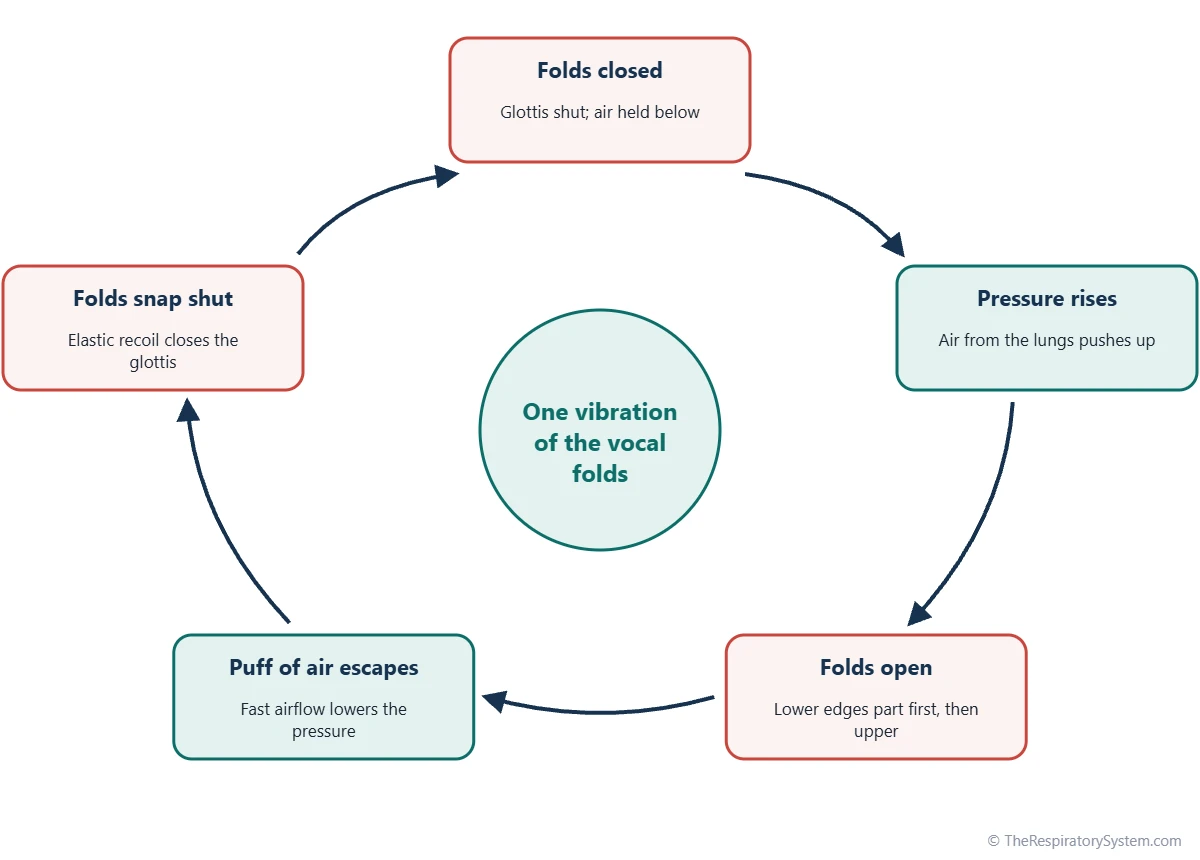
- The folds are blown apart. When that pressure is high enough, it forces the folds open, their lower edges first and their upper edges a moment later.
- The folds snap back. The elastic tissue of the folds pulls them back together, helped by the drop in pressure in the fast stream of air between them.
- The cycle repeats. Pressure builds again, and the open-close cycle runs on as long as air keeps flowing and the folds stay close together.
- The tract shapes the sound. The train of air puffs passes up through the throat and mouth, which filter it into vowels while the articulators add consonants.
What keeps the vocal folds vibrating?
The vibration is explained by the myoelastic-aerodynamic theory: the muscles set the position and tension of the folds, and air pressure together with the folds' own elasticity keeps them moving. No nerve impulse is needed for each single vibration, which is why the folds can vibrate hundreds of times per second. The folds also have a loose, jelly-like cover over a firmer muscular body, so each cycle runs as a ripple, the mucosal wave, that travels across the fold surface from bottom to top.
| Step | What happens | Main structures |
|---|---|---|
| 1. Breath in | Vocal folds open wide; air fills the lungs | Diaphragm, intercostal muscles, posterior cricoarytenoid muscles |
| 2. Adduction | Vocal folds move together and close the glottis | Arytenoid cartilages, lateral cricoarytenoid and arytenoid muscles |
| 3. Pressure builds | Air pressure rises below the closed folds | Lungs, abdominal and intercostal muscles, subglottis |
| 4. Folds blown apart | Pressure pushes the folds open, lower edges first | Vocal folds, glottis |
| 5. Folds snap shut | Elastic recoil and falling pressure close the folds | Vocal ligament, mucosal cover of the folds |
| 6. Repeat | The open-close cycle runs many times per second | Vocal folds, with tension set by the cricothyroid and thyroarytenoid |
| 7. Filtering | Air puffs pass up the tract, which shapes vowels | Pharynx, oral cavity, nasal cavity |
| 8. Articulation | Tongue, lips and palate add consonants | Tongue, lips, teeth, jaw, soft palate |
| Source: Typical adult voice production, our editors | ||
What Path Does Air Take During Voice Production?
During voice production, air leaves the alveoli, passes up the bronchi and trachea, is set into vibration at the glottis, and then flows through the pharynx and out of the mouth or nose. This is the same route used for every breath out, described on our pathway of air page, but speaking changes how that air is used.
Speech breathing
In quiet breathing, breathing in and breathing out take roughly similar amounts of time. When we talk, the pattern changes: breaths in become short and quick, and breaths out are stretched out and carefully controlled so that a steady pressure reaches the larynx for a whole phrase. The muscles of respiration, including the abdominal muscles, fine-tune this pressure, which is why a long sentence or a loud shout can leave you short of air.
Above the larynx
Above the glottis, the sound passes the epiglottis and enters the laryngopharynx and oropharynx. For most sounds the soft palate and uvula rise and seal off the nasopharynx, sending the sound out through the mouth. For the nasal sounds m, n and ng, the soft palate drops, and sound flows through the nasal cavity and out of the nostrils instead.
What Controls Pitch, Loudness and Voice Quality?
Pitch is controlled mainly by the length, tension and thickness of the vocal folds, loudness mainly by the air pressure below the folds and how firmly they close, and voice quality by the way the folds meet during each cycle.
Pitch
Pitch depends on how many times per second the folds vibrate, their fundamental frequency. The cricothyroid muscle tilts the thyroid cartilage forward, stretching and thinning the folds so they vibrate faster and the pitch rises. The thyroarytenoid muscle, which forms the body of each fold, shortens and thickens it to lower the pitch. Longer, heavier folds vibrate more slowly, which is why adult men usually speak lower than women and children. The laryngeal cartilages page shows the joints that make these movements possible.
Loudness
A louder voice needs more air pressure below the glottis and a firmer, quicker closure of the folds in each cycle. The folds then release stronger puffs of air, so the sound wave carries more energy. Raising loudness also tends to raise pitch slightly, unless the speaker relaxes the folds to compensate.
Voice quality
How tightly and how completely the folds close gives each voice its quality. Folds that close loosely let extra air escape and sound breathy, while folds squeezed hard together sound tight and pressed. The table below lists the main types of phonation, from whisper to falsetto.
| Type | How the vocal folds behave | How it sounds |
|---|---|---|
| Modal voice | Folds vibrate fully and close completely in each cycle | The normal speaking voice |
| Breathy voice | Folds vibrate but never close completely, so air leaks | Soft and airy, like a sigh |
| Pressed voice | Folds squeezed tightly together, with a long closed phase | Tight, strained and edgy |
| Flow phonation | Firm but not forced closure with strong airflow | Clear, full and efficient |
| Vocal fry (creaky voice) | Short, slack, thick folds vibrate slowly and irregularly | Low popping or creaking |
| Falsetto | Folds stretched thin, vibrating mainly at their edges | High, light and flute-like |
| Whisper | Folds do not vibrate; air rushes through a partly open glottis | Hissing, with no pitch |
| Source: Standard voice science descriptions, our editors | ||
Phonation vs Resonance: What Is the Difference?
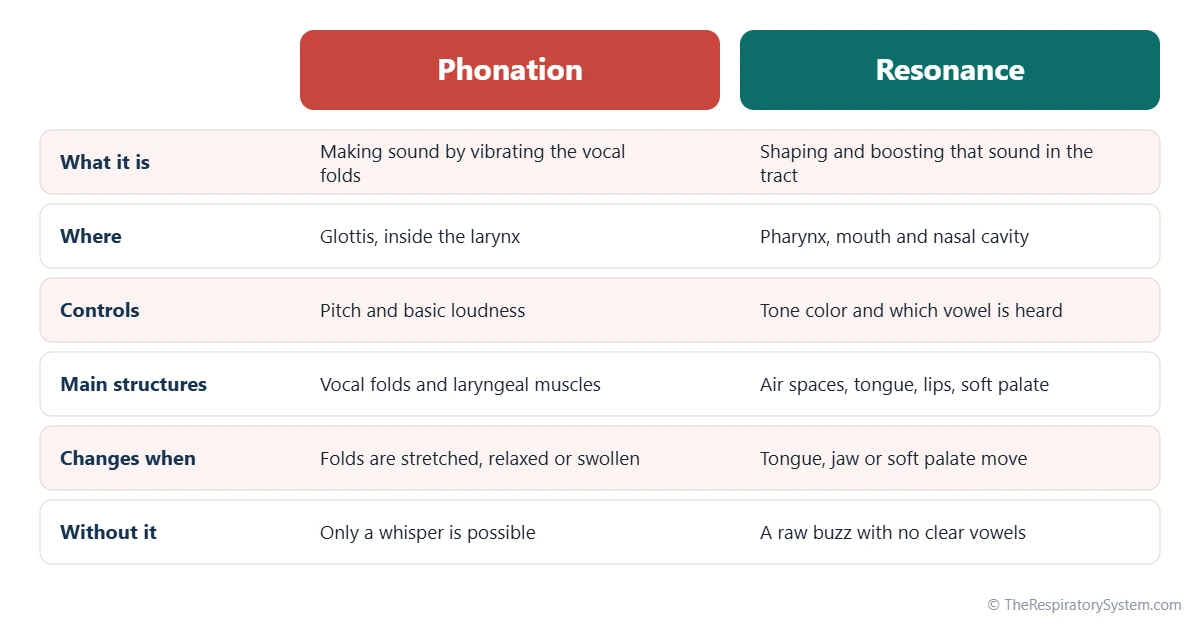
Phonation is the creation of sound at the vocal folds, while resonance is the shaping and amplifying of that sound as it passes through the throat, mouth and nose. Phonation decides the pitch and basic loudness of the voice; resonance decides its tone color and which vowel is heard.
The buzz from the glottis contains the fundamental frequency plus many overtones. The air spaces of the vocal tract each favor certain frequencies, called formants, and weaken the rest. Moving the tongue, lips and jaw changes the size and shape of these spaces and therefore the formants, so the same buzz becomes "ee" when the tongue is high and forward and "ah" when the jaw drops and the tongue lies low.
Resonance also explains why every voice sounds slightly different. Two people can speak at the same pitch, but the size and shape of their pharynx, mouth, nose and paranasal sinuses give each voice its own timbre. When the nose is blocked by a cold, nasal sounds lose their resonance and the voice sounds dull, even though phonation at the larynx is unchanged.
How Do the Brain and Nerves Control Phonation?
Phonation is controlled by motor areas of the brain that send signals through the brainstem and the vagus nerve to the muscles of the larynx, while hearing and touch feed back information to keep the voice on target.
Commands for voluntary speech start in the motor cortex and reach a group of nerve cells in the brainstem called the nucleus ambiguus. From there they travel in the vagus nerve (cranial nerve X). Its superior laryngeal nerve supplies the cricothyroid muscle, the main pitch-raising muscle, while the recurrent laryngeal nerve supplies all the other muscles inside the larynx, which open, close and relax the folds. The larynx page traces both nerves in full.
The same brainstem centers that control phonation also manage breathing, swallowing and coughing, and the protective jobs take priority. During a cough or a swallow, the folds close the glottis firmly, and speech stops. Our page on the glottis vs epiglottis explains how these two structures share the work of guarding the airway. Breathing rhythm is set by the brainstem centers described on our control of breathing page, and speech borrows that rhythm for its pauses.
Hearing your own voice closes the loop. The brain compares the sound you make with the sound you intended and corrects pitch and loudness within a fraction of a second, which is why people raise their voices in a noisy room without noticing.
How Does the Voice Change With Age?
The voice changes with age because the larynx and vocal folds grow, thicken and later thin out, which shifts the pitch and quality of phonation across a lifetime.
- Infancy: a baby's larynx sits high in the neck and its vocal folds are short, so cries are high-pitched. The larynx descends during childhood, which enlarges the pharynx and widens the range of speech sounds.
- Puberty: under the influence of sex hormones, the larynx grows. In boys the vocal folds lengthen and thicken markedly and the voice drops by about an octave, often with breaks and cracks while the muscles adjust. Girls' voices also deepen, but only slightly.
- Adulthood: the voice is most stable, with the folds fully grown and their layered structure mature.
- Older age: the vocal fold muscles and their cover can thin and stiffen. Men's voices often rise a little in pitch, while women's voices tend to lower slightly, and many older voices become weaker or breathier.
How these changes fit with the growth of the whole airway is described on our development of the respiratory system page.
Common Conditions That Affect Phonation
Phonation is affected by anything that swells, stiffens or weighs down the vocal folds, stops them from closing, or disturbs the nerves that move them. The main result is dysphonia, a change in voice such as hoarseness, breathiness or strain. Our respiratory diseases section covers conditions of the airway more broadly, and hoarseness that lasts for weeks is a reason to see a doctor.
- Laryngitis: inflammation of the larynx, often with a cold, swells the folds so they vibrate unevenly and the voice turns hoarse or fades.
- Vocal fold nodules and polyps: small benign growths on the edges of the folds stop them from closing fully, which makes the voice rough and breathy.
- Vocal fold paralysis: damage to the recurrent laryngeal nerve leaves one fold unable to move to the midline, so air leaks and the voice becomes weak and breathy.
- Croup: in young children, swelling just below the vocal folds causes a hoarse voice and a barking cough.
- Spasmodic dysphonia: a neurological condition in which the laryngeal muscles spasm during speech, making the voice strained or broken.
- Muscle tension dysphonia: excess tension in the muscles around the larynx changes the way the folds meet, without any visible growth.
Key Facts
- Phonation is the production of voiced sound by the vibration of the vocal folds in the larynx, powered by air from the lungs.
- Voice production has three parts: a power source (the lungs), a vibrator (the vocal folds) and a resonator (the throat, mouth and nose).
- The vocal folds do not need a nerve impulse for each vibration; air pressure and their own elasticity keep them moving once they are brought together.
- Pitch rises when the cricothyroid muscle stretches and thins the folds, and falls when the thyroarytenoid muscle shortens and thickens them.
- In a typical speaking voice the folds vibrate roughly 100 to 150 times per second in adult men and about 200 times per second in adult women.
- Whispering uses no vocal fold vibration at all, only air rushing through a partly open glottis.
- The vagus nerve controls the larynx through its superior and recurrent laryngeal branches, described on the larynx page.
Quick Quiz: Test What You Know About the How the Voice Is Produced
6 questions. Tap an answer to check it.
What is phonation?
Phonation is the creation of voiced sound when air from the lungs makes the vocal folds vibrate.
What supplies the power for phonation?
The lungs and breathing muscles act as the power source, pushing air up against the closed vocal folds.
Which muscle mainly raises the pitch of the voice?
The cricothyroid tilts the thyroid cartilage forward, stretching and thinning the vocal folds so they vibrate faster.
What decides which vowel you hear, such as "ee" or "ah"?
Vowels come from resonance: the shape of the throat and mouth sets the formants that the ear recognizes as each vowel.
Which nerve supplies most of the muscles inside the larynx?
The recurrent laryngeal nerve, a branch of the vagus, supplies every intrinsic laryngeal muscle except the cricothyroid.
What happens to the vocal folds during a whisper?
In a whisper the folds stay partly open and do not vibrate; the sound is the noise of air rushing through the glottis.
Frequently Asked Questions
What is flow phonation?
Flow phonation is a balanced way of producing voice in which the vocal folds close firmly enough to make a clear tone but not so tightly that the sound becomes strained. It sits between breathy phonation, where air leaks through the glottis, and pressed phonation, where the folds are squeezed together. Voice scientists describe it as the most efficient mode, because it gives a strong, clear tone without wasted effort or leaking air.
Why does your voice sound different on a recording?
When you speak, you hear your voice in two ways at once: through the air, like everyone else, and through the bones and tissues of your head, which carry the vibrations straight to your inner ear. Bone conduction favors the low frequencies, so your voice sounds deeper and fuller to you. A recording captures only the airborne sound, which is how other people hear you.
Why does the voice crack during puberty?
During puberty, especially in boys, the larynx grows quickly and the vocal folds become longer and thicker within a few years. The muscles that control their tension have to learn to work with the new, heavier folds. Until they adapt, the voice can jump suddenly between the old higher register and the new lower one, which is heard as a crack or break.
Can a person speak without vocal cords?
Yes, although not with ordinary phonation. People can whisper without vocal fold vibration. After the larynx is removed, some people learn to vibrate tissue at the top of the esophagus with swallowed air, others use a tracheoesophageal voice prosthesis, and others hold an electrolarynx against the neck to supply a buzz. In every case the mouth and tongue still shape the sound into words.
Why do men usually have deeper voices than women?
At puberty, rising testosterone makes the male larynx grow larger and the vocal folds become longer and thicker than in most women. Longer, heavier folds vibrate more slowly, so the voice sounds lower. The two plates of the larger thyroid cartilage also meet at a sharper angle, forming the Adam's apple, and the longer vocal tract above it lowers the resonances that color the voice.
How fast can the vocal cords vibrate when singing?
The rate depends on the note. A deep bass voice can sing notes below 100 vibrations per second, while a trained soprano singing very high notes makes her vocal folds vibrate more than 1,000 times per second. Singers reach these extremes by changing the length, tension and vibrating mass of the folds, often switching between registers such as chest voice and falsetto.
Why does your voice sound different when you have a cold?
A cold can change both stages of voice production. Swelling of the vocal folds, as in laryngitis, makes them heavier and less even, so the voice turns rough or lower. Congestion in the nose and sinuses blocks the nasal passages, so sounds like m and n lose their nasal resonance and the voice takes on a stuffy, muffled tone.
What is the difference between voiced and voiceless sounds?
Voiced sounds are made while the vocal folds vibrate, and voiceless sounds are made with the folds held apart. The pairs z and s, v and f, or b and p use the same tongue and lip positions, and differ only in phonation. Place your fingers on the front of your neck and say "zzz" and then "sss": you feel a buzz only with the voiced sound.


