At a Glance
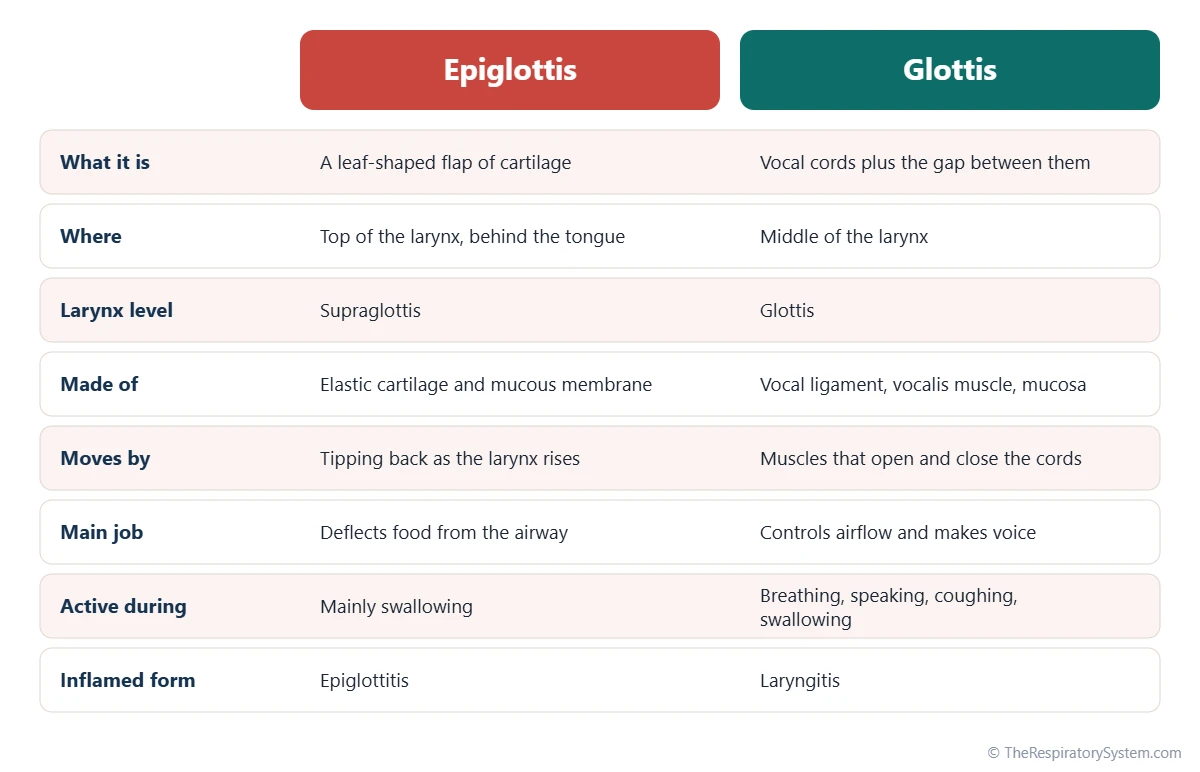
The glottis and epiglottis are two different parts of the larynx. The epiglottis is a flexible lid of elastic cartilage above the laryngeal inlet that folds down over it when you swallow. The glottis lies lower down: it is the true vocal cords plus the gap between them, called the rima glottidis, which is the narrowest part of the adult larynx and the source of the voice.
- Epiglottis
- A leaf-shaped flap of elastic cartilage covered by mucous membrane
- Glottis
- The true vocal cords and the opening between them (rima glottidis)
- Location
- Epiglottis at the top of the larynx behind the tongue; glottis in the middle of the larynx
- Region
- Epiglottis: supraglottis. Glottis: its own level, between supraglottis and subglottis
- Main job
- Epiglottis: steers food away from the airway. Glottis: controls airflow and makes voice
- Part of
- Both are parts of the larynx (voice box)
On this page
- What Is the Difference Between the Glottis and Epiglottis?
- Where Are the Glottis and Epiglottis Located?
- Glottis vs Epiglottis Anatomy: What Are They Made Of?
- Epiglottis vs Glottis Function: What Does Each Do?
- What Do the Glottis and Epiglottis Have in Common?
- How Do the Glottis and Epiglottis Work Together When You Swallow?
- Common Conditions That Affect the Glottis and Epiglottis
- Key Facts
- Quiz
- FAQ
What Is the Difference Between the Glottis and Epiglottis?
The difference between the glottis and epiglottis is that the epiglottis is a solid structure, a cartilage flap that acts as a lid above the airway, while the glottis is the voice-producing part of the larynx: the true vocal cords and the opening between them. The epiglottis sits at the very top of the larynx; the glottis lies a few centimeters lower, inside it.
They also do different jobs. The epiglottis is mainly a shield for swallowing, tipping back to deflect food and drink toward the esophagus. The glottis is a valve that works all the time: it opens wide to breathe, closes and vibrates to speak, and shuts tight to cough, strain or protect the airway.
What is the glottis vs epiglottis in one line?
The epiglottis is the lid on top of the voice box; the glottis is the adjustable doorway with the vocal cords deeper inside it. The names say the same thing: glottis comes from the Greek word for the mouthpiece of a pipe, and epi- means upon, so the epiglottis is the part that sits upon, or above, the glottis.
Explained simply
Think of the larynx as a short tube with a hinged lid on top and a pair of sliding doors halfway down. The lid is the epiglottis: it flips down when you swallow so food slides over it. The sliding doors are the vocal cords, and the gap between them is the glottis. You open the doors to breathe, hum them nearly shut to talk, and slam them closed to cough.
Where Are the Glottis and Epiglottis Located?
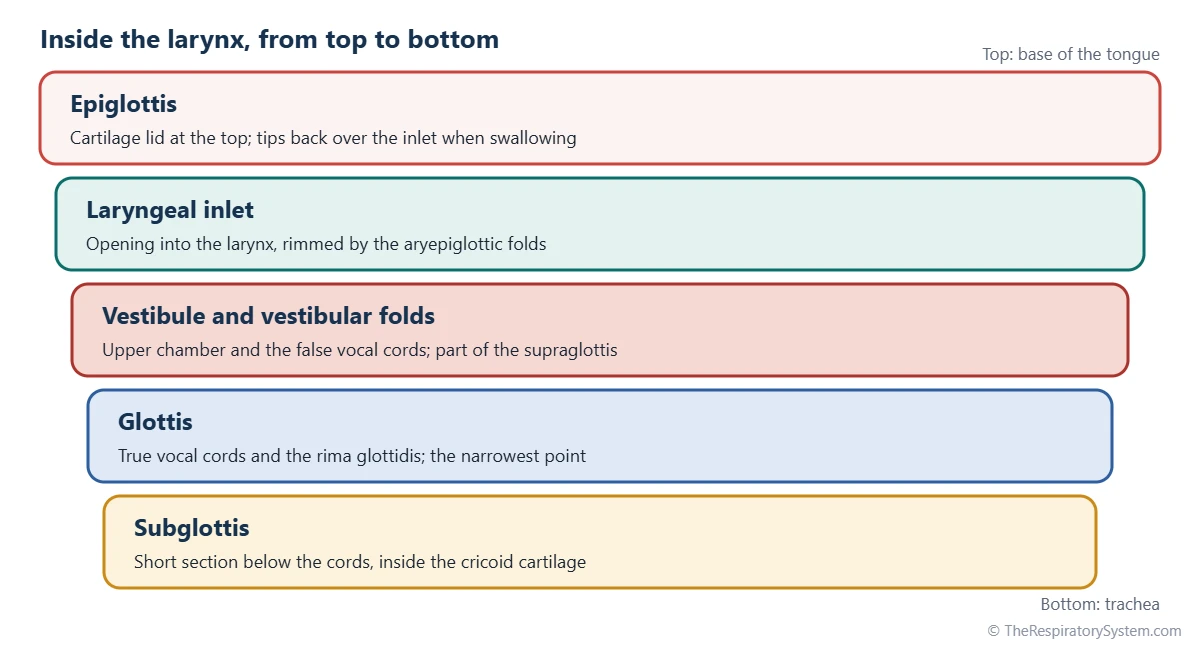
The epiglottis is located at the top of the larynx, behind the root of the tongue and in front of the laryngeal inlet, while the glottis is located in the middle of the larynx, at the level of the true vocal cords, roughly behind the middle of the thyroid cartilage. Between them lies the laryngeal vestibule, the upper chamber of the larynx.
The three levels of the larynx
Doctors divide the inside of the larynx into three levels, and the glottis and epiglottis fall into different ones.
- Supraglottis: everything above the true vocal cords, including the epiglottis, the aryepiglottic folds, the vestibule and the vestibular folds, or false vocal cords.
- Glottis: the true vocal cords, the small region where their front ends meet and the rima glottidis between them.
- Subglottis: the short section below the vocal cords down to the lower edge of the cricoid cartilage, where the trachea begins.
Epiglottis location in detail
The upper free tip of the epiglottis rises behind the tongue, and in some people, especially children, it can be seen at the back of the throat. Between the tongue and the front of the epiglottis lie two small pockets called the valleculae. Its narrow lower stalk is anchored to the inside of the thyroid cartilage, just above the front ends of the vocal cords, so the top of the epiglottis and the glottis are connected by a stalk of tissue rather than touching directly.
| Feature | Epiglottis | Glottis |
|---|---|---|
| What it is | A flap of cartilage, a solid structure | The true vocal cords and the opening between them |
| Position in the larynx | At the top, above the laryngeal inlet | In the middle, at the level of the true vocal cords |
| Larynx level | Supraglottis | Glottis, between supraglottis and subglottis |
| Main tissue | Elastic cartilage covered by mucous membrane | Vocal ligament, vocalis muscle and mucous membrane |
| Shape | Leaf-shaped, with a narrow stalk below | A slit or V-shaped gap that changes shape |
| Attached to | Thyroid cartilage and hyoid bone by ligaments | Thyroid cartilage in front, arytenoid cartilages at the back |
| Own muscles | None; moves as the larynx rises | Several intrinsic laryngeal muscles |
| Main nerve | Internal laryngeal nerve (sensation) | Recurrent laryngeal nerve (most muscles) |
| Main job | Deflecting food and drink during swallowing | Controlling airflow, making voice, coughing |
| Active during | Mainly swallowing | Every breath, word and cough |
| Typical conditions | Epiglottitis | Laryngitis, nodules, vocal cord paralysis |
| Source: Typical adult anatomy, our editors | ||
Glottis vs Epiglottis Anatomy: What Are They Made Of?
The epiglottis is made of a single plate of elastic cartilage covered by mucous membrane, while the glottis is made of two soft-tissue folds, each containing a ligament and a muscle, and the space between them. One is a framework part; the other is a moving, vibrating part.
Epiglottis structure
The epiglottis cartilage is elastic cartilage, so it bends and springs back rather than snapping, and it is dotted with small pits that hold mucous glands. A ligament called the thyroepiglottic ligament ties its stalk to the thyroid cartilage, and the hyoepiglottic ligament ties its front surface to the hyoid bone. On each side, an aryepiglottic fold runs from its edge back to the arytenoid cartilages and forms the rim of the laryngeal inlet. Its front surface and upper back surface are covered by stratified squamous epithelium, and its lower back surface by ciliated respiratory epithelium.
Glottis structure
Each true vocal cord is a fold of tissue stretched from the inside of the thyroid cartilage in front to an arytenoid cartilage at the back. Inside it lie the vocal ligament, the thickened upper edge of an elastic membrane, and the vocalis muscle, the inner part of the thyroarytenoid muscle. The surface is covered by stratified squamous epithelium over a loose, jelly-like layer that lets it ripple when it vibrates.
The rima glottidis, the gap itself, has two parts: a longer front part between the soft vocal cords and a shorter back part between the arytenoid cartilages. The laryngeal cartilages page shows how the arytenoids rotate and slide to change its shape.
Muscles and nerves
The epiglottis has no muscles of its own; it moves when the larynx rises and the tissues around it are compressed. The glottis is opened by a single pair of muscles, the posterior cricoarytenoids, and closed by the lateral cricoarytenoid and arytenoid muscles, while the cricothyroid muscles stretch the cords to raise the pitch. All of these are supplied by the recurrent laryngeal nerve except the cricothyroid, which is supplied by the superior laryngeal nerve; both are branches of the vagus nerve.
Epiglottis vs Glottis Function: What Does Each Do?
The epiglottis function is to deflect swallowed food and liquid away from the airway, while the glottis function is to control the flow of air through the larynx, produce the voice and seal the airway during swallowing and coughing. The glottis works with every breath and every word; the epiglottis mainly matters during a swallow.
Epiglottis function
- Deflecting food: it tips back over the laryngeal inlet and splits the stream of food and liquid to either side, into the piriform recesses and on to the esophagus.
- Sensing: its lining is rich in nerve endings that set off a cough if anything touches the entrance to the airway.
- Shaping the inlet: with the aryepiglottic folds, it forms the front edge of the opening into the larynx.
Glottis function
- Breathing: it opens on each breath in, and widens further during deep breathing or exercise.
- Voice: when the cords close and air pushes between them, they vibrate and produce sound, as explained in how the voice is produced.
- Coughing: it shuts while pressure builds in the chest, then bursts open to blast air out, part of the cough reflex.
- Airway protection: it closes tightly during swallowing and is the last barrier before the trachea.
- Straining: closing it traps air in the lungs to stiffen the trunk when lifting or straining.
The table below shows how the two structures behave during everyday activities.
| Activity | Glottis | Epiglottis |
|---|---|---|
| Quiet breathing | Open in a narrow V shape | Upright; laryngeal inlet open |
| Deep breathing or exercise | Wide open, cords pulled apart | Upright |
| Speaking or singing | Cords together and vibrating | Upright |
| Whispering | Front closed, small gap left at the back | Upright |
| Coughing | Shut while pressure builds, then bursts open | Upright |
| Lifting or straining | Tightly shut to trap air in the chest | Upright |
| Swallowing | Tightly shut, the lowest seal | Tipped back over the laryngeal inlet |
| Source: Typical adult physiology, our editors | ||
What Do the Glottis and Epiglottis Have in Common?
The glottis and epiglottis are both parts of the larynx that help protect the airway, both are covered by a moist mucous membrane and both are controlled by branches of the vagus nerve. They are also the two parts of the larynx that most often appear together in questions about swallowing and choking.
- Same organ: both belong to the larynx, which connects the pharynx to the trachea.
- Shared job: both help keep food and drink out of the lungs, the epiglottis from above and the glottis from below.
- Similar lining: both carry stratified squamous epithelium where they meet friction, the epiglottis from food and the vocal cords from vibration.
- Same nerve family: both are supplied by branches of the vagus nerve, sensation above the vocal cords by the internal laryngeal nerve.
- Change with age: in infants both sit higher in the neck and the epiglottis is softer and more curled; both descend as the neck lengthens in childhood.
Their names are also linked, which is a common source of mix-ups. Remember that the epiglottis is above the glottis, just as its prefix says, and the comparison of the whole larynx with the throat is covered on our larynx vs pharynx page.
How Do the Glottis and Epiglottis Work Together When You Swallow?
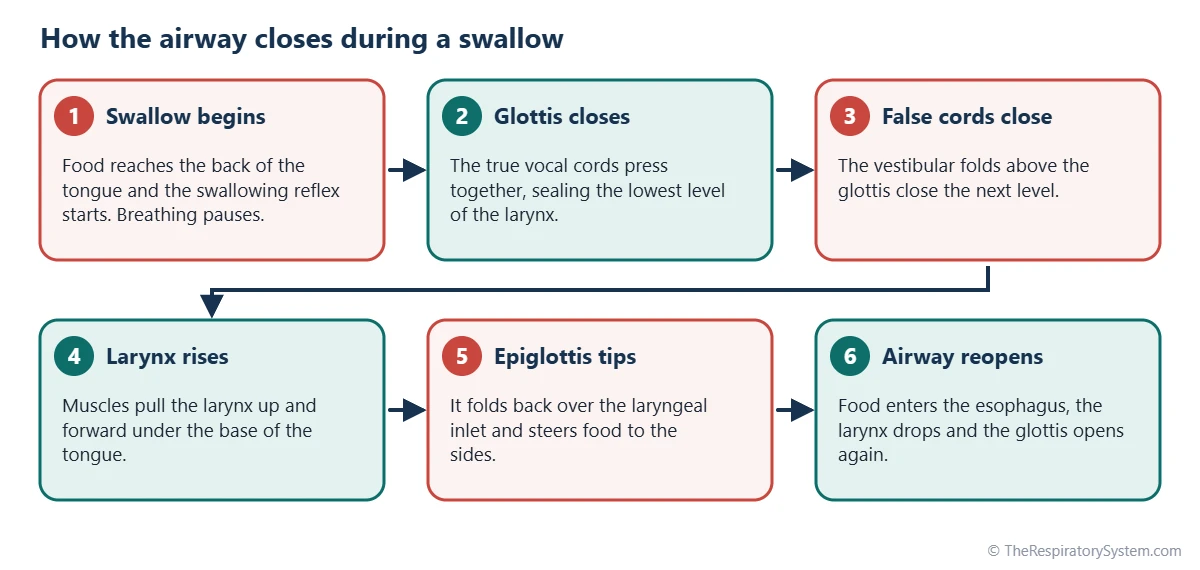
When you swallow, the glottis and epiglottis close the airway in layers from the bottom up: the vocal cords shut the glottis first, the vestibular folds close above them, and finally the epiglottis tips back over the laryngeal inlet. At the same time the whole larynx is pulled up and forward under the tongue, which helps tuck the airway out of the path of food.
This layered closure means that if a little food or liquid slips past the epiglottis, the closed vestibular folds and glottis still stand in its way. The food is steered around the sides of the laryngeal inlet through the laryngopharynx into the esophagus. Breathing stops for a moment during this sequence, and the glottis reopens as soon as the swallow ends, often with a small breath out that clears any remaining crumbs from the inlet.
The glottis also guards the airway when the epiglottis is not involved. If anything irritates the lining of the larynx, the glottis snaps shut in a protective reflex, and if material passes below it, a cough follows. The order of the whole swallow, from tongue to stomach, is shown on our trachea vs esophagus page.
Common Conditions That Affect the Glottis and Epiglottis
The epiglottis is mainly affected by inflammation and infection, while the glottis is affected by swelling, growths and nerve problems that change the voice or narrow the airway. Our respiratory diseases section covers airway conditions in more depth, and a lasting hoarse voice or noisy breathing is a reason to see a doctor.
Epiglottis vs epiglottitis
The epiglottis is the normal structure; epiglottitis is a disease, an inflammation of the epiglottis and the tissues around it, usually caused by a bacterial infection. The swollen epiglottis can block the laryngeal inlet, so epiglottitis is treated as a medical emergency. It used to be most common in young children, but vaccination against Haemophilus influenzae type b has made it much rarer in that age group.
Conditions of the glottis
- Laryngitis: swelling of the vocal cords, usually from a viral infection or overuse, which causes hoarseness.
- Vocal cord nodules and polyps: small benign growths on the cords that stop them from closing evenly.
- Vocal cord paralysis: damage to the recurrent laryngeal nerve leaves a cord unable to move, weakening the voice and the cough.
- Laryngospasm: a sudden, brief, involuntary closure of the glottis, often triggered by irritation.
- Croup: a childhood viral infection that swells the area just below the glottis and causes a barking cough.
- Glottic cancer: the glottis is the most common site of cancer of the larynx, which often shows up early as a change in the voice.
Key Facts
- The epiglottis is a leaf-shaped flap of elastic cartilage at the top of the larynx.
- The glottis is the true vocal cords plus the opening between them, the rima glottidis.
- The epiglottis belongs to the supraglottis; the glottis is the middle level of the larynx, above the subglottis.
- The glottis is the narrowest part of the adult larynx.
- During swallowing the airway closes from the bottom up: glottis first, then the vestibular folds, then the epiglottis.
- The glottis is opened by only one pair of muscles, the posterior cricoarytenoids.
- Epiglottitis is inflammation of the epiglottis, while laryngitis mainly affects the vocal cords of the glottis.
Quick Quiz: Test What You Know About the Glottis vs Epiglottis
6 questions. Tap an answer to check it.
What is the epiglottis made of?
The epiglottis is elastic cartilage, which lets it bend and spring back during swallowing.
What does the term glottis refer to?
The glottis is the vocal apparatus of the larynx: the true vocal cords plus the rima glottidis.
Which part of the larynx contains the epiglottis?
The epiglottis lies in the supraglottis, the level above the true vocal cords.
During a swallow, which seal closes first?
Airway closure runs from the bottom up: the glottis closes first, then the vestibular folds, and the epiglottis tips over last.
Which muscle is the only one that opens the glottis?
The posterior cricoarytenoid muscles are the only muscles that pull the vocal cords apart.
What is epiglottitis?
Epiglottitis is inflammation of the epiglottis, usually from a bacterial infection, and can block the airway.
Frequently Asked Questions
Does the epiglottis cover the glottis?
Not directly. The epiglottis folds back over the laryngeal inlet, the entrance at the top of the larynx, which lies above the glottis. The glottis is a few centimeters lower, at the level of the vocal cords, and it closes on its own during a swallow. So the epiglottis covers the way down to the glottis rather than lying on the vocal cords themselves.
Is the glottis the same as the vocal cords?
Not exactly. The vocal cords, or vocal folds, are the two bands of tissue; the glottis is the term for the cords together with the opening between them. In everyday use people treat the words as near synonyms, but strictly the gap alone is the rima glottidis, and the glottis is the whole voice-producing level of the larynx that contains it.
What is the rima glottidis?
The rima glottidis is the opening between the true vocal cords and the arytenoid cartilages. Its front part lies between the soft vocal cords and its back part between the arytenoids. It is a narrow slit when the cords are together for speech, a V shape in quiet breathing and a wide diamond-like gap during a deep breath.
Can a person swallow without an epiglottis?
Often, yes. People who lose part or all of the epiglottis through surgery or injury can usually learn to swallow safely, because the closing glottis, the vestibular folds and the rise of the larynx under the tongue still protect the airway. This shows that the epiglottis is one layer of protection among several, and that the glottis is the more important seal.
Is the epiglottis part of the larynx?
Yes. The epiglottis is one of the nine cartilages of the larynx and forms its uppermost part. Its tip projects up behind the tongue into the throat, which is why it is sometimes described as lying between the pharynx and the larynx, but its stalk is anchored inside the thyroid cartilage and it is counted as a laryngeal structure.
What is a glottal stop?
A glottal stop is a speech sound made by closing the glottis completely for an instant and then releasing it, which briefly blocks the airflow. English speakers use it in the middle of "uh-oh" and in some accents in place of the t in words such as "bottle". In many other languages it is a regular consonant written with its own letter or symbol.
Can you see your glottis or epiglottis in a mirror?
The tip of the epiglottis can sometimes be seen behind the base of the tongue, especially in children, when the mouth is opened wide and the tongue is pressed down. The glottis cannot be seen this way because it lies too far down. Doctors view it with a small angled mirror held at the back of the throat or with a thin camera called a laryngoscope.
Do animals have a glottis and epiglottis?
Most air-breathing vertebrates have a glottis, the opening into the airway, but only mammals have a true epiglottis. Birds and reptiles close the glottis by muscle action without a cartilage lid. Snakes can push the glottis forward along the floor of the mouth, so they can keep breathing while slowly swallowing large prey.
Keep Exploring


