At a Glance
The main difference between the larynx and pharynx is that the pharynx (throat) is a muscular passage about 12 to 14 cm long used by both air and food, while the larynx (voice box) is a cartilage tube about 4 to 5 cm long used only by air. Air passes through the pharynx first and then turns forward into the larynx and trachea, while food continues down the pharynx into the esophagus behind the larynx.
- Pharynx
- The throat: a muscular funnel from the base of the skull to the start of the esophagus
- Larynx
- The voice box: a cartilage tube between the base of the tongue and the trachea
- Position
- The larynx lies in front of the lowest part of the pharynx, the laryngopharynx
- What passes
- Pharynx: air and food. Larynx: air only
- Main jobs
- Pharynx: swallowing and air passage. Larynx: airway protection and voice
- In common
- Both in the neck, both part of the upper airway, both supplied by the vagus nerve
On this page
- What Is the Difference Between the Larynx and Pharynx?
- Where Is the Larynx vs Pharynx?
- Larynx and Pharynx Anatomy: How Are They Built?
- What Do the Larynx and Pharynx Do?
- What Do the Larynx and Pharynx Have in Common?
- How Do the Larynx and Pharynx Work Together?
- Pharynx vs Larynx vs Trachea vs Esophagus: Where Does Each Lead?
- Common Conditions That Affect the Larynx and Pharynx
- Key Facts
- Quiz
- FAQ
What Is the Difference Between the Larynx and Pharynx?
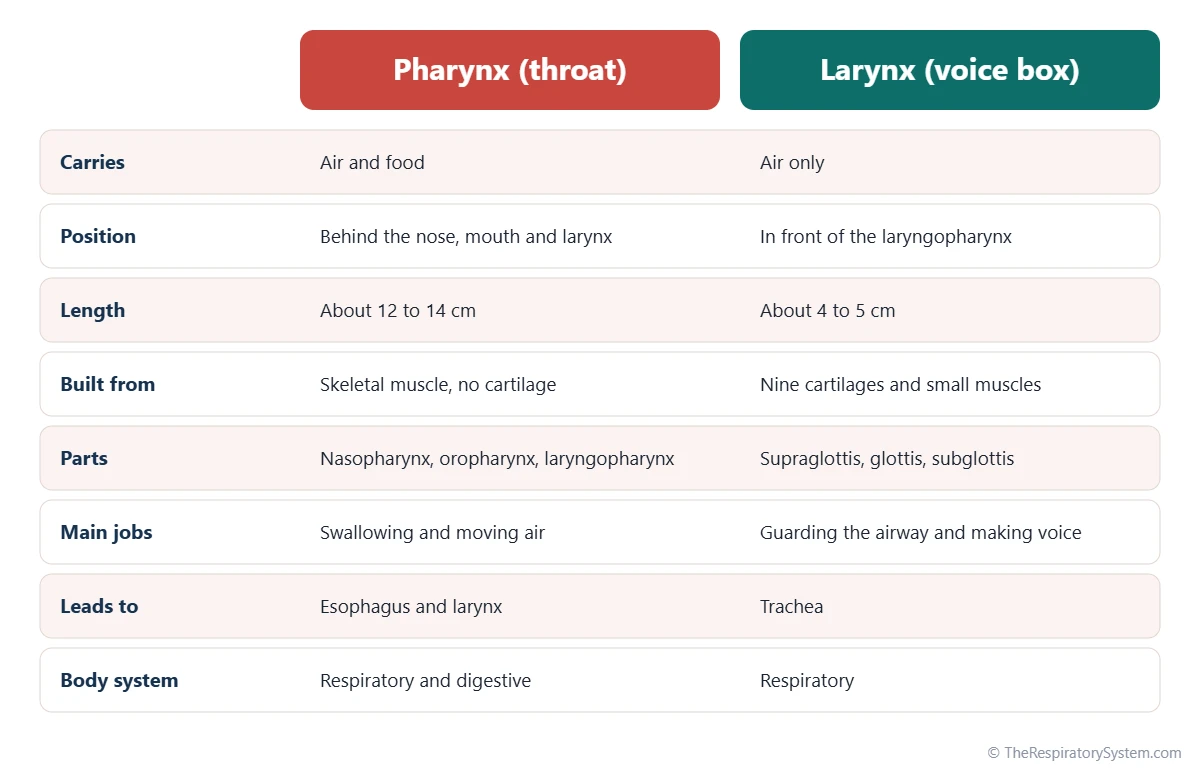
The difference between the larynx and pharynx is that the pharynx is a shared muscular passage for air and food, while the larynx is a cartilage-walled passage for air alone, built to protect the airway and produce the voice. The pharynx belongs to both the respiratory and the digestive system; the larynx belongs only to the respiratory system.
They also differ in shape and build. The pharynx is a long, soft funnel of skeletal muscle hanging from the base of the skull, open in front to the nose, the mouth and the larynx. The larynx is a short, rigid box of nine cartilages that sits below the hyoid bone and leads straight into the trachea.
What is the larynx vs pharynx in one line?
The pharynx is the crossroads where air and food travel together; the larynx is the guarded gate that lets only air turn off toward the lungs.
Explained simply
Picture a hallway that leads to two doors. The hallway is the pharynx: both air and food walk down it. At the bottom, air goes through the front door, the larynx, into the windpipe, and food goes through the back door into the food pipe. The larynx has a lid and a set of folds that slam shut whenever food goes by, so nothing goes through the wrong door.
Where Is the Larynx vs Pharynx?
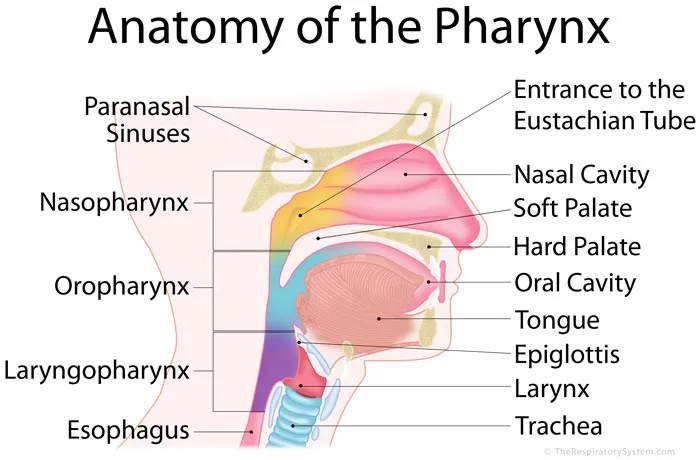
The pharynx lies behind the nasal cavity, the mouth and the larynx, running from the base of the skull down to the level of the cricoid cartilage, about the sixth cervical vertebra. The larynx lies in the front of the neck, in front of the lowest part of the pharynx, from about the third to the sixth cervical vertebra in an adult.
The three parts of the pharynx
- Nasopharynx: behind the nasal cavity and above the soft palate; normally only air passes through it.
- Oropharynx: behind the mouth, from the soft palate to the tip of the epiglottis; air and food share it.
- Laryngopharynx: behind the larynx, from the epiglottis to the start of the esophagus; air and food still share it.
Laryngopharynx and larynx
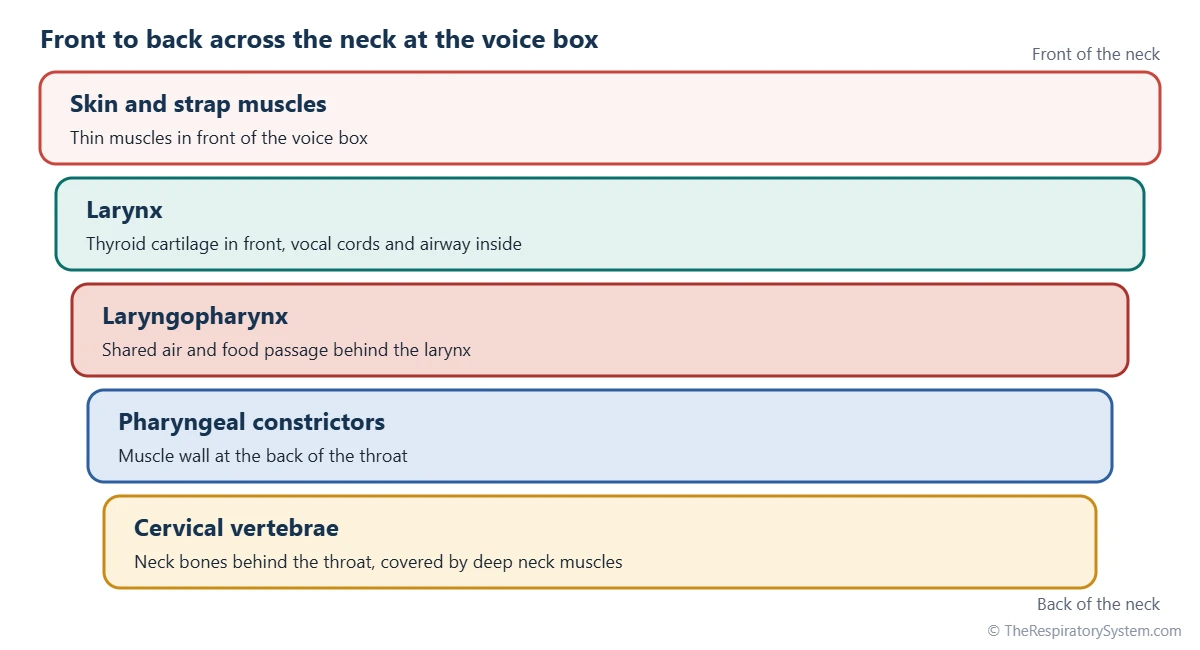
The laryngopharynx and the larynx sit side by side at the same height, which is why their names are easy to mix up. The laryngopharynx is the back part, a passage of the throat, while the larynx is the organ in front of it. The opening of the larynx, called the laryngeal inlet, faces backward into the laryngopharynx, and on each side of it a small gutter called the piriform recess guides swallowed food around the larynx toward the esophagus.
The larynx can be felt from the outside: its thyroid cartilage forms the Adam's apple, and the ring of the cricoid cartilage lies just below it. The pharynx cannot be felt through the neck, but its back wall is visible behind the uvula when the mouth is opened wide.
| Feature | Pharynx | Larynx |
|---|---|---|
| Common name | Throat | Voice box |
| Shape | Funnel-shaped muscular tube | Short, box-like tube of cartilage |
| Length in adults | About 12 to 14 cm | About 4 to 5 cm |
| Extends from | Base of the skull to the level of the cricoid cartilage | Tip of the epiglottis to the lower edge of the cricoid cartilage |
| Position | Behind the nasal cavity, mouth and larynx | In front of the laryngopharynx, below the hyoid bone |
| Parts | Nasopharynx, oropharynx, laryngopharynx | Supraglottis, glottis, subglottis |
| Framework | Skeletal muscle on a fibrous fascia, no cartilage | Nine cartilages joined by ligaments and membranes |
| Muscles | Three constrictors and three longitudinal muscles | Intrinsic muscles that move the vocal cords |
| Lining | Respiratory epithelium above, stratified squamous below | Respiratory epithelium; stratified squamous on the vocal cords |
| What passes through | Air and food | Air only |
| Main jobs | Swallowing, air passage, resonance, immune defense | Airway protection, voice, coughing |
| Nerve supply | Pharyngeal plexus (vagus and glossopharyngeal nerves) | Superior and recurrent laryngeal nerves (vagus) |
| Body systems | Respiratory and digestive | Respiratory |
| Leads to | Larynx in front, esophagus below | Trachea |
| Source: Typical adult anatomy, our editors | ||
Larynx and Pharynx Anatomy: How Are They Built?
The pharynx is built of skeletal muscle layers on a fibrous sheet with no cartilage, while the larynx is built on a framework of cartilages linked by ligaments, membranes and small muscles. This difference explains why the pharynx can squeeze food downward, while the larynx always stays open for air.
Pharynx wall
From the inside out, the pharynx wall has a mucous membrane, a tough fibrous layer called the pharyngobasilar fascia, a muscle layer and a thin outer fascia. The muscle layer has three overlapping constrictor muscles, superior, middle and inferior, which squeeze in sequence during swallowing, and three longitudinal muscles, the stylopharyngeus, palatopharyngeus and salpingopharyngeus, which lift and shorten the pharynx. The nasopharynx is lined by ciliated respiratory epithelium, while the oropharynx and laryngopharynx have tougher stratified squamous epithelium that resists the rubbing of food.
Larynx framework
The larynx has nine laryngeal cartilages: three single ones, the thyroid, cricoid and epiglottis, and three pairs, the arytenoid, corniculate and cuneiform cartilages. Inside, two pairs of folds project into the airway: the upper vestibular folds, or false vocal cords, and the lower true vocal cords. Small intrinsic muscles move the arytenoid cartilages to open, close and tighten the vocal cords. Most of the larynx is lined by respiratory epithelium, but the vocal cords carry stratified squamous epithelium that withstands constant vibration.
Nerves and blood supply
Both organs are controlled mainly by branches of the vagus nerve. The pharynx is supplied by the pharyngeal plexus, which carries motor fibers from the vagus and sensory fibers from the glossopharyngeal nerve. The larynx is supplied by the superior and recurrent laryngeal nerves, and its blood comes from the superior and inferior laryngeal arteries, branches of the thyroid arteries.
What Do the Larynx and Pharynx Do?
The pharynx moves air between the nose and the larynx and pushes food from the mouth into the esophagus, while the larynx keeps food and liquid out of the airway and produces the voice. Each organ also has a few extra jobs.
Pharynx functions
- Air passage: carries air from the nasal cavity and mouth down to the larynx.
- Swallowing: its constrictor muscles squeeze each mouthful down into the esophagus.
- Immune defense: a ring of lymphoid tissue, including the adenoids and the palatine tonsils, samples germs entering through the nose and mouth.
- Ear pressure: the openings of the auditory tubes in the nasopharynx let air reach the middle ears.
- Voice resonance: its changing shape colors the sound made by the larynx.
Larynx functions
- Airway: keeps an open, cartilage-supported passage between the pharynx and the trachea.
- Protection: closes tightly during swallowing and triggers a cough if anything enters it.
- Voice: the vibrating vocal cords produce the sound used for speech and singing.
- Holding the breath: by closing, it traps air in the chest to steady the trunk during lifting, straining or a cough.
What Do the Larynx and Pharynx Have in Common?
The larynx and pharynx are neighboring parts of the upper airway that share a location in the neck, a nerve supply and an origin in the embryo, and they work as a single unit during swallowing and speech. Both carry air on every breath.
- Same region: both lie in the neck, in front of the cervical vertebrae, and both are part of the upper respiratory tract.
- Same main nerve: the vagus nerve controls most of the muscles of both organs.
- Shared lining: both are lined by a moist mucous membrane, ciliated in places and kept moist by mucus glands.
- Shared origin: both develop from the pharyngeal arches and the front end of the embryonic gut, the same region that forms the lower airways, as described on our respiratory system development page.
- Shared movements: both rise when you swallow, pulled up by muscles attached to the hyoid bone.
Because they are so close, problems often spread between them. A throat infection can reach the larynx and change the voice, and acid or mucus from below can irritate both.
How Do the Larynx and Pharynx Work Together?
The larynx and pharynx work together by taking turns with the same space: during breathing the pharynx stays open and the larynx lets air through, and during swallowing the pharynx squeezes food downward while the larynx shuts and moves out of the way. The switch takes less than a second and is controlled by a reflex in the brainstem.
During swallowing
When food reaches the back of the mouth, the soft palate seals off the nasopharynx and the larynx is pulled upward and forward under the base of the tongue. The epiglottis tips back over the laryngeal inlet, and the vocal cords and vestibular folds close beneath it. The pharyngeal constrictors then squeeze the food past the closed larynx into the esophagus, and breathing pauses briefly. The full sequence is shown step by step on our trachea vs esophagus page.
During speech
The larynx is the sound source: air from the lungs makes the vocal cords vibrate and produce a buzz. The pharynx, mouth and nasal cavity above it act as a resonating tube that shapes this buzz into recognizable vowels and gives each voice its own tone. Changing the shape of the pharynx is a large part of how singers change their sound, as explained in how the voice is produced.
During breathing
On each breath, muscles keep the soft walls of the pharynx from collapsing, while the larynx widens the gap between the vocal cords slightly to let air in. During sleep the pharyngeal muscles relax, which is why the throat, not the larynx, is the usual site of snoring.
Pharynx vs Larynx vs Trachea vs Esophagus: Where Does Each Lead?
The pharynx comes first and is shared by air and food; below it, air turns forward into the larynx and then the trachea, while food continues backward into the esophagus. These four tubes form a Y shape in the neck, with the pharynx as the stem.
- Pharynx: the throat, shared by air and food, from behind the nose to the level of the cricoid cartilage.
- Larynx: the voice box, air only, in front of the laryngopharynx.
- Trachea: the windpipe, air only, continuing straight down from the larynx to the bronchi in the chest.
- Esophagus: the food pipe, food only, continuing down from the laryngopharynx behind the trachea to the stomach.
Laryngopharynx and oropharynx
The oropharynx and laryngopharynx are both shared air and food passages, divided by the level of the tip of the epiglottis. The oropharynx lies behind the mouth and holds the palatine tonsils, while the laryngopharynx lies behind the larynx and opens into the esophagus. To follow the air all the way to the lungs, see our pathway of air guide and upper vs lower respiratory tract.
Common Conditions That Affect the Larynx and Pharynx
Infections and inflammation are the most common problems of both organs: in the pharynx they cause a sore throat, and in the larynx they cause hoarseness or loss of voice. Our respiratory diseases section covers them in more depth, and anyone with a lasting voice change or trouble swallowing or breathing should see a doctor.
- Pharyngitis: inflammation of the pharynx, usually from a viral infection, causing a sore throat.
- Tonsillitis: infection of the palatine tonsils in the oropharynx.
- Laryngitis: swelling of the larynx and vocal cords, causing hoarseness.
- Croup: a childhood viral infection that swells the larynx and trachea and causes a barking cough.
- Epiglottitis: a rare but dangerous swelling of the epiglottis that can block the airway.
- Obstructive sleep apnea: the walls of the pharynx collapse during sleep and briefly stop airflow.
Key Facts
- The pharynx is the throat, a muscular passage shared by air and food; the larynx is the voice box, which carries air only.
- The pharynx is about 12 to 14 cm long and the adult larynx about 4 to 5 cm long.
- The larynx lies in front of the laryngopharynx, the lowest of the three parts of the pharynx.
- The pharynx has no cartilage, while the larynx is built on nine cartilages, including the thyroid cartilage that forms the Adam's apple.
- During swallowing the larynx rises, the epiglottis tips down and the vocal cords close while the pharynx squeezes food into the esophagus.
- The larynx makes the sound of the voice and the pharynx shapes it as part of the vocal tract.
- Air travels pharynx, larynx, trachea; food travels pharynx, esophagus.
Quick Quiz: Test What You Know About the Larynx vs Pharynx
6 questions. Tap an answer to check it.
Which structure carries both air and food?
The pharynx is shared by air and food. The larynx, trachea and bronchi carry air only.
Where does the larynx lie in relation to the pharynx?
The larynx sits in the front of the neck, directly in front of the laryngopharynx.
Which of these is part of the pharynx, not the larynx?
The oropharynx is the middle part of the pharynx. The glottis, cricoid cartilage and vocal cords belong to the larynx.
What is the larynx mainly built from?
The larynx is built on nine cartilages linked by ligaments, membranes and small muscles.
Which muscles squeeze food down through the pharynx?
The superior, middle and inferior pharyngeal constrictors contract in sequence to push food toward the esophagus.
After passing through the larynx, where does air go next?
The larynx leads directly into the trachea, the windpipe.
Frequently Asked Questions
Is the larynx part of the pharynx?
No. The larynx and pharynx are separate organs. The larynx opens into the pharynx at the laryngeal inlet and lies in front of its lowest part, the laryngopharynx, so the two touch and share a wall, but the larynx has its own cartilage skeleton, muscles and lining. Anatomists treat it as the organ that connects the pharynx to the trachea.
Which comes first, the pharynx or the larynx?
The pharynx comes first. Air breathed in through the nose or mouth enters the pharynx, travels down through the nasopharynx or oropharynx and the laryngopharynx, and then turns forward into the larynx. From the larynx it goes on into the trachea. On the way out the order is reversed, larynx first and pharynx second.
Is the throat the pharynx or the larynx?
In everyday language, the throat usually means the pharynx, the passage at the back of the mouth that you see when a doctor looks in with a light. People sometimes also include the larynx, especially when talking about the front of the neck. In anatomy, the throat is the pharynx, and the larynx is called the voice box.
Is the Adam's apple part of the larynx or pharynx?
The Adam's apple is part of the larynx. It is the forward point of the thyroid cartilage, the largest cartilage of the voice box. It usually becomes more prominent in males at puberty, when the larynx grows and the vocal cords lengthen, which also deepens the voice. The pharynx has no cartilage and cannot be felt through the skin of the neck.
Is the laryngopharynx part of the larynx?
No, the laryngopharynx is part of the pharynx, despite its name. It is the lowest section of the throat, lying behind the larynx and named after it. It runs from the level of the epiglottis down to the start of the esophagus and carries both air and food, while the larynx in front of it carries only air.
What happens if food goes into the larynx instead of the pharynx?
When food or liquid slips past the epiglottis into the larynx, the very sensitive lining triggers a strong cough reflex to blow it back out, which is the feeling of something going down the wrong way. If material passes below the vocal cords into the trachea and lungs, it is called aspiration, which can lead to an infection known as aspiration pneumonia.
Are the larynx and pharynx in the upper or lower respiratory tract?
Both are usually placed in the upper respiratory tract, together with the nose, nasal cavity and sinuses. The larynx marks its lower end, and the trachea below it starts the lower respiratory tract. Some textbooks, however, draw the line above the larynx and count it as part of the lower tract, so both groupings appear in study materials.
Can you have pharyngitis and laryngitis at the same time?
Yes. The same cold or flu virus often inflames the pharynx and the larynx together, because their linings are continuous. The result is a sore throat from the pharyngitis and a hoarse or weak voice from the laryngitis, sometimes called laryngopharyngitis. Both usually settle as the infection clears, and the voice often returns a little later than the throat stops hurting.
Keep Exploring


