At a Glance
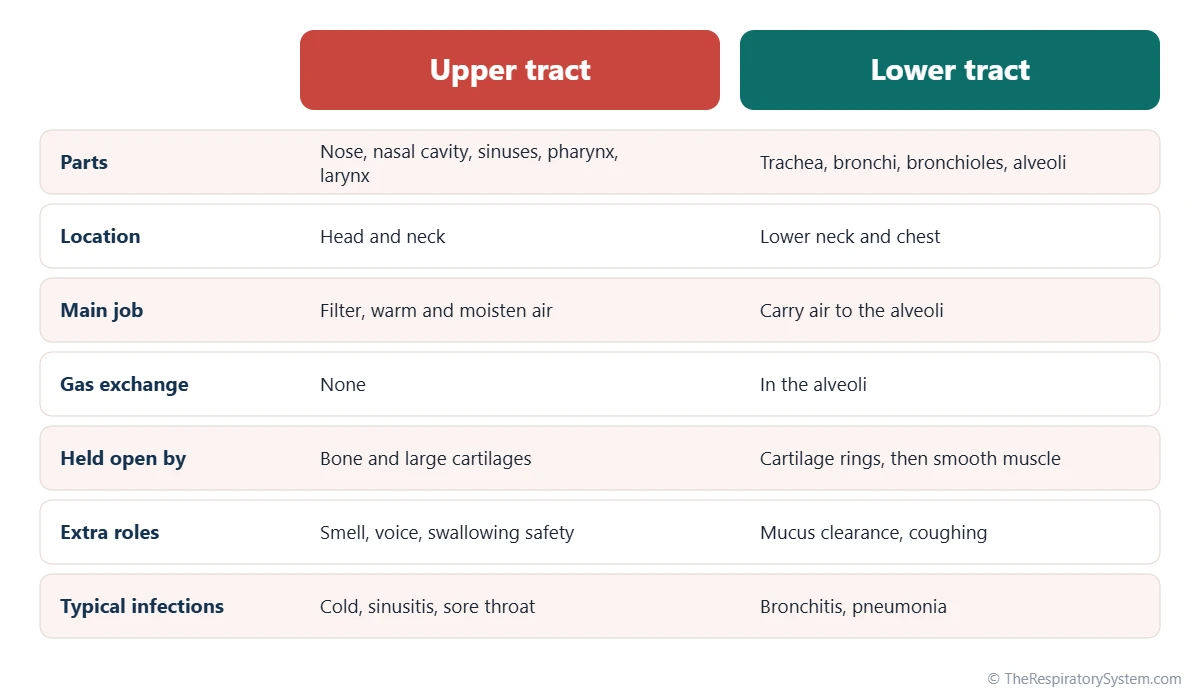
The upper respiratory tract includes the nose, nasal cavity, paranasal sinuses, pharynx and larynx, and the lower respiratory tract includes the trachea, bronchi, bronchioles and alveoli inside the lungs. The usual dividing line is the lower edge of the cricoid cartilage, where the larynx joins the trachea in the neck. The upper tract conditions air and the lower tract delivers it to roughly 300 to 500 million alveoli for gas exchange.
- Upper tract
- Nose, nasal cavity, paranasal sinuses, pharynx, larynx
- Lower tract
- Trachea, bronchi, bronchioles, alveolar ducts, alveoli (inside the lungs)
- Dividing line
- Lower edge of the cricoid cartilage, where the larynx meets the trachea
- Location
- Upper: head and neck. Lower: neck and chest (thoracic cavity)
- Gas exchange
- Only in the lower tract, in the respiratory bronchioles and alveoli
- Part of
- The respiratory system, which works as one continuous airway
On this page
- What Is the Difference Between the Upper and Lower Respiratory Tract?
- What Are the Parts of the Upper and Lower Respiratory Tract?
- Where Is the Upper and Lower Respiratory Tract?
- Upper vs Lower Respiratory Tract Function
- Upper vs Lower Respiratory Tract Anatomy: Lining and Support
- How Do the Upper and Lower Respiratory Tract Work Together?
- Upper vs Lower Respiratory Tract Infection Symptoms
- Key Facts
- Quiz
- FAQ
What Is the Difference Between the Upper and Lower Respiratory Tract?
The main difference is location and job: the upper respiratory tract sits in the head and neck and prepares the air, while the lower respiratory tract sits mostly in the chest and carries that air to the alveoli, where gas exchange happens. Both are parts of one continuous tube, so the split is a way of organizing the anatomy rather than a wall inside the airway.
The upper respiratory tract is built around bone and cartilage: the nose, the nasal cavity with its curled conchae, the air-filled paranasal sinuses, the pharynx and the larynx. These parts filter, warm and humidify air, hold the receptors for smell, make the voice and protect the airway when you swallow.
The lower respiratory tract is a branching tree that starts with the trachea, divides into the bronchi and bronchioles, and ends in millions of alveoli packed inside the lungs. Its first part only conducts air; its final part is the only place in the body where air meets blood.
Explained simply: the upper tract is the front porch and hallway, where air wipes its feet and warms up. The lower tract is the branching set of corridors and tiny rooms inside the house, where the real work of swapping oxygen for carbon dioxide gets done.
| Feature | Upper respiratory tract | Lower respiratory tract |
|---|---|---|
| Parts | Nose, nasal cavity, paranasal sinuses, pharynx, larynx | Trachea, bronchi, bronchioles, alveolar ducts, alveoli |
| Location | Head and neck | Lower neck and chest, mostly inside the lungs |
| Begins and ends | Nostrils and mouth to the lower edge of the cricoid cartilage | Top of the trachea to the alveoli |
| Main function | Filter, warm and humidify air; smell; voice; protect the airway | Distribute air through the lungs and exchange gases |
| Gas exchange | None | In the respiratory bronchioles and alveoli |
| Support | Bone of the skull and face plus cartilages of the nose and larynx | Cartilage rings and plates, then smooth muscle, then thin walls |
| Main lining | Respiratory epithelium; stratified squamous in the lower pharynx and on the vocal folds | Respiratory epithelium, then cuboidal cells, then type I and II pneumocytes |
| Special features | Conchae, sinuses, olfactory area, vocal folds, epiglottis | Carina, bronchial tree, surfactant, alveolar macrophages |
| Germs | Normally home to many harmless microbes | Normally keeps microbes at a very low level |
| Typical infections | Common cold, sinusitis, pharyngitis, tonsillitis, laryngitis | Bronchitis, bronchiolitis, pneumonia, tuberculosis |
| Source: Standard anatomy, our editors | ||
What Are the Parts of the Upper and Lower Respiratory Tract?
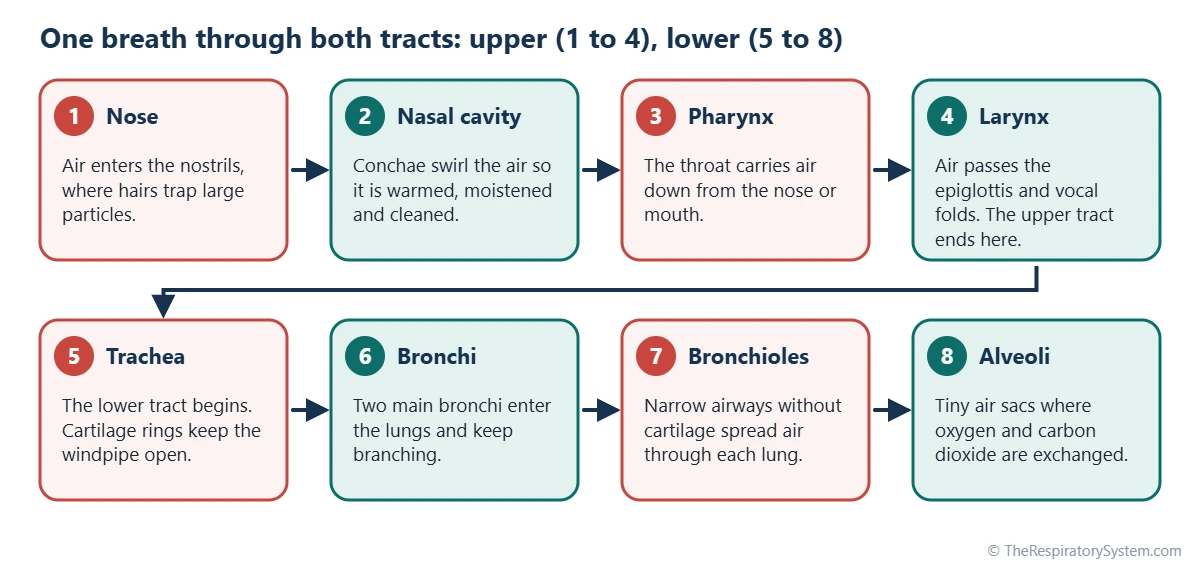
The upper respiratory tract has five main parts (nose, nasal cavity, paranasal sinuses, pharynx and larynx), and the lower respiratory tract has four levels of airway (trachea, bronchi, bronchioles and alveoli) inside or leading to the lungs. The mouth, or oral cavity, is a backup airway that joins the upper tract at the pharynx.
Upper respiratory tract
- Nose and nostrils: the entrance, lined with hairs that catch large particles.
- Nasal cavity: the space behind the nose, divided by the nasal septum and shaped by three nasal conchae on each side.
- Paranasal sinuses: four pairs of air spaces in the skull bones that drain into the nasal cavity.
- Pharynx: the throat, in three parts: nasopharynx, oropharynx and laryngopharynx.
- Larynx: the voice box, guarded by the epiglottis and holding the vocal folds.
Lower respiratory tract
- Trachea: the windpipe, held open by C-shaped rings of hyaline cartilage.
- Bronchi: the right and left main bronchi and their lobar and segmental branches.
- Bronchioles: small airways with no cartilage, ending in terminal and respiratory bronchioles.
- Alveolar ducts, sacs and alveoli: the gas exchange surface of the lungs.
Some textbooks count the larynx as the first part of the lower tract, and a few place the boundary at the vocal folds. Most anatomy and clinical sources, including this site, use the lower edge of the cricoid cartilage, the ring at the base of the larynx, as the dividing line.
Where Is the Upper and Lower Respiratory Tract?
The upper respiratory tract lies in the head and neck, and the lower respiratory tract runs from the lower neck down into the chest. The boundary between them sits at about the level of the sixth cervical vertebra, where the cricoid cartilage of the larynx meets the first ring of the trachea.
From there, the trachea runs down in front of the esophagus into the thoracic cavity. It splits at the carina, at about the level of the sternal angle, into the two main bronchi. Each bronchus enters a lung at its hilum, and from that point the whole lower tract is enclosed in the lungs and their pleura.
The upper tract, by contrast, is spread across several regions of the skull and neck: the nasal cavity sits above the hard palate, the sinuses sit inside the frontal, maxillary, ethmoid and sphenoid bones, and the pharynx hangs behind the nose, mouth and larynx. The pathway of air page follows a breath through every part in order.
Upper vs Lower Respiratory Tract Function
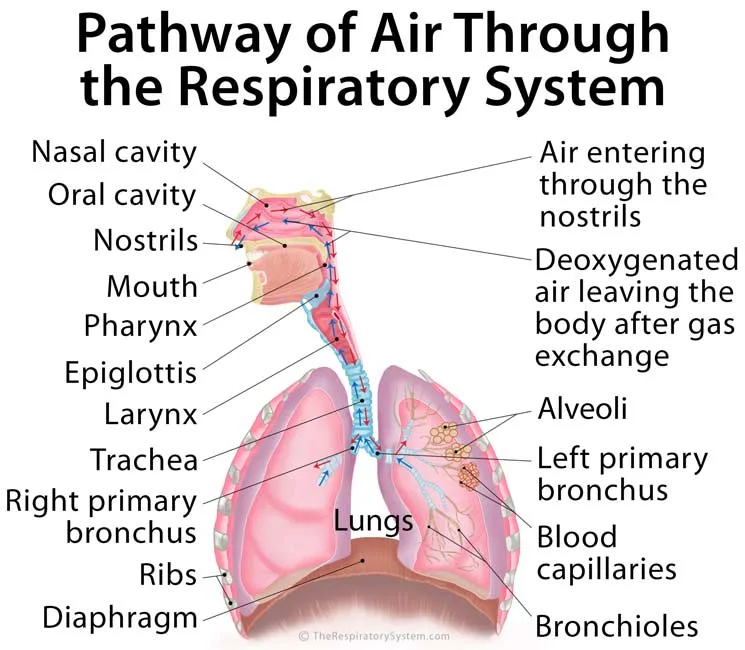
The upper respiratory tract conditions and guards the air, while the lower respiratory tract distributes it and exchanges gases. Most of the cleaning, warming and humidifying is done before air ever reaches the trachea, so the delicate alveoli receive air that is close to body temperature and fully saturated with water vapor.
What the upper tract does
- Filters large particles with nasal hairs and traps smaller ones in mucus.
- Warms and humidifies air over the large, blood-rich surface of the conchae.
- Detects smells through the olfactory area in the roof of the nasal cavity; see sense of smell.
- Produces the voice in the larynx and shapes it in the pharynx, mouth and sinuses.
- Keeps food out of the airway by closing the larynx during swallowing.
What the lower tract does
- Conducts air through the branching bronchial tree to every part of both lungs.
- Clears trapped dust and germs upward with the mucociliary escalator and the cough reflex.
- Adjusts airflow by tightening or relaxing smooth muscle in the bronchioles.
- Exchanges oxygen and carbon dioxide with the blood across the walls of the alveoli; see gas exchange.
Functionally, the airway can also be split another way: the conducting zone, from the nose to the terminal bronchioles, and the respiratory zone, from the respiratory bronchioles to the alveoli. Our conducting zone vs respiratory zone page explains that second division.
Upper vs Lower Respiratory Tract Anatomy: Lining and Support
The two tracts differ in their lining and in what holds them open: the upper tract is supported mainly by bone and large cartilages, while the lower tract relies on cartilage rings and plates that give way to smooth muscle and finally to walls only one cell thick.
Most of the airway from the nasal cavity to the bronchi is lined with respiratory epithelium, a pseudostratified ciliated columnar layer with mucus-making goblet cells. Places that rub against food or vibrate, such as the oropharynx, laryngopharynx and the vocal folds, are covered instead with tougher stratified squamous epithelium. A small patch in the roof of the nasal cavity carries the olfactory epithelium for smell.
In the lower tract the lining becomes simpler as the airways narrow. Ciliated columnar cells in the bronchi give way to ciliated cuboidal cells in the small bronchioles, where club cells replace most goblet cells. In the alveoli, the wall is made of very thin type I pneumocytes, with type II cells making surfactant. Cartilage follows a similar pattern: C-shaped rings in the trachea, irregular plates in the bronchi and none at all in the bronchioles. The respiratory system histology page shows each lining in detail.
How Do the Upper and Lower Respiratory Tract Work Together?
The upper and lower tracts work together as one continuous airway: every breath passes through the upper tract on its way to the lower tract and back out again, and both share the same defenses and the same lining of mucus and cilia. The two halves divide the labor so that the alveoli receive clean, warm, moist air.
- One air stream: the diaphragm lowers the pressure in the lungs and air is pulled in through the whole tract; neither part pumps air on its own.
- Shared cleaning: cilia in the nose sweep mucus back toward the throat, and cilia in the trachea and bronchi sweep it up toward the throat, where it is swallowed.
- Shared protection: sneezing clears the nose, and coughing clears the larynx, trachea and bronchi.
- Temperature and moisture: on the way out, the cooler nasal lining takes back some of the heat and water from the exhaled air.
Because the tracts are joined, a problem in one can spread to the other. Mucus from an inflamed nose or sinuses can drip down the back of the throat, and an infection that starts in the throat can travel down into the bronchi.
Upper vs Lower Respiratory Tract Infection Symptoms
Upper respiratory tract infections mainly cause nose and throat symptoms, while lower respiratory tract infections mainly cause chest symptoms such as a deep cough and breathlessness. This section is for general education only and is not a way to diagnose an illness.
Upper respiratory tract infections, which include the common cold, sinusitis, pharyngitis, tonsillitis and laryngitis, typically bring a runny or blocked nose, sneezing, a sore throat, a hoarse voice and sometimes a mild fever. They are the most common infections people get and are usually caused by viruses.
Lower respiratory tract infections, such as acute bronchitis, bronchiolitis in young children and pneumonia, tend to cause a cough that may bring up mucus, chest tightness, wheezing and shortness of breath. Because the lower tract is where oxygen enters the blood, these infections are generally more serious. The full list of conditions by part is on our respiratory diseases page, and anyone with trouble breathing should see a doctor.
Key Facts
- The upper respiratory tract includes the nose, nasal cavity, paranasal sinuses, pharynx and larynx.
- The lower respiratory tract includes the trachea, bronchi, bronchioles and alveoli, almost all of it inside the lungs.
- The usual dividing line is the lower edge of the cricoid cartilage, at about the level of the sixth cervical vertebra.
- Only the lower tract exchanges gases, across the walls of about 300 to 500 million alveoli.
- The upper tract warms, humidifies and filters air so that it reaches the alveoli clean, moist and near body temperature.
- Cartilage holds the airway open down to the small bronchi; the bronchioles have none.
- Upper tract infections mainly cause nose and throat symptoms, while lower tract infections mainly cause chest symptoms.
Quick Quiz: Test What You Know About the Upper vs Lower Respiratory Tract
6 questions. Tap an answer to check it.
Which structure marks the usual boundary between the upper and lower respiratory tract?
Most sources draw the line at the lower edge of the cricoid cartilage, where the larynx joins the trachea. The carina is lower, where the trachea splits.
Which of these belongs to the lower respiratory tract?
The trachea is the first part of the lower respiratory tract. The pharynx, nasal cavity and sinuses are all in the upper tract.
Where does gas exchange take place?
Gas exchange happens only in the lower tract, in the respiratory bronchioles and alveoli. The upper tract only conditions and conducts air.
Which job is done mainly by the upper respiratory tract?
The blood-rich lining of the nasal cavity and conchae warms and moistens air. Surfactant, gas exchange and branching belong to the lower tract.
Which airways of the lower tract have no cartilage in their walls?
Bronchioles lack cartilage and are held open by the elastic tissue of the surrounding lung. The trachea has C-shaped rings and the bronchi have cartilage plates.
Which infection affects the lower respiratory tract?
Pneumonia is an infection of the lung tissue and alveoli, so it is a lower tract infection. The other three affect the upper tract.
Frequently Asked Questions
Is the larynx part of the upper or lower respiratory tract?
Most anatomy and medical sources place the larynx in the upper respiratory tract, with the boundary at the lower edge of its cricoid cartilage. Some textbooks, especially older or physiology-focused ones, count the larynx as the first part of the lower tract. Both views agree that the trachea, which begins just below the larynx, is firmly in the lower tract.
Is the trachea upper or lower respiratory tract?
The trachea is part of the lower respiratory tract. It begins just below the larynx in the neck and runs down into the chest, where it divides into the right and left main bronchi. Although its top portion lies in the neck, it belongs to the branching airway tree that continues into the lungs, so it is grouped with the lower tract.
Are the lungs part of the lower respiratory tract?
Yes. The lungs contain almost the entire lower respiratory tract: the bronchi after they enter the hilum, all of the bronchioles, the alveolar ducts and sacs, and the alveoli. Strictly speaking, the lungs are organs that also include blood vessels, nerves, lymphatics and connective tissue, while the tract refers to the airway passages within them.
Is the mouth part of the upper respiratory tract?
The mouth, or oral cavity, is mainly part of the digestive system, but it serves as a backup airway and joins the upper respiratory tract at the oropharynx. Many diagrams include it in the upper tract for that reason. Air breathed through the mouth skips the filtering and warming of the nasal cavity before it reaches the throat.
Which is more serious, an upper or a lower respiratory tract infection?
In general, lower respiratory tract infections are more serious, because they affect the airways and alveoli where oxygen enters the blood. Upper respiratory tract infections such as colds are far more common and are usually mild. Severity also depends on the cause and on the person, with young children and older adults at higher risk.
Can an upper respiratory infection turn into a lower respiratory infection?
Yes, it can. Because the airway is one continuous tube, germs that infect the nose or throat can travel down into the trachea, bronchi or lungs. For example, a cold may be followed by acute bronchitis, or in some people by pneumonia. The lining, mucus and cilia of both tracts normally help stop this spread.
Why is the lower respiratory tract kept almost free of germs?
The upper tract filters and traps most particles and germs before they reach the chest, the epiglottis and cough reflex keep out food and liquid, and the mucociliary escalator keeps sweeping trapped material upward. Alveolar macrophages clean up anything that reaches the alveoli. Together these defenses keep the number of microbes in the healthy lower airways very low.
What is the difference between the respiratory tract and the respiratory system?
The respiratory tract means the airway passages that air flows through, from the nose to the alveoli. The respiratory system is broader: it includes the tract plus the structures that make breathing possible, such as the diaphragm and other breathing muscles, the pleura, the rib cage and the nerves and brain centers that control breathing.
Keep Exploring


