At a Glance
Key respiratory system facts: an adult at rest breathes about 12 to 20 times a minute, roughly 20,000 times a day, moving about 500 milliliters of air per breath. The lungs hold about 300 to 500 million alveoli with a surface of about 50 to 75 square meters, and the air you breathe out still contains about 16% oxygen.
- Main organs
- Nose, pharynx, larynx, trachea, bronchi, bronchioles, lungs, alveoli
- Breathing rate
- About 12 to 20 breaths per minute in a resting adult
- Air per breath
- About 500 milliliters during quiet breathing
- Alveoli
- About 300 to 500 million in an adult
- Gas exchange area
- About 50 to 75 square meters
- Main muscle
- Diaphragm
On this page
- What Are the Most Important Respiratory System Facts?
- What Are Some Fun Facts About the Lungs?
- What Are Some Facts About the Nose, Throat and Voice Box?
- What Are Some Facts About the Trachea, Bronchi and Alveoli?
- How Often and How Much Do We Breathe?
- Which Common Beliefs About Breathing Are Myths?
- Respiratory System Facts for Students: What Belongs on a Fact Sheet?
- What Are Some Facts About Respiratory Diseases?
- Key Facts
- FAQ
What Are the Most Important Respiratory System Facts?
The most important respiratory system facts are that it brings oxygen into the blood, removes carbon dioxide, and does this through a branching set of airways that ends in hundreds of millions of tiny air sacs. These ten facts give the big picture; the rest of the page adds detail.
- The respiratory system runs from the nose to the alveoli, the air sacs deep inside the lungs.
- Its main job is gas exchange: oxygen in, carbon dioxide out.
- A resting adult breathes about 12 to 20 times per minute.
- Each quiet breath moves about 500 milliliters of air, the tidal volume.
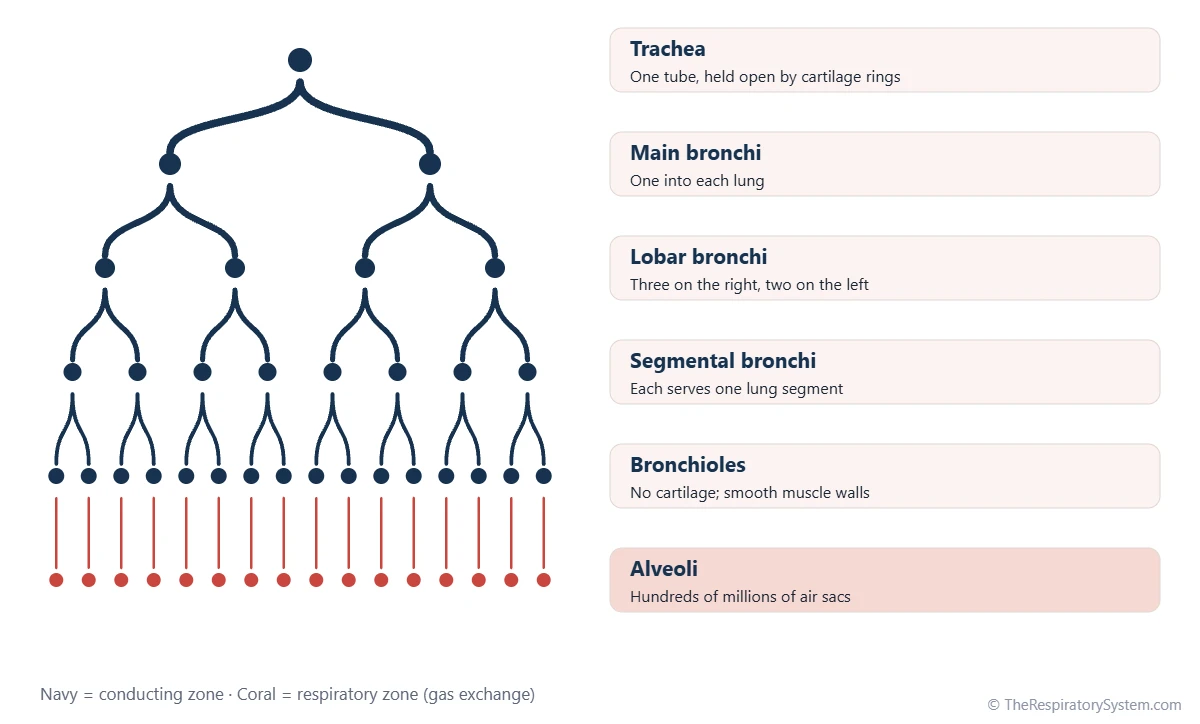
- The airways split again and again, about 23 times, between the trachea and the alveoli.
- An adult has about 300 to 500 million alveoli.
- Spread flat, the alveolar surface would cover about 50 to 75 square meters.
- Oxygen crosses a barrier only about 0.5 micrometer thick to reach the blood.
- The diaphragm does most of the work of quiet breathing.
- The main trigger for each breath is a rising level of carbon dioxide, not a falling level of oxygen.
For a guided tour of each organ, see organs of the respiratory system, and for what the system does as a whole, see respiratory system functions.
| Feature | Typical value | What it means |
|---|---|---|
| Breathing rate at rest (adult) | About 12 to 20 breaths per minute | Faster in children, during exercise and with fever |
| Breaths per day | About 17,000 to 29,000 | Often rounded to about 20,000 |
| Air per quiet breath | About 500 milliliters | Called the tidal volume |
| Air moved per minute at rest | About 6 liters | Breaths per minute times air per breath |
| Total lung capacity | About 6 liters in an average adult man | Usually smaller in women and children |
| Number of alveoli | About 300 to 500 million | Tiny air sacs where gas exchange happens |
| Alveolar surface area | About 50 to 75 square meters | Much larger than the skin surface |
| Air-blood barrier | About 0.5 micrometer thick | Short distance makes diffusion fast |
| Airway branching | About 23 divisions | From the trachea down to the alveolar sacs |
| Trachea | About 10 to 12 cm long, 16 to 20 rings | C-shaped cartilage keeps it open |
| Lung lobes | Three on the right, two on the left | The left lung leaves room for the heart |
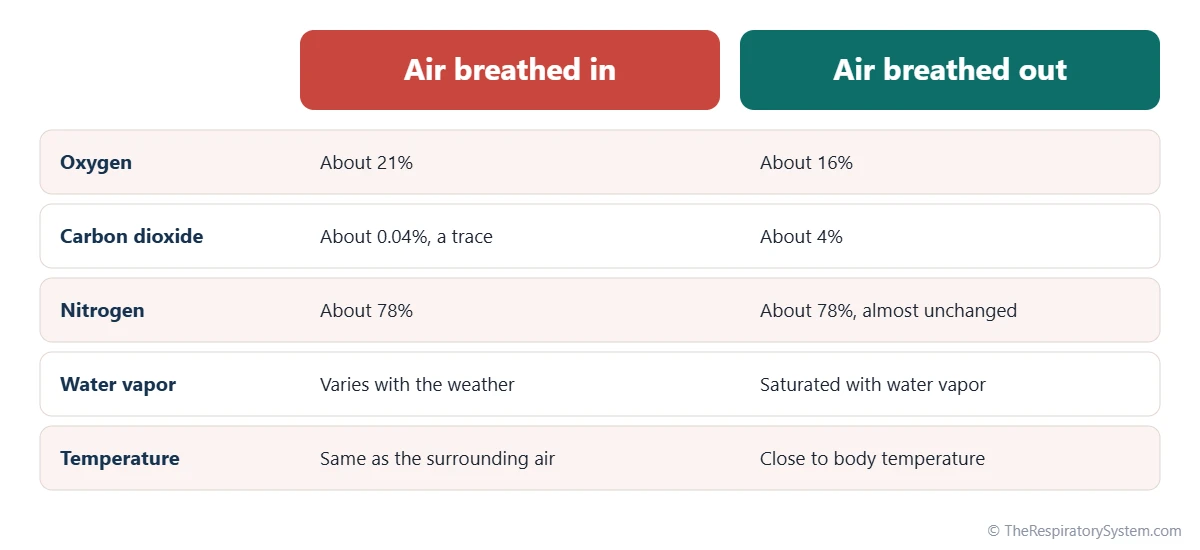
| Oxygen in inhaled vs exhaled air | About 21% vs about 16% | Only part of the oxygen is taken up |
| Source: Typical adult values, our editors | ||
What Are Some Fun Facts About the Lungs?
The lungs are full of surprises: they have no muscles of their own, they are not the same size, and healthy lung tissue is light enough to float in water. Here are the lung facts students ask about most.
- The two lungs are different. The right lung has three lobes, while the left lung has two and a notch for the heart, so the right lung is a little larger. Our page which lung is bigger compares them.
- Lungs cannot move on their own. They inflate only because the diaphragm and rib muscles enlarge the chest around them.
- Lungs float. Most of a healthy lung's volume is air, so its spongy tissue is lighter than water.
- The lungs sit higher than many people think. Their tops reach just above the collarbones.
- Lungs never empty completely. Even after the hardest breath out, about 1 to 1.5 liters of air stays inside, which keeps the alveoli from collapsing.
- The lungs have two blood supplies. Pulmonary arteries bring blood for gas exchange, while small bronchial arteries feed the lung tissue itself.
- A slippery wrapping. Each lung sits inside the pleura, two thin layers with a film of fluid between them that lets the lung glide as you breathe.
Explained simply
Your lungs are less like two balloons and more like two big sponges. Inside each one, air tubes branch into smaller and smaller tubes until they end in bunches of tiny bubbles. Those bubbles are where oxygen slips into your blood.
What Are Some Facts About the Nose, Throat and Voice Box?
The upper respiratory tract, made of the nose, sinuses, pharynx and larynx, cleans, warms and moistens air before it reaches the lungs, and it also handles smell and the voice. The upper respiratory tract section explains each part.
- The nose is an air conditioner. By the time inhaled air reaches the lungs, it is close to body temperature and almost fully saturated with water vapor.
- Your nostrils take turns. In the nasal cycle, the lining on one side swells while the other shrinks, switching every few hours without you noticing.
- Bony shelves stir the air. Three nasal conchae on each side make the air swirl against the moist lining.
- The skull has air pockets. Four pairs of paranasal sinuses lighten the skull and help the voice resonate.
- The throat is a shared road. The pharynx, about 12 to 13 centimeters long, carries both air and food.
- The voice box has nine cartilages. The largest, the thyroid cartilage, forms the bump called the Adam's apple, which is usually bigger in men. The larynx page shows all nine.
- A flap guards the airway. When you swallow, the epiglottis tips down so food goes into the esophagus.
What Are Some Facts About the Trachea, Bronchi and Alveoli?
The lower respiratory tract, from the trachea to the alveoli, carries air deep into the chest and is where gas exchange takes place. Its design packs a huge surface into a small space.
- The windpipe is ringed. The trachea is about 10 to 12 centimeters long and is held open by 16 to 20 C-shaped rings of cartilage.
- Objects tend to go right. The right main bronchus is wider and more vertical than the left, so inhaled objects more often lodge there.
- The airways branch like a tree. From the trachea to the alveoli, the bronchial tree divides about 23 times.
- Small airways have no cartilage. Bronchioles are held open by the pull of the surrounding lung tissue and use smooth muscle to change their width.
- Alveoli are tiny. Each one is only about 0.2 millimeter across, yet together they give a surface of about 50 to 75 square meters.
- A detergent keeps them open. Type II cells in the alveoli release surfactant, which lowers surface tension so the air sacs do not collapse.
- Cleaners on patrol. Alveolar macrophages, also called dust cells, swallow particles that reach the air sacs.
How Often and How Much Do We Breathe?
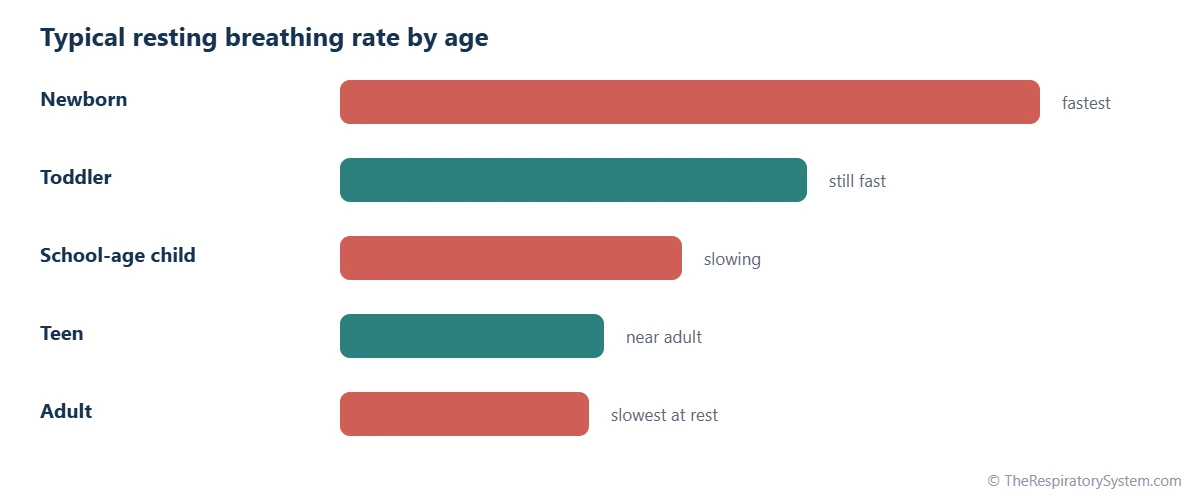
A resting adult breathes about 12 to 20 times a minute, which adds up to roughly 17,000 to 29,000 breaths a day, often rounded to about 20,000. Each quiet breath moves about 500 milliliters of air, so about 6 liters of air pass in and out every minute at rest.
Breathing speeds up and deepens a great deal during exercise, and babies breathe much faster than adults; newborns usually take about 30 to 60 breaths a minute. The normal ranges by age are on our respiratory rate page, and the different amounts of air the lungs can hold are explained in lung volumes and capacities.
- Breathing is automatic and voluntary. The brainstem sets the rhythm without thought, but you can also choose to speed up, slow down or pause briefly, as described in control of breathing.
- Carbon dioxide drives the urge to breathe. Sensors called chemoreceptors respond mostly to rising carbon dioxide.
- Breathing loses water. Exhaled air is saturated with water vapor, which is why breath fogs on a cold day.
- Hiccups start in the diaphragm. A sudden twitch of the diaphragm is followed by the vocal cords snapping shut, which makes the sound; see why do we hiccup.
Which Common Beliefs About Breathing Are Myths?
Several popular beliefs about breathing are wrong, and correcting them is one of the quickest ways to understand how the respiratory system really works.
- Myth: we breathe out only carbon dioxide. Exhaled air is still mostly nitrogen and contains about 16% oxygen; carbon dioxide makes up only about 4%.
- Myth: air is mostly oxygen. Dry air is about 78% nitrogen and only about 21% oxygen.
- Myth: the lungs are hollow bags. They are spongy organs packed with branching tubes and millions of air sacs.
- Myth: gas exchange happens all along the airways. The trachea and bronchi only carry air; exchange begins at the respiratory bronchioles and takes place mainly in the alveoli, as shown in gas exchange in the lungs.
- Myth: breathing and respiration are the same thing. Breathing moves air; respiration also includes gas exchange and the use of oxygen inside cells, as explained in breathing vs respiration.
Respiratory System Facts for Students: What Belongs on a Fact Sheet?
A good respiratory system fact sheet names the main organs in order, states the job of each one, and includes a few key numbers such as breathing rate, number of alveoli and lung lobes. The fact table on this page is designed to be copied into a fact file.
Students in grades 4 and 5 usually need the organs in order and the basic idea of oxygen in, carbon dioxide out; our respiratory system for kids page is written for that level. Students in grades 6 to 8 add the alveoli, the diaphragm, the link with the heart and blood, and the difference between breathing and cellular respiration. A labeled respiratory system diagram and our respiratory system worksheets help with labeling practice, and the respiratory system quiz checks what you remember.
Before birth, a baby does not breathe air at all. Its lungs are filled with fluid and it gets oxygen from the mother's blood through the placenta; the first breaths after birth clear that fluid. The development of the respiratory system page tells the whole story.
What Are Some Facts About Respiratory Diseases?
Respiratory diseases range from very common short infections of the nose and throat to long-term lung conditions, and they are among the most frequent reasons people visit a doctor. Our respiratory diseases section lists them by the part they affect, and anyone with breathing symptoms should see a doctor.
- The common cold is an infection of the upper respiratory tract and is caused by many different viruses.
- Asthma makes the airways narrow and swell, and it often begins in childhood.
- COPD slowly damages the airways and alveolar walls, and tobacco smoke is its leading cause.
- Pneumonia fills some alveoli with fluid, so less oxygen reaches the blood.
Key Facts
- A resting adult breathes about 12 to 20 times a minute, roughly 20,000 times a day.
- Each quiet breath moves about 500 milliliters of air, called the tidal volume.
- The lungs contain about 300 to 500 million alveoli with a total surface of about 50 to 75 square meters.
- The right lung has three lobes and the left lung has two, leaving room for the heart.
- Exhaled air still contains about 16% oxygen and about 4% carbon dioxide.
- The diaphragm does most of the work of quiet breathing; the lungs have no muscle of their own.
- Rising carbon dioxide, sensed by chemoreceptors, is the main signal that triggers each breath.
Frequently Asked Questions
What are 5 facts about the respiratory system?
Five key facts: the respiratory system brings oxygen into the blood and removes carbon dioxide; air passes through the nose, pharynx, larynx, trachea and bronchi to reach the lungs; gas exchange happens in about 300 to 500 million alveoli; the diaphragm is the main breathing muscle; and a resting adult breathes about 12 to 20 times a minute.
How much air can your lungs hold?
The total lung capacity of an average adult man is about 6 liters, and it is usually smaller in women, children and shorter people. Only a small part of that is used in quiet breathing, about 500 milliliters per breath. The rest is a reserve that can be drawn on during exercise, plus about 1 to 1.5 liters that always stays in the lungs.
Why is the left lung smaller than the right lung?
The left lung is smaller because the heart sits slightly to the left of the middle of the chest and takes up some of the space on that side. To make room, the left lung has only two lobes instead of three and a curved notch along its front edge, called the cardiac notch, where the heart presses against it.
When do the lungs stop growing?
The lungs keep growing through childhood and the teenage years. New alveoli continue to form after birth, especially in early childhood, and the lungs reach their full size and best function in the early twenties. After that, lung function declines very slowly with normal aging, which is one reason older adults have less breathing reserve during hard exercise.
Is breathing voluntary or involuntary?
Breathing is both. Most of the time it is involuntary, controlled by groups of nerve cells in the brainstem that set the rhythm without any thought. You can also take over for a short time, for example when speaking, singing or taking a deep breath on purpose. If the carbon dioxide level rises far enough, the automatic control takes back over.
Do lungs have muscles?
The lungs have no skeletal muscle, so they cannot expand by themselves. They do contain smooth muscle in the walls of the bronchi and bronchioles, which narrows or widens the airways but does not pump air. The work of breathing is done by the diaphragm and the intercostal muscles, which change the size of the chest so the lungs are pulled open.
Can a person live with one lung?
Yes. People can live with one lung, for example after one has been removed in surgery. A single healthy lung can usually supply enough oxygen for everyday life, although the person has less reserve for hard physical effort. Over time the remaining lung may expand to fill more of the chest, and the heart and breathing pattern adjust.
What is a fun fact about the respiratory system for kids?
A favorite fun fact is that if you could spread out all the tiny air sacs in your lungs, they would cover an area about the size of a small apartment floor. Another is that your nostrils take turns doing more of the work every few hours. Kids also enjoy learning that healthy lungs are so full of air that they float.
Keep Exploring


