At a Glance
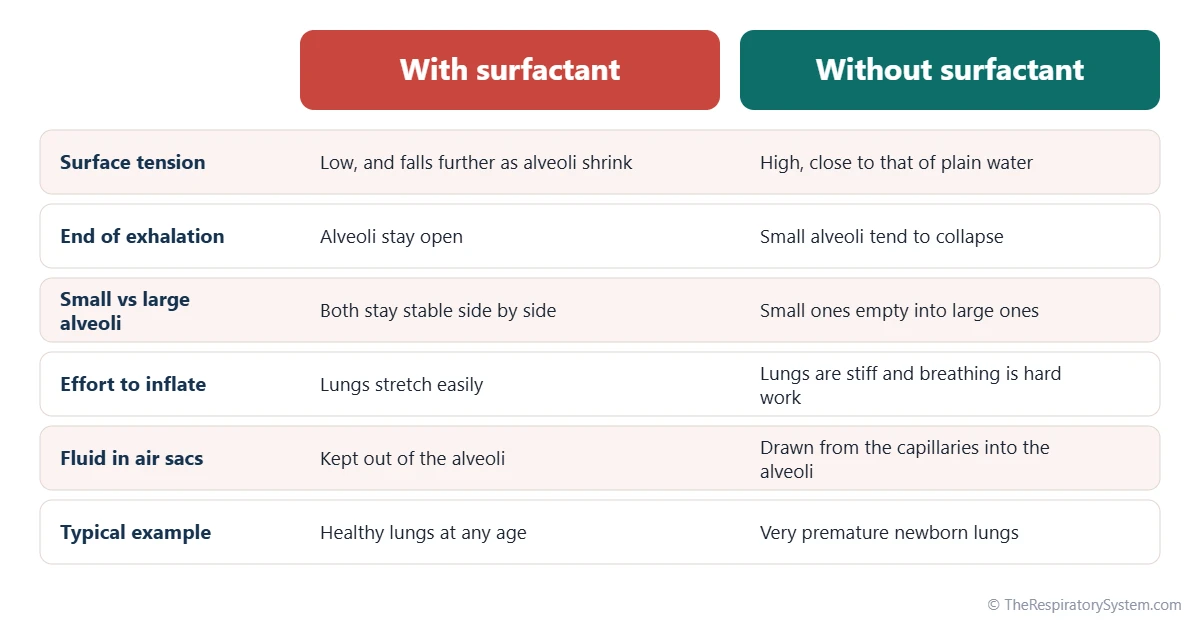
Pulmonary surfactant is a mixture of about 90% lipids and 10% proteins, mainly the phospholipid dipalmitoylphosphatidylcholine (DPPC), secreted by type II pneumocytes onto the fluid lining the alveoli. By lowering surface tension, it keeps alveoli open at the end of exhalation, makes the lungs easier to inflate and helps keep fluid out of the air sacs.
- Location
- Thin film on the fluid lining the alveoli and the smallest airways
- Made by
- Type II pneumocytes, which store it in lamellar bodies
- Made of
- About 90% lipids, mostly DPPC, and about 10% proteins, including SP-A, SP-B, SP-C and SP-D
- Function
- Lowers surface tension, keeps alveoli open, eases inflation, helps defend the lung
- Development
- Production begins late in the second trimester; usually sufficient by about 34 to 36 weeks of pregnancy
- Part of
- Alveolar lining of the respiratory zone
On this page
- What Is Pulmonary Surfactant?
- Where Is Surfactant Found in the Lungs?
- What Is Pulmonary Surfactant Made Of?
- How Is Surfactant Made, Released and Recycled?
- What Is the Function of Pulmonary Surfactant?
- Why Is Surfactant Important in the Lungs at Birth?
- Common Conditions That Affect Pulmonary Surfactant
- Key Facts
- Quiz
- FAQ
What Is Pulmonary Surfactant?
Pulmonary surfactant is a slippery, soap-like mixture of lipids and proteins that coats the wet inner surface of the alveoli and reduces the pull of surface tension. Without it, the moist walls of each tiny air sac would tend to stick together and collapse every time you breathed out.
Pulmonary surfactant definition
The word surfactant is short for surface-active agent: any substance that gathers at the boundary between a liquid and a gas, or between two liquids, and lowers the tension there. Soaps and detergents are everyday surfactants. Pulmonary surfactant is the natural surfactant of the lungs, produced by the body itself and found only in the air spaces.
Explained simply
Water molecules hold on to each other tightly, which is why a drop of water pulls itself into a bead. Inside an alveolus, that same pull tries to shrink the air sac like a deflating balloon. Surfactant squeezes in between the water molecules and weakens their grip, so the air sacs stay open with very little effort.
Where Is Surfactant Found in the Lungs?
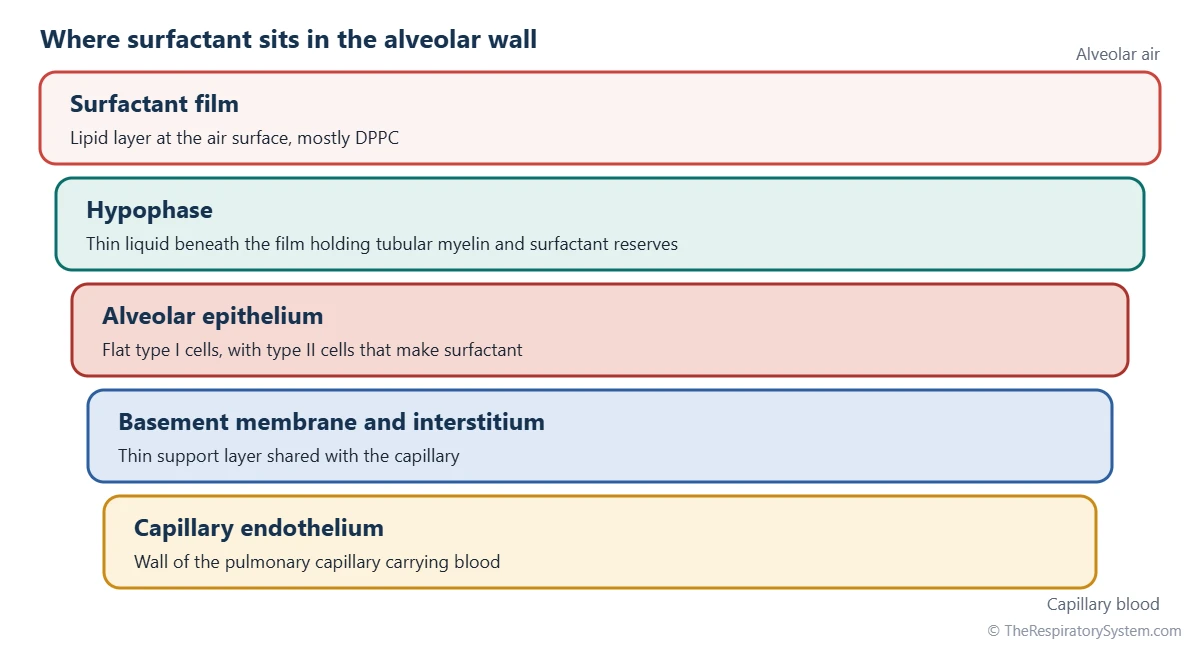
Surfactant is found as a very thin film at the air-liquid surface of the alveoli, floating on the watery lining that covers the alveolar wall, and small amounts reach the smallest bronchioles. It is made by type II pneumocytes, the rounded cells tucked into the corners of each alveolus.
The film forms the topmost layer of the alveolar wall, just above the respiratory membrane that oxygen must cross to reach the blood. Beneath the film is a thin liquid layer called the hypophase, which holds a reserve of surfactant waiting to move up to the surface. Type I pneumocytes, the flat cells that form most of the alveolar wall, lie under that liquid.
Surfactant works alongside other residents of the alveolus. Alveolar macrophages patrol the surface and swallow old surfactant along with dust and germs, while the alveolar ducts and sacs share the same lining.
What Is Pulmonary Surfactant Made Of?
Pulmonary surfactant is made of about 90% lipids and about 10% proteins. The lipids do most of the work of lowering surface tension, and the proteins help the lipids spread, recycle and defend the lung.
Lipids
The most important lipid is dipalmitoylphosphatidylcholine, usually shortened to DPPC. It is a phospholipid, a molecule with a water-loving head and two straight, water-avoiding fatty acid tails. At the surface, DPPC molecules line up side by side with their heads in the liquid and their tails pointing into the air, and when the alveolus shrinks they pack so tightly that surface tension falls close to zero. Other phospholipids, such as phosphatidylglycerol, plus a little cholesterol keep the film fluid enough to spread.
Surfactant proteins
Four surfactant proteins, named SP-A, SP-B, SP-C and SP-D, make up much of the protein part. SP-B and SP-C are small and water-repelling; they help the lipids move from the liquid to the surface and spread into a smooth film. SP-A and SP-D are larger and water-loving; they bind bacteria, viruses and fungi and help immune cells clear them. The table below lists the main components and their roles.
| Component | Type | Main role |
|---|---|---|
| DPPC (dipalmitoylphosphatidylcholine) | Phospholipid, the largest single component | Packs tightly at the surface and drives surface tension close to zero |
| Other phosphatidylcholines | Phospholipids with less regular tails | Keep the film fluid so it can spread |
| Phosphatidylglycerol | Phospholipid | Helps the film spread; its presence is a sign of mature fetal lungs |
| Cholesterol and other neutral lipids | Non-phospholipid fats | Adjust how stiff or fluid the film is |
| SP-A | Large, water-loving protein (collectin) | Binds microbes and helps macrophages clear them; helps form tubular myelin |
| SP-B | Small, water-repelling protein | Moves lipids into the surface film; essential for life after birth |
| SP-C | Small, water-repelling protein | Stabilizes the film during repeated breathing cycles |
| SP-D | Large, water-loving protein (collectin) | Clumps bacteria and viruses and helps control inflammation |
| Source: Standard lung physiology, our editors | ||
How Is Surfactant Made, Released and Recycled?
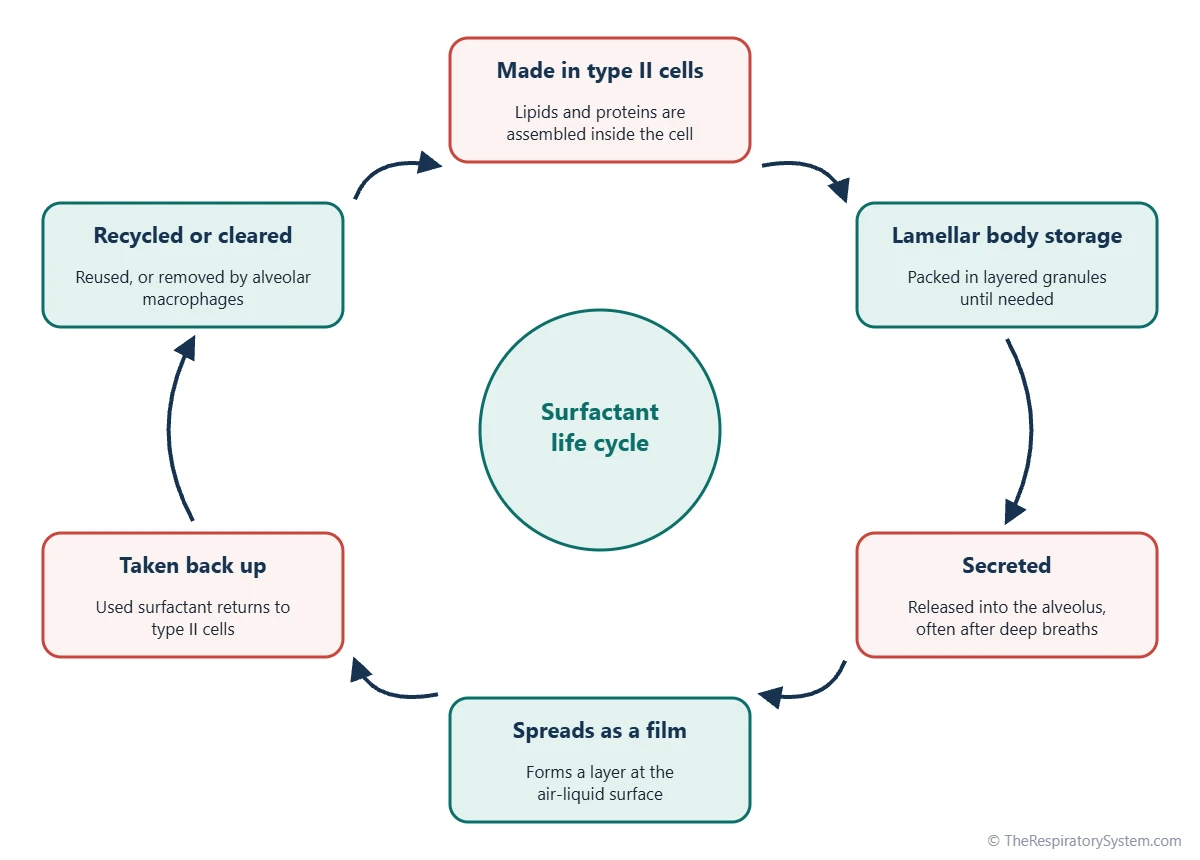
Surfactant is built inside type II pneumocytes, stored in layered granules called lamellar bodies, released into the alveolus, spread as a film on the surface, and then largely taken back by the same cells to be reused. This loop runs constantly throughout life.
- Production: type II cells assemble the lipids and proteins inside their endoplasmic reticulum and Golgi apparatus.
- Storage: the mixture is packed into lamellar bodies, which look like stacks of tightly rolled sheets under the electron microscope.
- Release: lamellar bodies fuse with the cell surface and empty into the alveolar fluid. Stretching of the alveoli during deeper breaths is one of the strongest triggers.
- Spreading: in the liquid the material unfolds into a lattice called tubular myelin, which feeds lipids up into the surface film.
- Recycling and clearance: used surfactant is taken back into type II cells and much of it is reused, while alveolar macrophages break down the rest.
The cells also respond to hormones. Cortisol and thyroid hormones help type II cells mature before birth, which is part of how the lungs prepare for their first breath, as described on our development of the respiratory system page.
What Is the Function of Pulmonary Surfactant?
The main function of pulmonary surfactant is to lower the surface tension of the fluid lining the alveoli, which keeps the alveoli open at the end of exhalation, makes the lungs easier to inflate and helps keep fluid out of the air spaces. It also has a smaller but real role in defending the lung against infection.
Keeping the alveoli open
The pressure needed to keep a bubble open follows the law of Laplace: pressure equals two times the surface tension divided by the radius (P = 2T/r). A small alveolus therefore needs more pressure than a large one, and without help the small ones would empty into the large ones and collapse. Surfactant solves this because its effect gets stronger as an alveolus shrinks: the molecules crowd together and surface tension drops, so small and large alveoli stay stable side by side.
Making breathing easier
By cutting surface tension, surfactant increases lung compliance, the ease with which the lungs stretch. The breathing muscles then need far less effort to pull air in during inhalation, a link explained on our mechanics of breathing page.
Keeping the alveoli dry and defended
High surface tension would also suck fluid out of the capillaries into the air sacs, so surfactant helps the lungs stay dry enough for gas exchange. SP-A and SP-D add a defense role by tagging microbes for removal, a quiet partner to the cilia and mucus that clean the larger airways.
Why Is Surfactant Important in the Lungs at Birth?
Surfactant is especially important at birth, because a newborn must open its fluid-filled lungs with its very first breaths and then keep them open with every breath after. Without enough surfactant, each breath would be almost as hard as the first.
Type II cells begin making surfactant late in the second trimester of pregnancy, and the amount usually becomes sufficient at around 34 to 36 weeks. A baby born well before this point may not have enough, and its alveoli tend to collapse at the end of each breath. Doctors can estimate lung maturity before birth by measuring surfactant lipids in the amniotic fluid.
Surfactant matters for adults too. It keeps millions of small alveoli inflated through each night of quiet breathing and protects the huge alveolar surface that the respiratory system depends on.
Common Conditions That Affect Pulmonary Surfactant
Surfactant problems arise when too little is made, when it is damaged or washed out by injury, when it is built incorrectly because of a gene change, or when it is not cleared and builds up. Our respiratory diseases section covers lung conditions more broadly, and anyone with breathing symptoms should see a doctor.
- Neonatal respiratory distress syndrome: a lung condition of premature babies, caused mainly by not enough surfactant. It was once called hyaline membrane disease.
- Acute respiratory distress syndrome (ARDS): in adults and children, severe lung injury floods the alveoli with protein-rich fluid that blocks and breaks down surfactant.
- Genetic surfactant disorders: rare changes in the genes for SP-B, SP-C or the lipid transporter ABCA3 can cause lung disease from birth or later in life.
- Pulmonary alveolar proteinosis: a rare condition in which surfactant is not cleared properly by macrophages and slowly fills the air sacs.
- Pneumonia: infection and inflammation can disturb the surfactant film in the affected alveoli.
In all of these, the shared result is stiffer lungs and collapsed or flooded alveoli, which lower the oxygen level of the blood, a state called hypoxemia.
Key Facts
- Pulmonary surfactant is a film of about 90% lipids and 10% proteins that lines the alveoli.
- It is made, stored and recycled by type II pneumocytes.
- Its main lipid, DPPC, can push surface tension close to zero when an alveolus shrinks.
- By lowering surface tension, surfactant keeps alveoli open at the end of exhalation and makes the lungs easier to inflate.
- Surfactant proteins SP-A and SP-D help the lung fight bacteria and viruses.
- Surfactant production usually becomes sufficient at about 34 to 36 weeks of pregnancy.
- A lack of surfactant is the main cause of breathing difficulty in very premature babies, while lung injury in ARDS disrupts it in adults.
Quick Quiz: Test What You Know About the Pulmonary Surfactant
6 questions. Tap an answer to check it.
Which cells produce pulmonary surfactant?
Type II pneumocytes make, store and recycle surfactant; macrophages only help clear old surfactant.
What is the main lipid in pulmonary surfactant?
DPPC is the largest single component and the one that drives surface tension close to zero.
What is the main function of pulmonary surfactant?
Surfactant lowers surface tension, which keeps the alveoli open and makes the lungs easier to inflate.
In which granules is surfactant stored before release?
Type II cells store surfactant in layered lamellar bodies, which empty into the alveolus.
According to the law of Laplace, which alveoli would collapse first without surfactant?
Pressure equals 2T/r, so smaller alveoli need more pressure to stay open and would empty into larger ones.
Which surfactant proteins help defend the lung against microbes?
SP-A and SP-D are collectins that bind microbes and help immune cells remove them.
Frequently Asked Questions
What are examples of surfactants?
Everyday surfactants include soap, dish detergent, shampoo and laundry detergent, which all lower the surface tension of water so it can wet and lift away grease. Lecithin used in foods is another example. Inside the body, pulmonary surfactant in the lungs and bile salts in the gut both act as natural surfactants, each suited to a different job.
Is surfactant the same as mucus?
No. Mucus is a thick, sticky gel made by goblet cells and glands in the larger airways, where it traps dust and germs so cilia can sweep them away. Surfactant is a very thin, slippery film of lipids and proteins made by type II pneumocytes in the alveoli, where its job is to lower surface tension.
When do babies start making surfactant?
Type II cells in a baby's lungs begin making surfactant late in the second trimester of pregnancy. The amount rises steadily and usually becomes sufficient for normal breathing at around 34 to 36 weeks. This is why babies born very early are much more likely to have breathing difficulty than babies born close to their due date.
What makes type II cells release surfactant?
The strongest trigger is stretch: when the alveoli expand during deeper breaths or sighs, type II cells are stretched and release lamellar bodies. Chemical signals also play a part, including adrenaline-like hormones acting on beta receptors and ATP released by neighboring cells. Together these keep the surface film topped up as breathing changes during the day.
Does surfactant help gas exchange?
Yes, indirectly. Surfactant does not carry oxygen, but it keeps the alveoli open so their whole surface stays available for gas exchange, and it helps keep fluid out of the air spaces so the barrier stays thin. Collapsed or flooded alveoli cannot exchange gases, so losing surfactant quickly lowers the oxygen level of the blood.
What happens if the lungs have no surfactant?
Without surfactant, surface tension in the alveoli would stay high. Small air sacs would collapse at the end of each breath, the lungs would become stiff, and every breath would take a great deal of effort. Fluid would also be pulled into the air sacs. Gas exchange would fall, which is what happens in surfactant deficiency in premature babies.
Do other animals have pulmonary surfactant?
Yes. Surfactant is found in the lungs of all air-breathing vertebrates, including mammals, birds, reptiles and amphibians, and even in the air-breathing organs of lungfish. Its basic makeup is similar across these animals, which suggests it appeared very early in the evolution of air breathing. Diving mammals have surfactant that helps their lungs reopen after deep dives.
Who discovered pulmonary surfactant?
Several scientists built up the picture. Kurt von Neergaard showed in 1929 that surface tension makes lungs harder to inflate. In the 1950s, Richard Pattle and John Clements independently showed that lung fluid contains a substance that lowers surface tension, and Mary Ellen Avery and Jere Mead linked a lack of it to breathing problems in premature babies in 1959.
Keep Exploring


