At a Glance
The mucociliary escalator is the clearance mechanism of the respiratory tract in which mucus made by goblet cells and submucosal glands traps inhaled particles, and cilia on the ciliated cells of the airway lining, beating about 10 to 20 times per second, move the mucus toward the pharynx. There it is swallowed, so the lower airways stay clean and almost free of microbes.
- Location
- Nasal cavity, trachea, bronchi and bronchioles; not the alveoli
- Function
- Traps inhaled particles and microbes and carries them out of the airways
- Cells
- Ciliated columnar cells, goblet cells, submucosal glands and club cells
- Direction
- Upward from the lungs and backward from the nose, toward the pharynx
- Backups
- Coughing, sneezing and alveolar macrophages
- Part of
- The respiratory epithelium and the innate defense of the lungs
On this page
- What Is the Mucociliary Escalator?
- Where Is the Mucociliary Escalator Located?
- What Is the Function of Cilia in the Respiratory System?
- What Is the Function of Mucus in the Respiratory System?
- How Does the Mucociliary Escalator Work?
- What Happens to the Mucus After It Is Cleared?
- What Affects Mucociliary Clearance?
- What Is a Respiratory Mucus Plug?
- Common Conditions That Affect Cilia and Mucus
- Key Facts
- Quiz
- FAQ
What Is the Mucociliary Escalator?
The mucociliary escalator is the moving layer of mucus and the cilia that drive it, which together clean the airways by carrying trapped particles out of the respiratory tract. Doctors and physiologists call the process mucociliary clearance, and it is the main defense of the bronchi and trachea against everything we breathe in.
Mucociliary escalator definition in anatomy
In anatomy, the mucociliary escalator is defined by two parts working together. The first is airway mucus, produced by goblet cells in the lining and by glands in the wall. The second is the cilia, tiny hair-like projections on the ciliated cells of the respiratory epithelium. Without mucus the cilia have nothing to push, and without cilia the mucus would simply pile up, so neither works alone.
Explained simply
Imagine a moving walkway in an airport, covered with flypaper. Dust and germs land on the sticky surface and get stuck, and the walkway slowly carries them up and out of the lungs to the back of the throat. You then swallow them without noticing, and your stomach acid destroys most of the germs. This walkway never stops, even while you sleep.
Where Is the Mucociliary Escalator Located?
The mucociliary escalator is located along the conducting airways, from the nasal cavity and the trachea down to the smallest bronchioles, wherever the lining is ciliated epithelium. Both halves of the system send their mucus to the same place, the pharynx.
- In the nose: cilia lining the nasal cavity and paranasal sinuses push mucus backward toward the nasopharynx.
- In the lower airways: cilia in the trachea, bronchi and bronchioles push mucus upward, against gravity, to the larynx.
- Where it stops: the escalator ends at the top of the larynx and at the lower edge of the nasopharynx, where the lining changes to the stratified squamous epithelium of the oropharynx and laryngopharynx, which is built for swallowing, not sweeping.
Several areas have no escalator at all. The skin-lined nasal vestibule relies on hairs, the true vocal cords are covered by stratified squamous epithelium, and the alveoli have no cilia because a mucus layer would block gas exchange. Deep in the lungs, cleaning is taken over by alveolar macrophages.
What Is the Function of Cilia in the Respiratory System?
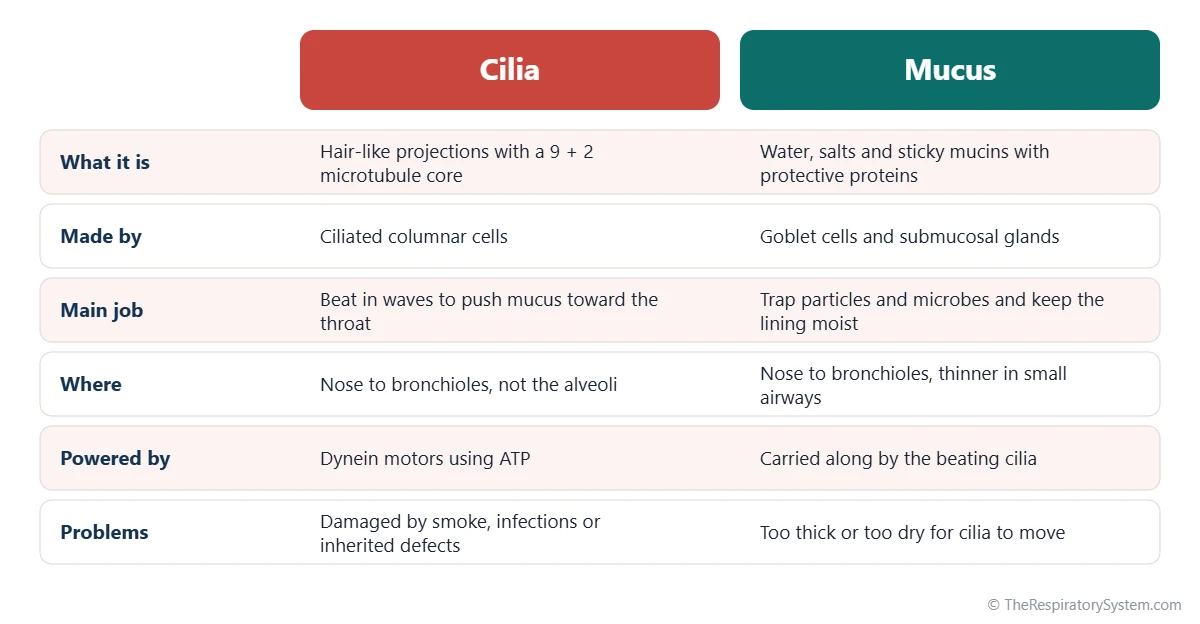
The function of cilia in the respiratory system is to beat in coordinated waves that push the mucus layer, and everything trapped in it, out of the airways. Each ciliated cell carries around 200 to 300 cilia, and together they line most of the conducting airways.
How a cilium is built
A cilium is a slender projection of the cell membrane, only a few micrometers long, with a core called the axoneme. The axoneme holds nine pairs of microtubules arranged in a ring around two central microtubules, the classic 9 + 2 pattern. Motor proteins called dynein arms link neighboring pairs and slide them past each other, using energy from ATP, which makes the whole cilium bend.
How cilia beat
Each beat has two phases. In the fast effective stroke, the cilium stands fully upright and sweeps forward, its tip reaching into the mucus and pushing it along. In the slower recovery stroke, the cilium bends low and swings back through the watery layer beneath the mucus, so it does not drag the mucus backward. The cilia beat about 10 to 20 times per second.
Neighboring cilia do not beat in unison but slightly out of step, so ripples called metachronal waves run across the surface, like a crowd doing a stadium wave. This pattern keeps the mucus sheet moving smoothly in one direction.
What Is the Function of Mucus in the Respiratory System?
The function of mucus in the respiratory system is to trap inhaled particles and microbes, keep the airway lining moist and carry chemical defenses that kill or neutralize germs. It is the part of the escalator that does the catching, while the cilia do the carrying.
What airway mucus is made of
Airway mucus is mostly water, roughly 95%, with salts, lipids and large sugar-coated proteins called mucins. Mucins absorb water and tangle together into a gel, which gives mucus its stickiness. The two main airway mucins are MUC5AC, made mostly by goblet cells, and MUC5B, made mostly by the submucosal glands.
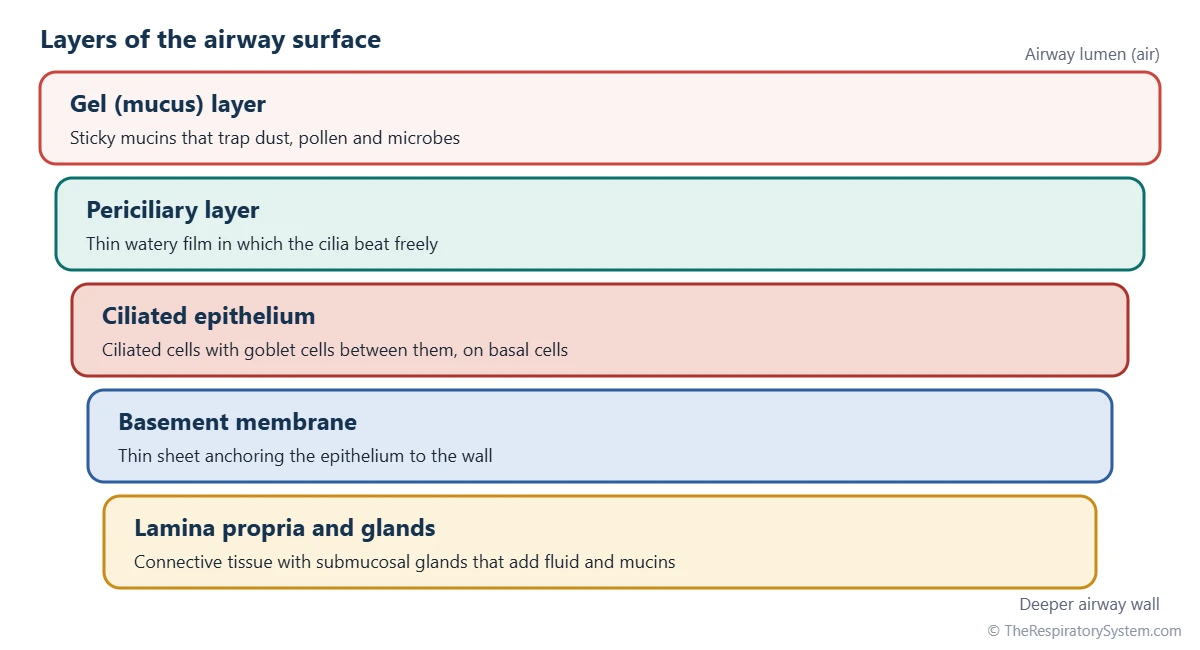
Two layers on the airway surface
The airway surface liquid has two layers. Next to the cells lies the periciliary layer, a thin watery film about as deep as the cilia are tall, in which the cilia can beat freely. On top of it floats the gel layer of mucus, which the tips of the cilia catch during each effective stroke. If the watery layer becomes too shallow, the cilia get stuck in the gel and clearance slows down.
Built-in defenses
Mucus also carries antimicrobial proteins such as lysozyme, lactoferrin and defensins, and antibodies called secretory IgA that bind germs before they can attach to the lining. Mucus keeps the delicate lining from drying out and helps humidify the air on its way down the pathway of air.
| Part | Where it is | What it does |
|---|---|---|
| Ciliated columnar cells | Lining of the nose, trachea, bronchi and bronchioles | Carry around 200 to 300 motile cilia each |
| Cilia | Surface of ciliated cells, inside the periciliary layer | Beat in waves that move the mucus toward the pharynx |
| Goblet cells | Between ciliated cells, fewer in small airways | Release mucins, mainly MUC5AC |
| Submucosal glands | Wall of the trachea and bronchi | Add watery fluid and mucins, mainly MUC5B |
| Club cells | Bronchioles | Release protective proteins and help repair the lining |
| Basal cells | Base of the epithelium | Act as stem cells that replace ciliated and goblet cells |
| Periciliary layer | Directly on the cell surface | Watery film in which the cilia beat |
| Gel (mucus) layer | On top of the periciliary layer | Traps particles and microbes |
| Alveolar macrophages | Alveoli, beyond the escalator | Engulf the finest particles that reach the air sacs |
| Source: Typical adult airway physiology, our editors | ||
How Does the Mucociliary Escalator Work?
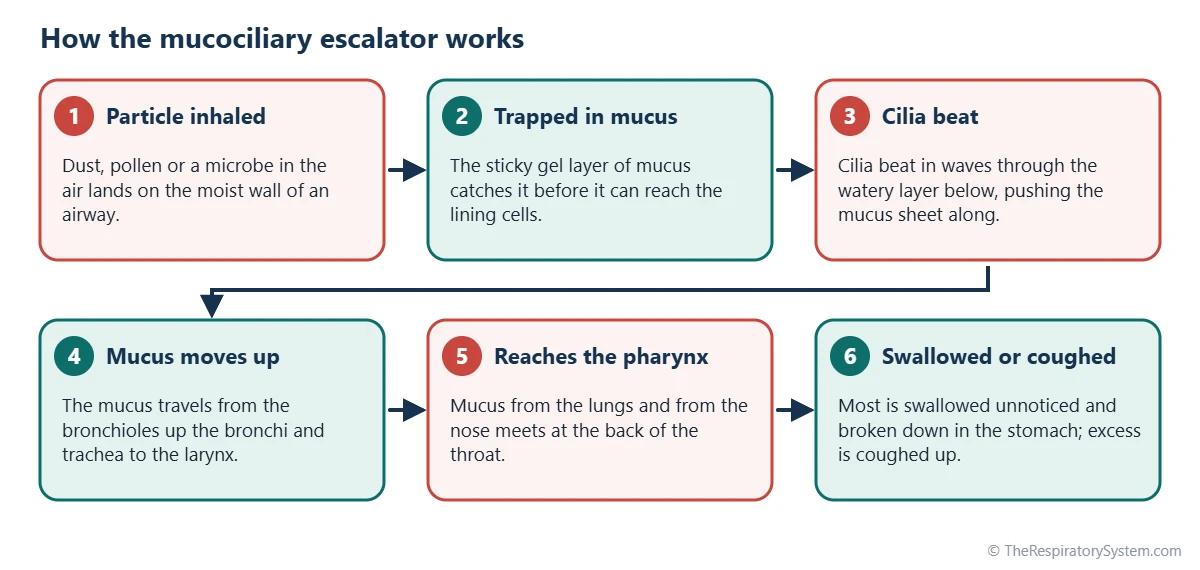
The mucociliary escalator works by trapping inhaled particles in the gel layer of mucus and then moving that layer, by the coordinated beating of cilia, up toward the pharynx, where it is swallowed. The steps below follow one speck of dust.
- A particle is inhaled. Dust, pollen, smoke or a microbe enters with the air, and larger particles, roughly bigger than 10 micrometers, are mostly caught by nose hairs and the nasal lining.
- It lands on the airway wall. Smaller particles are carried deeper and hit the moist walls where the airways branch or bend.
- The mucus traps it. The sticky gel layer catches the particle before it can touch the cells.
- Cilia move the mucus. Cilia beating through the periciliary layer push the gel layer along, a few micrometers with every stroke.
- The sheet flows toward the throat. Mucus from small airways merges into larger ones and travels up the trachea at several millimeters per minute.
- It reaches the pharynx. At the larynx the mucus spills over into the pharynx, where it meets the mucus coming back from the nose.
- It is swallowed or coughed out. Most is swallowed without notice, and stomach acid destroys most of the microbes in it.
The whole trip from the small airways to the throat can take hours, while mucus already in the trachea usually reaches the larynx in well under an hour. Very fine particles that slip past the escalator into the alveoli are engulfed by macrophages, which may later ride the escalator out themselves.
What Happens to the Mucus After It Is Cleared?
Cleared mucus is normally swallowed: it drops from the larynx and nasopharynx into the pharynx, passes down the esophagus and is broken down in the stomach. Most people never notice this happening.
Mucus only becomes noticeable when there is too much of it or it becomes too thick for the cilia to move. Mucus coughed up from the lower airways is called sputum, and the everyday word phlegm is used for thick mucus in the throat or chest. Its color can change during infections because of the white blood cells and their enzymes mixed into it.
When the escalator is overwhelmed, the cough reflex takes over. A cough uses a blast of high-speed air to tear mucus off the airway walls, and it works best in the large airways, where the air moves fastest. In the nose, a sneeze does the same job, as explained on the why do we sneeze page.
What Affects Mucociliary Clearance?
Mucociliary clearance is slowed by anything that damages the cilia, changes the thickness of the mucus or dries out the airway surface, including tobacco smoke, very dry air, infections and some inherited conditions. The table below sums up the main factors.
- Tobacco smoke: slows ciliary beating, damages and shortens cilia, and increases the number of goblet cells, so there is more mucus and less power to move it. This mismatch is the root of the morning cough common in long-term smokers.
- Dry or cold air: thins the watery periciliary layer and makes mucus stickier; air that passes through the nose is warmed and moistened first, which lessens this effect.
- Viral infections: colds and flu can strip patches of ciliated cells, which can take weeks to regrow, one reason a cough often lingers after the infection clears.
- Pollution and dust: heavy exposure overloads the system and, over years, irritates the lining.
- Age: clearance tends to become slower in older adults.
The airway lining can repair itself, because basal cells and club cells act as stem cells that rebuild damaged ciliated epithelium, a process described on the respiratory system histology page.
| Factor | What it changes | Effect on clearance |
|---|---|---|
| Tobacco smoke | Damages cilia and multiplies goblet cells | Slower, with more mucus to move |
| Dry or cold air | Thins the watery periciliary layer | Slower, stickier mucus |
| Viral infections | Destroys patches of ciliated cells | Slower until the lining regrows |
| Cystic fibrosis | Too little water on the airway surface | Thick mucus that cilia cannot move |
| Primary ciliary dyskinesia | Cilia built incorrectly | Little or no ciliary movement |
| Older age | Gradual changes in cilia and mucus | Tends to be slower |
| Coughing | High-speed airflow in large airways | Backup clearance when the escalator is overloaded |
| Source: Typical adult airway physiology, our editors | ||
What Is a Respiratory Mucus Plug?
A respiratory mucus plug is a mass of thick mucus that blocks an airway, usually a bronchus or bronchiole, so that air cannot pass beyond it. It forms when mucus is produced faster than the escalator can clear it, or when the mucus becomes too thick and dry for the cilia to move.
Mucus plugs are a feature of several airway diseases, especially asthma, cystic fibrosis, bronchiectasis and COPD. They can also form in people who cannot cough effectively, for example after major surgery. When a plug blocks an airway, the air beyond it can be absorbed into the blood and that part of the lung can collapse, a state known as atelectasis.
Common Conditions That Affect Cilia and Mucus
Some conditions damage the cilia themselves, while others change the mucus, but both kinds lead to mucus building up in the airways and to repeated infections. Our respiratory diseases section explains each condition in more depth, and anyone with a lasting cough or breathing symptoms should see a doctor.
- Cystic fibrosis: an inherited fault in the CFTR channel, which moves chloride and water onto the airway surface, leaves the periciliary layer too shallow and the mucus thick and sticky.
- Primary ciliary dyskinesia: an inherited defect in the structure of the cilia, often in the dynein arms, makes them beat weakly or not at all. About half of affected people also have their internal organs mirrored, a combination called Kartagener syndrome.
- Chronic bronchitis: long-term irritation enlarges the mucous glands and multiplies goblet cells, causing a cough that brings up mucus on most days.
- Bronchiectasis: permanently widened bronchi let mucus pool where the cilia cannot move it.
- Whooping cough: the bacteria behind it attach to ciliated cells and release toxins that damage them.
Key Facts
- The mucociliary escalator clears the conducting airways by trapping particles in mucus and moving the mucus with beating cilia.
- Each ciliated cell of the respiratory epithelium carries around 200 to 300 cilia.
- Airway cilia beat about 10 to 20 times per second, with a fast effective stroke and a slow recovery stroke.
- Mucus floats as a gel layer on a thin watery periciliary layer in which the cilia beat.
- Mucus from the lungs moves up and mucus from the nose moves back, and both are swallowed in the pharynx.
- The alveoli have no cilia; particles that reach them are cleared by alveolar macrophages.
- Tobacco smoke slows the cilia and increases mucus production, which is why long-term smokers often cough up mucus.
Quick Quiz: Test What You Know About the Cilia and Mucus
6 questions. Tap an answer to check it.
Which cells release most of the mucus in the airway lining?
Goblet cells in the lining, together with the submucosal glands, release the mucins that form airway mucus.
In which direction does the mucociliary escalator move mucus from the lungs?
Cilia in the trachea and bronchi push mucus upward to the larynx and pharynx, where it is swallowed.
What is the arrangement of microtubules inside a motile cilium?
Motile cilia have nine outer pairs of microtubules around two central microtubules, the 9 + 2 axoneme.
Which part of the airways has no cilia?
The alveoli have no cilia; alveolar macrophages clear particles that reach them.
In which layer do the cilia beat?
Cilia beat in the thin, watery periciliary layer, and only their tips reach the gel layer above.
Which inherited condition makes airway mucus thick because too little water reaches the airway surface?
In cystic fibrosis a faulty CFTR channel moves too little chloride and water onto the airway surface.
Frequently Asked Questions
What is mucociliary clearance?
Mucociliary clearance is the process by which the airways clean themselves. Mucus traps inhaled dust, pollen and microbes, and the coordinated beating of cilia carries the mucus out of the lungs and nose to the pharynx, where it is swallowed. The term is used in physiology and medicine as another name for the action of the mucociliary escalator.
Why is it called an escalator?
It is called an escalator because it works like a moving staircase that carries material in one direction without stopping. The mucus sheet rides on the beating cilia and is carried up from the small airways, through the bronchi and trachea, to the top of the airway. Anything stuck to the mucus is carried along with it, just as a passenger rides an escalator.
How much mucus do the airways make?
Healthy airways make a steady, modest amount of mucus every day, and almost all of it is cleared and swallowed without being noticed. Estimates vary widely between studies, so there is no single agreed figure. The amount rises sharply during colds, allergies and in long-term lung conditions, which is when mucus becomes visible as phlegm or sputum.
Do cilia grow back?
Yes, in most cases. When ciliated cells are damaged by an infection or irritants, basal cells and club cells divide and rebuild the lining, and new ciliated cells grow their cilia again. Recovery after a viral infection can take several weeks. After someone stops smoking, ciliary function also tends to improve over time, which is why some people notice more coughing at first.
Is it bad to swallow mucus?
No. Swallowing mucus is the normal end of the mucociliary escalator, and people swallow mucus from the airways and nose all day without noticing. The stomach's acid and enzymes break it down along with most of the microbes trapped in it. Swallowing mucus does not spread an infection to the lungs, because the swallowed mucus travels down the esophagus, not the airway.
What is the difference between mucus, phlegm and sputum?
Mucus is the general name for the slippery secretion that lines the airways, nose, gut and other surfaces. Phlegm is an everyday word for thick mucus produced in the throat or chest, usually during a cold or irritation. Sputum is the medical term for mucus coughed up from the lower airways, sometimes mixed with saliva, cells and microbes.
Are the cilia in the airways the same as the cilia in other parts of the body?
Airway cilia are motile cilia, which beat to move fluid. Similar motile cilia line the fallopian tubes and parts of the brain's ventricles, and a sperm tail is built on the same plan. Most other cells in the body carry a single primary cilium, which does not beat but works as a sensor. Defects in motile cilia can affect several of these organs at once.
Does the mucociliary escalator work during sleep?
Yes. Ciliary beating does not depend on the brain or on breathing effort, so the escalator keeps running through the night, although clearance may be somewhat slower during sleep. Mucus that collects overnight is often cleared on waking with a few coughs or by swallowing, which is why many people notice more phlegm first thing in the morning.
Keep Exploring


