At a Glance
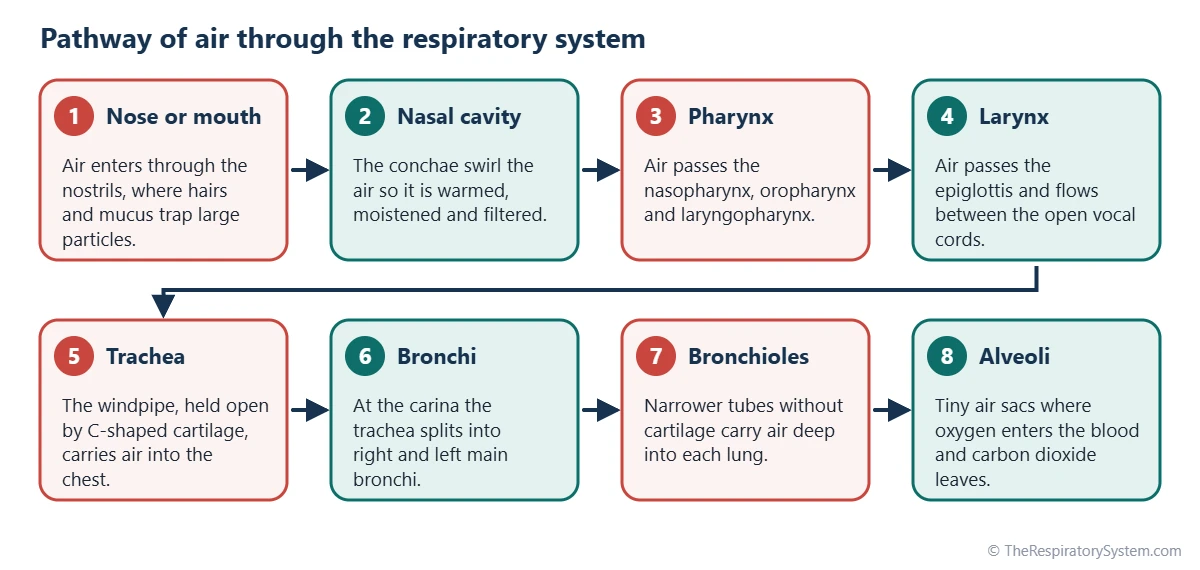
Air enters through the nostrils (external nares) or the mouth, passes through the nasal cavity, pharynx and larynx, then travels down the trachea into the right and left main bronchi. These branch about 23 times into smaller bronchi and bronchioles, ending in the alveoli, the roughly 300 to 500 million air sacs where gas exchange takes place.
- Order
- Nose or mouth, pharynx, larynx, trachea, bronchi, bronchioles, alveoli
- Starts at
- The nostrils (external nares), or the mouth during mouth breathing
- Ends at
- The alveoli, tiny air sacs wrapped in capillaries
- Conducting part
- Nose to terminal bronchioles: moves, cleans, warms and moistens air
- Exchange part
- Respiratory bronchioles, alveolar ducts, alveolar sacs and alveoli
- Way out
- The same route in reverse during exhalation
On this page
- What Is the Pathway of Air in the Respiratory System?
- Pathway of Air Steps: From the Nostrils to the Alveoli
- Air Flow Through the Respiratory System Starting With the External Nares
- How Does Air Pass Through the Larynx and Trachea?
- How Does Air Travel Through the Bronchial Tree?
- What Happens When Air Reaches the Alveoli?
- What Happens to the Air Along the Pathway?
- What Is the Pathway of Air Out of the Body?
- Pathway of Air Through the Respiratory System for GCSE PE
- Key Facts
- Quiz
- FAQ
What Is the Pathway of Air in the Respiratory System?
The pathway of air in the respiratory system is the fixed sequence of passages that inhaled air travels through, from the nostrils or mouth down to the alveoli of the lungs. Every breath follows the same route, and each part of it changes the air a little before it reaches the place where oxygen can enter the blood.
The route is usually split into two halves. The upper respiratory tract includes the nose, nasal cavity, pharynx and larynx, and it prepares the air. The lower respiratory tract runs from the trachea to the alveoli and delivers the air deep into the chest. The comparison of the upper vs lower respiratory tract explains the split in more detail.
Explained simply
Think of the airways as an upside-down tree. Air comes in through the nose, goes down the throat and into one big trunk, the windpipe. The trunk splits into two branches, one for each lung, and those branches keep splitting into smaller and smaller twigs. At the very tip of every twig is a cluster of tiny balloons, and that is where your body finally takes the oxygen out of the air.
Pathway of Air Steps: From the Nostrils to the Alveoli
The pathway of air has eleven main steps, from the external nares to the alveoli, and each structure hands the air on to the next. The list below gives the standard order used in anatomy courses.
- Nostrils (external nares): the two openings of the nose let air in; hairs in the nasal vestibule catch large particles.
- Nasal cavity: air flows over the curled nasal conchae and through the meatuses beneath them, where it is warmed, moistened and filtered.
- Internal nares (choanae): two openings at the back of the nasal cavity lead into the throat.
- Nasopharynx: the upper part of the pharynx, behind the nose, carries only air.
- Oropharynx: the middle part, behind the mouth, is shared by air and food; mouth breathing joins the pathway here.
- Laryngopharynx: the lowest part, where air turns forward into the larynx and food continues backward into the esophagus.
- Larynx: the voice box, guarded by the epiglottis, carries air through the glottis between the vocal cords.
- Trachea: the windpipe carries air down the neck into the chest.
- Bronchi: the trachea divides into the right and left main bronchi, which branch into lobar and segmental bronchi.
- Bronchioles: smaller tubes without cartilage spread the air through every part of each lung, ending in terminal and respiratory bronchioles.
- Alveoli: air reaches the alveolar ducts, alveolar sacs and finally the alveoli, where gas exchange happens.
The table below adds what happens to the air at each step and which part of the system it belongs to.
| Step | Structure | What happens to the air | Part of |
|---|---|---|---|
| 1 | Nostrils and nasal vestibule | Enters the body; hairs catch large particles | Upper tract, conducting zone |
| 2 | Nasal cavity | Swirls over the conchae; warmed, moistened, filtered and smelled | Upper tract, conducting zone |
| 3 | Choanae (internal nares) | Leaves the nasal cavity for the throat | Upper tract, conducting zone |
| 4 | Nasopharynx | Moves down behind the nose; air only | Upper tract, conducting zone |
| 5 | Oropharynx | Shares the tube with food; mouth air joins here | Upper tract, conducting zone |
| 6 | Laryngopharynx | Turns forward into the larynx | Upper tract, conducting zone |
| 7 | Larynx | Passes the epiglottis and the open glottis | Upper tract, conducting zone |
| 8 | Trachea | Carried down the neck into the chest | Lower tract, conducting zone |
| 9 | Main, lobar and segmental bronchi | Divided between the lungs, lobes and segments | Lower tract, conducting zone |
| 10 | Bronchioles and terminal bronchioles | Spread through each lung; flow slows down | Lower tract, conducting zone |
| 11 | Respiratory bronchioles and alveolar ducts | First gas exchange in scattered alveoli | Lower tract, respiratory zone |
| 12 | Alveolar sacs and alveoli | Oxygen enters the blood; carbon dioxide leaves | Lower tract, respiratory zone |
| Source: Standard adult airway anatomy, our editors | |||
Air Flow Through the Respiratory System Starting With the External Nares
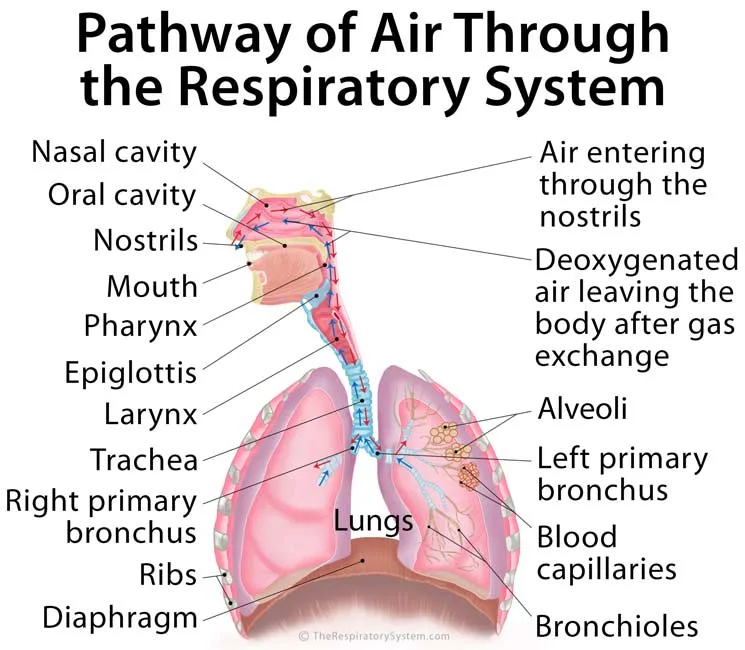
Air flow through the respiratory system starting with the external nares runs through the nasal vestibule, the nasal cavity and the choanae into the pharynx, which leads down to the larynx. This first stretch, inside the head and neck, is where most of the cleaning and conditioning of the air takes place.
Nostrils and nasal cavity
The nostrils open into the vestibule, a small skin-lined chamber with coarse hairs. Behind it lies the nasal cavity, split into left and right halves by the nasal septum. Three shelves of bone on each side wall, the superior, middle and inferior conchae, break the air into thin streams that flow through the narrow grooves called the nasal meatuses, which brings the air into close contact with the warm, wet lining.
Choanae and pharynx
At the back of the nasal cavity, the air passes through the choanae, or internal nares, into the nasopharynx. It then moves down through the oropharynx, behind the tongue, and the laryngopharynx, just above the larynx. Below the nasopharynx, air and food share the same tube, which is why the body needs a way to keep food out of the airway.
The mouth route
When the nose is blocked, or during hard exercise, air can also enter through the oral cavity. This shortcut joins the main pathway at the oropharynx but skips the filtering and warming of the nasal cavity, so the air reaches the lungs cooler, drier and less clean. The differences are covered on the nose breathing vs mouth breathing page.
How Does Air Pass Through the Larynx and Trachea?
Air passes through the larynx by flowing through the glottis, the opening between the vocal cords, and then enters the trachea, a tube about 10 to 12 cm long held open by 16 to 20 C-shaped rings of cartilage. Together they form the link between the throat and the lungs.
Larynx
The larynx sits at the top of the trachea in the front of the neck. During breathing, the epiglottis stands upright and the vocal cords are pulled apart, so air flows freely through the glottis. During swallowing, the larynx rises, the epiglottis tips back over the entrance and the vocal cords close, sending food into the esophagus instead. Air breathed out through the larynx can also make sound when the vocal cords are brought together and vibrate.
Trachea
The trachea, or windpipe, runs from the larynx down the neck and into the chest, in front of the esophagus. Its rigid rings stop it from collapsing as air pressure changes, while the ciliated lining keeps sweeping mucus and trapped dust upward. At about the level of the fourth or fifth thoracic vertebra, the trachea ends at a ridge called the carina, where it splits in two.
How Does Air Travel Through the Bronchial Tree?
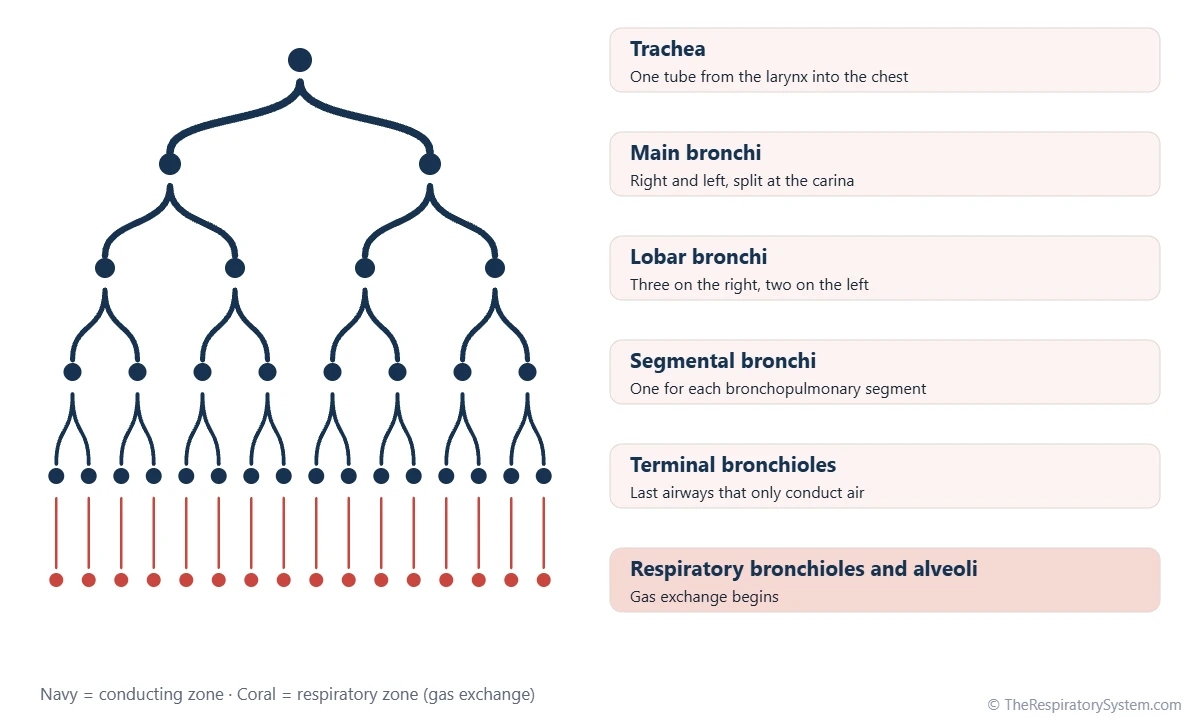
Air travels through the bronchial tree by flowing into the right and left main bronchi and then through about 23 generations of ever smaller branches, until it reaches the alveoli. With each branching the tubes get narrower, but there are so many of them that the total cross-section grows enormously and the air slows down.
Main, lobar and segmental bronchi
The right main bronchus is shorter, wider and more vertical than the left, which is why inhaled objects more often lodge on the right. Inside each lung, the main bronchi divide into lobar bronchi, three on the right and two on the left, one for each lobe. These split again into segmental bronchi, each supplying one of the bronchopulmonary segments.
Bronchioles
Once an airway is narrower than about 1 mm, its cartilage disappears and it is called a bronchiole. Bronchioles are wrapped in smooth muscle, which can widen or narrow them to adjust how air is shared out. The last purely conducting branches are the terminal bronchioles, and everything up to this point forms the conducting zone, about 150 mL of dead space that holds air but does not exchange gases. The whole branching pattern is mapped on the bronchial tree page.
What Happens When Air Reaches the Alveoli?
When air reaches the alveoli, oxygen diffuses across their thin walls into the blood of the surrounding capillaries, and carbon dioxide diffuses out of the blood into the air. This is the end point of the pathway and the reason for the whole journey.
The last stretch begins at the respiratory bronchioles, whose walls carry the first scattered alveoli. They lead into alveolar ducts and alveolar sacs, corridors lined on every side by alveoli. An adult has about 300 to 500 million alveoli, giving an inner surface of roughly 50 to 75 square meters, about the floor area of a small apartment.
By this point the air is barely moving forward. Bulk flow carries it to about the terminal bronchioles, and over the last few millimeters, in the respiratory zone, the gases spread mainly by diffusion. The details of how oxygen and carbon dioxide cross the wall are explained on our gas exchange page, and the blood that collects the oxygen is followed on the pulmonary circulation page.
What Happens to the Air Along the Pathway?
Along the pathway the air is filtered, warmed to body temperature, humidified, checked for odors and, on the way out, used for speech. These jobs are spread along the route, so each structure has a specific role.
- Filtering: nose hairs catch large particles, and sticky mucus traps smaller ones. Cilia then carry the mucus toward the throat, a cleaning system known as the mucociliary escalator. Very fine particles that reach the alveoli are eaten by alveolar macrophages.
- Warming: a dense network of blood vessels under the nasal lining heats the air, and by the time it passes the trachea it is close to body temperature, about 37 °C.
- Humidifying: water evaporates from the moist lining into the air, so it is almost fully saturated with water vapor before it reaches the alveoli, which protects their delicate walls from drying out.
- Smelling: a small patch of olfactory tissue in the roof of the nasal cavity samples the air, as described on the sense of smell page.
- Protecting: irritants in the nose trigger a sneeze, and irritants in the larynx or trachea trigger the cough reflex, which blasts them back out along the pathway.
- Speaking: exhaled air passing through the larynx vibrates the vocal cords to produce the voice.
The full list of jobs the airways and lungs perform is on the respiratory system functions page.
What Is the Pathway of Air Out of the Body?
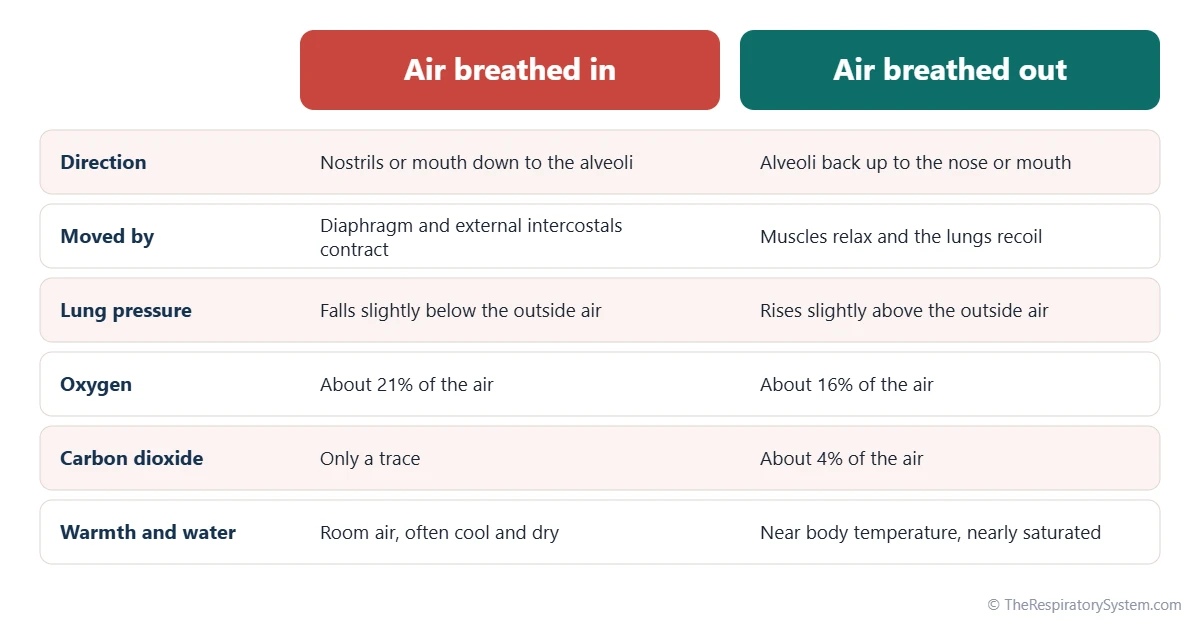
The pathway of air out of the body is the same route in reverse: alveoli, bronchioles, bronchi, trachea, larynx, pharynx and out through the nose or mouth. Air does not flow in a loop; it moves in and out along the same tubes, like the tide.
Breathing out at rest is mostly passive. The diaphragm and external intercostal muscles relax, the stretched lungs recoil, and the pressure inside them rises slightly above the air outside, pushing air out. The muscles behind each phase are explained on the inhalation and exhalation and mechanics of breathing pages.
Exhaled air is different from the air that came in. It holds less oxygen, about 16% instead of about 21%, much more carbon dioxide, about 4% instead of a trace, and it is warm and nearly saturated with water vapor. That moisture is why breath fogs up a cold window. The first air to leave with each breath is the air that sat in the dead space and never reached the alveoli.
Pathway of Air Through the Respiratory System for GCSE PE
For GCSE PE and similar school courses, the pathway of air is usually learned as seven steps: mouth or nose, pharynx, larynx, trachea, bronchi, bronchioles and alveoli. This shorter version leaves out the smaller parts but keeps the order correct.
A simple way to remember the order is to follow the air from big tubes to small ones: two ways in (nose or mouth), one throat (pharynx), one voice box (larynx), one windpipe (trachea), two main bronchi, many bronchioles and millions of alveoli. Exam questions often ask what happens at each stage, so it helps to pair each structure with one job: the nose filters and warms, the trachea carries air to the lungs, and the alveoli exchange gases with the blood.
A labeled respiratory system diagram is useful for checking the order, and our respiratory system worksheets include a trace-the-airflow exercise. For a quick test, try the respiratory system quiz.
Key Facts
- The pathway of air runs from the nose or mouth through the pharynx, larynx, trachea, bronchi and bronchioles to the alveoli.
- Air enters through the external nares and leaves the nasal cavity through the internal nares, or choanae.
- Air and food share the oropharynx and laryngopharynx, and the epiglottis helps keep food out of the larynx.
- The trachea splits at the carina into right and left main bronchi; the right one is shorter, wider and more vertical.
- The airways branch about 23 times between the trachea and the alveoli.
- Everything from the nose to the terminal bronchioles is the conducting zone, about 150 mL of dead space in an adult.
- Exhaled air follows the same route in reverse and carries about 4% carbon dioxide.
Quick Quiz: Test What You Know About the Pathway of Air Through the Respiratory System
6 questions. Tap an answer to check it.
What is the correct order of the pathway of air?
Air passes the pharynx before the larynx, then travels down the trachea and bronchi to the alveoli.
Through which openings does air leave the nasal cavity to enter the pharynx?
The choanae, or internal nares, connect the back of the nasal cavity to the nasopharynx.
Where does the trachea divide into the two main bronchi?
The trachea ends at the carina, a ridge where it splits into the right and left main bronchi.
Which part of the pharynx carries only air?
The nasopharynx sits behind the nose and carries only air; the lower two parts are shared with food.
Where does gas exchange begin along the pathway of air?
The terminal bronchioles end the conducting zone; respiratory bronchioles carry the first alveoli.
Why do inhaled objects more often lodge in the right main bronchus?
The right main bronchus continues almost straight down from the trachea and is wider than the left.
Frequently Asked Questions
What is the pathway of air into the body?
Air enters the body through the nostrils or the mouth. From the nostrils it passes through the nasal cavity and the internal nares into the pharynx; from the mouth it joins the pharynx at the oropharynx. It then flows through the larynx and down the trachea into the bronchi, bronchioles and alveoli of the lungs, where oxygen passes into the blood.
Is the larynx before or after the pharynx?
The larynx comes after the pharynx. Air passes through the nasopharynx, oropharynx and laryngopharynx first, and only then turns forward into the larynx, which sits at the top of the trachea. A common memory trick is that the pharynx is the shared throat for air and food, and the larynx is the private entrance to the airway.
How long does it take air to travel from the nose to the alveoli?
In quiet breathing, one breath in lasts only a second or two, and fresh air reaches the deepest conducting airways within that time. The last tiny distance into the alveoli is covered mainly by diffusion, which works almost instantly over such short gaps. Not all inhaled air arrives, though: the first part of each breath is stale air pulled back from the dead space.
Why does air not go into the esophagus when we breathe?
The esophagus is normally a flattened, closed tube held shut by a ring of muscle at its upper end, while the airway is held open by cartilage. Air therefore follows the open path into the larynx and trachea. During swallowing the situation reverses: the larynx closes and rises, the epiglottis folds over it and the upper esophageal opening relaxes to let food through.
What can block the pathway of air?
The pathway can be narrowed or blocked at many points: a swollen nasal lining during a cold, enlarged adenoids or tonsils, an inhaled object in the larynx or a main bronchus, swelling of the upper airway in croup, or tightened and mucus-filled small airways in asthma. Sudden trouble breathing is a medical emergency, and any lasting breathing problem should be checked by a doctor.
Does air go into the stomach when you breathe?
Normally no. Breathing sends air down the trachea, not the esophagus. Small amounts of air are swallowed with food and drink, and more can be swallowed when eating quickly or gulping, which is the air later released by burping. That swallowed air travels the digestive pathway and never reaches the lungs or the blood.
What is the difference between the pathway of air and the pathway of oxygen?
The pathway of air ends in the alveoli. The pathway of oxygen continues further: oxygen diffuses across the alveolar wall into the blood, binds to hemoglobin in red blood cells, travels through the pulmonary veins to the heart and is pumped to the body's tissues. There it leaves the blood and enters the cells, where it is used in cellular respiration to release energy.
How many times do the airways branch?
From the trachea to the alveoli, the airways divide about 23 times. Roughly the first 16 divisions form the conducting zone, ending at the terminal bronchioles, and the remaining divisions form the respiratory zone, with respiratory bronchioles, alveolar ducts and alveolar sacs. Because the number of tubes doubles at each step, there are millions of small airways at the end.
Keep Exploring


