At a Glance
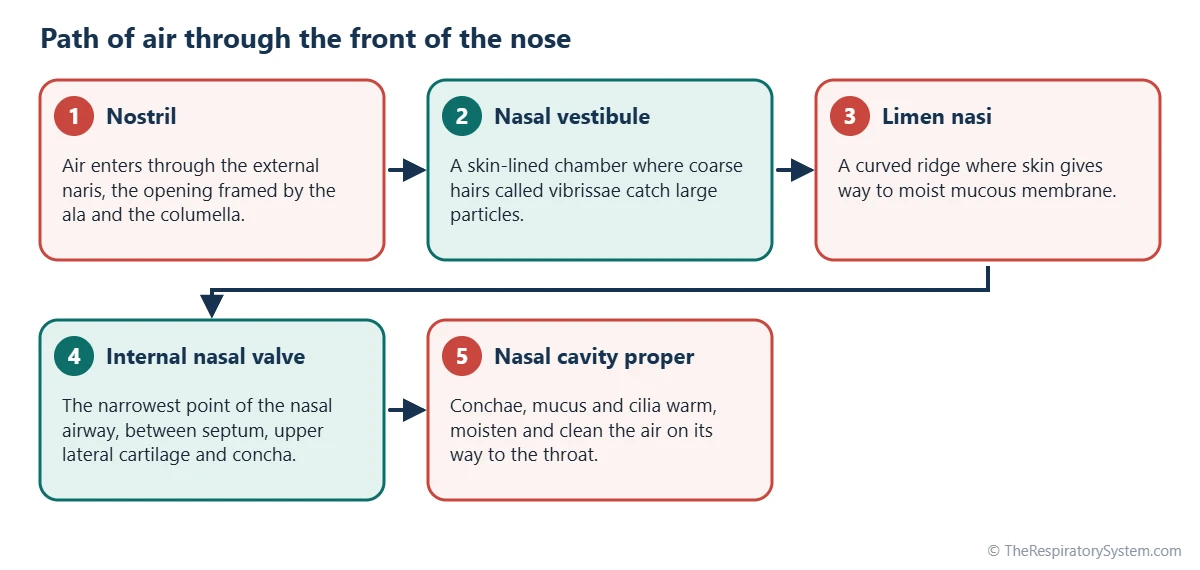
The nasal vestibule (vestibule of the nose) is the entrance chamber of each nasal passage, between the nostril and the limen nasi. Unlike the rest of the nasal cavity, it is lined by keratinized skin with coarse hairs (vibrissae), sebaceous glands and sweat glands, and its walls are shaped by the alar cartilages and the columella.
- Location
- Just inside each nostril, at the front of the nasal cavity
- Function
- Entrance for air; nose hairs trap large particles; shapes incoming airflow
- Tissue
- Skin (keratinized stratified squamous epithelium) with vibrissae and glands
- Framework
- Major alar cartilage, columella and soft fibrofatty tissue
- Connects to
- Nostril in front, nasal cavity proper behind the limen nasi
- Part of
- Nose and nasal cavity, upper respiratory tract
On this page
- What Is the Nasal Vestibule?
- Where Is the Nasal Vestibule Located?
- Nasal Vestibule Anatomy: Lining, Hairs and Glands
- What Is the Function of the Nasal Vestibule?
- Nares vs Nasal Vestibule and Other Related Structures
- How Does the Nasal Vestibule Change With Age?
- Common Conditions That Affect the Nasal Vestibule
- Key Facts
- Quiz
- FAQ
What Is the Nasal Vestibule?
The nasal vestibule is the widened front part of each nasal passage, the space that lies directly behind the nostrils and in front of the main nasal cavity. There are two vestibules, one on each side of the septum, and every breath taken through the nose passes through them first. This term is part of our respiratory system glossary.
The word vestibule means an entrance hall, and the name fits: the nasal vestibule is the lobby of the airway. It is the only part of the nasal cavity lined by skin rather than mucous membrane, which is why it feels dry and can grow hair. Anatomists also call it the vestibule of the nose or the vestibulum nasi.
Explained simply
When you breathe in through your nose, air first enters a small room just inside each nostril. That room is the vestibule. Its walls are covered with skin and stiff little hairs that work like a doormat, catching dust and specks before the air walks deeper into the nose.
Where Is the Nasal Vestibule Located?
The nasal vestibule is located inside the lower, movable part of the nose, extending from the nostril opening back and up to the limen nasi, a curved ridge on the outer wall. It sits within the soft, cartilage-supported tip of the nose rather than inside the bony skull.
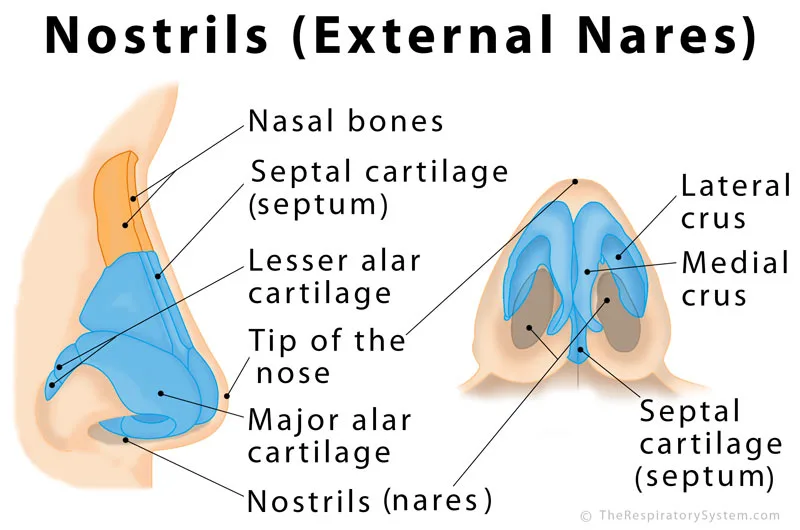
- Lateral wall: the ala, or wing of the nose, built from the lateral crus of the major alar cartilage and dense fibrofatty tissue.
- Medial wall: the columella and the soft, movable front edge of the nasal septum, which separate the right and left vestibules.
- Floor: skin over soft tissue at the base of the nose, just above the upper lip.
- Upper and back limit: the limen nasi, a ridge formed by the upper edge of the lateral crus, where skin changes to mucous membrane.
Just behind the vestibule lies the internal nasal valve, the narrowest point of the nasal airway, formed by the septum, the lower edge of the upper lateral cartilage and the front end of the inferior nasal concha.
Nasal Vestibule Anatomy: Lining, Hairs and Glands
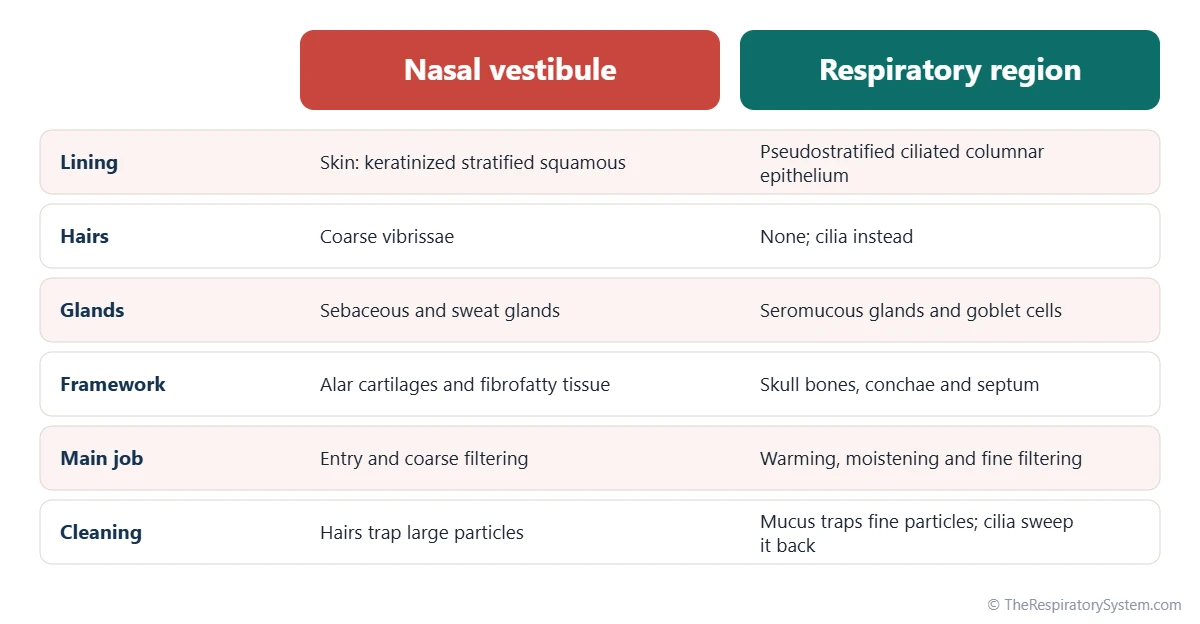
The nasal vestibule is lined by keratinized stratified squamous epithelium, the same tough surface layer as the skin of the face, which carries coarse hairs, sebaceous glands and sweat glands. This lining sets it apart from every other part of the respiratory tract.
Vibrissae
The hairs of the vestibule are called vibrissae. They are thicker and stiffer than ordinary body hair and point toward the nostril, so they form a loose mesh across the incoming air. Their sebaceous glands coat them with oil that helps particles stick.
Change of lining at the limen nasi
At the limen nasi the skin loses its keratin layer and hairs, and after a short stretch of non-keratinized epithelium it becomes the ciliated respiratory epithelium that lines the rest of the nasal cavity. From that point on, mucus and cilia, described in cilia and mucus, take over cleaning the air.
Blood, nerves and lymph
Blood reaches the vestibule mainly through branches of the facial artery, including the septal branch of the superior labial artery and the lateral nasal artery, and drains into the facial vein. Its skin is sensitive because it is supplied by branches of the trigeminal nerve, chiefly the infraorbital nerve and the external nasal branch of the anterior ethmoidal nerve. Lymph from the vestibule drains to the submandibular lymph nodes under the jaw.
| Feature | Structure | What it does |
|---|---|---|
| Entrance | Nostril (external naris) | Lets air into each vestibule |
| Lateral wall | Ala: lateral crus of the major alar cartilage and fibrofatty tissue | Gives a flexible, springy outer wall |
| Medial wall | Columella and membranous front edge of the septum | Separates the right and left vestibules |
| Back limit | Limen nasi, ridge formed by the upper edge of the lateral crus | Marks where skin turns into mucous membrane |
| Lining | Keratinized stratified squamous epithelium (skin) | Tough surface that withstands outside air |
| Hairs | Vibrissae | Trap large particles and insects |
| Glands | Sebaceous and sweat glands | Oil the hairs and keep the skin supple |
| Muscle | Alar part of the nasalis (dilator naris) | Flares the nostril to widen the entrance |
| Arteries | Branches of the facial artery | Supply blood to the skin and walls |
| Sensory nerves | Infraorbital nerve and external nasal branch of the anterior ethmoidal nerve | Detect touch and irritants |
| Lymph drainage | Submandibular lymph nodes | Carry lymph away from the area |
| Source: Typical adult anatomy, our editors | ||
What Is the Function of the Nasal Vestibule?
The main function of the nasal vestibule in the respiratory system is to receive inhaled air, screen out larger particles and steer the airstream into the nasal cavity. It is the first filter of the airway.
- Coarse filtering: the vibrissae catch insects, lint, pollen clumps and larger dust before they go deeper.
- Shaping airflow: the curved vestibule turns the airstream upward and backward toward the narrow valve region, where it speeds up and spreads over the nasal conchae.
- Keeping the entrance open: the springy alar cartilage holds the vestibule open, and the alar part of the nasalis muscle can flare the nostrils to widen it during hard breathing.
- Early warming and moistening: air begins to pick up heat and moisture here, although most of this work happens farther back.
- Protection: sensitive nerve endings detect irritants and can trigger a sneeze, while the skin barrier resists the constant contact with outside air.
Because the vestibule only begins this conditioning, air breathed through the mouth misses both the vestibule and the rest of the nasal filter, a difference explored in nose breathing vs mouth breathing.
Nares vs Nasal Vestibule and Other Related Structures
The nares are openings, while the nasal vestibule is the chamber that lies behind each opening. Several neighboring structures are easy to mix up with it.
Nares vs nasal vestibule
The external nares, or nostrils, are the two holes on the underside of the nose. Air passes through a naris and immediately enters a vestibule. At the far end of the nasal cavity, the internal nares, or choanae, open into the throat.
Nasal vestibule vs nasal cavity proper
Behind the limen nasi lies the nasal cavity proper, with its respiratory region over the conchae and its olfactory region high in the roof, where the sense of smell begins. These regions are lined by mucous membrane, not skin.
Nasal vestibule vs oral vestibule
The oral vestibule is the slit-shaped space between the lips and cheeks on the outside and the teeth and gums on the inside. It is the entrance zone of the mouth, just as the nasal vestibule is the entrance zone of the nose. The oral cavity entry describes how the oral vestibule differs from the oral cavity proper.
How Does the Nasal Vestibule Change With Age?
The nasal vestibule grows with the nose through childhood, and in later adult life its hairs and supporting tissues change. In infants the vestibules are small and the nostrils round, and they lengthen as the nasal tip develops during adolescence.
With age, many people, especially men, notice longer and coarser vestibular hairs. The supporting cartilage and skin also lose some stiffness, and the nasal tip may droop slightly, which can narrow the vestibule and the nearby valve region. These changes are part of normal aging of the face.
Common Conditions That Affect the Nasal Vestibule
Because it is lined by skin with hair follicles, the nasal vestibule is affected mostly by skin-type infections and by narrowing of its entrance. Wider nasal and airway disorders are listed in our respiratory diseases section.
- Nasal vestibulitis: a bacterial infection of the hair follicles of the vestibule, most often caused by Staphylococcus aureus, which can make the nostril red, crusted and sore.
- Nasal furuncle: a boil that forms when a single infected hair follicle becomes a small abscess.
- Vestibular stenosis: narrowing of the vestibule from scarring after injury, burns or surgery.
- Nasal valve collapse: weakness of the walls near the vestibule that lets them fall inward when breathing in, sometimes together with a deviated septum.
- Tumors: rare skin cancers can arise in the vestibule, most often squamous cell carcinoma.
The vestibule is also the place where Staphylococcus aureus most often lives harmlessly in healthy people, which is why screening swabs are taken from just inside the nostrils. Any sore, swelling or lump inside the nose that does not settle is a reason to see a doctor.
Key Facts
- The nasal vestibule is the skin-lined entrance chamber just inside each nostril.
- It is the only part of the nasal cavity lined by keratinized skin instead of mucous membrane.
- Coarse hairs called vibrissae grow in the vestibule and trap large particles.
- The vestibule ends at the limen nasi, a ridge formed by the upper edge of the lateral crus of the major alar cartilage.
- The columella and front of the nasal septum separate the right and left vestibules.
- Nasal vestibulitis, an infection of its hair follicles, is the most common condition of the vestibule.
Quick Quiz: Test What You Know About the Nasal Vestibule
6 questions. Tap an answer to check it.
What lines the nasal vestibule?
The vestibule is lined by keratinized stratified squamous epithelium, the same as facial skin, with coarse hairs.
What are the coarse hairs of the nasal vestibule called?
Vibrissae are the stiff nose hairs that trap large particles; cilia are tiny cell projections farther back.
Where does the nasal vestibule end?
The limen nasi is the ridge where skin gives way to the mucous membrane of the nasal cavity proper.
Which cartilage forms the lateral wall of the vestibule?
The lateral crus of the major alar cartilage, with fibrofatty tissue, shapes the ala or wing of the nose.
What separates the right and left nasal vestibules?
The columella and the soft front edge of the nasal septum form the medial wall of each vestibule.
Which infection affects the hair follicles of the nasal vestibule?
Nasal vestibulitis is a bacterial infection of the vestibule's hair follicles, often caused by Staphylococcus aureus.
Frequently Asked Questions
Is the nasal vestibule part of the nasal cavity?
Yes. Most anatomy texts describe the nasal cavity as having three regions: the vestibule at the front, the respiratory region over the conchae and the olfactory region in the roof. The vestibule is the only one lined by skin. Some sources treat it as a separate entrance zone of the nose, but it is still the first part of each nasal passage.
What is the limen nasi?
The limen nasi, or nasal threshold, is a curved ridge on the outer wall of each nasal passage, formed by the upper edge of the lateral crus of the major alar cartilage. It marks the boundary between the nasal vestibule in front and the nasal cavity proper behind. At the limen nasi, hairy skin ends and moist mucous membrane begins.
Why does the nose have hair inside?
The hairs in the nasal vestibule, called vibrissae, act as a coarse filter. They catch insects, lint, pollen clumps and larger dust before the air moves deeper into the nose, where mucus traps finer particles. Their position at the very entrance means the largest debris is stopped in a place where it can easily be cleared by blowing the nose or sneezing.
What does vestibule of the nose mean?
Vestibule comes from a Latin word for entrance hall or forecourt. In anatomy, a vestibule is any small space at the entrance of a larger cavity. The vestibule of the nose is the entrance space of each nasal passage, just as the oral vestibule is the entrance zone of the mouth and the laryngeal vestibule is the upper entrance of the larynx.
What is the difference between the nasal vestibule and the oral vestibule?
The nasal vestibule is the hair-bearing chamber just inside each nostril, at the start of the airway through the nose. The oral vestibule is the narrow space between the lips and cheeks and the teeth and gums. Both are entrance zones, but the nasal vestibule carries air, while the oral vestibule holds saliva and food during chewing.
What is the nasal valve?
The nasal valve is the narrowest part of the nasal airway and controls how much air flows through the nose. The external nasal valve is the opening formed by the nostril rim, the columella and the vestibule walls. The internal nasal valve, just behind the vestibule, lies between the septum, the lower edge of the upper lateral cartilage and the inferior concha.
Can you see the nasal vestibule?
Yes, partly. The nasal vestibule is the only part of the nasal cavity visible without instruments, simply by tilting the head back and looking into the nostrils. Doctors widen it gently with a small speculum to look past it into the nasal cavity. The hairs, skin and front edge of the septum are all inside the vestibule.
Why is the area around the nasal vestibule called the danger triangle?
The danger triangle of the face is the area from the corners of the mouth to the bridge of the nose, which includes the vestibule. Veins from this area connect with veins inside the skull, so in rare cases an infection here can spread inward. This is why infections of the vestibule, such as boils, are regarded as more than a minor skin problem.


