At a Glance
Olfaction is the sense of smell. Odor molecules carried in inhaled air dissolve in the mucus of the olfactory epithelium at the top of the nasal cavity and bind to receptor proteins on olfactory sensory neurons, of which humans have about 400 working types. The neurons send signals through the cribriform plate of the ethmoid bone to the olfactory bulb and on to the olfactory cortex.
- Location
- Olfactory epithelium in the roof of each nasal cavity, on the upper septum and the superior nasal concha
- Receptor cells
- Olfactory sensory neurons, several million in all, with hair-like cilia lying in the mucus
- Stimulus
- Odorants: small, volatile molecules that dissolve in the nasal mucus
- Nerve
- Olfactory nerve (cranial nerve I), passing through the cribriform plate
- Brain targets
- Olfactory bulb, then the piriform cortex, amygdala and entorhinal cortex
- Works with
- Taste, to create the flavor of food and drink
On this page
- What Is Olfaction?
- What Is the Olfactory Epithelium?
- Respiratory Epithelium vs Olfactory Epithelium
- Sense of Smell Process: How Do We Smell, Step by Step?
- How Does Air Carry Odors to the Olfactory Epithelium?
- Where Do Smell Signals Go in the Brain?
- Sense of Smell vs Taste: How Do They Work Together?
- What Is the Function of the Sense of Smell?
- Common Conditions That Affect the Sense of Smell
- Key Facts
- Quiz
- FAQ
What Is Olfaction?
Olfaction is the sense of smell: the detection of chemicals in the air by specialized nerve cells in the upper part of the nasal cavity, and the brain's interpretation of those signals as odors. Together with taste it is one of the two chemical senses, because it responds to molecules rather than to light, sound or touch.
Sense of smell definition
The sense of smell is the ability to perceive odors when odor molecules reach the olfactory epithelium and bind to receptor proteins on olfactory sensory neurons. The word olfaction comes from the Latin olfacere, to smell. A substance can only be smelled if it is volatile, meaning it releases molecules into the air, and if those molecules can dissolve in the thin layer of mucus over the receptors.
Why smell belongs with breathing
Every breath through the nose carries a sample of the surrounding air past the smell receptors. The nose warms, cleans and humidifies that air for the lungs, and at the same time checks it for smoke, spoiled food or other chemical warnings. This double role is one of the many respiratory system functions.
Explained simply
Imagine millions of tiny locks high up inside your nose. Smells are made of floating molecules that act like keys. When the right key fits a lock, the cell holding that lock sends a message to your brain, and your brain reads the pattern of opened locks as coffee, roses or smoke.
What Is the Olfactory Epithelium?
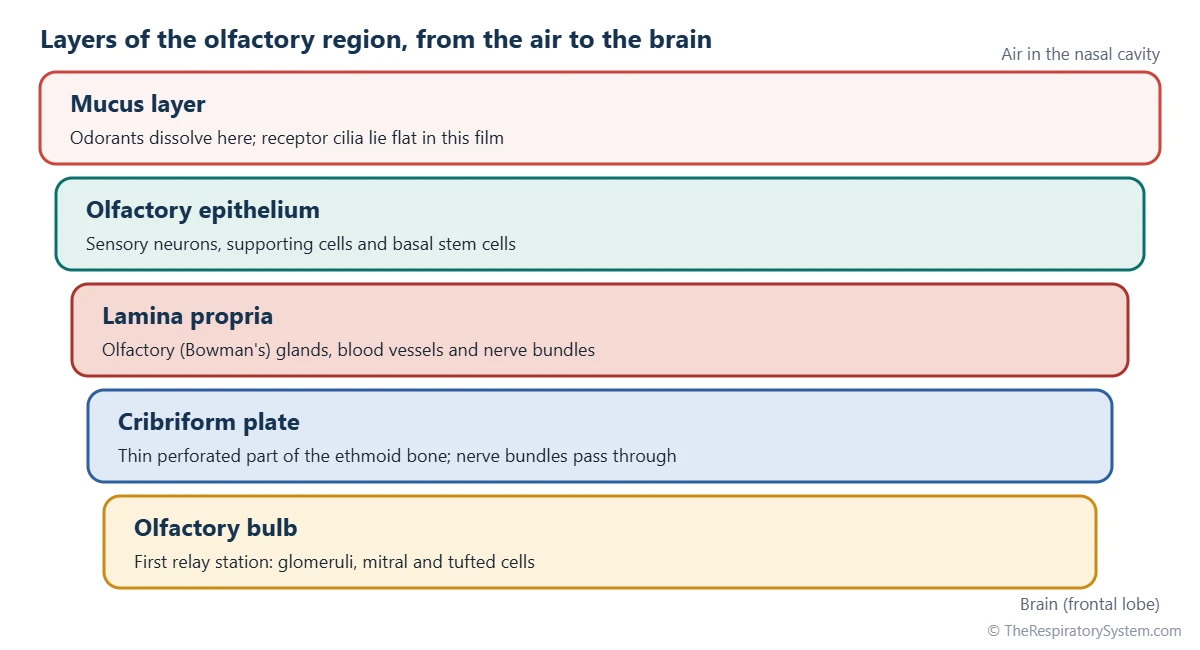
The olfactory epithelium is the specialized sensory lining in the roof of the nasal cavity that contains the smell receptor cells. It covers a small area on each side, roughly the size of a postage stamp, on the underside of the cribriform plate, the upper part of the nasal septum and the superior nasal concha. It has a faint yellowish-brown tint that sets it apart from the pink lining elsewhere in the nose.
Cells of the olfactory epithelium
The olfactory epithelium is a tall pseudostratified columnar epithelium with three main cell types:
- Olfactory sensory neurons: bipolar nerve cells. Each sends a dendrite to the surface, ending in a knob with several long, non-moving cilia that lie flat in the mucus and carry the odorant receptors. From the other end, a thin unmyelinated axon runs up toward the brain.
- Supporting (sustentacular) cells: tall columnar cells with microvilli that hold the neurons in place, insulate them and help process odor molecules.
- Basal cells: stem cells near the base of the epithelium that divide to replace worn-out neurons and supporting cells.
Olfactory glands and the mucus layer
Beneath the epithelium, the lamina propria holds olfactory glands, also called Bowman's glands, together with blood vessels and bundles of olfactory axons. The glands produce a watery mucus that bathes the cilia, dissolves incoming odorants and washes old molecules away so new smells can be detected.
Respiratory Epithelium vs Olfactory Epithelium
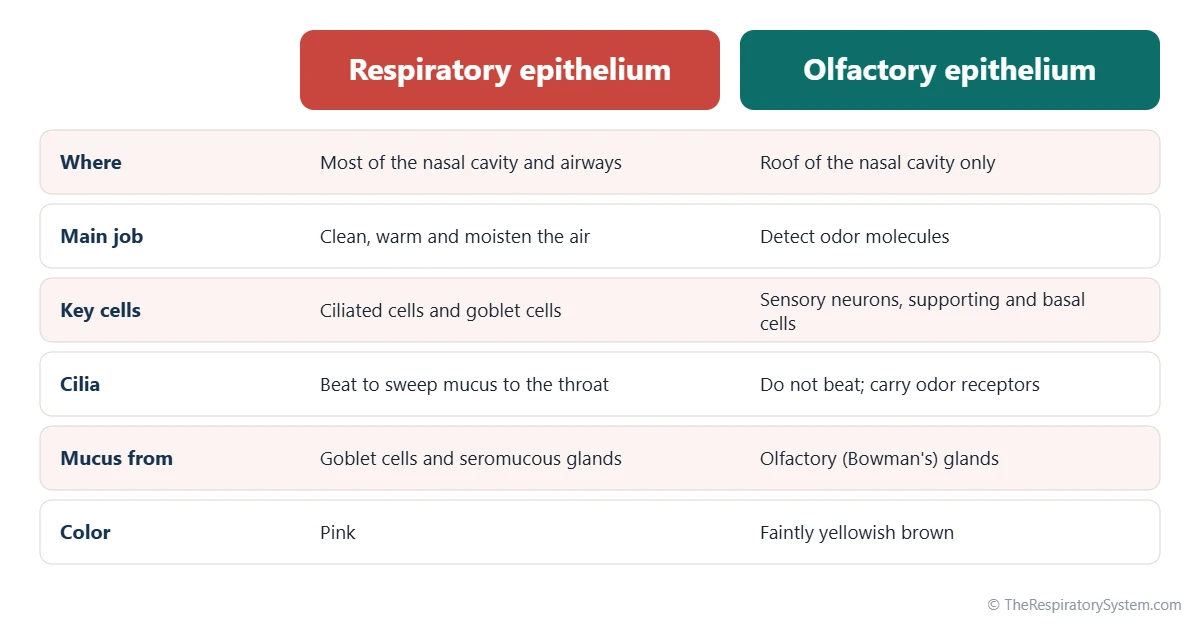
Respiratory epithelium lines most of the nasal cavity and moves mucus with beating cilia, while olfactory epithelium lines only the roof of the cavity and senses odors with the non-moving cilia of nerve cells. Both are pseudostratified columnar epithelia, but they are built for different jobs.
The respiratory epithelium contains ciliated cells and mucus-secreting goblet cells that trap dust and germs and sweep them back toward the throat, the system described on our cilia and mucus page. Olfactory epithelium has no goblet cells; its mucus comes from the olfactory glands below it, and its cilia belong to sensory neurons and do not beat. It is also thicker, and it is the only place in the body where nerve cells sit directly on a surface exposed to the outside air.
The border between the two is not sharp. Patches of respiratory-type lining can appear inside the olfactory area, and they become more common with age and after repeated infections, which is one reason the sense of smell tends to weaken over a lifetime.
Sense of Smell Process: How Do We Smell, Step by Step?
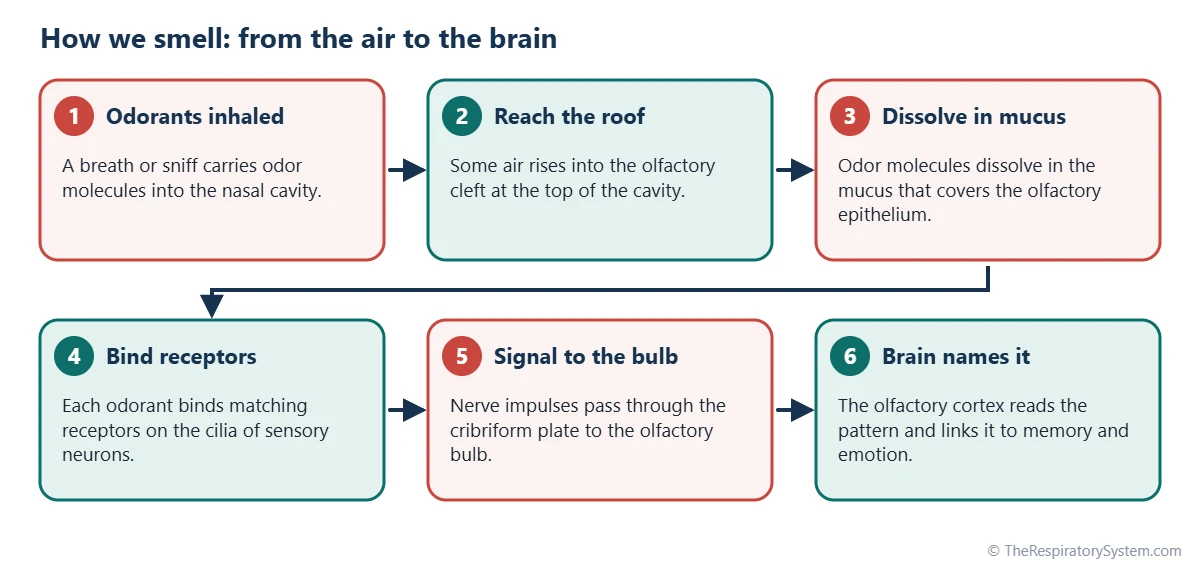
We smell when odor molecules reach the olfactory epithelium, dissolve in its mucus, bind to receptors on the cilia of olfactory sensory neurons and trigger nerve signals that travel through the olfactory nerve to the olfactory bulb and the brain. The sequence below follows a single sniff.
- Odorants enter the nose. Breathing or sniffing draws air containing odor molecules through the nostrils and into the nasal cavity.
- Air reaches the olfactory cleft. A small share of each breath swirls up into the narrow space in the roof of the cavity.
- Odorants dissolve. The molecules dissolve in the mucus, sometimes helped by odorant-binding proteins that carry them toward the receptors.
- Receptors are activated. An odorant binds to a matching receptor protein on the cilia of an olfactory sensory neuron.
- A nerve signal starts. The receptor switches on a chain of reactions inside the cilium that opens ion channels and makes the neuron fire.
- Signals cross the skull. The impulses travel along olfactory axons through the holes of the cribriform plate to the olfactory bulb.
- The bulb sorts the signals. Axons from neurons with the same receptor type gather in the same small knots of synapses, called glomeruli.
- The brain names the smell. Mitral and tufted cells carry the pattern to the olfactory cortex, where it is recognized and linked to memory and emotion.
How the receptor signal works
Odorant receptors belong to the family of G protein-coupled receptors. When an odorant binds, the receptor activates a G protein called G-olf, which switches on the enzyme adenylyl cyclase and raises the level of cyclic AMP inside the cilium. Cyclic AMP opens channels that let sodium and calcium ions flow in, and the calcium then opens chloride channels that boost the electrical change until the neuron fires.
How a few hundred receptors detect so many smells
Humans have about 400 functioning odorant receptor types, and each sensory neuron carries just one of them. Most odorants bind to several receptor types, and each receptor responds to several odorants, so every smell activates its own combination of receptors. The brain reads that combination, much as letters combine into many different words.
| Step | What happens | Where it happens |
|---|---|---|
| 1. Inhalation or sniff | Air carrying odor molecules enters the nose | Nostrils and nasal vestibule |
| 2. Delivery | Some of the air rises into the roof of the cavity | Olfactory cleft, above the superior concha |
| 3. Dissolving | Odorants dissolve in the mucus over the receptors | Mucus layer from the olfactory glands |
| 4. Binding | An odorant binds a matching receptor protein | Cilia of olfactory sensory neurons |
| 5. Transduction | G-olf and cyclic AMP open ion channels; the neuron fires | Inside the cilia and the neuron |
| 6. Transmission | Impulses travel up the olfactory nerve bundles | Through the cribriform plate of the ethmoid bone |
| 7. First relay | Signals from the same receptor type gather in glomeruli | Olfactory bulb |
| 8. Perception | The odor is identified and linked to memory and emotion | Piriform cortex, amygdala, entorhinal and orbitofrontal cortex |
| Source: Typical human olfaction, our editors | ||
How Does Air Carry Odors to the Olfactory Epithelium?
Air carries odors to the olfactory epithelium along two routes: up through the nostrils from the outside world, which is orthonasal smell, and up from the mouth through the back of the nasal cavity while eating, which is retronasal smell.
The orthonasal route
Inhaled air enters through the nostrils and the nasal vestibule. Most of it flows along the floor and middle of the cavity, between the nasal conchae and through the nasal meatuses, on its way to the nasopharynx. Only a small fraction rises into the olfactory cleft during quiet breathing. A sniff is faster and stronger, and it directs more air upward over the receptors, which is why animals and people sniff when they want to identify a smell.
The retronasal route
When we chew and swallow, odor molecules released from food in the oral cavity rise behind the soft palate, pass through the choanae into the back of the nasal cavity and reach the olfactory epithelium from behind, especially as we breathe out. The brain treats these signals as part of the taste of food, even though they come from the nose. Breathing through the mouth bypasses the orthonasal route almost completely, one of the differences described on our nose vs mouth breathing page.
Where Do Smell Signals Go in the Brain?
Smell signals travel from the olfactory epithelium through the cribriform plate to the olfactory bulb, then along the olfactory tract to the olfactory cortex and to brain areas involved in emotion and memory.
The axons of the olfactory sensory neurons gather into about 20 small bundles on each side, which together form the olfactory nerve, the first cranial nerve. They pass through the tiny holes of the cribriform plate, part of the ethmoid bone that also contains the ethmoid sinus, and end in the olfactory bulb, which lies on the plate just under the frontal lobe of the brain.
In the bulb, the axons meet mitral and tufted cells in the glomeruli, and local nerve cells sharpen the contrast between similar smells. The output runs back along the olfactory tract to the piriform cortex, the main smell area, and to the amygdala and the entorhinal cortex, which connect to the hippocampus. Smell is the only sense whose signals reach the cortex without first passing through the thalamus, and its close wiring to the amygdala and hippocampus helps explain why an odor can bring back a vivid memory or emotion in an instant. Signals then continue to the orbitofrontal cortex, where smell and taste are combined into flavor.
Sense of Smell vs Taste: How Do They Work Together?
Smell detects airborne odor molecules in the nose, while taste detects dissolved chemicals on the tongue, and the brain merges the two into what we experience as flavor. Most of the detail in flavor actually comes from smell.
Taste buds on the tongue and in the throat recognize five basic tastes: sweet, salty, sour, bitter and umami. Their signals travel in three cranial nerves, the facial, glossopharyngeal and vagus nerves. Smell, by contrast, can tell apart a huge range of odors. When the retronasal route is blocked, for example by a stuffy nose, food still tastes sweet or salty but loses most of its character, so an apple and a raw potato can be hard to tell apart.
A third system adds to the mix. Branches of the trigeminal nerve in the nose and mouth sense irritation, cooling and burning, such as the sting of ammonia, the coolness of menthol and the heat of chili. These sensations are often mistaken for smell or taste, and strong irritants can trigger a protective sneeze.
| Feature | Smell (olfaction) | Taste (gustation) |
|---|---|---|
| Detects | Volatile odor molecules carried in air | Chemicals dissolved in saliva |
| Receptor cells | Olfactory sensory neurons, which are true nerve cells | Taste receptor cells in taste buds |
| Where | Roof of the nasal cavity | Tongue, soft palate and throat |
| Receptor types | About 400 working odorant receptor types | Receptors for five basic tastes |
| Cranial nerves | Olfactory nerve (I) | Facial (VII), glossopharyngeal (IX) and vagus (X) |
| Route to the cortex | Reaches the cortex without a thalamic relay | Relays in the brainstem and thalamus first |
| Role in flavor | Provides most of the detail of flavor | Provides sweet, salty, sour, bitter and umami |
| Source: Standard sensory physiology, our editors | ||
What Is the Function of the Sense of Smell?
The sense of smell warns of danger, shapes the flavor of food, prepares the body for eating and plays a part in memory, emotion and social life.
- Warning: smell detects smoke, gas leaks and spoiled food. Natural gas has no odor of its own, so suppliers add a sulfur-containing chemical to make leaks easy to notice.
- Flavor and appetite: food odors make up most of what we call flavor, and the smell of food triggers saliva and stomach secretions before the first bite.
- Memory and emotion: because smell signals reach the amygdala and hippocampus so directly, odors are strongly tied to remembered places and feelings.
- Social signals: people can recognize the smell of family members, and newborn babies turn toward the smell of their own mother.
- Protecting the airway: irritating fumes trigger reflexes such as sneezing, coughing and holding the breath, which help keep harmful chemicals away from the lungs.
How the sense of smell changes with age
Olfactory sensory neurons are among the few nerve cells in the adult body that are replaced throughout life. Basal stem cells produce new neurons that grow fresh axons through the cribriform plate, and each neuron lasts for a period of weeks to months. With age this renewal slows, and the sense of smell commonly declines from about the age of 60 onward, a change known as presbyosmia.
Common Conditions That Affect the Sense of Smell
The sense of smell can be reduced, lost or distorted by anything that blocks air from reaching the olfactory cleft, damages the olfactory epithelium or nerve, or affects the brain areas that process smell. Our respiratory diseases section covers the airway conditions involved, and a sudden or lasting change in smell is a reason to see a doctor.
- Anosmia and hyposmia: total loss and partial loss of smell.
- Parosmia: familiar odors smell distorted, often unpleasant, commonly during recovery after an infection.
- Phantosmia: smelling an odor that is not present.
- Colds and other viral infections: swelling blocks airflow, and some viruses, including the one that causes COVID-19, can disrupt the olfactory epithelium itself.
- Sinusitis and nasal polyps: inflamed tissue narrows the passages that lead up to the olfactory cleft.
- Deviated septum: a bent septum can change the airflow through one side of the nose.
- Head injury: a blow to the head can shear the fine olfactory nerve bundles where they pass through the cribriform plate.
- Neurological conditions: a reduced sense of smell is an early feature of Parkinson's disease and Alzheimer's disease in many people.
Key Facts
- Olfaction, the sense of smell, starts in the olfactory epithelium, a small patch of lining in the roof of each nasal cavity.
- Olfactory sensory neurons are true nerve cells whose cilia lie in the nasal mucus, making them the only neurons directly exposed to the outside air.
- Humans have about 400 working types of odorant receptors, and each sensory neuron carries only one type.
- Every odor activates its own combination of receptor types, which lets a few hundred receptors tell apart a vast number of smells.
- The olfactory nerve passes through the cribriform plate of the ethmoid bone to reach the olfactory bulb.
- Smell is the only sense that reaches the cortex without first relaying in the thalamus.
- Most of what we call the taste of food is smell, delivered to the nose from the mouth by the retronasal route.
Quick Quiz: Test What You Know About the Sense of Smell
6 questions. Tap an answer to check it.
Where is the olfactory epithelium located?
The olfactory epithelium lines the roof of the nasal cavity, under the cribriform plate, on the upper septum and the superior concha.
Which cranial nerve carries the sense of smell?
Smell travels in the olfactory nerve, the first cranial nerve, whose bundles pass through the cribriform plate.
Through which bony structure do olfactory nerve bundles reach the brain?
The cribriform plate is a thin, sieve-like part of the ethmoid bone with small holes for the olfactory nerve bundles.
What must happen to an odorant before it can bind a receptor?
Odor molecules dissolve in the mucus covering the olfactory epithelium, which brings them to the receptors on the cilia.
How do the cilia of olfactory neurons differ from those of the respiratory epithelium?
Olfactory cilia are non-moving and carry odorant receptors, while respiratory cilia beat to sweep mucus toward the throat.
What is retronasal smell?
Retronasal smell happens when odors from food in the mouth travel up behind the soft palate to the olfactory epithelium.
Frequently Asked Questions
How many smells can humans detect?
No one knows the exact number, and estimates vary widely depending on how the experiments are designed. What is clear is that people can tell apart a very large number of odors, far more than the five basic tastes. This is possible because each odor activates a different combination of the roughly 400 receptor types, and the brain recognizes each combination as a separate smell.
Why do we stop noticing a smell after a while?
This is called olfactory adaptation. When the same odor stays around, the receptors and the nerve cells in the olfactory bulb gradually reduce their response, and the brain also turns down its attention to an unchanging signal. A strong smell in a room can seem to fade within minutes, but someone walking in from outside notices it at once. A new or changing odor is detected again quickly.
Do women have a better sense of smell than men?
On average, studies of smell tests find that women score slightly higher than men in detecting and identifying odors, although the difference is small and there is a wide overlap between individuals. Age, smoking, nasal health and practice often matter more than sex. Trained noses, such as those of perfumers and wine tasters, show that the ability to name smells improves with experience.
Why can smell trigger such strong memories?
Smell signals take an unusually short path to the brain areas that handle emotion and memory. From the olfactory bulb they go directly to the amygdala and to the entorhinal cortex, the gateway to the hippocampus, without first passing through the thalamus. Because of this wiring, an odor met during an emotional moment can later bring that memory back in vivid detail.
How does the sense of smell compare with a dog's?
Dogs have a far larger olfactory epithelium than humans, many more sensory neurons and more working receptor genes, and a large share of their brain is devoted to smell. Their noses also send part of each sniff into a separate channel that leads straight to the olfactory area. The human sense of smell is still sensitive, and for some odors people detect very low concentrations.
Is the olfactory nerve the only nerve in the nose?
No. The olfactory nerve carries smell, but the lining of the nose also has branches of the trigeminal nerve, which sense touch, temperature, pain and chemical irritation. These branches are why ammonia stings, menthol feels cool and pepper makes you sneeze. Autonomic nerve fibers in the nose also control its blood vessels and glands, which change how congested the nasal passages feel.
Why does food taste bland when you have a cold?
During a cold, swelling and mucus block the nasal passages, so odor molecules released from food in the mouth cannot travel up the back of the nose to the olfactory epithelium. The taste buds still detect sweet, salty, sour, bitter and umami, but the rich detail of flavor, which comes mainly from smell, is lost until the passages clear.
Can the olfactory epithelium grow back?
Yes, to a large degree. Basal stem cells in the olfactory epithelium keep producing new sensory neurons and supporting cells throughout life, and the new neurons grow axons back to the olfactory bulb. This is why the sense of smell often returns after an infection. Recovery can be slow or incomplete when the stem cells themselves or the nerve bundles at the cribriform plate are badly damaged.
Keep Exploring


