At a Glance
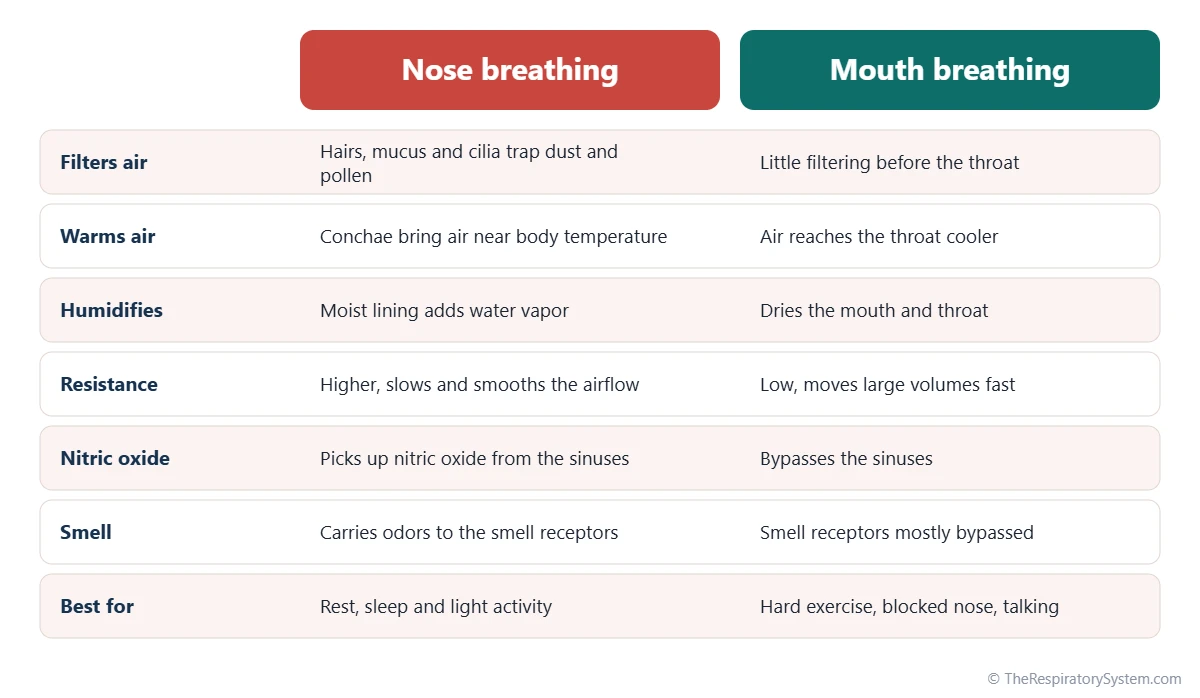
Nose breathing sends air through the nasal cavity, where hairs, mucus and the nasal conchae filter it and bring it close to body temperature and full humidity; mouth breathing skips most of that conditioning but offers far less resistance. The nose accounts for up to about half of total airway resistance, so people breathe through the nose at rest and switch to the mouth, or both, when they need more air.
- Verdict
- Nose breathing for rest and sleep; mouth breathing as the backup for high demand or a blocked nose
- Nose route
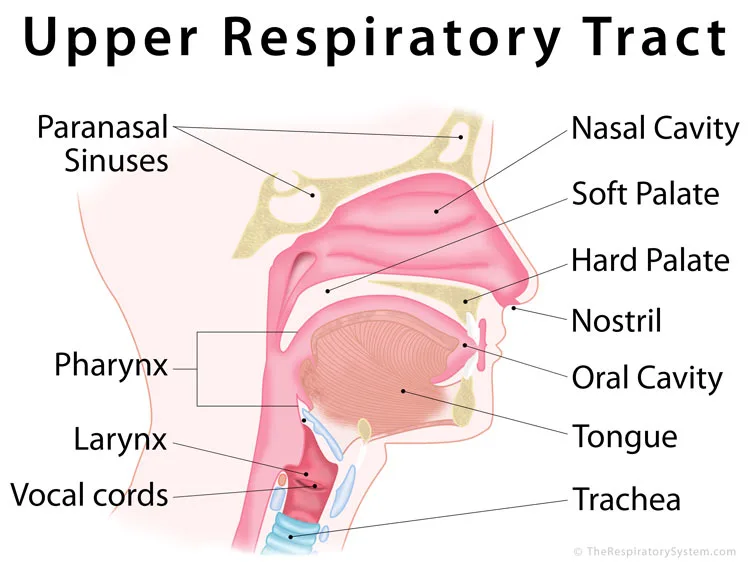
- Nostrils, nasal vestibule, nasal cavity and conchae, nasopharynx
- Mouth route
- Lips, oral cavity, oropharynx
- Where they meet
- The pharynx (throat), from which air follows one path to the lungs
- Key difference
- Nose filters, warms and humidifies air; mouth gives low resistance and high airflow
- Part of
- Upper respiratory tract
On this page
- What Is the Difference Between Nose Breathing and Mouth Breathing?
- Is Nasal Breathing Better Than Mouth Breathing?
- What Does the Nose Do to Air That the Mouth Cannot?
- How Do Nose and Mouth Breathing Work Together?
- Nose Breathing vs Mouth Breathing During Exercise and Running
- Nose Breathing vs Mouth Breathing During Sleep
- Can Mouth Breathing Change Face Shape?
- Why Do Some People Breathe Through Their Mouth?
- Key Facts
- Quiz
- FAQ
What Is the Difference Between Nose Breathing and Mouth Breathing?
The difference between nose breathing and mouth breathing is the doorway air uses to enter the airways: nasal breathing draws air through the nostrils and the nasal cavity, while mouth breathing draws it straight through the oral cavity. Both paths meet in the pharynx, so from the throat downward the air follows the same route to the lungs.
The two doorways are built very differently. The nose opens into the nasal cavity, a narrow, curving chamber lined with moist mucous membrane and divided in two by the nasal septum. The oral cavity is wider and shorter, and its lining is built mainly for chewing, tasting and swallowing rather than for treating air. That design difference explains almost every other contrast on this page.
Explained simply
Think of the nose as an air conditioner with a dust filter, and the mouth as an open window. The air conditioner cleans, warms and moistens the air but lets it in more slowly. The open window lets in a lot of air quickly, but whatever is outside, cold, dry or dusty, comes straight in.
Is Nasal Breathing Better Than Mouth Breathing?
Yes, for everyday quiet breathing nasal breathing is better than mouth breathing, because the nose prepares air for the lungs and the mouth does very little of that work. Mouth breathing is not harmful in itself; it is the body's backup route for moments when the nose cannot supply enough air.
The verdict depends on the situation:
- At rest and during sleep: the nose wins. Air arrives cleaner, warmer and moister, and the mouth and throat stay moist.
- During hard exercise: the mouth wins on volume. Its low resistance lets a person move far more air per minute than the nose alone allows.
- With a blocked nose: the mouth is the only practical route, whether the cause is a cold, an allergy or the shape of the nose itself.
- While talking or singing: quick breaths are usually taken through the mouth between phrases, then let out slowly to make sound.
The table below sets the two routes side by side, feature by feature.
| Feature | Nose breathing | Mouth breathing |
|---|---|---|
| Entry point | Nostrils into the nasal cavity | Lips into the oral cavity |
| Filtering | Hairs, mucus and cilia trap most large particles | Little filtering before the throat |
| Warming | Air brought close to body temperature | Air reaches the throat cooler |
| Humidifying | Air nearly saturated with water vapor | Air drier; mouth and throat dry out |
| Airflow resistance | Higher; up to about half of total airway resistance | Low |
| Maximum airflow | Limited by narrow passages | Large volumes moved quickly |
| Nitric oxide | Carries nitric oxide from the sinuses to the lungs | Bypasses the sinuses |
| Smell | Odors reach the olfactory epithelium | Odors in the air are mostly missed |
| Typical use | Rest, sleep, light activity | Hard exercise, blocked nose, speech |
| In newborns | Main route for the first months | Used mainly when crying |
| Source: Typical healthy adult, our editors | ||
What Does the Nose Do to Air That the Mouth Cannot?
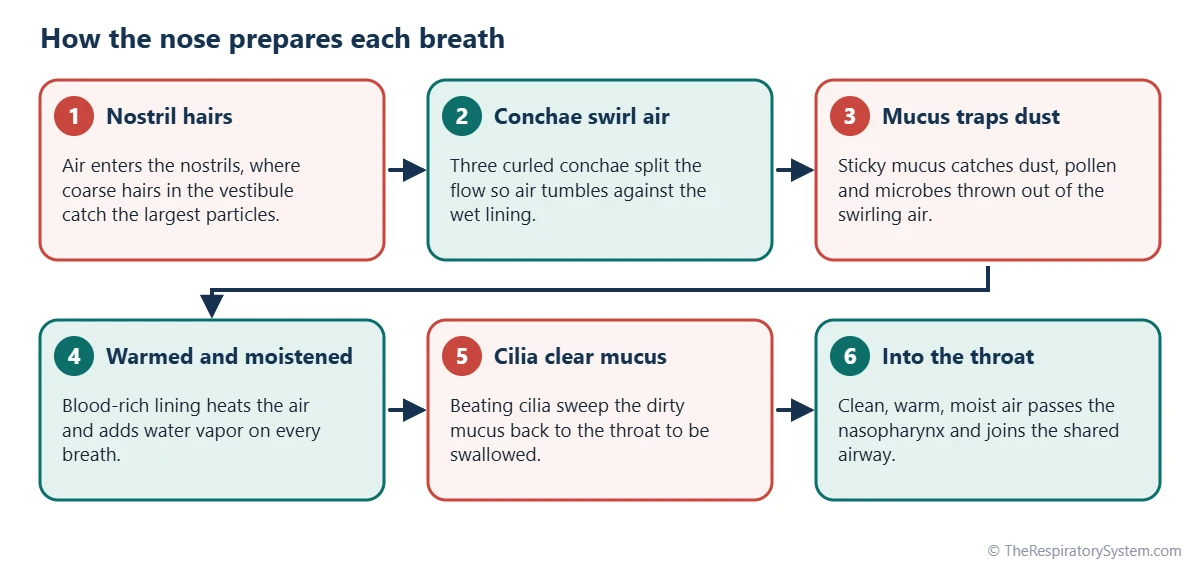
The nose filters, warms and humidifies inhaled air, adds nitric oxide from the sinuses and carries odors to the smell receptors, five jobs the mouth does poorly or not at all. Each job depends on structures found only in the nasal passages.
Filtering
Coarse hairs in the nasal vestibule catch large particles at the entrance. Farther in, three curled shelves of bone, the nasal conchae, split the airflow into narrow channels and make it swirl, so dust, pollen and microbes are thrown against sticky mucus. Most particles larger than about 10 micrometers are removed this way. The trapped material is carried back to the throat by beating cilia and swallowed, a system described on our cilia and mucus page.
Warming and humidifying
The lining of the nasal cavity is packed with blood vessels and kept wet by mucus. As air flows over this large, warm, moist surface, it gains heat and water vapor, so by the time it passes the throat it is much closer to body temperature and nearly saturated with moisture. On the way out, the cooler front of the nose takes back part of that heat and water, which helps the body conserve both.
Nitric oxide from the sinuses
The paranasal sinuses release nitric oxide gas into the nasal passages, and nasal breathing carries small amounts of it down into the lungs. Nitric oxide relaxes blood vessels and has antimicrobial effects, and researchers think this nasal supply may support airway defense and blood flow in the lungs. Mouth breathing bypasses this source.
Smell and protective reflexes
Only air drawn in through the nose sweeps odors up to the olfactory epithelium in the roof of the nasal cavity, which is why we sniff to sample a smell; see sense of smell. The nasal lining is also sensitive to irritants and can trigger a sneeze to blast them out before they travel deeper.
How Do Nose and Mouth Breathing Work Together?
Nose and mouth breathing work together as two entrances to one airway: both lead into the pharynx, feed the same lungs and are driven by the same breathing muscles, and the body can use either one or both at once. Whichever route the air takes, it then passes the larynx and trachea and reaches the same alveoli.
What they have in common
- Both are powered by the diaphragm and the intercostal muscles, which lower the pressure in the chest so air flows in.
- Both are run automatically by the breathing centers in the brainstem, and both can also be used on purpose.
- Both routes meet in the oropharynx, the part of the throat behind the mouth, and share the airway from there down.
- Neither changes how gas exchange works; oxygen crosses the same respiratory membrane either way.
Switching between routes
The lips, tongue and soft palate act as the switch. During quiet nasal breathing the lips are closed and the tongue rests against the roof of the mouth, sealing off the oral route. When more air is needed, the mouth opens and air flows through both routes at once, a pattern called oronasal breathing. Most people slide into oronasal breathing without noticing as activity rises.
The nasal cycle
Even in healthy people, one side of the nose is usually more congested than the other, and the sides swap every few hours. This normal nasal cycle lets each side rest and restore its moisture, and it is one reason a stuffy feeling can seem to move from one nostril to the other.
Nose Breathing vs Mouth Breathing During Exercise and Running
During exercise and running, most people breathe through the nose at low intensity and switch to combined nose and mouth breathing as the effort rises, because the nose cannot pass enough air for hard work. The point of the switch varies from person to person and depends on the size of the nasal passages, fitness and how congested the nose is.
At rest an adult breathes about 6 liters of air per minute, which the nose handles easily. During hard exercise the air breathed per minute can rise more than tenfold, and pulling all of it through the narrow nasal passages would take great effort from the breathing muscles. Opening the mouth removes most of that resistance. Studies of nose-only breathing during exercise show that it is possible at easy and moderate intensities, but it tends to limit the highest airflow a person can reach.
Mouth breathing during hard exercise has a cost too: cold, dry air reaches the lower airways with less conditioning. This is one reason sports in cold, dry air are linked to airway narrowing in people with asthma, a reaction known as exercise-induced bronchoconstriction.
Nose Breathing vs Mouth Breathing During Sleep
During sleep, nasal breathing is the normal pattern, and habitual mouth breathing at night is linked to snoring, a dry mouth on waking and lighter, more broken sleep. With the mouth closed, the jaw and tongue stay forward and help hold the throat open.
When the mouth falls open, the jaw drops back and the tongue can shift toward the back of the throat, narrowing the airway behind it. The soft tissues there may then flutter as air passes, which is the sound of snoring. Breathing through the mouth all night also dries out saliva, which normally protects the teeth and gums, so people who mouth breathe at night more often wake with a dry mouth, bad breath or irritated gums.
Night-time mouth breathing is often a sign rather than a cause: it usually means the nose is narrowed by congestion, enlarged adenoids or a deviated septum. Loud snoring with pauses in breathing can point to obstructive sleep apnea, in which the throat repeatedly collapses during sleep.
Can Mouth Breathing Change Face Shape?
Long-term mouth breathing in childhood has been associated with changes in face shape, including a longer lower face, a narrow upper jaw and crowded teeth, but the link is debated and genes play a large part. In adults, whose facial bones have finished growing, mouth breathing does not reshape the face in the same way.
While a child's face is still growing, the resting position of the lips, tongue and jaw influences how the bones develop. In habitual nasal breathing the tongue rests against the palate and helps widen the upper jaw. In habitual mouth breathing the jaw hangs open and the tongue sits low, and researchers have described a pattern sometimes called adenoid facies or long face syndrome: open lips at rest, a high, narrow palate and a longer lower face. Enlarged adenoids or tonsils that block the nasal airway are a common cause of this kind of mouth breathing in children.
Most studies behind this pattern show an association, not proof of cause, and faces vary widely for reasons that have nothing to do with breathing. Dentists and orthodontists often take breathing habits into account when they look at how a child's jaws are developing.
Why Do Some People Breathe Through Their Mouth?
People breathe through the mouth mainly when the nasal airway is narrowed or blocked, either briefly, as during a cold, or long term, because of the structure of the nose and throat. Common causes include:
- Colds and allergies: swelling of the nasal lining and extra mucus narrow the passages.
- Sinusitis: inflamed sinuses and thick mucus can block drainage and airflow.
- Deviated septum: a septum bent to one side narrows one or both nasal passages.
- Enlarged turbinates: swollen inferior nasal conchae reduce the space for air.
- Enlarged adenoids and tonsils: especially in children, these can block the back of the nose and the throat.
- Habit: some people keep breathing through the mouth after the original blockage has cleared.
Newborn babies are the opposite case. For their first months they are strongly preferential nose breathers, partly because the larynx sits high in the neck and the epiglottis nearly touches the soft palate, so a blocked nose troubles them more than it troubles older children. Our respiratory diseases section covers these conditions, and anyone with lasting breathing problems should see a doctor.
Key Facts
- Nose breathing filters, warms and humidifies air, while mouth breathing moves more air with less effort but conditions it far less.
- The nose contributes up to about half of the total resistance to airflow in the airways, which is why hard exercise pushes people to open the mouth.
- Most particles larger than about 10 micrometers are trapped in the nasal cavity before they reach the throat.
- The paranasal sinuses release nitric oxide, and only nasal breathing carries it into the lungs.
- The nasal and oral routes join in the oropharynx and share one airway from there to the alveoli.
- Newborns are preferential nose breathers for their first months of life.
- Long-term mouth breathing in children has been associated with a longer face and a narrow upper jaw, though cause and effect are still debated.
Quick Quiz: Test What You Know About the Nose Breathing vs Mouth Breathing
6 questions. Tap an answer to check it.
Where do the nasal and oral breathing routes meet?
Both routes open into the pharynx (throat), and from there air follows one path past the larynx into the trachea.
Which structures make inhaled air swirl so particles stick to the nasal mucus?
The curled nasal conchae split and swirl the airflow, throwing particles against the sticky mucus that lines the nasal cavity.
Why do people switch to mouth breathing during hard exercise?
The narrow nasal passages resist airflow, so when the body needs large volumes of air, the low-resistance mouth route takes over.
Which gas made in the paranasal sinuses is carried to the lungs mainly by nose breathing?
The paranasal sinuses release nitric oxide into the nasal passages, and nasal breathing carries small amounts of it into the lungs.
What is the normal alternating congestion between the two sides of the nose called?
In the nasal cycle, the lining of one side swells while the other shrinks, and the sides swap every few hours.
Which group breathes mainly through the nose for the first months of life?
Newborns are preferential nose breathers, partly because the larynx sits high and the epiglottis nearly touches the soft palate.
Frequently Asked Questions
Is it bad to breathe through your mouth?
Occasional mouth breathing is normal and harmless; everyone uses it during hard exercise, while talking or when the nose is stuffy. Problems are linked to habitual mouth breathing, especially at night, which can dry the mouth and throat, raise the risk of gum irritation and bad breath, and go along with snoring. Constant mouth breathing is often a sign that something is narrowing the nasal airway.
Do runners breathe through the nose or the mouth?
Most runners breathe through the nose at an easy pace and shift to combined nose and mouth breathing as the pace rises. At race effort almost everyone breathes mainly through the mouth, because the nose cannot pass enough air for that demand. Nose-only breathing is possible at easy speeds, but research shows it tends to cap the highest airflow a runner can reach.
Why do I breathe through my mouth when I sleep?
Mouth breathing in sleep usually happens because the nose is partly blocked. Common reasons include a cold or allergy, swollen nasal turbinates, a deviated septum or, in children, enlarged adenoids and tonsils. Lying down also raises blood flow to the nasal lining, which can make congestion worse at night. A dry mouth on waking and snoring are typical signs that someone mouth breathes during sleep.
Does nose breathing give you more oxygen?
In healthy people at rest, the blood ends up almost fully loaded with oxygen whether air comes through the nose or the mouth. Nose breathing tends to make each breath slower and deeper, and it carries nitric oxide from the sinuses into the lungs, which may help the lungs match air and blood flow. Any extra oxygen benefit is modest; the main advantages of the nose are cleaner, warmer, moister air.
Can you smell anything when breathing through your mouth?
Breathing in through the mouth carries very little of the surrounding air up to the smell receptors, so odors in the room are easy to miss. Flavors are different: while you chew and swallow, aromas from food in the mouth rise through the back of the throat into the nasal cavity as you breathe out. This retronasal smell is a large part of what we experience as taste.
Do babies breathe through their nose or mouth?
Babies breathe mainly through the nose, especially in the first few months. A newborn's larynx sits high in the neck, close to the soft palate, which lets milk flow around the airway while the baby keeps breathing through the nose. Babies can breathe through the mouth, most obviously while crying, but a stuffy nose bothers them more than it bothers older children for this reason.
Is it possible to breathe through the nose and mouth at the same time?
Yes. Breathing through both at once is called oronasal breathing, and it is how most people breathe during moderate to hard activity. Air enters through both openings and mixes in the pharynx before continuing to the lungs. The share that passes through the nose falls as effort rises, while the mouth carries more and more of the extra airflow the body needs.
Why does the nose feel more blocked at night?
When you lie down, blood pools more easily in the spongy tissue of the nasal lining, especially over the inferior nasal conchae, so the lining swells and the passages narrow. The normal nasal cycle can also leave one side more congested, and the side you lie on often feels more blocked. Allergens in bedding and dry indoor air can add to the stuffy feeling.
Keep Exploring


