At a Glance
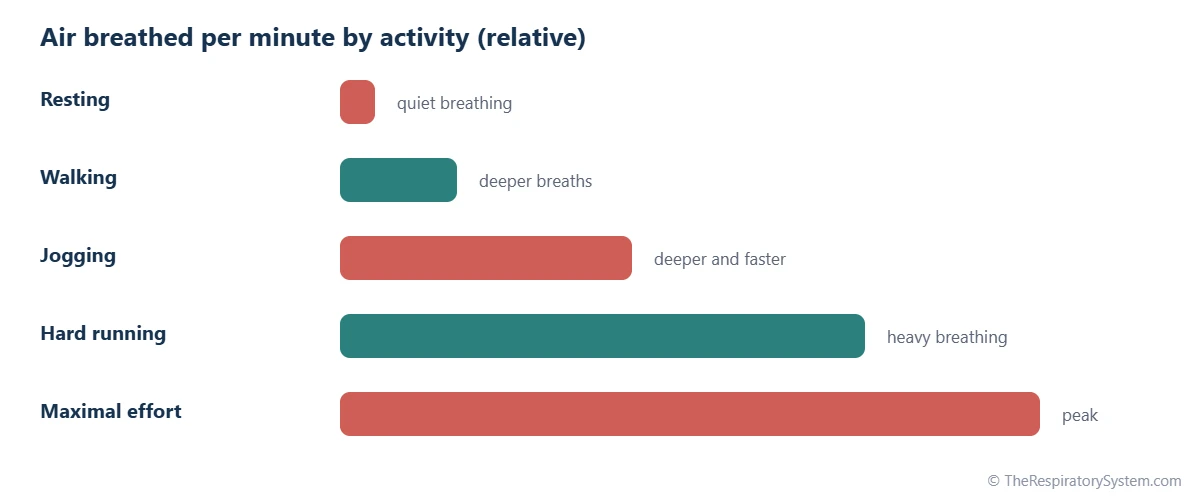
During exercise, working muscles use more oxygen and make more carbon dioxide, so the respiratory system increases ventilation by taking deeper breaths first and then faster breaths. Minute ventilation rises from about 6 liters per minute at rest to over 100 liters per minute at maximal effort in a healthy young adult, while blood oxygen and carbon dioxide levels stay close to normal. Training mainly strengthens the breathing muscles and makes breathing more efficient; the lungs themselves change very little.
- Main change
- Breathing becomes deeper first, then faster
- Air moved per minute
- About 6 L at rest; over 100 L at maximal exercise
- Oxygen use
- Can rise more than tenfold from the resting value of about 250 mL per minute
- Blood gases
- Arterial oxygen and carbon dioxide stay near normal in moderate exercise
- Training effect
- Stronger, more efficient breathing muscles; lung size changes little
- Works with
- Heart and blood vessels (cardiorespiratory system)
On this page
- What Is the Effect of Exercise on the Respiratory System?
- How Does the Respiratory System Respond to Exercise?
- What Controls Breathing During Exercise?
- What Happens in the Lungs and Blood During Exercise?
- How Do the Breathing Muscles Work During Exercise?
- What Are the Benefits of Exercise on the Respiratory System?
- How Do Altitude, Age and Air Quality Change Breathing During Exercise?
- Common Conditions That Affect Breathing During Exercise
- Key Facts
- Quiz
- FAQ
What Is the Effect of Exercise on the Respiratory System?
The main effect of exercise on the respiratory system is a rapid rise in ventilation, the amount of air moved in and out of the lungs each minute, matched to the extra oxygen the muscles need and the extra carbon dioxide they produce. At the same time, more blood flows through the lungs, and gas exchange across the alveoli speeds up.
Why the body needs more air
Muscles turn fuel into usable energy through cellular respiration, which consumes oxygen and releases carbon dioxide. At rest the whole body uses about 250 milliliters of oxygen per minute. During hard exercise that figure can climb more than tenfold in a healthy young adult, and even higher in endurance athletes. The respiratory system must bring in that oxygen and remove the carbon dioxide fast enough to keep the blood chemistry steady.
Short-term and long-term effects
The effects fall into two groups. Short-term or acute effects happen within seconds to minutes of starting exercise: faster and deeper breathing, more blood through the lungs and greater oxygen unloading in the muscles. Long-term effects, or training adaptations, build up over weeks to months of regular activity and mostly concern the breathing muscles, the heart and the muscles themselves rather than the lungs.
Explained simply
Think of the body as a fire in a stove. When the fire burns harder, it needs more air flowing in and makes more smoke to send up the chimney. Exercise turns the fire up, so the lungs act like a bigger bellows, pushing more fresh air in and more stale air out with every breath.
How Does the Respiratory System Respond to Exercise?
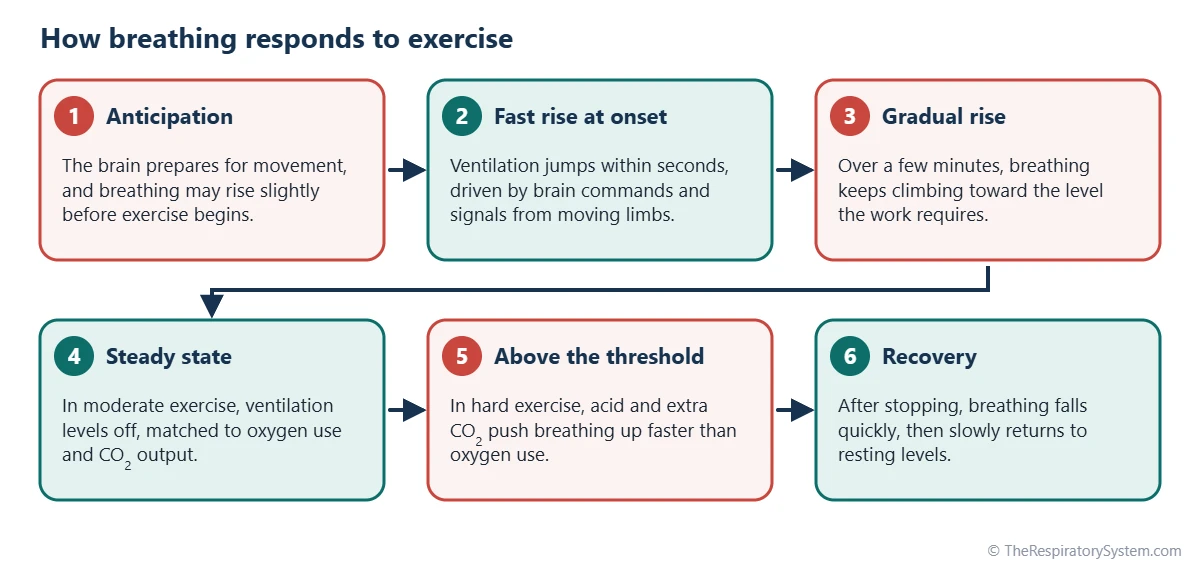
The respiratory system responds to exercise in stages: breathing jumps up within seconds of starting, rises more gradually over the next few minutes, settles at a steady level during moderate effort and climbs steeply again during very hard effort. After exercise it drops quickly at first and then slowly returns to resting levels.
The stages of the breathing response
- Anticipation: breathing may increase slightly even before movement starts, driven by the brain preparing for activity.
- Fast rise at onset: within the first few seconds, ventilation jumps sharply, long before blood chemistry has had time to change.
- Gradual rise: over the next few minutes, ventilation keeps rising toward a level matched to the work rate.
- Steady state: during moderate exercise, ventilation levels off and stays matched to oxygen use and carbon dioxide output.
- Extra rise above the threshold: at high intensity, ventilation rises faster than oxygen use, as described below.
- Recovery: after stopping, ventilation falls quickly, then declines slowly while the body repays its oxygen debt.
Deeper first, then faster
At low and moderate intensities, the main change is a larger tidal volume, the air moved per breath, which can grow from about 0.5 liter to roughly half of the vital capacity. Once tidal volume nears this limit, the respiratory rate rises, from about 12 to 20 breaths per minute at rest to around 40 to 50 at maximal effort in adults. Deeper breaths are more efficient, because a smaller share of each breath is wasted in the dead space of the airways.
Above the ventilatory threshold
As exercise gets harder, muscles rely more on fast, oxygen-free energy pathways and produce lactic acid. The blood buffers the acid with bicarbonate, which releases extra carbon dioxide, and the rising acidity stimulates the respiratory chemoreceptors. Ventilation then rises out of proportion to oxygen use, the point where breathing becomes noticeably heavy and talking gets difficult.
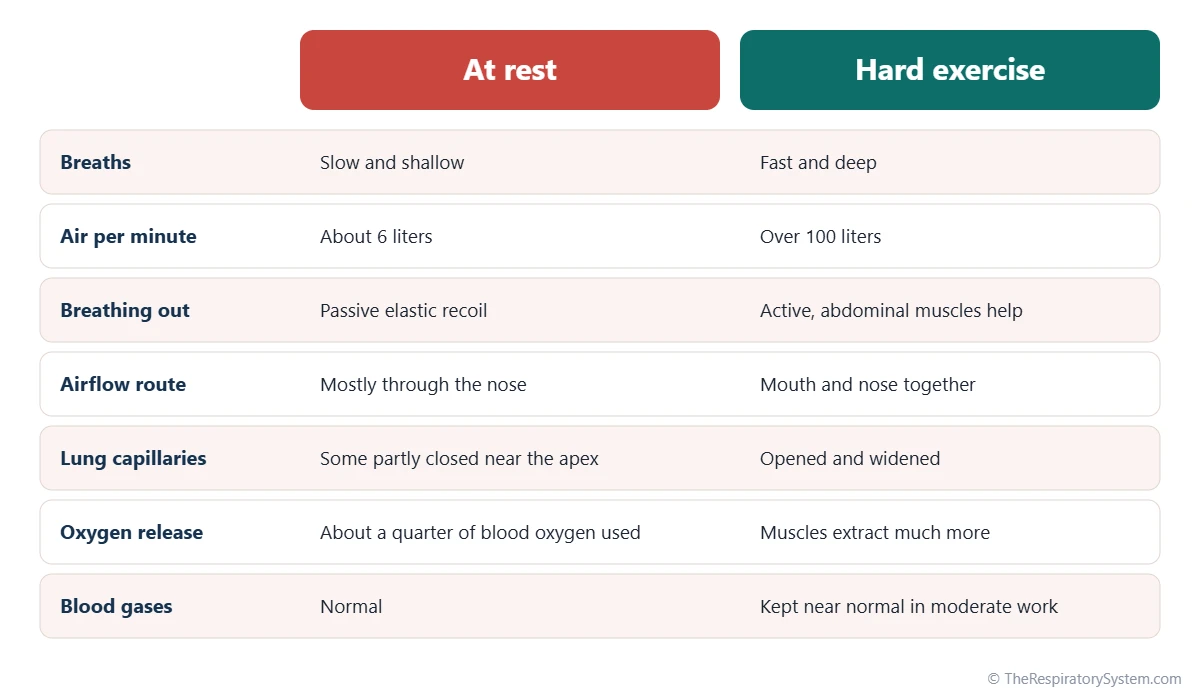
| Measure | At rest | Maximal exercise | Why it changes |
|---|---|---|---|
| Breathing rate | About 12 to 20 per minute | About 40 to 50 per minute | Rises once breaths are as deep as practical |
| Tidal volume | About 0.5 L | About half of vital capacity | Breath depth rises first |
| Minute ventilation | About 6 L per minute | Over 100 L per minute | Matches oxygen use and CO2 output |
| Oxygen use | About 250 mL per minute | More than ten times higher | Working muscles burn more fuel |
| Cardiac output | About 5 L per minute | About 20 L per minute or more | The heart beats faster and stronger |
| Red cell time in lung capillary | About 0.75 second | About 0.3 second | Faster blood flow through the lungs |
| Arterial PO2 | About 95 to 100 mmHg | Usually little change | Lungs still load the blood fully |
| Arterial PCO2 | About 40 mmHg | Near normal, may fall in very hard work | Ventilation clears extra carbon dioxide |
| Exhalation | Mostly passive recoil | Active, using abdominal muscles | Lungs must empty faster |
| Source: Typical values for a healthy young adult, our editors | |||
What Controls Breathing During Exercise?
Breathing during exercise is controlled by several signals working together: commands from the motor areas of the brain, feedback from receptors in the working muscles and joints, and fine-tuning by chemoreceptors that sense carbon dioxide, oxygen and acidity in the blood. The breathing centers in the brainstem combine these signals, as explained on our control of breathing page.
Central command
When the motor cortex sends signals to the muscles to move, it sends parallel signals to the breathing centers. This feed-forward command explains why breathing rises the moment exercise starts, and even slightly beforehand, before any change in blood gases.
Signals from muscles and joints
Sensory receptors in moving limbs detect movement, stretch and the build-up of chemicals in working muscle. Their signals travel to the brainstem and add to the drive to breathe. Studies in which limbs are moved passively show that movement alone can raise breathing.
Chemical fine-tuning
The central chemoreceptors in the medulla and the peripheral chemoreceptors in the carotid and aortic bodies make small corrections that keep arterial carbon dioxide close to its normal level of about 40 mmHg. Remarkably, during moderate exercise the average levels of oxygen and carbon dioxide in arterial blood barely change, which shows that ventilation is matched to metabolism with great precision. Rising temperature and potassium in the blood may also add to the drive during hard work.
What Happens in the Lungs and Blood During Exercise?
During exercise the lungs receive much more blood, open up capillaries that were partly closed at rest and exchange gases faster, while the blood unloads more oxygen in the muscles. These changes let oxygen uptake rise many times over without a fall in arterial oxygen in most healthy people.
More blood through the lungs
The heart's output can rise from about 5 liters per minute at rest to 20 liters or more at maximal effort, and every drop of it passes through the pulmonary circulation. The lung vessels handle this by opening extra capillaries, especially near the top of the lungs, and by widening those already open. Pulmonary artery pressure therefore rises only modestly, and air and blood become more evenly matched, as described on our ventilation-perfusion ratio page.
Faster gas exchange
With more capillaries open, the surface area for diffusion grows, and the lungs' diffusing capacity rises. A red blood cell crosses a lung capillary faster during exercise, in roughly a third of a second instead of about three-quarters of a second at rest. Because oxygen loading is normally complete early in the transit, healthy lungs usually still fill the blood with oxygen in time. Some highly trained endurance athletes are an exception: at very high work rates, their blood can leave the lungs slightly less saturated.
Greater oxygen unloading in the muscles
Working muscle is warmer, more acidic and richer in carbon dioxide. These conditions shift the oxygen-hemoglobin dissociation curve to the right, the Bohr effect, so hemoglobin releases more of its oxygen. Blood returning from hard-working muscle may hold only a small fraction of its oxygen, compared with about three-quarters at rest. The extra carbon dioxide is carried back to the lungs mainly as bicarbonate, as explained on our carbon dioxide transport page.
How Do the Breathing Muscles Work During Exercise?
During exercise the diaphragm and external intercostal muscles contract harder to enlarge the chest, and breathing out, which is passive at rest, becomes active with help from the abdominal and internal intercostal muscles. In very hard work, accessory muscles in the neck join in as well.
Breathing in
The diaphragm remains the main muscle of inhalation and moves further with each breath. The external intercostal muscles lift the ribs more strongly, and at high ventilation the sternocleidomastoid and scalene muscles raise the upper rib cage. The full set is described on our muscles of respiration page.
Breathing out
At rest, exhalation happens mostly by elastic recoil of the lungs and chest wall. During exercise, the abdominal muscles push the abdominal organs up against the diaphragm, and the internal intercostals pull the ribs down, emptying the lungs further and faster. This active exhalation also helps the next breath in, because the stretched diaphragm starts from a more effective length. The mechanics of breathing page explains the pressure changes behind each breath.
The cost of breathing
Breathing muscles need oxygen too. At rest they use only a tiny share of the body's oxygen, but at maximal exercise they can use about 10 to 15% of the total in fit people. They also compete with the leg and arm muscles for blood flow during the hardest efforts.
Breathing while running
During running, many people fall into a rhythm in which breaths lock to strides, a pattern called locomotor-respiratory coupling. Above moderate intensity, most people also switch from nose breathing to breathing through the mouth and nose together, because the nasal passages offer more resistance to high airflow; see nose breathing vs mouth breathing.
What Are the Benefits of Exercise on the Respiratory System?
The main benefits of regular exercise on the respiratory system are stronger and more fatigue-resistant breathing muscles, more efficient breathing at any given workload and less breathlessness during everyday activities. Most of the gain in fitness, however, comes from changes in the heart, blood and muscles rather than from bigger lungs.
Training adaptations
- Stronger breathing muscles: the diaphragm and intercostals gain endurance, with more oxidative fibers and capillaries, like other trained muscles.
- Lower ventilation at the same pace: a trained person breathes less air to run or cycle at a given speed, because their muscles produce less lactic acid at that intensity.
- Higher ventilatory threshold: the point where breathing becomes heavy shifts to a faster pace.
- Higher maximal ventilation: trained people can move more air at peak effort, partly because they can work harder.
- Less breathlessness: everyday tasks take a smaller share of maximal capacity, so they feel easier.
What does not change much
In adults, the size of the lungs, the number of alveoli and the structure of the airways change very little with training. Vital capacity may rise slightly through stronger muscles, but the main reason maximal oxygen uptake rises is a larger stroke volume of the heart, more capillaries in muscle and more mitochondria in muscle cells. Swimmers and divers often have larger lung volumes, which may reflect both training from childhood and natural selection into the sport.
The cardiorespiratory system
The heart and lungs work as one oxygen delivery chain, which is why fitness is often called cardiorespiratory fitness. Our page on the respiratory and circulatory system explains how they share the task. In healthy people the lungs rarely limit exercise; the heart's pumping capacity and the muscles' ability to use oxygen are usually the limiting links.
| What adapts | Change with regular endurance training | Effect |
|---|---|---|
| Diaphragm and intercostals | More endurance, more capillaries and oxidative fibers | Less breathing muscle fatigue |
| Ventilation at a given pace | Lower | Breathing feels easier at the same speed |
| Ventilatory threshold | Occurs at a higher work rate | Heavy breathing starts later |
| Maximal ventilation | Higher | More air moved at peak effort |
| Lung size and alveoli | Little or no change in adults | Lungs are rarely the limiting factor |
| Heart stroke volume | Larger | More blood pumped to lungs and muscles |
| Muscle capillaries and mitochondria | More | Muscles extract and use more oxygen |
| Source: Our editors, from standard exercise physiology | ||
How Do Altitude, Age and Air Quality Change Breathing During Exercise?
Altitude, age and the air itself all change how the respiratory system copes with exercise: thin air lowers the oxygen available, aging gradually reduces lung and chest elasticity, and cold, dry or polluted air can irritate the airways.
Altitude
At high altitude each breath holds fewer oxygen molecules, because the partial pressure of oxygen in the air is lower. Ventilation at any workload is higher, and maximal oxygen uptake falls. Over days to weeks the body adapts, partly by breathing more and later by making more red blood cells, as described on our breathing at high altitude page.
Age
With aging, the lungs lose some elastic recoil, the chest wall stiffens and the breathing muscles weaken slightly, so maximal ventilation and oxygen uptake decline slowly. Physically active older adults keep much more of their capacity than inactive people of the same age, mainly through the heart and muscle adaptations described above.
Cold, dry and polluted air
Heavy breathing through the mouth bypasses the warming and humidifying role of the nasal cavity. Large volumes of cold, dry air can dry and cool the airway lining, and in sensitive people this can trigger airway narrowing. Polluted air also delivers more particles to the airways when ventilation is high, because far more air passes through the lungs per minute.
Children
Children breathe faster and with smaller breaths than adults during exercise, and their ventilation per unit of oxygen used is slightly higher. Their lungs are still growing, adding alveoli through early childhood, a process described on our development of the respiratory system page.
Common Conditions That Affect Breathing During Exercise
Several conditions limit breathing during exercise, mostly by narrowing the airways, reducing lung elasticity or impairing gas exchange. Our respiratory diseases section covers them in more detail, and breathlessness that is unusual or out of proportion to effort should be checked by a doctor.
- Exercise-induced bronchoconstriction: temporary narrowing of the airways during or after exercise, common in people with asthma and also seen in some athletes without other symptoms.
- COPD: narrowed airways trap air in the lungs during fast breathing, a process called dynamic hyperinflation, which makes each breath harder.
- Pulmonary fibrosis: stiff lungs and a thickened respiratory membrane limit both breath size and oxygen uptake.
- Exercise-induced laryngeal obstruction: the larynx partly closes during hard breathing, causing noisy inhalation that can be mistaken for asthma.
- Heart conditions and anemia: these reduce oxygen delivery and cause breathlessness even when the lungs are healthy.
Fast, deep breathing that goes beyond the body's needs is described on our hyperventilation and hypoventilation page.
Key Facts
- During exercise, minute ventilation can rise from about 6 liters per minute at rest to more than 100 liters per minute at maximal effort.
- Breathing gets deeper first, then faster; tidal volume can reach about half of vital capacity.
- Ventilation jumps within seconds of starting exercise, before blood gases change, because of brain commands and signals from moving limbs.
- In moderate exercise, arterial oxygen and carbon dioxide stay close to their resting values despite the huge rise in gas exchange.
- Breathing out becomes active during exercise, with help from the abdominal and internal intercostal muscles of respiration.
- Regular training strengthens the breathing muscles and lowers ventilation at a given pace, but adult lungs change very little in size.
- In healthy people the heart and muscles, not the lungs, usually set the limit of maximal exercise.
Quick Quiz: Test What You Know About the How Exercise Affects the Respiratory System
6 questions. Tap an answer to check it.
What usually increases first when exercise begins at a low intensity?
Breaths get deeper first; breathing rate rises more once tidal volume nears its practical limit.
Why does ventilation rise within seconds of starting exercise?
Central command from the motor cortex and feedback from muscle and joint receptors drive the fast early rise.
Which muscles make exhalation active during hard exercise?
The abdominal muscles and internal intercostals pull the ribs down and push the diaphragm up to empty the lungs faster.
What happens to arterial oxygen in most healthy people during moderate exercise?
Ventilation is matched so closely to oxygen use that arterial oxygen barely changes in moderate exercise.
Which of these changes LEAST with endurance training in adults?
Lung structure, including the number of alveoli, changes very little with training in adults.
What makes hemoglobin release more oxygen in working muscle?
Warmer, more acidic tissue with more carbon dioxide shifts the dissociation curve to the right, releasing oxygen.
Frequently Asked Questions
Does exercise make your lungs bigger?
Not really. In adults, the size of the lungs and the number of alveoli change very little with training. What improves is the strength and endurance of the breathing muscles, the efficiency of breathing and, above all, the heart and muscles that deliver and use oxygen. Vital capacity may rise slightly because stronger muscles can expand and empty the chest more fully.
Why do you breathe heavily after exercise stops?
Breathing stays high after exercise because the body is recovering. It must restore oxygen stores in muscle and blood, clear lactic acid, cool down and rebuild energy compounds in the muscles. This extra oxygen use after exercise is often called excess post-exercise oxygen consumption, or oxygen debt. Breathing falls quickly in the first minute and then slowly returns to normal.
What is the effect of exercise on the cardio respiratory system?
Exercise raises both breathing and heart output together. The lungs move more air and exchange more gas, while the heart pumps more blood through the lungs and to the muscles. With regular training, the heart's stroke volume grows, muscles gain capillaries and mitochondria, and breathing becomes more efficient, so the whole oxygen delivery chain from air to muscle works better.
What is the best exercise for the respiratory system?
There is no single best exercise. Any regular activity that makes you breathe harder for a sustained time, such as walking briskly, cycling, swimming or running, works the breathing muscles and the heart together. The respiratory system adapts to the overall amount and intensity of activity rather than to one specific sport. Activities that use large muscle groups raise breathing the most.
Why do you get out of breath when you exercise?
Breathlessness during exercise is the normal feeling of a high drive to breathe. Working muscles produce more carbon dioxide and, at high intensity, acid, and the brain increases breathing to clear them. When ventilation approaches its upper range, the effort of breathing becomes noticeable. Fitter people reach that point at a faster pace because their muscles produce less acid at the same workload.
Do the lungs limit how hard you can exercise?
In most healthy people, no. The lungs have spare capacity, and arterial oxygen stays near normal even at high workloads. The usual limits are the heart's pumping capacity and the muscles' ability to use oxygen. Some elite endurance athletes are an exception, because their very high blood flow can leave too little time in the lung capillaries to fully load the blood.
Why do you breathe through your mouth during hard exercise?
The nasal passages are narrow and curved, so they resist airflow much more than the open mouth. At rest and in light exercise, nose breathing easily supplies enough air and warms and humidifies it. As ventilation rises, the effort of pulling air through the nose becomes too great, and most people switch to breathing through the mouth and nose together.
What happens to breathing at the start of a race?
Breathing often rises even before the start, as the brain anticipates effort and stress hormones increase. When movement begins, ventilation jumps within seconds because the motor areas of the brain send signals to the breathing centers and receptors in the moving limbs report activity. Only after this does the slower rise linked to changing blood chemistry follow.
Keep Exploring


