At a Glance
Tidal volume (TV or VT) is the volume of air inhaled or exhaled in a single quiet breath. A typical healthy adult at rest has a tidal volume of about 500 mL, of which about 150 mL stays in the airways as dead space and about 350 mL reaches the alveoli. Multiplied by the breathing rate, it gives minute ventilation, about 6 liters per minute at rest.
- Definition
- Air moved in or out during one quiet, unforced breath
- Typical adult value
- About 500 mL (0.5 L) per breath at rest
- Per body size
- About 6 to 8 mL per kg of predicted body weight
- Abbreviation
- TV or VT
- Measured with
- Spirometer, or flow sensors on a ventilator
- Part of
- The lung volumes; included in inspiratory capacity and vital capacity
On this page
- What Is Tidal Volume?
- What Is the Tidal Volume of a Typical Adult?
- How Does a Tidal Breath Move Air In and Out?
- Tidal Volume and Functional Residual Capacity
- What Is the Tidal Volume Formula?
- What Is the Function of Tidal Volume?
- What Changes Tidal Volume?
- How Is Tidal Volume Measured?
- Common Conditions That Affect Tidal Volume
- Key Facts
- Quiz
- FAQ
What Is Tidal Volume?
Tidal volume is the volume of air breathed in, or breathed out, during one ordinary breath taken without any extra effort. Physiologists write it as TV or VT, and it is the smallest of the four standard lung volumes. It describes quiet, automatic breathing, the kind that goes on while a person reads or sits still, not a deep or forced breath.
Tidal volume definition in anatomy and physiology
In anatomy and physiology courses, tidal volume is defined as the amount of air that moves between the atmosphere and the lungs in a single resting respiratory cycle, measured either on the way in or on the way out. Textbooks treat the inhaled and exhaled volumes as equal. Tidal air first fills the conducting airways, from the trachea down to the terminal bronchioles, and the rest mixes with the much larger volume of air that always stays inside the alveoli.
Tidal breathing versus deep breathing
Tidal breathing, also called eupnea, is the normal, unforced breathing of a person at rest. A deep breath, a sigh, a yawn or a forced breath during a lung test all move more air than a tidal breath and draw on the reserve volumes above and below it. Tidal volume always refers to the relaxed breath, which is why lung tests begin with a short period of normal breathing before any deep breath is taken.
Explained simply
Picture the lungs as a large sponge that is never squeezed completely dry. With each relaxed breath, a small cup of fresh air is pushed into the sponge and a small cup of used air comes back out. That small cup, about half a liter in an adult, is the tidal volume, and it is enough to keep the blood supplied with oxygen while the body is at rest.
What Is the Tidal Volume of a Typical Adult?
The tidal volume of a typical healthy adult at rest is about 500 milliliters, or half a liter, per breath. Because the lungs scale with body size, the value is often given as about 6 to 8 milliliters per kilogram of predicted body weight, which works out to roughly 400 to 600 mL in most adults.
Men, women and body size
Tidal volume depends mainly on height and sex, because these set the size of the chest and lungs. Taller people, and men on average, have larger lungs and slightly larger tidal volumes, but when the volume is expressed per kilogram of predicted body weight, men and women breathe about the same. Actual body weight is a poor guide, since fat tissue adds weight without adding lung.
Children and newborns
Children breathe smaller volumes in proportion to their size. A newborn's tidal volume is only about 20 milliliters, a little more than a tablespoon, yet per kilogram it is close to the adult value. To move enough air with such small breaths, babies and young children breathe much faster than adults, as shown on our respiratory rate page.
Older adults
Resting tidal volume stays fairly steady through adult life, because the body's oxygen needs at rest change little. What changes with age is the room around it: the lungs lose some elastic recoil and the chest wall stiffens, so the deepest possible breath, the vital capacity, slowly shrinks while the air left behind after a full exhalation grows.
| Person or situation | Typical tidal volume | What it means |
|---|---|---|
| Healthy adult at quiet rest | About 500 mL (0.5 L) | The standard textbook value for one relaxed breath |
| Adult, scaled to body size | About 6 to 8 mL per kg of predicted body weight | Predicted weight comes from height and sex, not actual weight |
| Part that stays in the airways | About 150 mL | Fills the anatomical dead space and never reaches the alveoli |
| Part that reaches the alveoli | About 350 mL | Mixes with about 2.3 to 2.4 L already in the lungs at FRC |
| Newborn baby | About 20 mL | Close to the adult value per kilogram; the breathing rate is much faster |
| Deep non-REM sleep | Slightly below waking rest | Breathing becomes slow and very regular |
| Late pregnancy | Larger than before pregnancy | Progesterone deepens breathing while the rate changes little |
| Hard exercise | Up to around half of vital capacity | Depth rises first; rate provides most of the later increase |
| Source: Typical values for healthy people at sea level, our editors | ||
How Does a Tidal Breath Move Air In and Out?
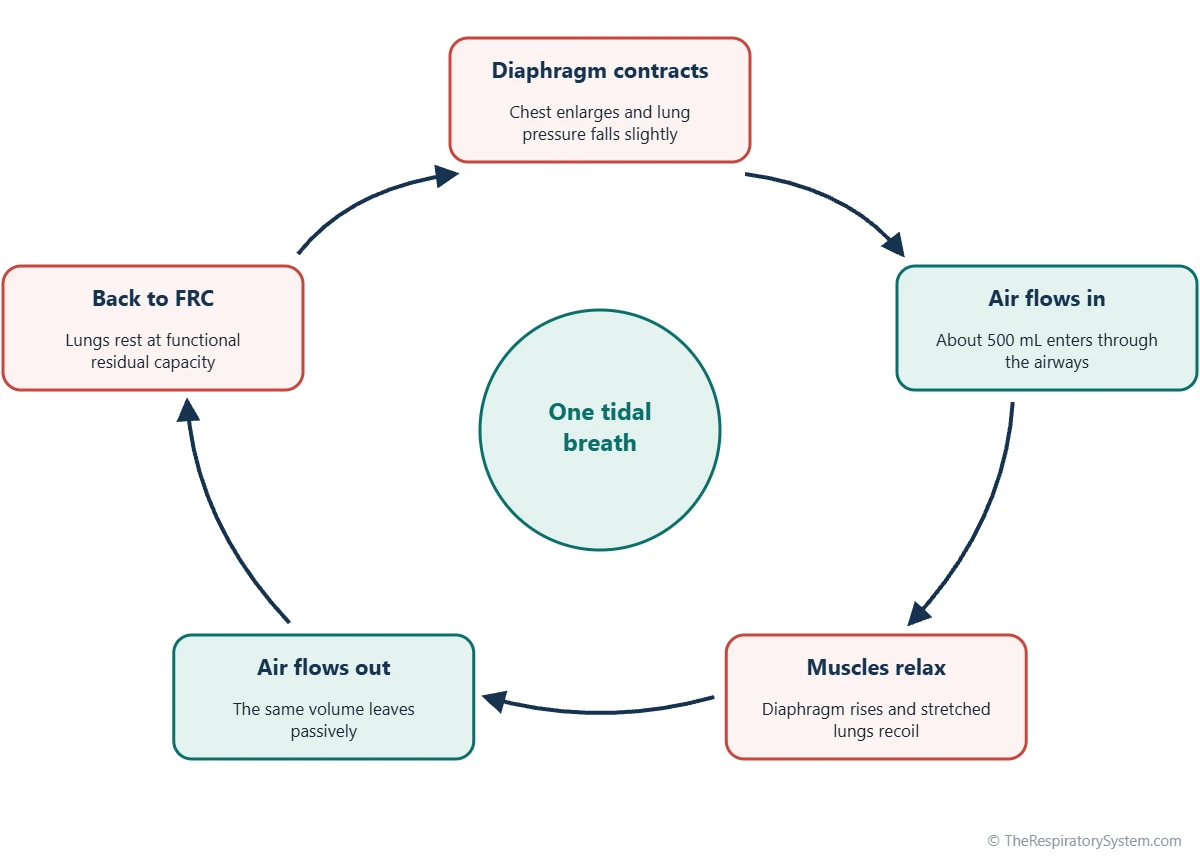
A tidal breath moves air because the breathing muscles briefly enlarge the chest, lowering the pressure inside the lungs below the pressure of the outside air, and then relax so the lungs spring back and push the air out. During quiet breathing only inhalation uses muscle effort; exhalation is passive.
- The diaphragm contracts. A signal from the brainstem travels down the phrenic nerve, and the dome of the diaphragm flattens and moves down by about 1 to 2 centimeters. The external intercostal muscles help by lifting the ribs slightly.
- Pressure inside the lungs falls. As the chest enlarges, the pressure in the alveoli drops about 1 mmHg below atmospheric pressure. The pressure in the pleural cavity becomes more negative, from about 4 to about 6 mmHg below atmospheric, so the lungs are pulled outward with the chest wall.
- Air flows in. Air moves down this small pressure difference through the nose, pharynx, larynx and airways until the pressure inside equals the pressure outside. The amount that has entered is the tidal volume.
- The muscles relax. At the end of inhalation the diaphragm relaxes and rises, and the stretched elastic fibers of the lungs recoil, helped by surface tension in the alveoli.
- Air flows out. Pressure in the alveoli rises about 1 mmHg above atmospheric, and the same volume of air leaves the lungs.
- The lungs return to their resting point. The breath ends at the functional residual capacity, the balance point where the inward pull of the lungs equals the outward spring of the chest wall.
A full quiet breath in an adult takes about 4 to 5 seconds, and exhalation usually lasts a little longer than inhalation. Our pages on the mechanics of breathing and inhalation and exhalation follow these pressure changes in more detail.
Tidal Volume and Functional Residual Capacity
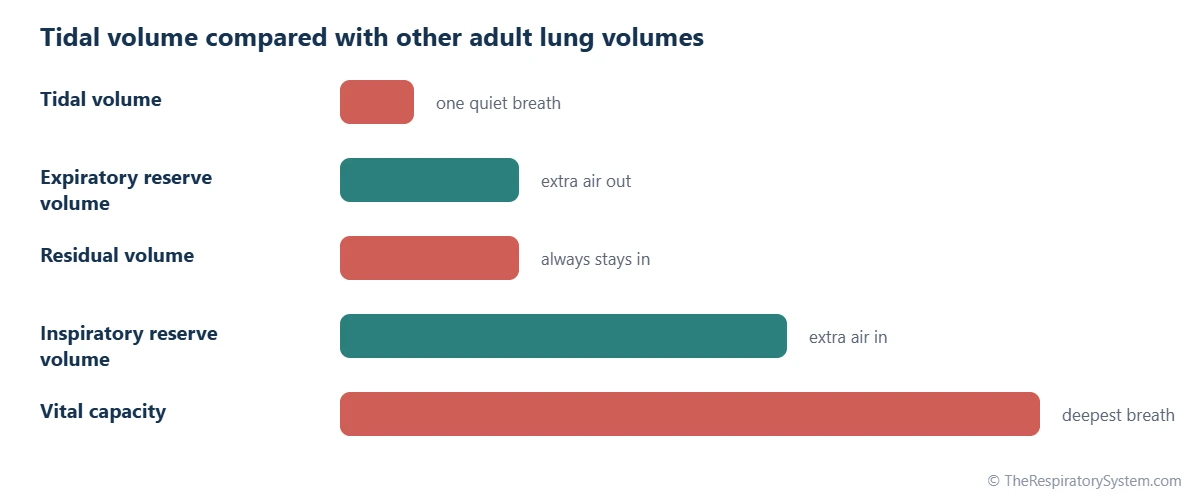
Tidal volume sits on top of the functional residual capacity (FRC), the roughly 2.3 to 2.4 liters of air left in an adult's lungs at the end of a quiet exhalation. Each quiet breath starts at the FRC, adds about half a liter, and returns to it.
Lung volumes are split into four parts that do not overlap, and the capacities are sums of two or more of them:
- Tidal volume (TV): about 500 mL, the air of a quiet breath.
- Inspiratory reserve volume (IRV): about 3,000 mL in a young adult man, the extra air that can be breathed in after a normal inhalation.
- Expiratory reserve volume (ERV): about 1,100 to 1,200 mL, the extra air that can be pushed out after a normal exhalation.
- Residual volume (RV): about 1,200 mL, the air that cannot be breathed out at all.
From these, the functional residual capacity equals ERV plus RV, the inspiratory capacity equals TV plus IRV, and the vital capacity equals IRV plus TV plus ERV. Tidal volume is therefore only about a tenth of the vital capacity and less than a tenth of the total lung capacity of about 6 liters. Our overview of lung volumes and capacities sets every volume and capacity side by side.
Why the FRC matters for each tidal breath
Because the FRC is so much larger than one tidal breath, each breath replaces only a small share of the air in the alveoli. Of the 500 mL inhaled, about 350 mL of fresh air reaches the alveoli and mixes with about 2.3 liters already there, so roughly one-seventh of the alveolar air is renewed per breath. This buffer keeps the oxygen and carbon dioxide levels of alveolar air nearly constant between breaths, so the blood does not swing between oxygen-rich and oxygen-poor with every inhalation.
What Is the Tidal Volume Formula?
The basic tidal volume formula links the depth and the rate of breathing: minute ventilation equals tidal volume multiplied by respiratory rate, so tidal volume equals minute ventilation divided by respiratory rate. In symbols, VE = VT × f, and VT = VE ÷ f.
Worked example
An adult breathing 12 times per minute with a tidal volume of 500 mL moves 500 × 12 = 6,000 mL, or 6 liters, of air each minute. If a spirometer records a minute ventilation of 7.5 liters at 15 breaths per minute, the average tidal volume is 7,500 ÷ 15 = 500 mL.
Alveolar ventilation: the part that counts
Not all of each breath reaches the gas-exchange surface. The first part of every tidal breath fills the conducting airways, the anatomical dead space of about 150 mL in an adult, and is breathed back out unchanged. Alveolar ventilation therefore equals tidal volume minus dead space, multiplied by rate: (500 - 150) × 12 = 4.2 liters per minute. The same minute ventilation can give very different alveolar ventilation:
- Normal quiet breathing: 500 mL × 12 per minute = 6 L/min in total, 4.2 L/min reaching the alveoli.
- Rapid, shallow breathing: 250 mL × 24 per minute = 6 L/min in total, only 2.4 L/min reaching the alveoli.
- Slow, deep breathing: 1,000 mL × 6 per minute = 6 L/min in total, 5.1 L/min reaching the alveoli.
This is why tidal volume matters as much as breathing rate: shallow breaths spend a larger share of each breath on dead space.
How a tidal volume calculator works
Tidal volume calculators usually estimate a normal value from height and sex rather than from actual weight. They first work out predicted body weight, for example 50 kg + 0.91 × (height in cm - 152.4) for men and 45.5 kg + 0.91 × (height in cm - 152.4) for women, and then multiply it by 6 to 8 mL per kilogram. For a man 175 cm tall, predicted body weight is about 70.6 kg, which gives an estimated resting tidal volume of roughly 420 to 560 mL. These estimates only show how lung size scales with height; real tidal volume is measured, not calculated, and the formula is not a guide to setting any medical equipment.
What Is the Function of Tidal Volume?
The function of tidal volume is to renew the air in the alveoli with every breath, bringing in oxygen and carrying away carbon dioxide at a steady, low-effort rate that matches the body's needs at rest.
Keeping alveolar gases steady
Each tidal breath tops up the alveolar air just enough to hold its oxygen partial pressure near 100 mmHg and its carbon dioxide partial pressure near 40 mmHg. These steady levels maintain the gradients that drive gas exchange across the alveolar walls. If tidal breaths become too small, carbon dioxide builds up in the alveoli and the blood; if breathing is much larger than needed, too much carbon dioxide is blown off, as described on our page on hyperventilation and hypoventilation.
Saving energy
Quiet breathing at a moderate tidal volume costs very little energy. Very small breaths waste a large share of each breath on dead space, while very large breaths force the muscles to stretch stiffer lung and chest tissue, so resting tidal volume falls near the point where the total work of breathing is lowest. At rest the breathing muscles use only a small share of the body's oxygen.
Keeping a reserve ready
Because quiet breathing uses only a sliver of the lungs' range, large reserves remain above and below each breath. When demand rises, tidal volume can grow into the inspiratory and expiratory reserve volumes without any change in lung structure. Occasional deeper breaths, known as sighs, also reopen small groups of alveoli that tend to close during long periods of shallow breathing, helped by pulmonary surfactant.
What Changes Tidal Volume?
Tidal volume changes whenever the brainstem adjusts breathing to the body's needs: it rises with exercise, higher carbon dioxide or low oxygen, and falls during sleep or when the breathing centers are depressed. The control of breathing sets depth and rate together.
- Exercise: working muscles produce more carbon dioxide, and tidal volume rises several-fold, often to around half of the vital capacity in hard exercise, before breathing rate takes over most of the further increase. See how exercise affects the respiratory system.
- Blood gases: a rise in arterial carbon dioxide, sensed mainly by central chemoreceptors in the medulla, is the strongest stimulus to breathe more deeply. A large fall in oxygen, sensed by the carotid and aortic bodies, adds to the drive.
- Lung stretch: stretch receptors in the airway walls signal the brainstem when the lungs inflate, a response called the Hering-Breuer reflex. In adults it mainly limits very large breaths, such as those during exercise.
- Sleep: tidal volume falls slightly in deep non-REM sleep, when breathing becomes slow and even; in REM sleep breathing turns more irregular.
- Altitude: thinner air with a lower oxygen pressure makes people breathe more deeply and faster, as explained on breathing at high altitude.
- Pregnancy: the hormone progesterone makes the breathing centers more sensitive to carbon dioxide, so tidal volume rises while breathing rate changes little.
- Body position: lying flat lets the abdominal organs push up on the diaphragm, which lowers the functional residual capacity, though quiet tidal volume changes little.
Rest versus exercise
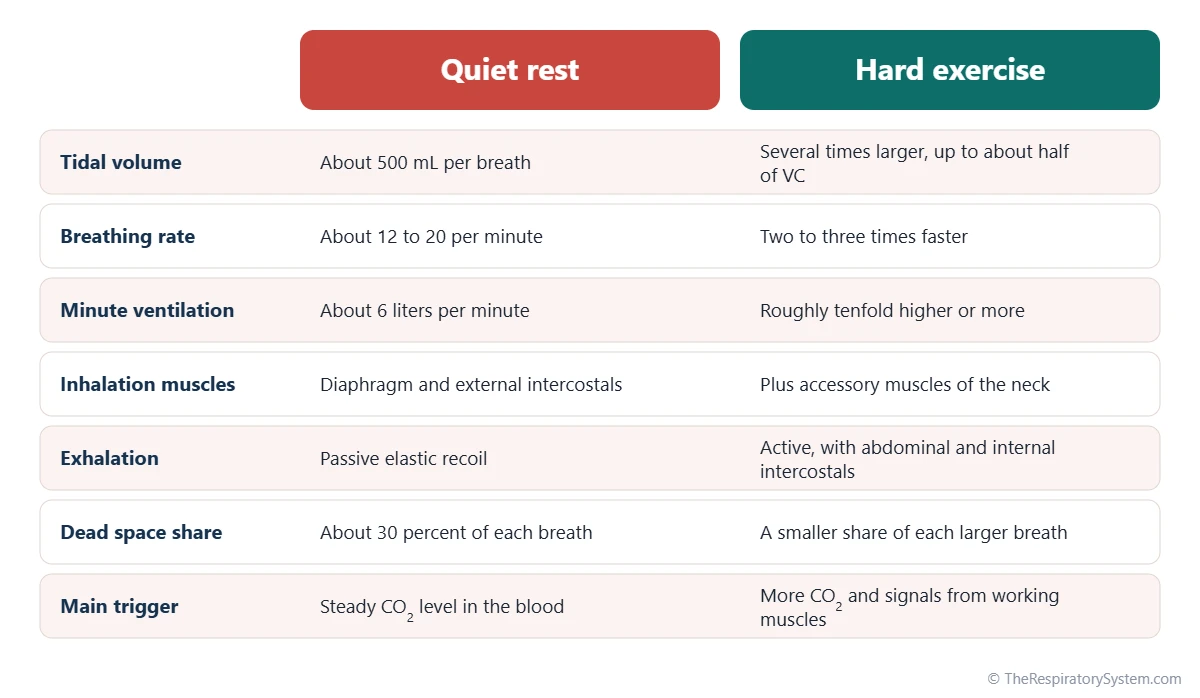
At rest, an adult meets the body's needs with about half a liter per breath. During hard exercise both depth and rate climb, and total ventilation can rise roughly tenfold or more from its resting level of about 6 liters per minute. Exhalation also stops being passive, as the abdominal and internal intercostal muscles help push air out quickly. The diagram below compares the two states.
How Is Tidal Volume Measured?
Tidal volume is measured with a spirometer, a device that records the volume of air a person breathes in and out through a mouthpiece, usually with a nose clip in place. During a few minutes of relaxed breathing the trace rises and falls in small, regular waves, and the height of each wave is the tidal volume.
The spirogram
On a spirogram, quiet tidal breaths form the baseline. The person is then asked to breathe in as deeply as possible and out as fully as possible, which reveals the reserve volumes above and below the tidal waves. Our spirometry page explains how these traces are read.
Other ways it is measured
- Ventilators and anesthesia machines measure the volume of each breath with flow sensors in the breathing circuit.
- Body plethysmography, in which a person sits in a sealed booth, measures lung volumes from small pressure changes and is used for volumes a spirometer cannot read, such as residual volume.
- Respiratory inductance bands worn around the chest and abdomen estimate breath size from body movement, mainly in sleep studies and research.
Measured values are always compared with predicted values for the person's age, height and sex, because a single number means little without that context.
Common Conditions That Affect Tidal Volume
Tidal volume can be reduced by stiff lungs, weak breathing muscles, a depressed breathing drive or pain, and the body often responds by breathing faster. Our respiratory diseases section covers these conditions, and anyone with breathing symptoms should see a doctor.
- Restrictive lung disease: in pulmonary fibrosis, scar tissue stiffens the lungs, so breaths become small and fast. The contrast with airway disease is explained in obstructive vs restrictive lung disease.
- Obstructive lung disease: in COPD and severe asthma, narrowed airways slow exhalation, so air can be trapped and each tidal breath starts from a higher lung volume, which makes breathing more tiring.
- Neuromuscular conditions: weakness of the diaphragm or chest muscles limits how far the chest can expand.
- Depressed breathing drive: some sedating medicines and some brain injuries lower both tidal volume and rate, causing hypoventilation.
- Chest pain and rib injuries: pain makes breathing shallow, which can let small areas of lung collapse.
- Obesity: extra weight on the chest and abdomen reduces the reserve volumes, though resting tidal volume is often kept up by breathing slightly faster.
Key Facts
- Tidal volume is the volume of air moved in or out during one quiet, relaxed breath, about 500 mL in a typical adult.
- Scaled to body size, normal tidal volume is about 6 to 8 mL per kilogram of predicted body weight, which is worked out from height and sex.
- About 150 mL of each tidal breath stays in the conducting airways as dead space, and about 350 mL reaches the alveoli.
- Minute ventilation equals tidal volume times respiratory rate: about 500 mL × 12 = 6 liters per minute at rest.
- Each quiet breath starts and ends at the functional residual capacity, about 2.3 to 2.4 liters in an adult.
- Quiet inhalation is active, powered mainly by the diaphragm, while quiet exhalation is passive elastic recoil.
- Tidal volume is only about a tenth of the vital capacity, which leaves large reserves for exercise.
Quick Quiz: Test What You Know About the Tidal Volume
6 questions. Tap an answer to check it.
What is the typical tidal volume of a resting adult?
A quiet adult breath moves about 500 mL. About 150 mL is dead space volume, and about 4,800 mL is a typical vital capacity.
Which lung capacity is the starting point of every quiet breath?
Quiet breaths start and end at the functional residual capacity, where the pull of the lungs balances the spring of the chest wall.
How is minute ventilation calculated?
Minute ventilation is tidal volume multiplied by breaths per minute, about 500 mL × 12 = 6 L per minute at rest.
About how much of a 500 mL tidal breath stays in the anatomical dead space?
About 150 mL fills the conducting airways, so about 350 mL of fresh air reaches the alveoli.
Which muscle does most of the work in a quiet tidal breath?
The diaphragm powers quiet inhalation; neck and abdominal muscles join in only during heavy breathing.
During quiet breathing, exhalation is mainly caused by:
Quiet exhalation is passive: the stretched lungs and chest wall spring back when the diaphragm relaxes.
Frequently Asked Questions
What is the difference between tidal volume and vital capacity?
Tidal volume is the air moved in one relaxed breath, about 500 mL in an adult. Vital capacity is the largest amount of air a person can breathe out after the deepest possible breath in, about 4.5 to 5 liters in a young adult man and less in women. Vital capacity includes tidal volume plus the inspiratory and expiratory reserve volumes, so it is roughly ten times larger.
Is tidal volume the same for men and women?
In absolute terms, men usually have slightly larger tidal volumes because they are on average taller and have larger lungs. When tidal volume is expressed per kilogram of predicted body weight, which is based on height and sex, the values for men and women are about the same, roughly 6 to 8 mL per kilogram. Body size matters far more than sex itself.
Why is it called tidal volume?
The word tidal comes from the tides of the sea. In quiet breathing, air flows into the lungs and back out in a regular, gentle rhythm, much like water rising and falling along a shore. And like a tide that only stirs part of a harbor, each breath replaces only a small share of the air already sitting inside the lungs.
What is tidal volume measured in?
Tidal volume is a volume of air, usually given in milliliters (mL) for a single breath or in liters (L). A typical adult value is written as about 500 mL or 0.5 L. In physiology books and clinical notes it is abbreviated TV or VT, and it is often reported in milliliters per kilogram of predicted body weight to compare people of different sizes.
What is a normal tidal volume for a child?
A child's tidal volume is roughly the same as an adult's when measured per kilogram, about 6 to 8 mL per kilogram of body weight, so the actual volume grows as the child grows. A newborn moves only about 20 mL per breath, while an older child moves a few hundred milliliters. Children make up for their small breaths by breathing faster than adults.
Does tidal volume change with age?
Resting tidal volume stays fairly stable through adult life, because it is set by the body's steady oxygen needs at rest. Age mostly affects the reserves: the lungs lose some elastic recoil, the chest wall becomes stiffer and the breathing muscles weaken a little. As a result, vital capacity falls and residual volume rises, so older adults have less extra room to deepen their breaths during exercise.
What happens if tidal volume is too low?
If breaths become too shallow, a larger share of each breath stays in the dead space of the airways and less fresh air reaches the alveoli. Carbon dioxide then builds up in the blood and oxygen levels can fall, a state called hypoventilation. The body usually tries to make up for it by breathing faster, which is why doctors look at both depth and rate when they assess breathing.
Why do people sigh if tidal volume is enough?
Even healthy people take a deeper breath, or sigh, every few minutes without noticing. During long stretches of quiet breathing, some small air sacs slowly begin to collapse, and a sigh, which is much larger than a tidal breath, reopens them and spreads surfactant over their surface. Sighs are triggered automatically by the brainstem and become more frequent with stress or low oxygen.
Keep Exploring


