At a Glance
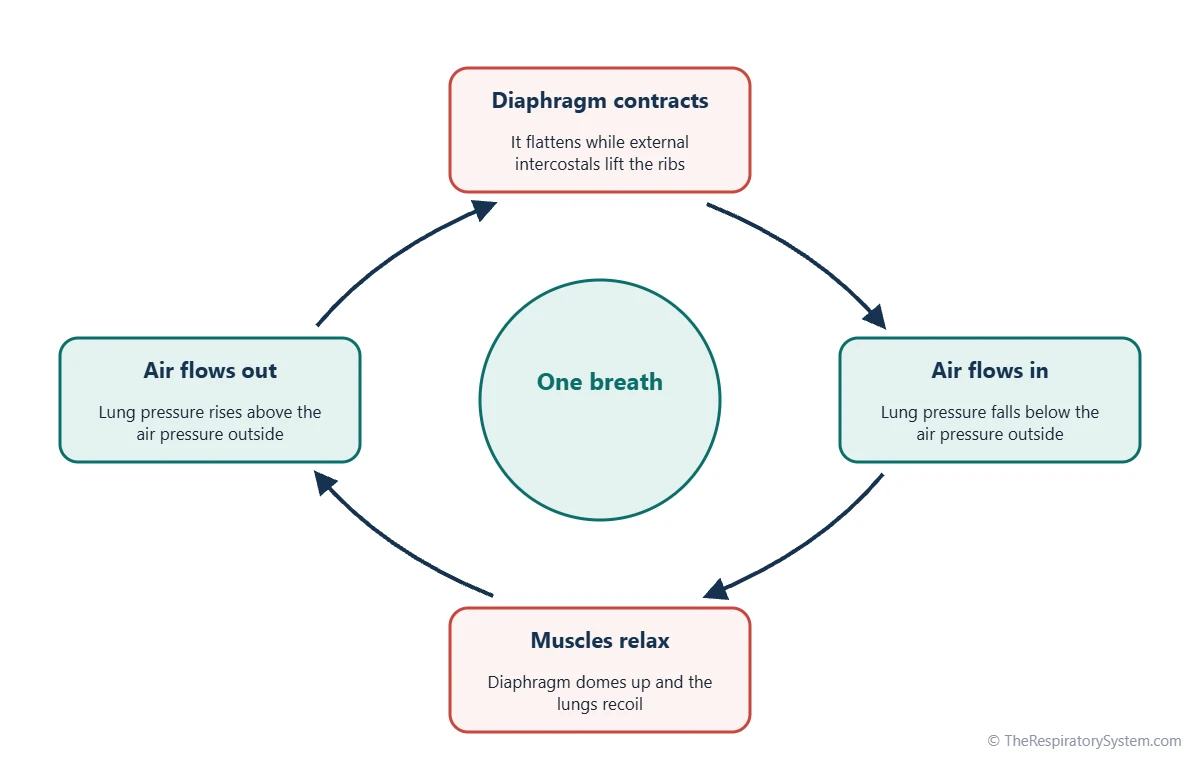
Inhalation (inspiration) happens when the diaphragm contracts and flattens and the external intercostal muscles lift the ribs, enlarging the chest so that pressure in the alveoli falls about 1 mmHg below atmospheric pressure and air flows in. Exhalation (expiration) happens when these muscles relax and the elastic lungs and chest wall recoil, raising alveolar pressure about 1 mmHg above atmospheric so air flows out. At rest an adult repeats this cycle about 12 to 20 times a minute, moving about 500 mL of air per breath.
- Also called
- Inspiration and expiration; together, pulmonary ventilation
- Main muscles
- Diaphragm and external intercostals for inhalation; none for quiet exhalation
- Driving force
- Small pressure differences between the alveoli and the outside air
- Typical rate
- About 12 to 20 breaths a minute in a resting adult
- Air per breath
- About 500 mL at rest (tidal volume)
- Part of
- Pulmonary ventilation, the first step of respiration
On this page
- What Is Inhalation?
- What Is Exhalation?
- Inhalation Process: What Are the Steps of Inhalation?
- What Happens During Exhalation?
- Inhalation vs Exhalation: What Is the Difference?
- How Is Quiet Breathing Different From Forced Breathing?
- What Path Does Air Take During Inhalation and Exhalation?
- How Is Inhaled Air Different From Exhaled Air?
- Common Conditions That Affect Inhalation and Exhalation
- Key Facts
- Quiz
- FAQ
What Is Inhalation?
Inhalation is the active phase of breathing in which the breathing muscles enlarge the chest, lowering the pressure inside the lungs so that air flows in from the atmosphere. It is also called inspiration, and it brings oxygen-rich air down the airways to the alveoli, where gas exchange takes place.
Inhalation definition
In biology, inhalation is the movement of air into the lungs caused by contraction of the inspiratory muscles. The key muscle is the diaphragm, a dome-shaped sheet of skeletal muscle under the lungs, helped by the external intercostal muscles between the ribs. In quiet breathing the diaphragm does most of the work, moving roughly three-quarters of the air that enters the lungs.
Why air flows in
Air always flows from higher to lower pressure. When the chest enlarges, the lungs, which cling to the chest wall through the thin film of fluid in the pleural cavity, expand with it. The same amount of air now fills a bigger space, so its pressure drops, a relationship known as Boyle's law, and outside air rushes in until the pressures are equal. The physics of these pressure changes is covered in more depth on our mechanics of breathing page.
Explained simply
Picture the chest as a box with a stretchy floor. When the floor (the diaphragm) pulls down and the walls (the ribs) swing out, the box gets bigger inside. The air inside is spread thinner, so air from outside is pulled in to fill the space, much like air rushing into a syringe when you pull back the plunger.
What Is Exhalation?
Exhalation is the phase of breathing in which the chest becomes smaller, raising the pressure inside the lungs above atmospheric pressure so that air flows out. It is also called expiration, and it carries carbon dioxide, water vapor and leftover air out of the body.
During quiet breathing, exhalation is a passive process: no muscle has to contract. The lungs contain elastic fibers that were stretched during inhalation, and the fluid film lining the alveoli creates surface tension that also pulls inward. When the inspiratory muscles relax, this stored elastic energy springs the lungs and chest wall back to their resting size, a process called elastic recoil.
Exhalation becomes active when the body needs to move air faster or empty the lungs more fully, for example during heavy exercise, coughing, singing a long note or blowing out candles. Then the internal intercostal muscles and the abdominal muscles contract to push the air out, as described in the section on forced breathing below.
Inhalation Process: What Are the Steps of Inhalation?
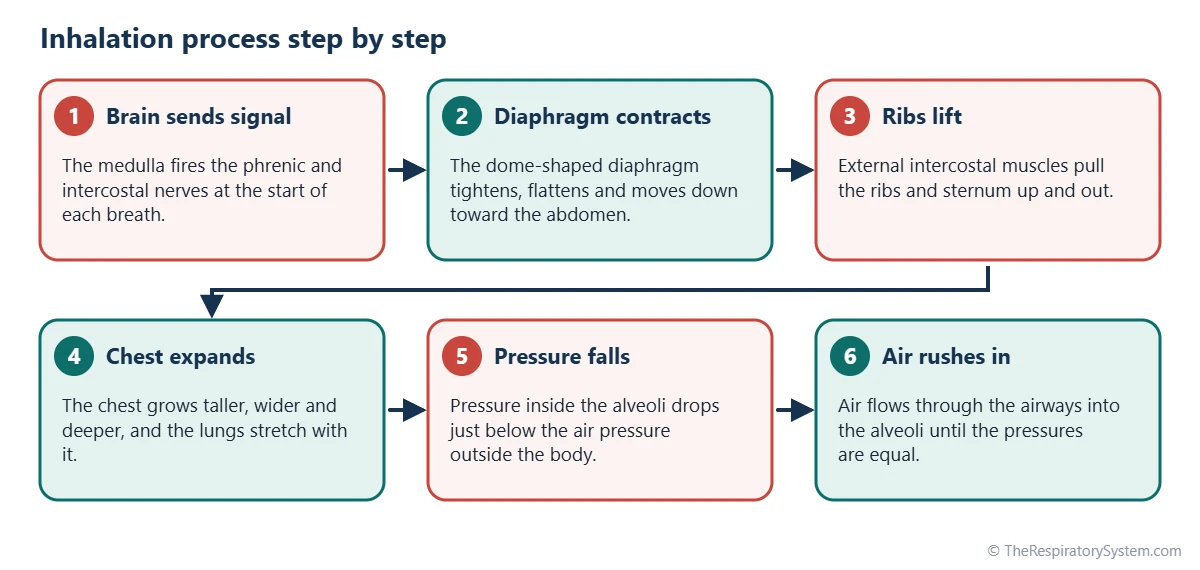
The inhalation process runs in a fixed order: the brainstem sends a signal, the diaphragm and external intercostals contract, the chest enlarges, pressure in the lungs falls and air flows in. Each step takes only a fraction of a second, and a quiet breath in usually lasts about one to two seconds.
- The brain sends the signal. Breathing centers in the medulla fire nerve impulses down the phrenic nerve to the diaphragm and down the intercostal nerves to the rib muscles. The control of breathing page explains how this rhythm is set.
- The diaphragm contracts. Its central tendon is pulled down, so the dome flattens and the chest becomes taller.
- The ribs lift. The external intercostals pull each rib upward and outward. The lower ribs swing out sideways like a bucket handle, and the sternum moves forward like a pump handle, widening and deepening the rib cage.
- The lungs expand. Because the visceral pleura on the lungs and the parietal pleura on the chest wall are held together by pleural fluid, the lungs follow the chest wall outward.
- Pressure falls. Pressure in the pleural cavity becomes more negative, and pressure in the alveoli drops about 1 mmHg below the air pressure outside.
- Air flows in. Air moves through the airways into the alveoli until alveolar pressure again equals atmospheric pressure, which marks the end of the breath in.
In a resting adult, one quiet inhalation draws in about 500 mL of air, the tidal volume. About 150 mL of it stays in the airways, the anatomical dead space, and never reaches the alveoli.
What Happens During Exhalation?
During exhalation the inspiratory muscles relax, the elastic lungs and chest wall recoil inward, the pressure in the alveoli rises above atmospheric pressure, and air flows out until the pressures are equal again.
- The signal stops. The medulla stops firing the inspiratory nerves at the end of the breath in.
- The diaphragm relaxes. It is pushed back up into its dome shape by the recoil of the lungs and the pressure of the abdominal organs below.
- The ribs drop. The rib cage falls back down and in under its own weight and elasticity.
- The lungs recoil. Stretched elastic fibers and alveolar surface tension pull the lungs back toward their resting size.
- Pressure rises. Alveolar pressure climbs about 1 mmHg above atmospheric pressure.
- Air flows out. Air leaves through the airways until the pressures balance, and the lungs settle at their resting volume until the next breath.
Why the lungs do not collapse
Even at the end of a full exhalation, air remains in the lungs. The chest wall tends to spring outward while the lungs tend to pull inward, and the slightly negative pressure in the pleural cavity holds them together. Pulmonary surfactant lowers surface tension in the alveoli, which keeps the smallest air sacs from closing at the end of each breath out.
How long does exhalation take?
At rest, exhalation usually lasts a little longer than inhalation, often in a ratio of about 1 to 2. Because no muscle effort is needed, the end of a quiet breath out is a natural resting point, which is why there is often a short pause before the next inhalation begins.
Inhalation vs Exhalation: What Is the Difference?
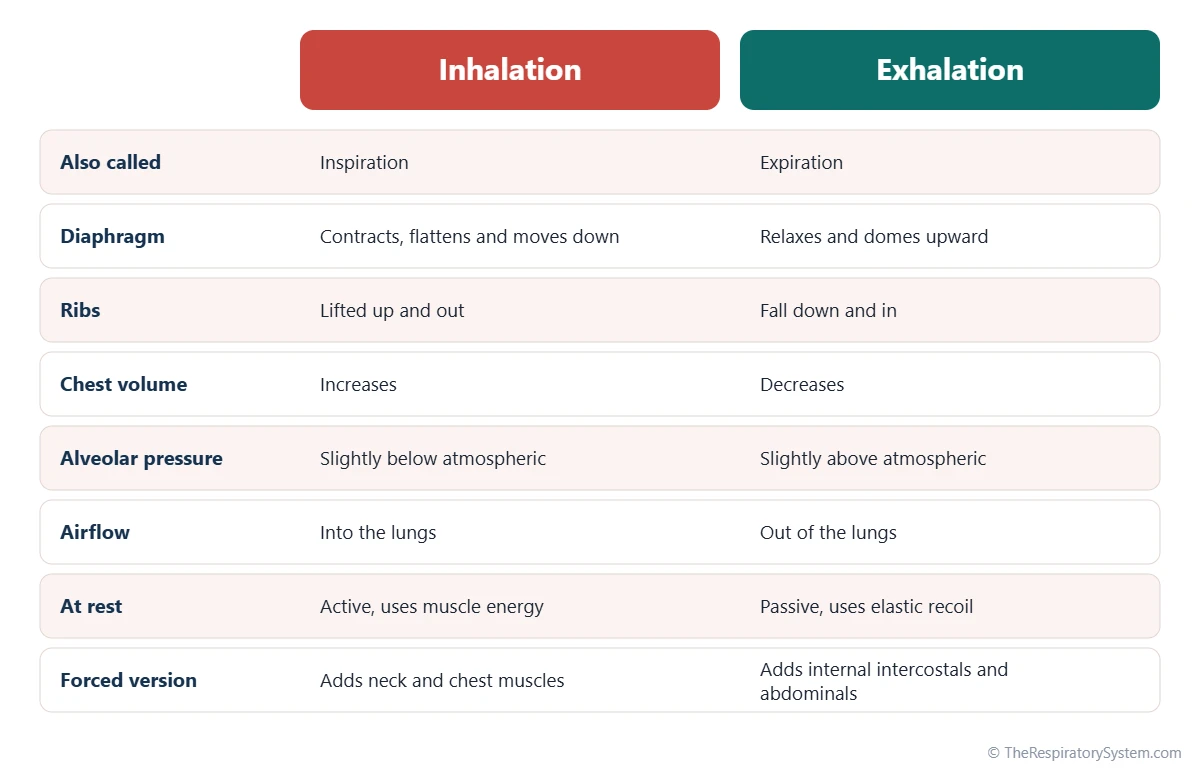
The main difference between inhalation and exhalation is that inhalation is an active process that enlarges the chest and draws air in, while quiet exhalation is a passive process in which the chest shrinks back and pushes air out. The two phases mirror each other in muscle action, chest size, pressure and the direction of airflow.
- Muscles: inhalation needs the diaphragm and external intercostals to contract; quiet exhalation only needs them to relax.
- Chest size: the thoracic cavity grows during inhalation and shrinks during exhalation.
- Pressure: alveolar pressure is slightly below atmospheric during inhalation and slightly above it during exhalation.
- Air: inhaled air is richer in oxygen; exhaled air carries more carbon dioxide and water vapor.
- Energy: inhalation always uses muscle energy; quiet exhalation uses the elastic energy stored during inhalation.
The terms inspiration and expiration mean the same as inhalation and exhalation. They should not be confused with respiration in the cellular sense, the use of oxygen inside cells, a distinction explained on our breathing vs respiration page. The table below follows one full breath, phase by phase.
| Phase | Muscles | Chest and lungs | Pressure in the alveoli | Airflow |
|---|---|---|---|---|
| Start of inhalation | Diaphragm and external intercostals begin to contract | Chest starts to enlarge | Starts to fall below atmospheric | Air begins to flow in |
| Middle of inhalation | Contraction continues | Lungs expand with the chest wall | About 1 mmHg below atmospheric | Fastest inflow |
| End of inhalation | Muscles stop contracting | Chest at its largest for this breath | Equal to atmospheric | Flow stops for a moment |
| Start of exhalation | Inspiratory muscles relax | Lungs and chest wall recoil inward | Rises above atmospheric | Air begins to flow out |
| Middle of exhalation | No active muscle work at rest | Chest volume keeps shrinking | About 1 mmHg above atmospheric | Fastest outflow |
| End of exhalation | Muscles at rest | Lungs back at resting volume | Equal to atmospheric | Pause until the next breath |
| Forced inhalation | Scalenes, sternocleidomastoid and pectoralis minor join in | Chest enlarges much more | Falls well below atmospheric | Much larger, faster inflow |
| Forced exhalation | Internal intercostals and abdominal muscles contract | Chest squeezed below resting size | Rises well above atmospheric | Extra air pushed out |
| Source: Typical values for a healthy adult at rest, our editors | ||||
How Is Quiet Breathing Different From Forced Breathing?
Quiet breathing uses only the diaphragm and external intercostals for inhalation and no muscles for exhalation, while forced breathing recruits extra accessory muscles for both phases to move larger volumes of air faster.
Forced inhalation
When the body needs more air, as during exercise, the diaphragm contracts more strongly and accessory muscles of the neck and chest join in. The scalene muscles and the sternocleidomastoid lift the upper ribs and sternum, and the pectoralis minor can help raise the ribs when the arms are braced. A deep breath in can draw in up to about 3 liters more than a quiet breath in an adult man, a reserve described on our lung volumes and capacities page.
Forced exhalation
Forced exhalation is active. The internal intercostal muscles pull the ribs down and in, and the abdominal muscles, including the rectus abdominis, the external and internal obliques and the transversus abdominis, squeeze the abdomen and push the diaphragm upward. This is what powers a cough, a sneeze, a shout or the hard breath out used in a breathing test such as spirometry.
The full list of breathing muscles, with their attachments and nerves, is on our muscles of respiration page. As breathing speeds up during exercise, both phases shorten, and exhalation can become as active as inhalation.
What Path Does Air Take During Inhalation and Exhalation?
During inhalation air travels from the nose or mouth through the pharynx, larynx, trachea, bronchi and bronchioles to the alveoli, and during exhalation it follows the same route in reverse. The full pathway of air has its own page, so here we focus on what each stage does to the air on the way in and out.
- Nose and nasal cavity: filter, warm and moisten the incoming air; on the way out they recover some of the heat and moisture.
- Pharynx: the shared passage for air and food behind the nose and mouth.
- Larynx: the vocal folds move apart slightly during inhalation, and exhaled air passing between them can produce the voice.
- Trachea and bronchi: cartilage keeps them open while mucus and cilia trap particles.
- Bronchioles: smaller airways whose smooth muscle adjusts their width; they widen slightly during inhalation as the lungs stretch.
- Alveoli: the tiny air sacs where oxygen enters the blood and carbon dioxide leaves it.
Breathing through the nose filters and conditions air better than breathing through the mouth, a comparison covered on our nose vs mouth breathing page.
How Is Inhaled Air Different From Exhaled Air?
Exhaled air contains less oxygen and much more carbon dioxide than inhaled air, and it is warmer and saturated with water vapor. Inhaled air is about 21% oxygen and 0.04% carbon dioxide, while exhaled air is about 16% oxygen and about 4% carbon dioxide.
The change happens in the alveoli, where the blood takes up part of the oxygen and releases carbon dioxide made by the body's cells during cellular respiration. Exhaled air is not pure alveolar air: it is mixed with the dead-space air that sat in the airways and never took part in the exchange, which is why it still holds a good deal of oxygen.
Nitrogen makes up about 78% of the air and passes in and out unchanged, because the body does not use it. The warmth and moisture added on the way in explain why breath forms a cloud on a cold day and fogs a mirror.
| Component | Inhaled air | Exhaled air | Why it changes |
|---|---|---|---|
| Oxygen | About 21% | About 16% | Part of it diffuses into the blood in the alveoli |
| Carbon dioxide | About 0.04% | About 4% | Added from the blood, where cells release it |
| Nitrogen | About 78% | About the same amount | The body does not use it |
| Water vapor | Varies with the weather | Saturated | Added by the moist lining of the airways |
| Temperature | Room or outdoor temperature | Close to body temperature | Warmed by the nasal cavity and airways |
| Dust and microbes | Varies with the air | Mostly removed | Trapped by mucus and swept away by cilia |
| Source: Typical values at sea level, our editors | |||
Common Conditions That Affect Inhalation and Exhalation
Inhalation and exhalation are affected by conditions that narrow the airways, stiffen the lungs, weaken the breathing muscles or let air or fluid into the pleural space. Our respiratory diseases section describes each condition, and anyone with breathing difficulty should see a doctor.
- Asthma: narrowed, inflamed airways make exhalation especially slow and can cause wheezing.
- COPD and emphysema: loss of elastic recoil and airway collapse trap air, so exhalation becomes slow and incomplete.
- Pulmonary fibrosis: scar tissue stiffens the lungs, so each inhalation takes more effort and moves less air.
- Pneumothorax: air in the pleural cavity breaks the link between the lung and chest wall, so the lung cannot expand normally.
- Pleural effusion: extra fluid in the pleural space presses on the lung and limits inhalation.
- Diaphragm weakness or paralysis: damage to the phrenic nerve or muscle disease reduces the main force of inhalation.
Conditions that block the airways tend to make exhalation harder, while those that stiffen the lungs or chest tend to make inhalation harder, the basis of the obstructive vs restrictive lung disease distinction.
Key Facts
- Inhalation (inspiration) is active: the diaphragm and external intercostal muscles contract to enlarge the chest.
- Quiet exhalation (expiration) is passive and is powered by the elastic recoil of the lungs and chest wall.
- Air flows into the lungs when alveolar pressure falls about 1 mmHg below atmospheric pressure, and out when it rises about 1 mmHg above it.
- The diaphragm moves roughly three-quarters of the air in quiet breathing.
- A resting adult breathes about 12 to 20 times a minute and moves about 500 mL of air per breath.
- Forced exhalation uses the internal intercostals and the abdominal muscles, which power coughing and sneezing.
- Exhaled air holds about 16% oxygen and about 4% carbon dioxide, compared with about 21% and 0.04% in inhaled air.
Quick Quiz: Test What You Know About the Inhalation and Exhalation
6 questions. Tap an answer to check it.
Which muscle does most of the work during quiet inhalation?
The diaphragm moves roughly three-quarters of the air in quiet breathing, helped by the external intercostals.
What happens to pressure in the alveoli during inhalation?
The enlarging chest lowers alveolar pressure about 1 mmHg below atmospheric, so air flows in.
Why is quiet exhalation called passive?
When the inspiratory muscles relax, stored elastic energy in the lungs and chest wall returns them to resting size.
Which muscles contract during forced exhalation?
Internal intercostals pull the ribs down, and abdominal muscles push the diaphragm up.
About how much carbon dioxide does exhaled air contain?
Exhaled air holds about 4% carbon dioxide, around a hundred times more than inhaled air.
What is another name for exhalation?
Exhalation is also called expiration; inhalation is inspiration.
Frequently Asked Questions
Is inhalation active or passive?
Inhalation is always active, because air only enters when muscles contract to enlarge the chest. Even in the quietest breath, the diaphragm and external intercostal muscles must do work against the elastic pull of the lungs. Quiet exhalation is the passive phase, using the elastic energy stored during the breath in, and it becomes active only during forced breathing.
What is the difference between inspiration and expiration?
Inspiration is the medical term for breathing in, and expiration is the term for breathing out. In inspiration the chest enlarges, alveolar pressure falls below atmospheric pressure and air flows in. In expiration the chest gets smaller, alveolar pressure rises above atmospheric pressure and air flows out. Together they make up pulmonary ventilation.
Does the diaphragm move up or down when you inhale?
The diaphragm moves down when you inhale. At rest it is dome-shaped and arches up under the lungs. When it contracts, the dome flattens and descends toward the abdomen, making the chest taller, and the belly often moves outward as the abdominal organs are pushed down. When it relaxes during exhalation, it rises back into its dome.
Why do we breathe out carbon dioxide?
Carbon dioxide is a waste product of cellular respiration, the process cells use to release energy from food. The blood carries it to the lungs, where it diffuses into the alveoli and is removed with each breath out. If it were not exhaled it would build up and make the blood more acidic, so its level helps set how fast we breathe.
Can you breathe in and out at the same time?
No, humans cannot inhale and exhale at the same moment, because the same airways carry air in both directions and the lungs fill and empty like bellows. Air flow simply reverses at the end of each phase. Birds are different: a system of air sacs keeps air moving in one direction through their lungs during both inhalation and exhalation.
Why do you exhale longer than you inhale?
At rest, exhalation is passive and relies on the gradual elastic recoil of the lungs, so it tends to take a little longer than inhalation, often about twice as long. Airflow also slows naturally toward the end of the breath out as the lungs approach their resting size. During exercise both phases shorten and exhalation becomes active.
What controls inhalation and exhalation?
Breathing is controlled automatically by groups of neurons in the medulla and pons of the brainstem, which set the rhythm and send signals through the phrenic and intercostal nerves. Chemoreceptors that sense carbon dioxide, pH and oxygen adjust the rate and depth. The cerebral cortex can override this rhythm for a while, which allows talking, singing and holding the breath.
What happens to the lungs during inhalation?
During inhalation the lungs expand passively. They have no muscle of their own to pull air in; instead they follow the chest wall outward because the two pleural layers are held together by a thin film of fluid. As the lungs stretch, the alveoli enlarge and the airways widen slightly, and fresh air mixes with the air already inside.
Keep Exploring


