At a Glance
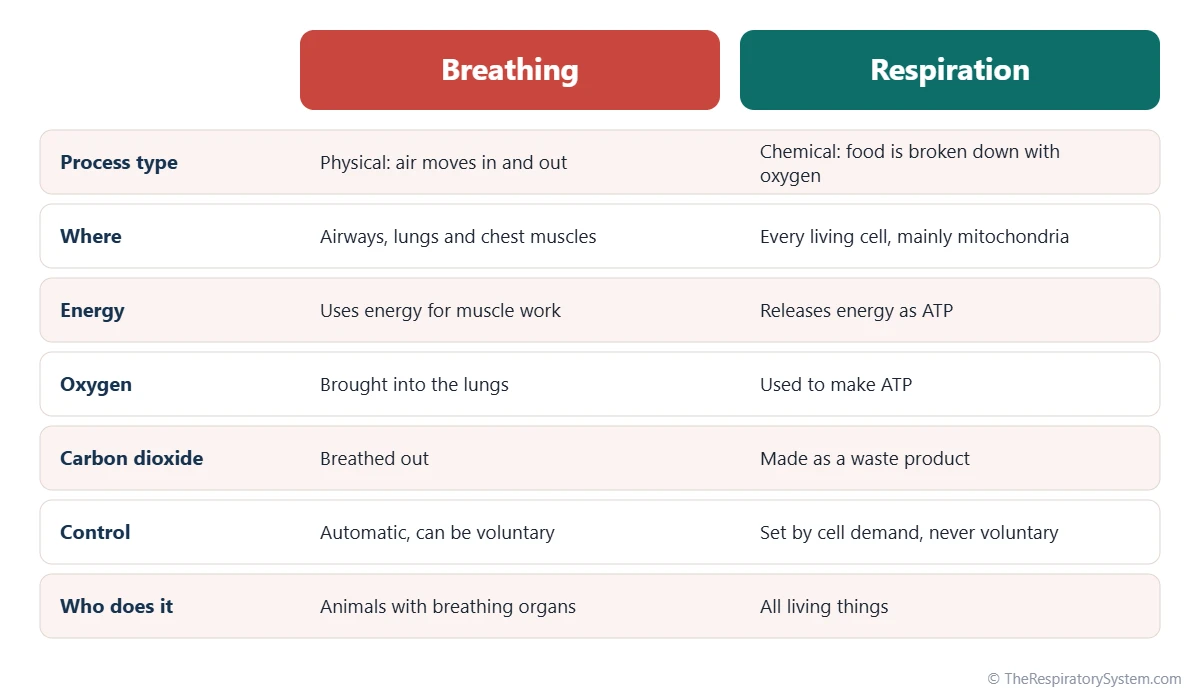
Breathing (pulmonary ventilation) is a mechanical process in which muscles move air into and out of the lungs, about 12 to 20 times a minute in a resting adult. Respiration is a broader term: in physiology it includes gas exchange in the lungs and tissues, and in biology it means cellular respiration, the chemical breakdown of glucose with oxygen in the mitochondria to make ATP. Every living cell respires, but only some organisms breathe.
- Breathing
- Mechanical movement of air into and out of the lungs (pulmonary ventilation)
- Respiration
- Gas exchange plus cellular respiration, the release of energy from food using oxygen
- Where
- Breathing: airways, lungs, chest muscles; cellular respiration: every living cell, mainly mitochondria
- Type of process
- Breathing is physical; cellular respiration is chemical, driven by enzymes
- Energy
- Breathing uses energy; cellular respiration releases it as ATP
- Link
- Breathing supplies the oxygen and removes the carbon dioxide of respiration
On this page
- What Is the Difference Between Breathing and Respiration?
- What Is Breathing?
- What Does Respiration Mean in Biology?
- Are Breathing and Respiration the Same?
- Cellular Respiration vs Breathing
- External Respiration vs Breathing
- How Do Breathing and Respiration Work Together?
- Do All Living Things Breathe and Respire?
- Key Facts
- Quiz
- FAQ
What Is the Difference Between Breathing and Respiration?
The difference between breathing and respiration is that breathing is the physical act of moving air into and out of the lungs, while respiration is the chemical process in which cells use oxygen to break down food and release energy, together with the gas exchange that serves it. Breathing happens in the chest; respiration in its full sense happens in every living cell of the body.
Breathing is done by an organ system: the diaphragm and other muscles of respiration change the size of the chest, and air flows through the airways to the lungs. Respiration is done by cells: enzymes in the cytoplasm and mitochondria break down glucose and fats step by step and store the released energy in ATP. Breathing is one link in a chain, and cellular respiration is the reason the chain exists.
The verdict in one line
Breathing brings oxygen in and takes carbon dioxide out; respiration is the whole process of getting that oxygen to the cells and using it to make energy.
Explained simply
Think of a car. Breathing is like the air intake and the exhaust pipe, pulling clean air in and pushing waste gases out. Respiration is the engine itself, where fuel and oxygen are combined to make the car move. A car with a perfect air intake but no engine goes nowhere, and an engine with a blocked intake soon stalls.
What Is Breathing?
Breathing, called pulmonary ventilation in physiology, is the movement of air into the lungs during inhalation and out of them during exhalation, driven by pressure changes that the breathing muscles create in the chest. It is a mechanical process that moves gas in bulk; no chemical change happens to the air during the trip.
How breathing works
During inhalation, the diaphragm contracts and flattens and the external intercostal muscles lift the ribs, enlarging the chest so that air pressure in the lungs falls below outside pressure and air flows in. At rest, exhalation is mostly passive: the muscles relax, the elastic lungs recoil and air flows out. The full physics is on our mechanics of breathing page.
Breathing by the numbers
A resting adult takes about 12 to 20 breaths a minute, as described on our respiratory rate page, and each quiet breath moves about 500 milliliters of air, the tidal volume. That adds up to about 6 liters of air per minute at rest. Breathing is automatic, set by centers in the brainstem, but unlike the heartbeat it can also be controlled voluntarily for speech, singing or a breath hold.
What Does Respiration Mean in Biology?
In biology, respiration most often means cellular respiration, the set of chemical reactions in which cells break down glucose and other fuels, usually with oxygen, to make ATP, releasing carbon dioxide and water as waste. In physiology and medicine the word is used more widely and covers several different stages.
- Cellular respiration: the energy-releasing chemistry inside every living cell, explained on our cellular respiration page.
- External respiration: gas exchange between the air in the alveoli and the blood in the lung capillaries.
- Internal respiration: gas exchange between the blood and the tissue cells. Both stages are compared on our external and internal respiration page.
- Respiration as breathing: in everyday clinical speech, terms such as respiratory rate and artificial respiration use respiration to mean breathing itself.
This range of meanings is the main source of confusion. When a biology textbook compares breathing and respiration, it almost always means breathing versus cellular respiration, and that is the comparison the rest of this page follows unless stated otherwise.
Are Breathing and Respiration the Same?
No, breathing and respiration are not the same: breathing is a physical process that only moves air, while respiration is a chemical process that releases energy, although the two are closely linked and the words are sometimes used loosely as if they meant the same thing. The confusion comes from everyday language, where respiration often stands in for breathing.
Several facts show that the two are different processes. Breathing can stop for a minute during a breath hold while cellular respiration carries on in every cell, drawing on the oxygen already in the blood and lungs. Red blood cells, which have no mitochondria, keep making ATP by breaking down glucose without oxygen. Plants, fungi and bacteria respire all the time without breathing at all. And during intense exercise, muscle cells can briefly respire without enough oxygen, making lactate, even while breathing is at its highest.
The side-by-side table below sets out the key differences between breathing and cellular respiration.
| Feature | Breathing | Cellular respiration |
|---|---|---|
| Also called | Pulmonary ventilation | Aerobic or anaerobic respiration |
| Type of process | Physical (mechanical) | Chemical (biochemical) |
| Where it happens | Airways, lungs and chest muscles | Every living cell, mainly in the mitochondria |
| What happens | Air moves into and out of the lungs | Glucose and fats are broken down to make ATP |
| Energy | Uses energy (muscle work) | Releases energy, stored as ATP |
| Enzymes | None involved in moving air | Many enzymes control each step |
| Oxygen | Brought into the lungs | Used as the final electron acceptor |
| Carbon dioxide | Breathed out | Produced as a waste product |
| Control | Automatic brainstem rhythm, can be voluntary | Set by each cell's energy demand, never voluntary |
| Who does it | Animals with lungs, gills or air tubes | All living organisms |
| Can it pause? | Yes, for a short breath hold | No, it must run continuously in living cells |
| Source: Standard biology and physiology textbook definitions, our editors | ||
Cellular Respiration vs Breathing
Cellular respiration vs breathing is a contrast between chemistry inside cells and mechanics in the chest: cellular respiration breaks down glucose with oxygen to make ATP, while breathing simply supplies that oxygen and carries away the carbon dioxide the reaction produces. The two are linked by the gases they share.
What cellular respiration does
The overall reaction is often summarized as glucose plus six oxygen molecules giving six carbon dioxide molecules, six water molecules and energy. It runs in stages: glycolysis in the cytoplasm, then the citric acid cycle (Krebs cycle) and the electron transport chain inside the mitochondria, where oxygen accepts the electrons at the very end. Aerobic respiration yields about 30 to 32 ATP per glucose molecule, far more than the 2 ATP from glycolysis alone.
How breathing serves it
Every molecule of oxygen used by the mitochondria first entered the body with a breath, and every molecule of carbon dioxide they release eventually leaves with one. An adult at rest uses about 250 milliliters of oxygen a minute and makes about 200 milliliters of carbon dioxide. When cells work harder, carbon dioxide rises, and chemoreceptors signal the brainstem to breathe more, as explained on our control of breathing page.
External Respiration vs Breathing
External respiration vs breathing is the difference between exchanging gases and moving them: breathing moves air in bulk to the alveoli, while external respiration is the diffusion of oxygen and carbon dioxide between that alveolar air and the blood. One is a pump; the other is a passive exchange across a membrane.
Breathing needs muscle work and changes the pressure in the chest. External respiration needs no energy from the lung cells; it happens because the alveolar air holds more oxygen and less carbon dioxide than the blood arriving from the body. The two can also come apart: air can be breathed in and out of airways that never reach working alveoli, which is why the air in the trachea and bronchi is called dead space. The alveolar side of this stage is covered in full on our gas exchange page.
How Do Breathing and Respiration Work Together?
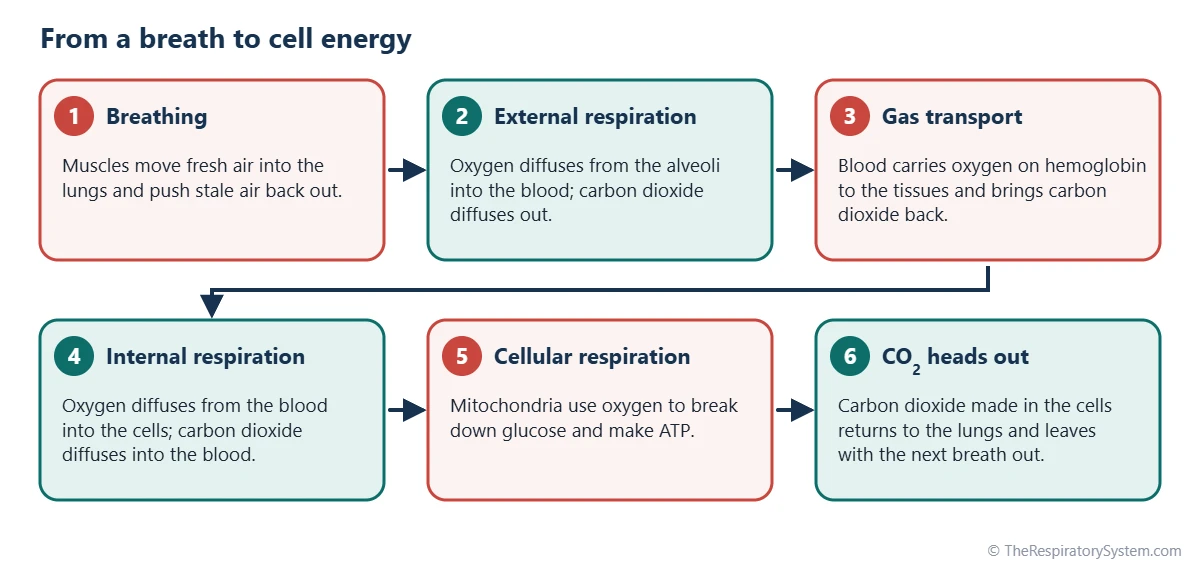
Breathing and respiration work together as one supply chain that runs from the outside air to the mitochondria and back: breathing brings air to the lungs, gas exchange loads the blood, the circulation carries the gases, and the cells use the oxygen and release carbon dioxide. Each stage depends on the one before it.
The respiratory and circulatory systems act as partners in this chain. Oxygen rides mainly on hemoglobin, as explained on our oxygen transport page, and carbon dioxide travels mostly as bicarbonate, as described under carbon dioxide transport. Because carbon dioxide forms an acid in water, breathing also helps hold blood pH steady, so the system serves both energy supply and homeostasis.
What they have in common
- Both involve the same two gases, oxygen and carbon dioxide.
- Both are continuous, running day and night throughout life.
- Both speed up together during exercise, because breathing is adjusted to the rate of cellular respiration.
- Both are essential: stopping either one for more than a few minutes threatens the brain and heart.
Do All Living Things Breathe and Respire?
All living things respire, but not all of them breathe: respiration is universal to living cells, while breathing is a special adaptation of animals that need to move air or water over a gas exchange surface. This is one of the clearest ways to see that the two words describe different processes.
- Plants have no lungs and do not breathe, yet every plant cell respires. Gases diffuse in and out through stomata on the leaves and lenticels on the stems.
- Bacteria and yeast respire, some with oxygen and some without, and exchange gases directly across their surfaces.
- Fish pump water over their gills, which is a form of breathing, as described on our how fish breathe page.
- Insects move air through a network of tubes from openings called spiracles, explained on our insect respiratory system page.
For more animal examples, see our guide to respiration in animals.
Key Facts
- Breathing is the physical movement of air into and out of the lungs; respiration is the chemical release of energy from food in the cells.
- Breathing uses energy for muscle work, while cellular respiration releases energy and stores it as ATP.
- A resting adult breathes about 12 to 20 times a minute, moving about 500 mL of air per breath.
- Aerobic cellular respiration yields about 30 to 32 ATP per glucose molecule and releases carbon dioxide and water.
- In physiology, respiration also includes external respiration in the lungs and internal respiration in the tissues.
- All living things respire, but only some animals breathe; plants exchange gases through stomata without breathing.
- Breathing rate is adjusted to the rate of cellular respiration, mainly through carbon dioxide sensed by chemoreceptors.
Quick Quiz: Test What You Know About the Breathing vs Respiration
6 questions. Tap an answer to check it.
Which statement best describes breathing?
Breathing, or pulmonary ventilation, is a mechanical process that moves air; it does not change the air chemically.
Where does most of aerobic cellular respiration take place?
Glycolysis happens in the cytoplasm, but the citric acid cycle and electron transport chain run inside the mitochondria.
Which of these organisms respires but does not breathe?
Plants respire in every cell but have no breathing movements; gases diffuse through stomata and lenticels.
What is the role of oxygen in cellular respiration?
Oxygen accepts electrons at the end of the electron transport chain and combines with hydrogen ions to form water.
Which process releases energy?
Cellular respiration releases energy from food and stores it as ATP; breathing uses energy and gas exchange is passive.
What is another name for breathing in physiology?
Physiologists call breathing pulmonary ventilation, the bulk movement of air into and out of the lungs.
Frequently Asked Questions
Why do people confuse breathing and respiration?
The confusion comes from language. In everyday and clinical speech, respiration often means breathing, as in respiratory rate, respiratory distress or artificial respiration, and the whole organ system is called the respiratory system. In biology, respiration usually means the chemical process inside cells. Both meanings are in common use, so the context decides which one is intended.
Can respiration happen without breathing?
Yes. Cellular respiration happens in every living cell whether or not the organism breathes. Plants, fungi and bacteria respire without breathing movements, and in humans cells keep respiring during a breath hold by using the oxygen already stored in the lungs and blood. Some cells, such as red blood cells, respire entirely without oxygen, and muscles can respire without enough oxygen for short bursts.
Is breathing a part of respiration?
In physiology, yes. The full process of respiration is often described in four stages: pulmonary ventilation (breathing), external respiration, gas transport in the blood and internal respiration, followed by cellular respiration in the cells. In that sense breathing is the first step. In a strict biology sense, respiration means only the chemical process in cells, and breathing is a separate process that supports it.
What is the difference between aerobic and anaerobic respiration?
Aerobic respiration uses oxygen and breaks glucose down completely to carbon dioxide and water, yielding about 30 to 32 ATP per glucose molecule. Anaerobic respiration happens without oxygen. In human muscle it stops at glycolysis, yields only 2 ATP per glucose and produces lactate. Yeast use a different anaerobic pathway that makes ethanol and carbon dioxide, which is why it is used in brewing and baking.
Which uses more energy, breathing or respiration?
Breathing uses energy, while respiration produces it, so the two are not directly comparable. At rest the breathing muscles use only a small share of the body's total oxygen consumption, often estimated at a few percent, because quiet exhalation is passive. Cellular respiration across all the body's cells is what supplies the ATP for everything, including the breathing muscles themselves.
Do plants breathe at night?
Plants do not breathe in the animal sense, but they respire all the time, day and night, taking in oxygen and releasing carbon dioxide. In daylight photosynthesis usually outpaces respiration, so a leaf takes in more carbon dioxide than it gives off and releases oxygen. At night photosynthesis stops, and only respiration continues, so the plant's net gas exchange reverses.
Is respiration the same as photosynthesis in reverse?
In overall chemistry the two look like mirror images: photosynthesis uses carbon dioxide, water and light energy to make glucose and oxygen, while aerobic respiration uses glucose and oxygen to make carbon dioxide, water and ATP. The actual pathways, enzymes and cell parts are completely different, though. Photosynthesis happens in chloroplasts, and aerobic respiration mainly in mitochondria.
Why do we breathe faster during exercise if breathing is not respiration?
Breathing speeds up because cellular respiration speeds up. Working muscles use more oxygen and produce more carbon dioxide, which raises the acid level of the blood. Chemoreceptors detect the change and the brainstem increases the rate and depth of breathing to bring in more oxygen and remove the extra carbon dioxide. Breathing is the supply line that keeps pace with the demand of respiration.
Keep Exploring


