At a Glance
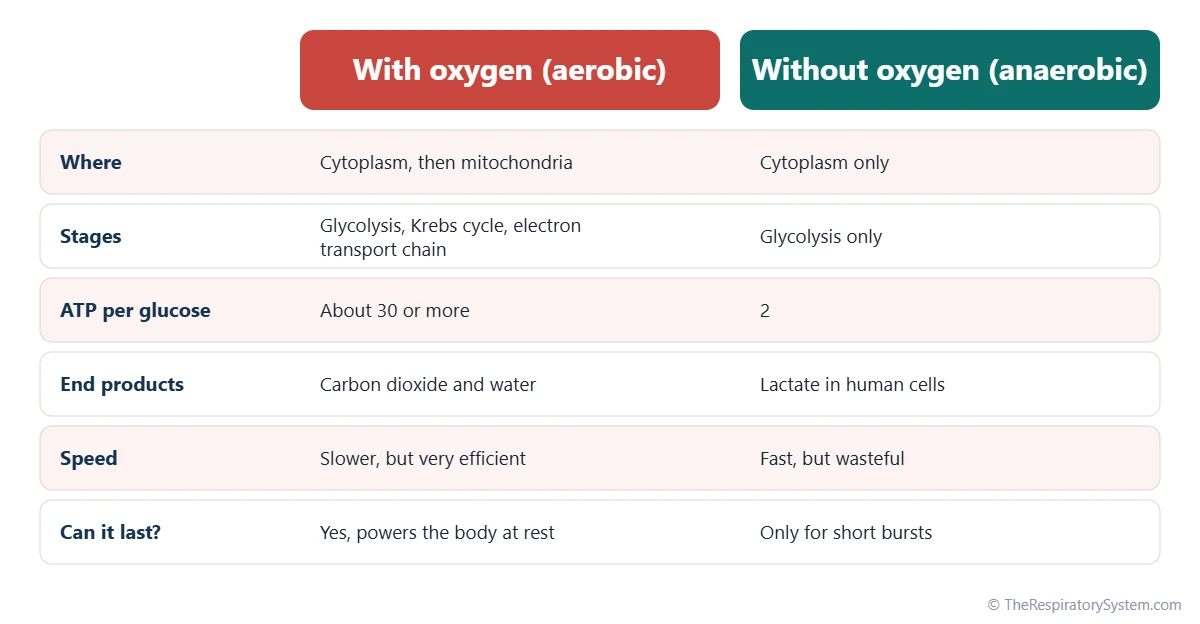
Humans need oxygen because aerobic cellular respiration, the main way our cells make ATP energy, depends on it. Oxygen is the final electron acceptor in the mitochondria and is turned into water, which lets each glucose molecule yield about 30 or more ATP instead of only 2 without oxygen. A resting adult uses roughly 250 milliliters of oxygen every minute.
- Short answer
- Cells use oxygen to release energy (ATP) from glucose and fats
- Where it is used
- Mitochondria, at the end of the electron transport chain
- What oxygen becomes
- Water; the carbon in food leaves as carbon dioxide
- Energy gain
- About 30 or more ATP per glucose with oxygen, 2 without
- How it arrives
- Breathing, gas exchange in the alveoli, then hemoglobin in red blood cells
- Part of
- Cellular respiration and respiratory physiology
On this page
Why Do We Need Oxygen to Live?
We need oxygen to live because almost every cell in the body runs on energy that is released by burning food with oxygen, a process called aerobic cellular respiration. Without a steady supply, cells cannot make enough ATP (adenosine triphosphate), the small molecule that pays for muscle contraction, nerve signals, heartbeats and the building of new proteins.
The body stores almost no oxygen. Apart from what is held in the lungs, bound to hemoglobin in the blood and to myoglobin in muscle, there is no reserve tank, so oxygen has to be delivered nonstop. That is why we breathe every few seconds for our whole lives, while we can go days without water and weeks without food.
Explained simply
Think of food as fuel and oxygen as the thing that lets the fuel burn. A log will not burn in a sealed jar, and your cells cannot fully burn sugar without oxygen. Breathing keeps bringing in fresh oxygen, and breathing out removes the smoke, which in your body is carbon dioxide.
What Does Oxygen Do Inside Your Cells?
Inside your cells, oxygen acts as the final electron acceptor of the electron transport chain in the mitochondria, where it combines with electrons and hydrogen ions to form water. This last step keeps the whole energy-releasing assembly line moving.
Aerobic respiration breaks down glucose in three main stages, summed up by the equation glucose + 6 O2 → 6 CO2 + 6 H2O + energy:
- Glycolysis in the cytoplasm splits glucose into two molecules of pyruvate and makes a small amount of ATP. It does not need oxygen.
- The Krebs cycle (citric acid cycle) in the mitochondrial matrix takes the carbon atoms apart. The carbon leaves as carbon dioxide, and the energy is loaded onto carrier molecules called NADH and FADH2.
- The electron transport chain on the inner mitochondrial membrane passes electrons from those carriers along a chain of proteins. The flow pumps hydrogen ions across the membrane, and their return through ATP synthase makes most of the cell's ATP.
Oxygen sits at the very end of that chain. If it is missing, electrons have nowhere to go, the chain backs up, and the Krebs cycle stops as well. The cell is then left with glycolysis alone, which yields only 2 ATP per glucose instead of about 30 or more.
How Does Oxygen Get From the Air to Your Cells?
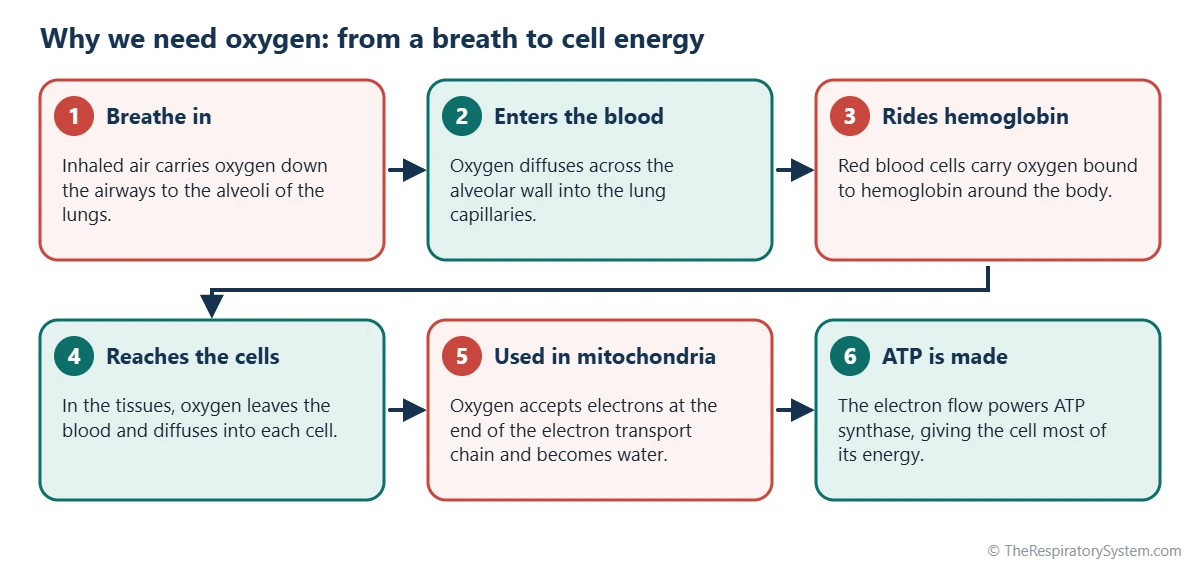
Oxygen reaches your cells in four linked steps: breathing moves air into the lungs, gas exchange loads oxygen into the blood, the circulation carries it around the body, and diffusion delivers it from the capillaries into each cell. Biologists split this into external and internal respiration, and our page on breathing vs respiration explains why breathing and respiration are not the same thing.
- Ventilation: during inhalation the diaphragm pulls air through the airways down to the alveoli.
- External respiration: oxygen diffuses across the thin alveolar wall into the lung capillaries, as described on our gas exchange page.
- Transport: about 98% of that oxygen binds to hemoglobin in red blood cells, as covered under oxygen transport, and the heart pumps it to the tissues.
- Internal respiration: in the tissue capillaries, oxygen leaves the blood and diffuses into cells, where it is used in the mitochondria.
The waste travels the same route in reverse. Carbon dioxide made in the Krebs cycle diffuses into the blood, is carried mostly as bicarbonate, and is breathed out, a journey traced on our carbon dioxide transport page.
| Stage | Where it happens | What happens to oxygen |
|---|---|---|
| Inhalation | Nose, pharynx, larynx, trachea and bronchi | Air rich in oxygen (about 21%) is warmed, moistened and carried to the lungs |
| Mixing in the alveoli | Alveoli | Fresh air mixes with air already in the lungs, so alveolar oxygen is lower than in outside air |
| External respiration | Respiratory membrane of the alveoli | Oxygen diffuses from alveolar air into the blood of the lung capillaries |
| Loading | Red blood cells | About 98% of oxygen binds to hemoglobin; a small amount dissolves in plasma |
| Transport | Pulmonary veins, heart, aorta and arteries | The left side of the heart pumps oxygen-rich blood to every organ |
| Internal respiration | Tissue capillaries | Oxygen unloads from hemoglobin and diffuses into the cells |
| Cellular respiration | Mitochondria | Oxygen accepts electrons at the end of the electron transport chain and becomes water |
| Waste removal | Blood, then lungs | Carbon dioxide made from the food carbon is carried back and breathed out |
| Source: Typical adult physiology, our editors | ||
Why Do We Breathe Oxygen and Not Nitrogen or Other Gases?
We breathe oxygen and not nitrogen because oxygen is the only common gas in air that eagerly accepts electrons, which is exactly the job the electron transport chain needs done. Nitrogen makes up about 78% of air, but its two atoms are held together by a very strong triple bond, so our cells cannot use it and it passes in and out of the lungs unchanged.
Why not carbon dioxide?
Carbon dioxide is the end product of burning food, not a fuel or an electron acceptor. Its carbon is already fully oxidized, so there is no energy left to release from it. Animals breathe it out, while plants take it in for photosynthesis and release oxygen, which is how the two groups balance each other.
Why O2 and not single O atoms?
In the air we breathe, oxygen exists as O2, two atoms bonded together, because single oxygen atoms are so reactive that they combine with something almost at once. Only O2 is stable enough to make up about 21% of the lower atmosphere and to be carried safely by hemoglobin.
Some microbes live without oxygen and use other electron acceptors such as sulfate or nitrate, but they get far less energy per molecule of food. Large, warm-blooded animals with busy brains need the high energy yield that only oxygen provides.
What Happens When Cells Do Not Get Enough Oxygen?
When cells do not get enough oxygen, they fall back on anaerobic glycolysis, which makes ATP quickly but in small amounts and produces lactate, and if the shortage continues the cells stop working and begin to die. A low oxygen level in the tissues is called hypoxia.
Muscles can run on anaerobic energy for short bursts, such as a sprint, which is one reason they feel tired and burn during hard effort. The brain cannot: it makes up only about 2% of body weight but uses about 20% of the body's oxygen at rest, and it has almost no energy store. Consciousness is lost within seconds of a complete stop in blood flow to the brain, and brain cells start to be damaged after a few minutes without oxygen.
The heart muscle is similarly dependent on a constant oxygen supply, which is why a blocked coronary artery is so serious. Anyone with breathing trouble, bluish lips or confusion needs prompt medical care.
Why Do We Breathe Faster When We Exercise?
We breathe faster when we exercise because working muscles burn more fuel, so they use more oxygen and make more carbon dioxide, and the brain raises the rate and depth of breathing to match. The main signal is the rise in carbon dioxide and acid in the blood, detected by the respiratory chemoreceptors.
The breathing centers in the brainstem then send stronger, faster signals to the diaphragm and the muscles between the ribs, as explained under control of breathing. At the same time, the heart beats faster to move more oxygen-loaded blood. The full set of short-term and training changes is covered on our page about exercise and the respiratory system.
Key Facts
- We need oxygen because aerobic cellular respiration uses it to release energy from glucose and fats as ATP.
- Oxygen is the final electron acceptor of the electron transport chain in the mitochondria and is turned into water.
- With oxygen, one glucose molecule yields about 30 or more ATP; without it, glycolysis alone yields only 2.
- The carbon dioxide we breathe out comes from the carbon atoms of the food our cells burn.
- Nitrogen makes up about 78% of air but cannot be used by our cells, so it is breathed in and out unchanged.
- The brain is about 2% of body weight but uses about 20% of the body's oxygen at rest.
- Oxygen reaches the cells through gas exchange in the alveoli and transport by hemoglobin.
Frequently Asked Questions
Why do we breathe?
We breathe to bring oxygen into the body and to get rid of carbon dioxide. Cells use oxygen to release energy from food and make carbon dioxide as waste. Breathing keeps the air in the alveoli fresh so that oxygen can keep diffusing into the blood and carbon dioxide can keep diffusing out. The urge to breathe is driven mainly by the carbon dioxide level in the blood.
Why do we need oxygen to survive but plants make it?
Plants make oxygen during photosynthesis, using light energy to split water and build sugar from carbon dioxide. But plant cells also need oxygen for their own cellular respiration, day and night, just like animal cells. In daylight a leaf releases more oxygen than it uses, so there is a net gain. Animals depend on that surplus, while plants use the carbon dioxide animals breathe out.
How much oxygen does the human body use?
A resting adult uses roughly 250 milliliters of oxygen per minute and produces about 200 milliliters of carbon dioxide in the same time. During hard exercise, oxygen use can rise many times above the resting level, mainly because of the working muscles. Body size, age, fitness, temperature and digestion all change the exact amount from person to person.
Do we breathe out oxygen?
Yes. Exhaled air still contains roughly 16% oxygen, compared with about 21% in fresh air, because only part of the oxygen in each breath is taken up by the blood. Exhaled air also holds about 4% carbon dioxide, about 100 times more than inhaled air.
Can the body store oxygen?
Only a little. Oxygen is held in the air in the lungs, bound to hemoglobin in the blood and to myoglobin in muscle, but together these stores last only a few minutes at rest. That is why breathing cannot pause for long. Diving mammals such as seals and whales carry much more oxygen in their blood and muscles, which lets them stay underwater far longer.
Is too much oxygen harmful?
Yes, breathing very high oxygen concentrations for long periods can harm the lungs and other tissues. Extra oxygen raises the production of reactive oxygen species, unstable molecules that can damage cell membranes, proteins and DNA. At normal air pressure, ordinary air poses no such risk. For this reason, medical oxygen is always given in measured amounts.
What is the difference between breathing and cellular respiration?
Breathing is the physical movement of air in and out of the lungs by the diaphragm and rib muscles. Cellular respiration is the chemical process inside cells that uses oxygen to release energy from food and makes carbon dioxide. Breathing supplies the oxygen and removes the carbon dioxide, so it serves cellular respiration, but the two happen in different places and work in different ways.
Keep Exploring


