At a Glance
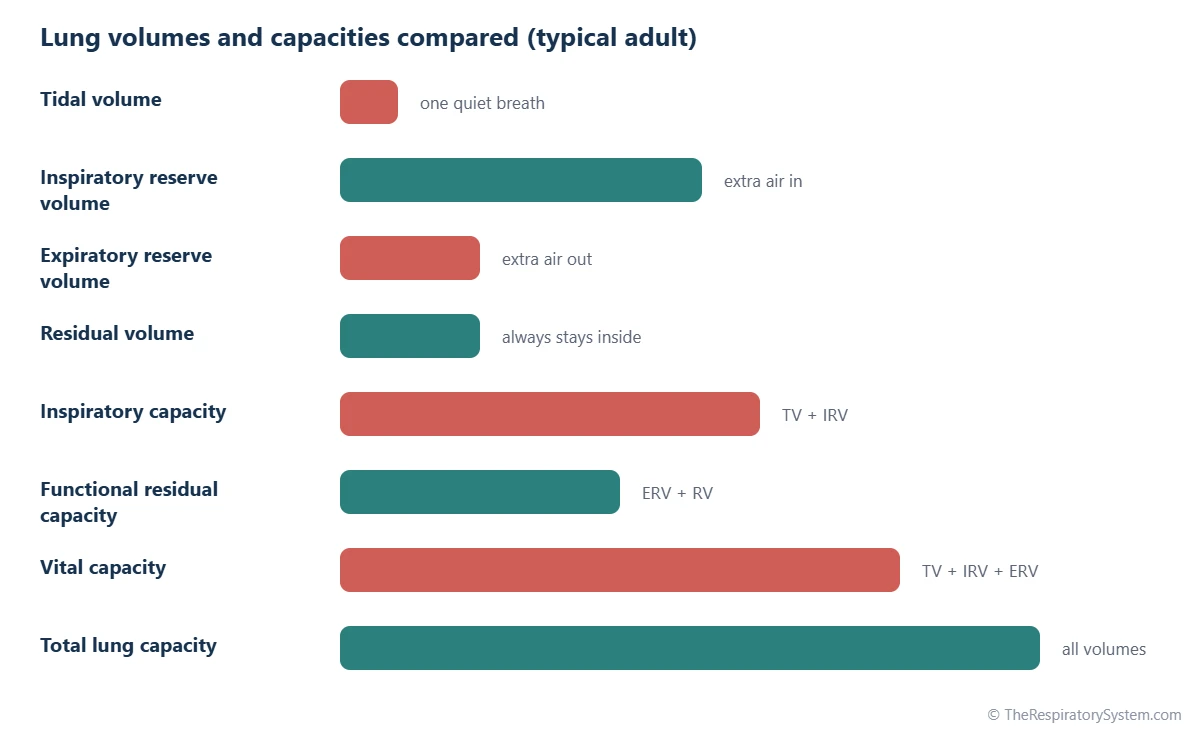
The four lung volumes are tidal volume (about 500 mL), inspiratory reserve volume (about 3,100 mL), expiratory reserve volume (about 1,200 mL) and residual volume (about 1,200 mL) in a typical adult man. The four lung capacities combine them: inspiratory capacity (about 3,600 mL), functional residual capacity (about 2,400 mL), vital capacity (about 4,800 mL) and total lung capacity (about 6,000 mL). Values are roughly 20 to 30% lower in women.
- Lung volumes
- Tidal, inspiratory reserve, expiratory reserve and residual volume
- Lung capacities
- Inspiratory, functional residual, vital and total lung capacity
- Total lung capacity
- About 6 liters in an adult man, about 4.2 liters in an adult woman
- Measured by
- Spirometry, plus gas dilution or body plethysmography for residual volume
- Minute ventilation
- About 6 liters of air per minute at rest
- Part of
- Pulmonary function testing and the mechanics of ventilation
On this page
- What Are Lung Volumes and Capacities?
- What Are the Four Lung Volumes?
- What Are the Four Lung Capacities?
- Lung Volumes and Capacities Diagram: How Do They Fit Together?
- Why Do the Lungs Never Empty? Residual Volume and FRC
- What Is Minute Ventilation?
- How Are Lung Volumes Measured?
- What Affects Lung Volumes and Capacities?
- Common Conditions That Change Lung Volumes
- Key Facts
- Quiz
- FAQ
What Are Lung Volumes and Capacities?
Lung volumes are the four separate, non-overlapping amounts of air that make up the total air in the lungs, and lung capacities are combinations of two or more of those volumes. Together they describe how much air moves in a quiet breath, how much extra can be drawn in or pushed out, and how much always stays behind.
Lung volumes and capacities definitions
A volume is a single slice of the lungs' air that cannot be divided further in a standard breathing test. A capacity is a sum, so it always includes at least two volumes. For example, vital capacity is the tidal volume plus both reserve volumes, and total lung capacity is all four volumes added together.
Why they matter
These measurements show how well the lungs fill and empty, and they change in typical ways with age, body size and lung disease. Doctors read them as part of pulmonary function tests, and physiologists use them to explain how breathing, gas exchange and the work of the breathing muscles fit together.
Lung volumes and capacities explained simply
Imagine the lungs as a large jug that is never completely empty. In a normal breath you pour a small cup of air in and out at the middle of the jug. You can pour in much more if you try, or squeeze out extra, but a layer of air always stays at the bottom. The volumes are the separate layers, and the capacities are what you get when you add layers together.
What Are the Four Lung Volumes?
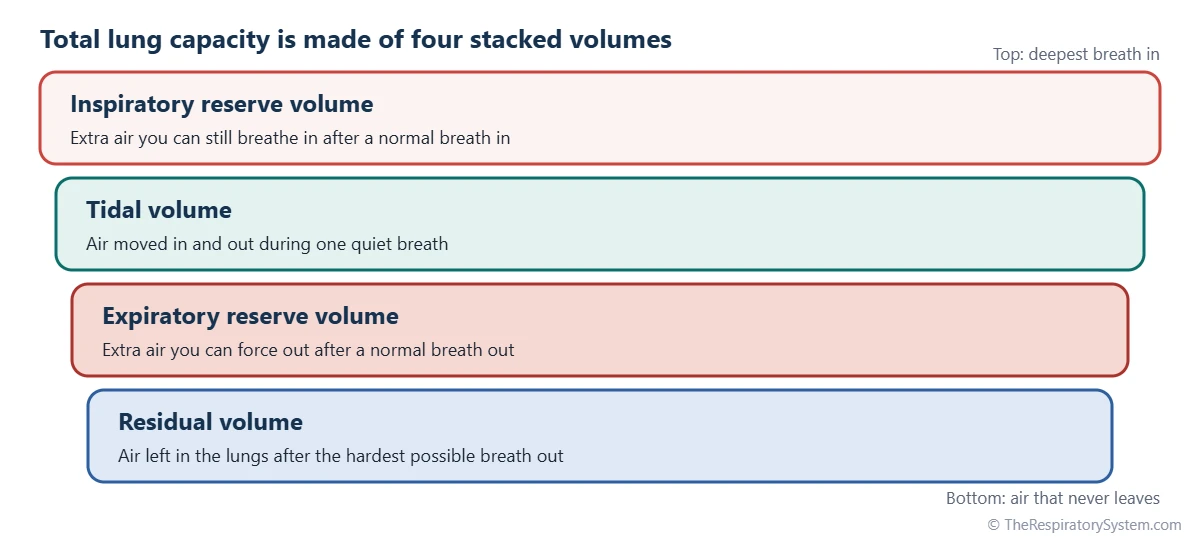
The four lung volumes are tidal volume, inspiratory reserve volume, expiratory reserve volume and residual volume, and added together they equal total lung capacity.
Tidal volume (TV)
Tidal volume is the amount of air moved in or out during one normal, quiet breath, about 500 mL in a resting adult. About 150 mL of it fills the airways and never reaches the alveoli. Our tidal volume page covers how it is measured and how it changes with body size and activity.
What is inspiratory reserve volume?
Inspiratory reserve volume (IRV) is the extra air that can be breathed in with maximum effort after a normal, quiet inhalation, about 3,100 mL in an adult man and about 1,900 mL in an adult woman. It is the largest of the four volumes and the main reserve the body draws on during exercise, when deeper breaths eat into it.
Expiratory reserve volume (ERV)
Expiratory reserve volume is the extra air that can be forced out after a normal, quiet exhalation, about 1,200 mL in an adult man and about 700 mL in an adult woman. Pushing it out takes active work by the abdominal muscles and the internal intercostals, as described on the inhalation and exhalation page.
Residual volume (RV)
Residual volume is the air that remains in the lungs after the most forceful possible exhalation, about 1,200 mL in an adult man and about 1,100 mL in an adult woman. It cannot be breathed out, so it cannot be measured with a simple spirometer.
What Are the Four Lung Capacities?
The four lung capacities are inspiratory capacity, functional residual capacity, vital capacity and total lung capacity, each made by adding two or more lung volumes.
- Inspiratory capacity (IC) = TV + IRV. The most air that can be breathed in starting from the end of a quiet exhalation, about 3,600 mL in an adult man.
- Functional residual capacity (FRC) = ERV + RV. The air left in the lungs at the end of a quiet exhalation, about 2,400 mL in an adult man. It is the resting volume of the lungs.
- Vital capacity (VC) = TV + IRV + ERV. The most air that can be breathed out after the deepest possible breath in, about 4,800 mL in an adult man. The vital capacity page explains what affects it.
- Total lung capacity (TLC) = TV + IRV + ERV + RV. All the air the lungs hold after the deepest possible breath in, about 6,000 mL in an adult man and about 4,200 mL in an adult woman.
A useful rule is that any capacity containing the residual volume, which means FRC and TLC, cannot be measured by spirometry alone. The table below gathers all eight values in one place.
| Measurement | Type | Definition | Adult man (typical) | Adult woman (typical) |
|---|---|---|---|---|
| Tidal volume (TV) | Volume | Air moved in or out in one quiet breath | About 500 mL | About 500 mL |
| Inspiratory reserve volume (IRV) | Volume | Extra air breathed in with effort after a quiet breath in | About 3,100 mL | About 1,900 mL |
| Expiratory reserve volume (ERV) | Volume | Extra air forced out after a quiet breath out | About 1,200 mL | About 700 mL |
| Residual volume (RV) | Volume | Air left after the most forceful breath out | About 1,200 mL | About 1,100 mL |
| Inspiratory capacity (IC) | Capacity: TV + IRV | Most air that can be breathed in from the end of a quiet breath out | About 3,600 mL | About 2,400 mL |
| Functional residual capacity (FRC) | Capacity: ERV + RV | Air left in the lungs at the end of a quiet breath out | About 2,400 mL | About 1,800 mL |
| Vital capacity (VC) | Capacity: TV + IRV + ERV | Most air that can be breathed out after the deepest breath in | About 4,800 mL | About 3,100 mL |
| Total lung capacity (TLC) | Capacity: all four volumes | All the air in the lungs after the deepest breath in | About 6,000 mL | About 4,200 mL |
| Source: Typical values for healthy young adults, our editors; individual values vary with height, age and sex | ||||
Lung Volumes and Capacities Diagram: How Do They Fit Together?
On a lung volumes diagram or graph, the volumes are stacked on top of one another like layers, from residual volume at the bottom to inspiratory reserve volume at the top, and each capacity is drawn as a bracket that spans the layers it contains.
Reading a lung volumes graph
The standard lung volumes chart is a spirogram, a trace of volume over time recorded while a person breathes into a spirometer. Quiet breathing appears as small, regular waves; their height is the tidal volume. A maximal breath in raises the trace to its top, which marks total lung capacity, and a maximal breath out drops it to the lowest point the spirometer can record, which sits one residual volume above the true bottom of the lungs. Our spirometry page explains how the trace is recorded and how the timed measurements are read.
Three useful landmarks
- End of a quiet breath out: the lungs are at functional residual capacity, the resting point of the whole system.
- End of a maximal breath in: the lungs are at total lung capacity.
- End of a maximal breath out: only the residual volume is left.
Every volume and capacity is the vertical distance between two of these landmarks or the top and bottom of a quiet breath. Once the landmarks are clear, the eight names become easy to place on any chart.
Why Do the Lungs Never Empty? Residual Volume and FRC
The lungs never empty completely because the chest wall cannot be squeezed small enough to push out all the air, and the smallest airways close before the alveoli can collapse, trapping the residual volume inside.
What residual volume does
Residual volume keeps the alveoli partly open between breaths, so they do not have to be reopened from a collapsed state each time, which would take far more effort. It also means air is always in contact with the blood, so gas exchange continues between breaths rather than stopping each time we breathe out. Residual volume rises with age, as the lungs lose some elastic recoil and small airways close earlier.
Functional residual capacity: the lungs at rest
Functional residual capacity is where the lungs settle when all the breathing muscles are relaxed. At that point the inward elastic pull of the lungs is exactly balanced by the outward spring of the chest wall, and the slightly negative pressure in the pleural cavity holds the two together. Each quiet breath adds only about 350 mL of fresh air to the roughly 2,400 mL already in the lungs, so the alveolar air changes only gradually and its oxygen and carbon dioxide levels stay steady.
How posture changes FRC
Functional residual capacity is smaller lying down than standing, because the abdominal organs push the diaphragm up into the chest. The same effect makes it smaller in pregnancy and in people with obesity.
What Is Minute Ventilation?
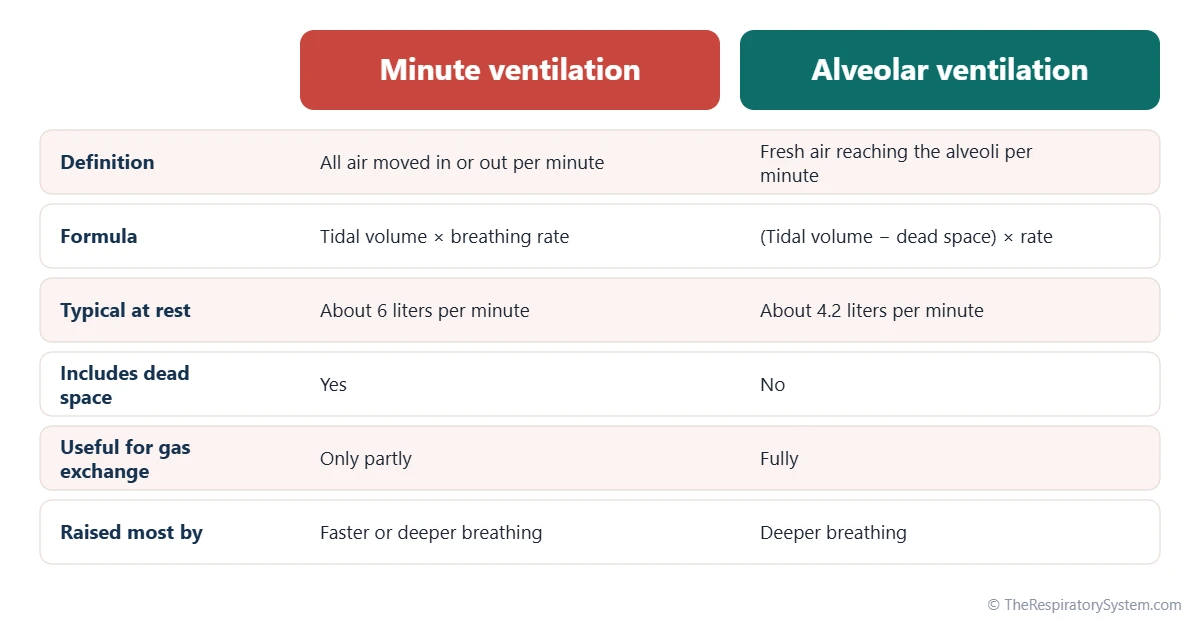
Minute ventilation is the total volume of air breathed in or out in one minute, calculated as tidal volume multiplied by the breathing rate, and it is about 6 liters per minute in a resting adult (500 mL × 12 breaths per minute).
Minute ventilation vs alveolar ventilation
Not all of that air reaches the alveoli. About 150 mL of each breath stays in the conducting airways, the anatomical dead space. Alveolar ventilation counts only the fresh air that reaches the gas exchange surfaces: (500 mL − 150 mL) × 12 breaths per minute, or about 4.2 liters per minute at rest.
Why deep breaths beat fast, shallow ones
Because the dead space is the same size in every breath, the depth of breathing matters more than its speed. Fast, shallow breathing can keep minute ventilation the same while sharply cutting alveolar ventilation, since a larger share of each small breath only fills the airways. Deeper breathing does the opposite, which is why the body raises tidal volume first when it needs more air.
Changes with activity
During hard exercise, both tidal volume and respiratory rate rise, and minute ventilation can increase more than tenfold over the resting value. How breathing adapts to effort and training is covered on our exercise and the respiratory system page.
How Are Lung Volumes Measured?
Lung volumes are measured with spirometry for the volumes a person can breathe in and out, and with gas dilution or body plethysmography for the residual volume and the capacities that include it.
- Spirometry: the person breathes through a mouthpiece into a device that records the volume moved. It measures tidal volume, both reserve volumes, inspiratory capacity and vital capacity, along with timed values used to judge airflow.
- Helium dilution: the person breathes from a closed container holding a known amount of helium, which does not cross into the blood. The dilution of the helium reveals how much air was already in the lungs, giving functional residual capacity.
- Nitrogen washout: the person breathes pure oxygen, and the nitrogen washed out of the lungs is collected and measured to calculate functional residual capacity.
- Body plethysmography: the person sits in a sealed booth, often called a body box, and pants against a closed shutter. Pressure changes in the booth and at the mouth, interpreted with Boyle's law, give the total gas volume in the chest.
Once functional residual capacity is known, residual volume is found by subtracting the expiratory reserve volume, and total lung capacity by adding the inspiratory capacity. Results are compared with predicted values for a person of the same age, sex and height, so a single number has little meaning on its own.
What Affects Lung Volumes and Capacities?
Lung volumes and capacities depend mainly on body size, sex and age, and also on posture, fitness, the altitude where a person grew up and the health of the lungs and chest wall.
- Height and body size: taller people have larger chests and larger lung volumes; height is the main factor in predicted values.
- Sex: on average, adult women have lung volumes about 20 to 30% smaller than men of the same age, partly because of smaller chest size.
- Age: vital capacity falls gradually in later adulthood, while residual volume rises; total lung capacity changes little.
- Posture: functional residual capacity and vital capacity are larger standing or sitting upright than lying flat.
- Altitude: people who grow up at high altitude tend to have larger lung volumes, an adaptation discussed on our breathing at high altitude page.
- Training: some athletes, such as swimmers, have larger than predicted vital capacities, although training changes lung size far less than it changes muscle strength and endurance.
The lungs themselves do not stretch much with practice; most differences between healthy people come from the size and shape of the chest and the strength of the muscles of respiration.
Common Conditions That Change Lung Volumes
Lung diseases change lung volumes in two typical patterns: obstructive diseases trap air and raise residual volume, while restrictive diseases shrink the lungs and lower most volumes. Our respiratory diseases section covers each condition, and anyone with breathing problems should see a doctor.
- Obstructive pattern: in COPD, emphysema and poorly controlled asthma, narrowed or floppy airways close early during exhalation. Air is trapped, so residual volume and functional residual capacity rise, total lung capacity may increase, and vital capacity often falls.
- Restrictive pattern: in pulmonary fibrosis, the lungs become stiff and cannot fill fully, so total lung capacity, vital capacity and functional residual capacity all decrease.
- Chest wall and muscle problems: severe curvature of the spine, weakness of the breathing muscles or marked obesity limit how far the chest can expand, giving a restrictive pattern with healthy lung tissue.
- Pleural disease: a large pleural effusion or a pneumothorax takes up space in the chest and reduces the volume the lung can occupy.
The full comparison of the two patterns is on our obstructive vs restrictive lung disease page.
Key Facts
- There are four lung volumes (tidal, inspiratory reserve, expiratory reserve and residual) and four lung capacities, each the sum of two or more volumes.
- Total lung capacity is about 6 liters in a typical adult man and about 4.2 liters in a typical adult woman.
- Inspiratory reserve volume, about 3,100 mL in an adult man, is the largest lung volume and the main reserve used in exercise.
- Residual volume, about 1,200 mL, can never be breathed out, so it and the capacities that include it cannot be measured by spirometry alone.
- Functional residual capacity is the resting volume of the lungs, where the inward recoil of the lungs balances the outward spring of the chest wall.
- Minute ventilation is tidal volume times breathing rate, about 6 liters per minute at rest, while alveolar ventilation is about 4.2 liters per minute.
- Obstructive diseases raise residual volume by trapping air, while restrictive diseases lower total lung capacity.
Quick Quiz: Test What You Know About the Lung Volumes and Capacities
6 questions. Tap an answer to check it.
What is inspiratory reserve volume?
Inspiratory reserve volume is the additional air that can be inhaled with maximum effort after a quiet inhalation.
Which lung volume cannot be measured with a simple spirometer?
Residual volume never leaves the lungs, so it needs gas dilution or body plethysmography to measure.
Functional residual capacity is the sum of which two volumes?
FRC = ERV + RV, the air left in the lungs at the end of a quiet breath out.
What is the typical total lung capacity of an adult man?
Total lung capacity, the sum of all four volumes, is about 6,000 mL in a typical adult man.
A person breathes 12 times a minute with a tidal volume of 500 mL. What is the minute ventilation?
Minute ventilation = 500 mL × 12 = 6,000 mL, or about 6 liters per minute.
Which capacity includes tidal volume, inspiratory reserve volume and expiratory reserve volume?
Vital capacity is TV + IRV + ERV; adding residual volume gives total lung capacity.
Frequently Asked Questions
What is the difference between a lung volume and a lung capacity?
A lung volume is a single, basic slice of the air in the lungs that does not overlap with any other, such as tidal volume or residual volume. A lung capacity is the sum of two or more volumes, such as vital capacity, which adds the tidal volume and both reserve volumes. There are four of each, and the four volumes together make up total lung capacity.
What is a normal lung capacity?
In a typical healthy young adult man, total lung capacity is about 6 liters, and in a typical adult woman about 4.2 liters. Normal values vary widely with height, age, sex and ancestry, so test results are judged against predicted values for a person of the same build and age rather than against a single fixed number.
Why is residual volume important?
Residual volume keeps the alveoli from collapsing completely at the end of each breath out, so the lungs do not need extra effort to reopen them. It also lets gas exchange continue between breaths, because there is always air in contact with the blood. An abnormally high residual volume is a sign of air trapping, as seen in obstructive lung disease.
Can you increase your lung capacity?
Total lung capacity is set mainly by body size and the shape of the chest, and in adults it changes little with practice. Regular aerobic activity strengthens the breathing muscles and can make a slightly larger share of that capacity usable, but it does not grow new lung tissue. Most of the benefit of training comes from the heart and muscles using oxygen more efficiently.
Why do lung volumes decrease when lying down?
When a person lies flat, the abdominal organs press up against the diaphragm instead of hanging below it. This pushes the diaphragm higher into the chest and reduces the space the lungs can occupy at rest, so functional residual capacity falls noticeably. Vital capacity also drops a little, and blood shifts into the chest, taking up some space.
What is the difference between vital capacity and total lung capacity?
Vital capacity is the most air a person can breathe out after the deepest possible breath in, about 4.8 liters in an adult man. Total lung capacity is all the air in the lungs at that point, about 6 liters, including the residual volume that can never be breathed out. The difference between them is therefore the residual volume.
What is dead space, and how does it relate to lung volumes?
Dead space is the part of each breath that does not take part in gas exchange, mainly the air filling the nose, pharynx, trachea and bronchi. In an adult it is about 150 milliliters, close to one milliliter per pound of ideal body weight. It is subtracted from the tidal volume to find how much fresh air actually reaches the alveoli with each breath.
Do lung volumes change with age?
Yes. The lungs grow through childhood and adolescence and reach their largest volumes in early adulthood. Later in life the lung tissue slowly loses elastic recoil and the chest wall becomes stiffer, so vital capacity gradually falls while residual volume rises. Total lung capacity stays roughly the same, because the air that can no longer be breathed out stays behind as residual volume.
Keep Exploring


