At a Glance
External respiration is gas exchange in the lungs: oxygen diffuses from alveolar air (PO2 about 100 mmHg) into blood arriving with a PO2 of about 40 mmHg, and carbon dioxide diffuses out. Internal respiration is gas exchange in the tissues: oxygen diffuses from arterial blood (PO2 about 95 mmHg) into cells at about 40 mmHg or lower, and carbon dioxide diffuses into the blood. Both are passive diffusion; only the direction of the gradients differs.
- External respiration
- Alveolar air and pulmonary capillary blood: oxygen into the blood, carbon dioxide out
- Internal respiration
- Systemic capillary blood and tissue cells: oxygen into the cells, carbon dioxide into the blood
- How
- Passive diffusion down partial pressure gradients in both places
- Linked by
- The circulation, which carries both gases between the lungs and the tissues
- Not the same as
- Cellular respiration, the chemical reactions inside mitochondria that use the oxygen
- Part of
- The four processes of respiration: ventilation, external respiration, transport, internal respiration
On this page
- What Is the Difference Between External and Internal Respiration?
- What Is External Respiration?
- What Are the Steps of External Respiration?
- What Is Internal Respiration?
- External Respiration vs Internal Respiration: Side by Side
- What Do External and Internal Respiration Have in Common?
- How Is Internal Respiration Related to Cellular Respiration?
- How Do External and Internal Respiration Work Together?
- Common Conditions That Affect External and Internal Respiration
- Key Facts
- Quiz
- FAQ
What Is the Difference Between External and Internal Respiration?
The difference between external and internal respiration is where the gas exchange happens and which way the gases move: external respiration takes place in the lungs and loads the blood with oxygen, while internal respiration takes place in the tissues and unloads that oxygen into the cells. Carbon dioxide does the reverse, entering the blood in the tissues and leaving it in the lungs.
External respiration definition
External respiration, also called pulmonary gas exchange, is the diffusion of oxygen from the air in the alveoli into the pulmonary capillary blood and of carbon dioxide from that blood into the alveoli. It is called external because it is the exchange between the body and the outside world, with the alveolar air standing in for the outside air. Our page on gas exchange in the lungs covers the alveolar side of this stage in full detail.
Internal respiration definition
Internal respiration, also called systemic or tissue gas exchange, is the diffusion of oxygen from the blood in the systemic capillaries into the tissue cells and of carbon dioxide from the cells into the blood. It happens in every organ that has a blood supply, from the brain and heart muscle to the skin and bones.
The verdict in one line
External respiration refills the blood with oxygen in the lungs, and internal respiration hands that oxygen to the cells everywhere else, so one cannot be useful without the other.
Explained simply
Picture a delivery truck. At the warehouse, which is the lungs, it loads fresh boxes of oxygen and drops off a pile of carbon dioxide trash. At each house, which is a body cell, it drops off oxygen boxes and picks up new trash. External respiration is the warehouse stop, and internal respiration is every house stop along the route.
What Is External Respiration?
External respiration is the stage in which blood passing through the lungs picks up oxygen from alveolar air and releases carbon dioxide into it, turning oxygen-poor blood into oxygen-rich blood in less than a second. It depends on three things working at once: fresh air delivered by breathing, blood delivered by the right side of the heart, and a thin, moist barrier between them.
Where it happens
External respiration takes place across the respiratory membrane, the barrier formed by the alveolar wall, a fused basement membrane and the capillary wall, usually only about 0.5 micrometer thick. The blood comes from the right ventricle through the pulmonary arteries and leaves through the pulmonary veins toward the left atrium, as traced on our pulmonary circulation page.
The partial pressures at the lung
Alveolar air has an oxygen partial pressure (PO2) of about 100 mmHg and a carbon dioxide partial pressure (PCO2) of about 40 mmHg. The blood that arrives from the body has a PO2 of about 40 mmHg and a PCO2 of about 45 mmHg. Oxygen therefore moves into the blood down a gradient of about 60 mmHg, while carbon dioxide moves out down a gradient of only about 5 mmHg, which is enough because carbon dioxide dissolves about 20 times more readily than oxygen.
How quickly the blood is loaded
At rest a red blood cell spends about 0.75 second in a lung capillary, yet its oxygen level usually matches the alveolar air within roughly the first third of that time. The spare time is a safety margin that keeps arterial oxygen almost unchanged when blood speeds up during exercise. Matching air to blood flow matters too, a balance described by the ventilation-perfusion ratio.
What Are the Steps of External Respiration?
The steps of external respiration are fresh air reaching the alveoli, oxygen diffusing into the blood, carbon dioxide diffusing out of the blood, and the reloaded blood being carried away while the waste air is breathed out. These four steps repeat with every breath and every heartbeat.
- Ventilation refreshes the alveolar air. During inhalation, new air mixes with the air already in the alveoli and keeps its oxygen pressure high and its carbon dioxide pressure low.
- Oxygen diffuses into the blood. Oxygen dissolves in the fluid lining the alveolus, crosses the respiratory membrane and the plasma, and binds to hemoglobin inside red blood cells.
- Carbon dioxide diffuses out of the blood. Bicarbonate in the plasma is turned back into carbon dioxide gas inside red blood cells, and the gas crosses the membrane into the alveolus.
- Blood leaves and air is exhaled. Oxygen-rich blood flows to the left heart, and exhalation removes the carbon dioxide so the gradients are ready for the next cycle.
The four processes of respiration
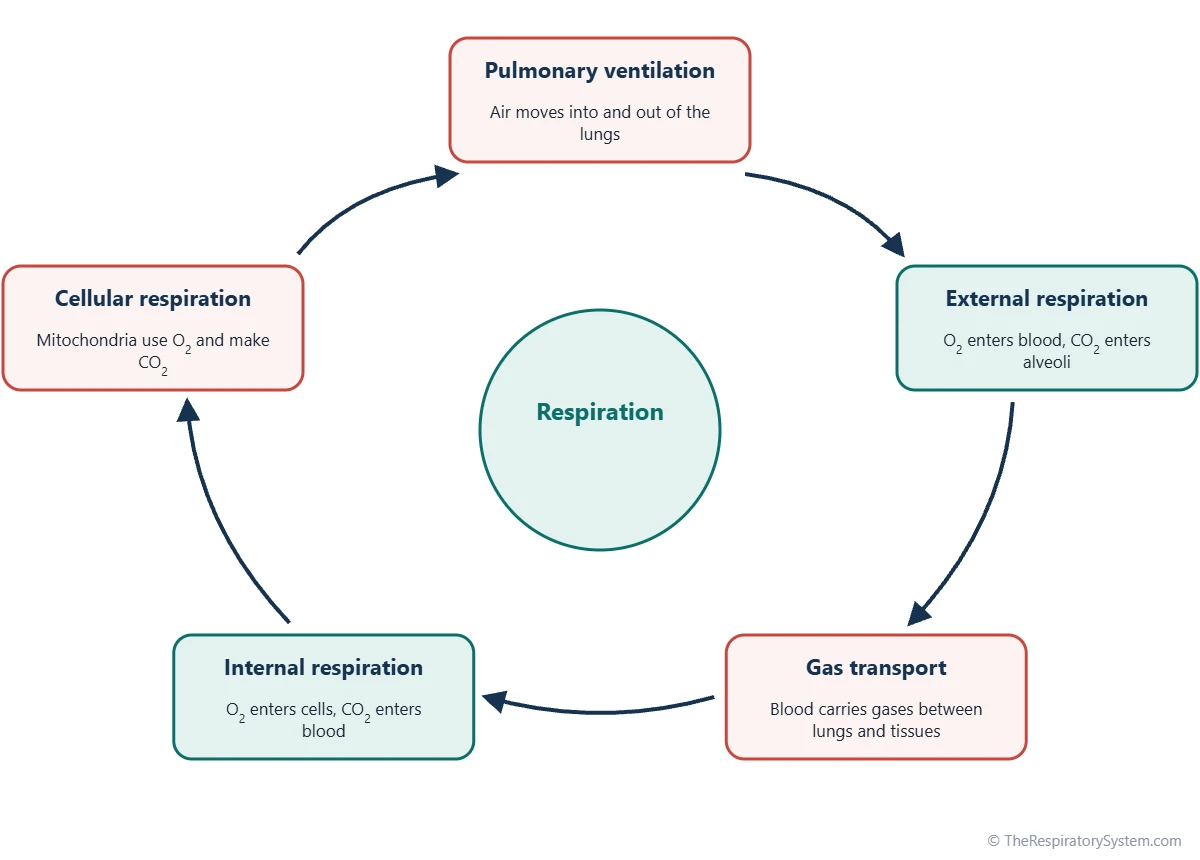
Many textbooks list a different set of four steps that covers the whole journey of the gases, not just the lung stage. These are pulmonary ventilation, external respiration, transport of gases in the blood, and internal respiration. Ventilation is the mechanical part described on our mechanics of breathing page; the other three are diffusion and transport, and the diagram below shows how they connect to cellular respiration inside the cells.
What Is Internal Respiration?
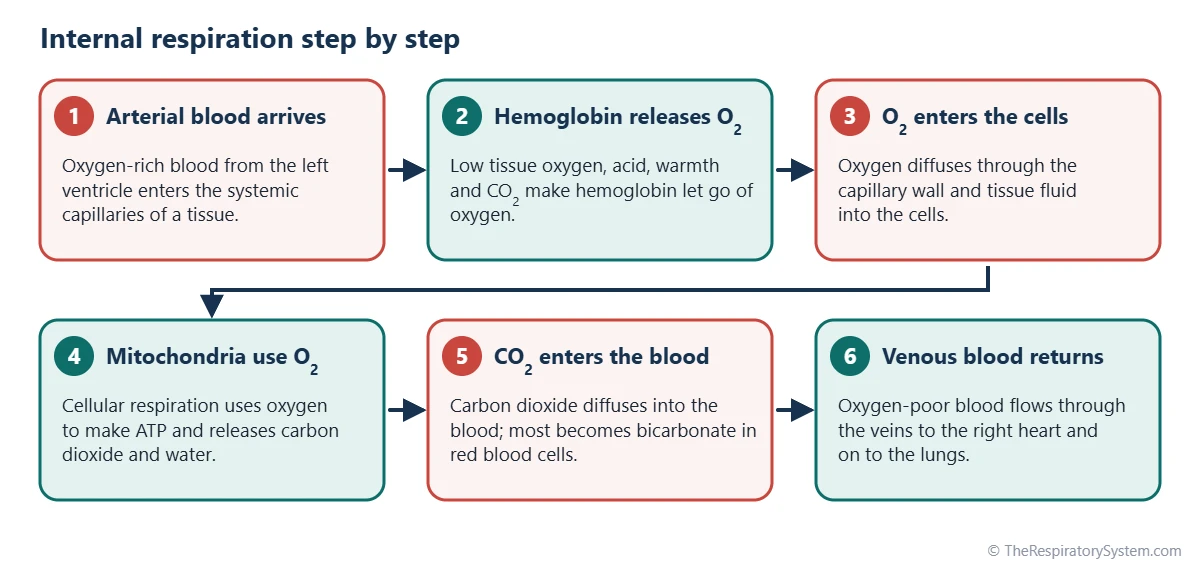
Internal respiration is the stage in which oxygen leaves the blood in the systemic capillaries and enters the tissue cells, while carbon dioxide made by those cells enters the blood. It is the exact mirror of external respiration: the same diffusion, driven by gradients that point the other way.
Where it happens
Internal respiration takes place across the thin walls of the systemic capillaries and the interstitial fluid that bathes the cells. Oxygen-rich blood arrives from the left ventricle through the arteries and arterioles, and oxygen-poor blood leaves through the venules and veins toward the right atrium. Gases cross the capillary wall, the tissue fluid and the cell membrane, and oxygen then travels on to the mitochondria.
The partial pressures in the tissues
Arterial blood reaching the tissues has a PO2 of about 95 to 100 mmHg and a PCO2 of about 40 mmHg. Tissue cells at rest have a PO2 of about 40 mmHg or lower and a PCO2 of about 45 mmHg or higher, because they use oxygen and make carbon dioxide all the time. Oxygen therefore diffuses out of the blood, carbon dioxide diffuses in, and the blood leaves with a PO2 of about 40 mmHg and a PCO2 of about 45 mmHg.
Why the tissues take only part of the oxygen
At rest, the tissues remove only about a quarter of the oxygen carried in arterial blood, so venous blood is still about 75% saturated. That reserve is released when it is needed: working muscle has a lower PO2, more carbon dioxide, more acid and a higher temperature, all of which make hemoglobin let go of oxygen more easily, a shift known as the Bohr effect. In strenuous exercise, active muscle can extract most of the oxygen in its blood supply, and extra capillaries open to shorten the distance oxygen has to travel.
External Respiration vs Internal Respiration: Side by Side
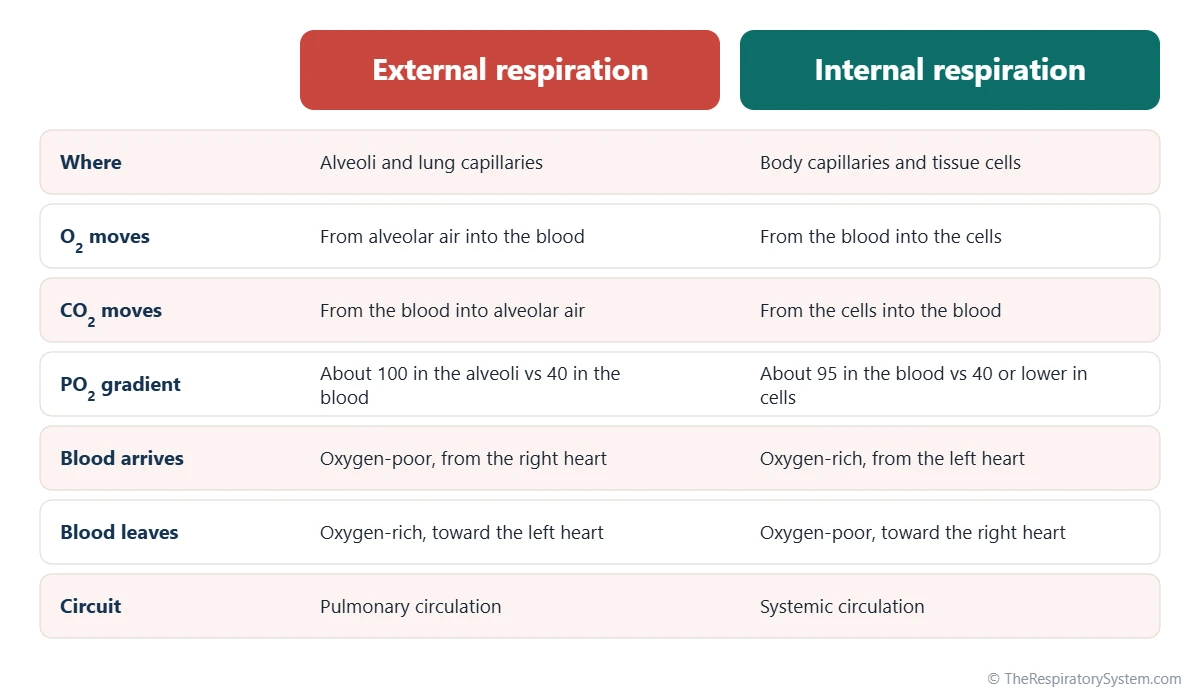
External respiration vs internal respiration comes down to opposite directions in different places: the lungs load oxygen and unload carbon dioxide, and the tissues unload oxygen and load carbon dioxide. The table below lines up every feature of the two stages, including the typical partial pressures at each site.
Notice that the blood leaving one stage is exactly the blood entering the other. Blood leaves the lungs with a PO2 of about 100 mmHg and reaches the tissues at about 95 mmHg, slightly lower because a small amount of oxygen-poor blood from the bronchial and heart veins mixes in. Blood leaves the tissues at about 40 mmHg and arrives at the lungs at the same value. This continuity is why physiologists treat the two stages as one loop rather than two separate events.
| Feature | External respiration | Internal respiration |
|---|---|---|
| Also called | Pulmonary gas exchange | Systemic or tissue gas exchange |
| Where | Alveoli and pulmonary capillaries | Systemic capillaries and tissue cells |
| Oxygen moves | From alveolar air into the blood | From the blood into the cells |
| Carbon dioxide moves | From the blood into alveolar air | From the cells into the blood |
| PO2 on each side | About 100 mmHg in the alveoli vs about 40 mmHg in arriving blood | About 95 mmHg in arriving blood vs about 40 mmHg or lower in the cells |
| PCO2 on each side | About 45 mmHg in arriving blood vs about 40 mmHg in the alveoli | About 45 mmHg or higher in the cells vs about 40 mmHg in arriving blood |
| Blood arrives | Oxygen-poor, from the right ventricle via the pulmonary arteries | Oxygen-rich, from the left ventricle via the systemic arteries |
| Blood leaves | Oxygen-rich, to the left atrium via the pulmonary veins | Oxygen-poor, to the right atrium via the systemic veins |
| Hemoglobin | Loads oxygen and releases carbon dioxide (Haldane effect) | Releases oxygen (Bohr effect) and picks up carbon dioxide |
| Carbonic anhydrase | Turns bicarbonate back into carbon dioxide gas | Turns carbon dioxide into bicarbonate |
| Gradient kept by | Breathing and fresh blood flow | Cells using oxygen and making carbon dioxide |
| Barrier crossed | Respiratory membrane, about 0.5 micrometer thick | Capillary wall, tissue fluid and cell membrane |
| Source: Typical values for a healthy adult at rest at sea level, our editors | ||
What Do External and Internal Respiration Have in Common?
External and internal respiration share the same physical mechanism, the same two gases and the same carrier, the blood, and both happen across capillary walls only a cell or two thick. The list below sums up what they have in common.
- Both are passive diffusion. Neither stage uses energy from the cells doing the exchange; each gas simply moves from higher to lower partial pressure.
- Both involve oxygen and carbon dioxide moving in opposite directions at the same time.
- Both happen in capillaries, the only blood vessels with walls thin enough for gases to cross quickly.
- Both depend on hemoglobin. It loads oxygen in the lungs and releases it in the tissues, and it also carries part of the carbon dioxide.
- Both rely on carbonic anhydrase, the red blood cell enzyme that turns carbon dioxide into bicarbonate in the tissues and back again in the lungs.
- Both speed up together when the body is more active, because the circulation and breathing are adjusted as one system.
The Haldane effect ties the two stages together chemically: oxygen loading in the lungs helps hemoglobin release carbon dioxide, and oxygen unloading in the tissues helps it pick carbon dioxide up.
How Is Internal Respiration Related to Cellular Respiration?
Internal respiration delivers oxygen to the cells and removes their carbon dioxide, while cellular respiration is the chemical process inside the cells that actually uses that oxygen to release energy from food. Internal respiration is physics, the diffusion of gases; cellular respiration is chemistry, a chain of enzyme reactions.
What the mitochondria do with the oxygen
Inside the mitochondria, oxygen is the final electron acceptor at the end of the electron transport chain, where it combines with hydrogen ions to form water. This step lets the cell make most of its ATP, the molecule that powers muscle contraction, nerve signals and nearly every other job. The overall reaction for glucose is often summarized as glucose plus six oxygen molecules giving six carbon dioxide, six water and energy.
Where the carbon dioxide comes from
The carbon dioxide that internal respiration carries away is made in the mitochondria too, when pyruvate is broken down and during the citric acid cycle (Krebs cycle). An adult at rest uses about 250 milliliters of oxygen per minute and produces about 200 milliliters of carbon dioxide, a ratio of about 0.8 called the respiratory quotient. Our page on why we need oxygen explains what happens when this supply fails.
How Do External and Internal Respiration Work Together?
External and internal respiration work together as two ends of one loop: the circulation carries oxygen from the lungs to the tissues and carbon dioxide from the tissues to the lungs, so each stage creates the conditions the other needs. If the tissues use more oxygen, the blood returns to the lungs emptier, and external respiration loads more.
Transport links the two stages
Between the two exchanges the gases travel in the blood. About 98 to 99% of oxygen rides on hemoglobin, as described on our oxygen transport page, and its loading and unloading follow the S-shaped oxygen-hemoglobin dissociation curve. Carbon dioxide travels mostly as bicarbonate, with smaller shares bound to proteins and dissolved in plasma, as explained under carbon dioxide transport.
Control keeps them in balance
The brainstem matches breathing to the rate at which the tissues make carbon dioxide. Respiratory chemoreceptors sense the carbon dioxide, acid and oxygen levels of the blood and adjust the depth and rate of breathing, a system described on our control of breathing page. The heart speeds up at the same time, so more blood passes through both the lungs and the tissues every minute. This partnership is the subject of our guide to the respiratory and circulatory systems.
Common Conditions That Affect External and Internal Respiration
External respiration is limited by problems in the lungs, while internal respiration is limited by problems with the blood, the circulation or the cells themselves. Our respiratory diseases section covers lung conditions in more depth, and anyone with breathing symptoms should see a doctor.
- Lung conditions such as pneumonia, emphysema and pulmonary fibrosis reduce external respiration by filling, destroying or thickening the exchange surface.
- Low inspired oxygen, as at high altitude, lowers alveolar PO2 and weakens the gradient that drives oxygen into the blood.
- Anemia and carbon monoxide leave external respiration intact but reduce how much oxygen the blood can carry to the tissues.
- Poor blood flow, from a blocked artery or a failing heart, starves internal respiration in the affected tissue even when the blood itself is full of oxygen.
- Cyanide poisoning blocks the use of oxygen inside the mitochondria, so oxygen reaches the cells but cellular respiration cannot use it.
When either stage fails, tissue oxygen falls, a state described on our hypoxia and hypoxemia page.
Key Facts
- External respiration is gas exchange between alveolar air and the blood in the pulmonary capillaries; internal respiration is gas exchange between the blood and the tissue cells.
- Both stages are passive diffusion; only the direction of the oxygen and carbon dioxide gradients differs.
- In the lungs oxygen moves from about 100 mmHg in the alveoli to about 40 mmHg in arriving blood; in the tissues it moves from about 95 mmHg in arterial blood to about 40 mmHg or lower in the cells.
- At rest the tissues remove only about a quarter of the oxygen in arterial blood, leaving a large reserve for exercise.
- Internal respiration delivers oxygen to the cells, but cellular respiration in the mitochondria is what uses it to make ATP.
- An adult at rest uses about 250 mL of oxygen and produces about 200 mL of carbon dioxide per minute.
- The four processes of respiration are pulmonary ventilation, external respiration, gas transport and internal respiration.
Quick Quiz: Test What You Know About the External and Internal Respiration
6 questions. Tap an answer to check it.
Where does external respiration take place?
External respiration is the exchange of gases across the respiratory membrane between the alveoli and the lung capillaries.
In internal respiration, which way does oxygen move?
Arterial blood has a higher PO2 (about 95 mmHg) than the tissue cells (about 40 mmHg or lower), so oxygen diffuses into the cells.
What drives both external and internal respiration?
Both stages are simple diffusion, with each gas moving from higher to lower partial pressure.
What is the typical PO2 of blood arriving at the lungs at rest?
Blood returning from the tissues has a PO2 of about 40 mmHg, compared with about 100 mmHg in alveolar air.
Which process actually uses oxygen to make ATP?
Internal respiration only delivers oxygen to the cells; cellular respiration in the mitochondria uses it to produce ATP.
Which change helps hemoglobin release oxygen in active tissues?
More carbon dioxide and acid, along with warmth, reduce hemoglobin's grip on oxygen, which is the Bohr effect.
Frequently Asked Questions
Is external respiration the same as breathing?
No. Breathing, or pulmonary ventilation, is the movement of air into and out of the lungs by the diaphragm and chest muscles. External respiration is the diffusion of gases between that air and the blood once it reaches the alveoli. Breathing keeps the alveolar air fresh so external respiration can continue, but the two are separate steps, and gas exchange goes on between breaths and even during a breath hold.
Where does internal respiration take place?
Internal respiration takes place in the systemic capillaries throughout the body, wherever blood flows close to living cells. Gases cross the capillary wall, the thin layer of tissue fluid around the cells and the cell membrane. It happens in every organ with a blood supply, including the brain, heart, muscles, kidneys and skin, but not in the alveoli, where the exchange is external.
What is the main difference between internal respiration and cellular respiration?
Internal respiration is the physical exchange of oxygen and carbon dioxide between the blood and the cells, driven by diffusion. Cellular respiration is the chemical process inside the cells, mainly in the mitochondria, that uses oxygen to break down glucose and fats and capture energy as ATP. Internal respiration supplies the oxygen and removes the waste carbon dioxide that cellular respiration produces.
Does internal respiration produce energy?
No. Internal respiration only moves gases by diffusion and neither uses nor produces energy itself. The energy comes from cellular respiration, which uses the delivered oxygen to make ATP. Indirectly, energy is spent to keep internal respiration going, because the heart must pump blood through the capillaries and the breathing muscles must keep the arterial blood well supplied with oxygen.
How does exercise change external and internal respiration?
During exercise working muscles use far more oxygen, so their PO2 falls and their carbon dioxide rises, steepening the gradients of internal respiration. More capillaries open and hemoglobin releases oxygen more readily. Blood returns to the lungs with less oxygen, which steepens the gradient for external respiration, while faster, deeper breathing and a higher heart rate deliver more air and blood to the alveoli every minute.
What happens to external respiration at high altitude?
At high altitude the air pressure is lower, so the partial pressure of oxygen in inhaled air and in the alveoli is lower too. The gradient that pushes oxygen into the blood becomes smaller, and the blood may leave the lungs less than fully loaded. Carbon dioxide exchange is affected much less, and the body responds by breathing more and, over weeks, making more red blood cells.
Do plants have external and internal respiration?
Plants exchange gases with the air through stomata in their leaves and lenticels in their stems, and the gases then diffuse through air spaces to the cells. Because plants have no lungs or blood, biologists do not usually split this into external and internal respiration. All plant cells carry out cellular respiration day and night, using oxygen and releasing carbon dioxide, just as animal cells do.
Why is blood leaving the lungs not at the same PO2 as arterial blood?
Blood leaving the alveolar capillaries has a PO2 of about 100 mmHg, but arterial blood reaching the body is slightly lower, about 95 mmHg. A small amount of oxygen-poor blood, from the bronchial veins and from small veins draining the heart muscle, joins the oxygen-rich blood on its way to the left side of the heart. Uneven matching of air and blood across the lungs adds a little more to this gap.
Keep Exploring


