At a Glance
The Bohr effect is the fall in hemoglobin's oxygen affinity caused by a higher carbon dioxide level or a lower blood pH. It shifts the oxygen-hemoglobin dissociation curve to the right, raising the P50 above its normal value of about 26 to 27 mmHg, so red blood cells unload more oxygen in active tissues and load it more easily in the lungs. It was described in 1904 by the Danish physiologist Christian Bohr.
- Type
- Physiological property of hemoglobin in red blood cells
- Trigger
- Rising carbon dioxide (PCO2) and falling pH (more hydrogen ions)
- Result
- Lower oxygen affinity and a right shift of the oxygen-hemoglobin curve
- Where
- Systemic capillaries of active tissues; reversed in the pulmonary capillaries
- Described by
- Christian Bohr, with Karl Hasselbalch and August Krogh, in 1904
- Partner effect
- Haldane effect, the mirror image for carbon dioxide transport
On this page
What Is the Bohr Effect?
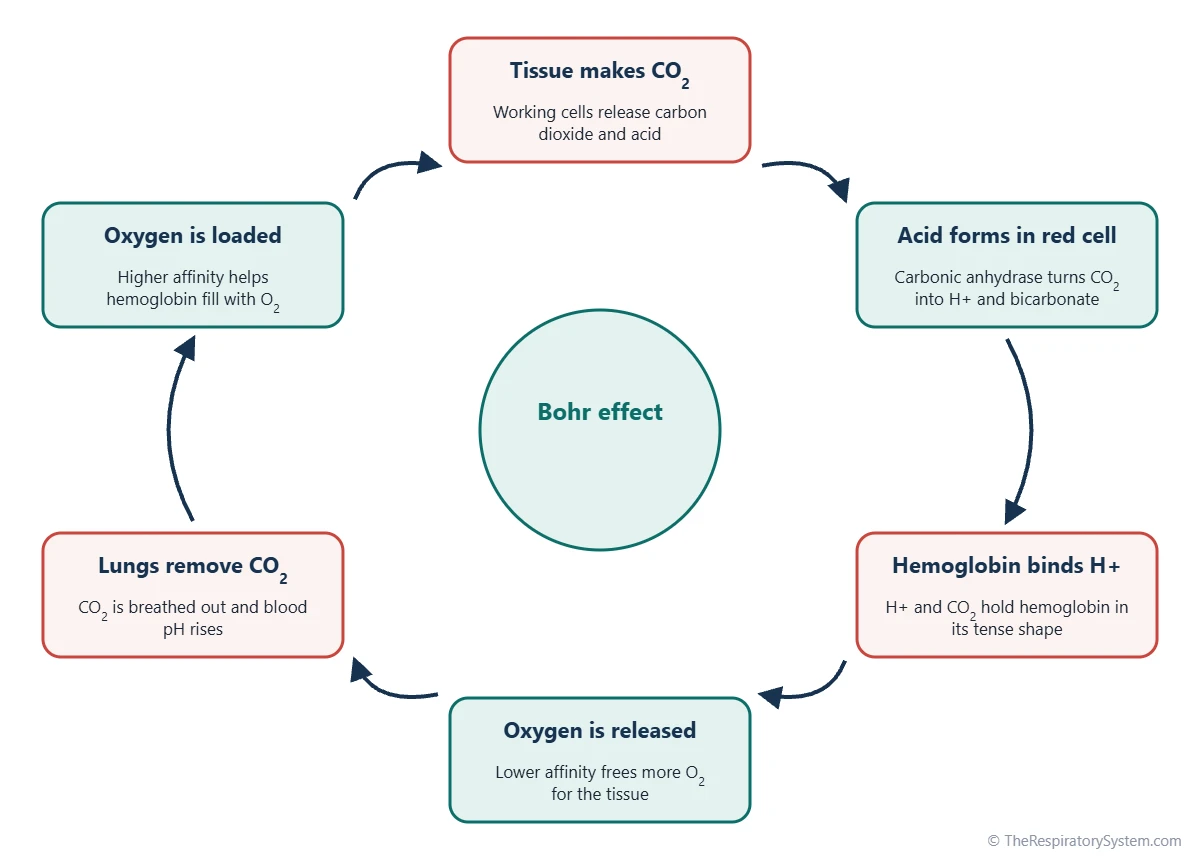
The Bohr effect is the way carbon dioxide and acid weaken the bond between hemoglobin and oxygen, so that oxygen is released more readily from the blood. It links the waste products of working cells directly to the delivery of oxygen, which makes oxygen supply follow demand without any nerve or hormone signal. The effect happens inside red blood cells and is a core part of how the respiratory and circulatory systems work together.
Bohr effect definition in physiology
In physiology, the Bohr effect is defined as the decrease in the oxygen affinity of hemoglobin caused by a rise in the partial pressure of carbon dioxide or a fall in pH. On a graph, it appears as a rightward shift of the oxygen-hemoglobin dissociation curve: at any given oxygen pressure, hemoglobin is less saturated than it would be at normal pH. The opposite change, a fall in carbon dioxide or a rise in pH, shifts the curve to the left and makes hemoglobin hold on to oxygen more tightly.
Who discovered it?
The effect is named after Christian Bohr, a Danish physiologist who published it in 1904 together with Karl Hasselbalch and August Krogh. They measured how much oxygen blood could hold at different carbon dioxide levels and found that more carbon dioxide meant less oxygen binding. Christian Bohr was the father of the physicist Niels Bohr, who is famous for his model of the atom.
Explained simply
Think of hemoglobin as a delivery truck carrying oxygen boxes. In the lungs the truck grips its load firmly. When it drives past a busy muscle that is giving off carbon dioxide and acid, those exhaust products loosen the truck's grip, so it drops more boxes right where the work is happening.
What Is the Bohr Effect in Hemoglobin?
In hemoglobin, the Bohr effect comes from hydrogen ions and carbon dioxide binding to the protein and holding it in its low-affinity shape, called the tense or T state. Hemoglobin can switch between this T state and a relaxed, high-affinity R state, and anything that favors the T state makes it release oxygen.
The hemoglobin molecule
Each adult hemoglobin molecule is built from four protein chains, two alpha and two beta, and each chain holds one heme group with an iron atom that can carry one oxygen molecule. Binding one oxygen makes the next one easier to bind, which is called cooperative binding and gives the dissociation curve its S shape. About 98 to 99% of the oxygen in arterial blood travels this way, as described on our oxygen transport page.
How hydrogen ions and carbon dioxide act
- Hydrogen ions (H+): they attach to certain amino acid groups, especially histidine residues such as the last histidine of each beta chain. Once charged, these groups form extra salt bridges that lock the molecule into the T state.
- Carbon dioxide: some CO2 binds directly to the free amino ends of the protein chains, forming carbamino groups. This also stabilizes the T state and releases more hydrogen ions.
- Result: with more of the molecule held in the T state, the iron atoms let go of oxygen at a higher oxygen pressure than usual.
Because the binding sites for hydrogen ions are not the same as the iron atoms that carry oxygen, the Bohr effect is an example of allosteric regulation: a signal at one site changes how the protein behaves at another.
How Does the Bohr Effect Work?
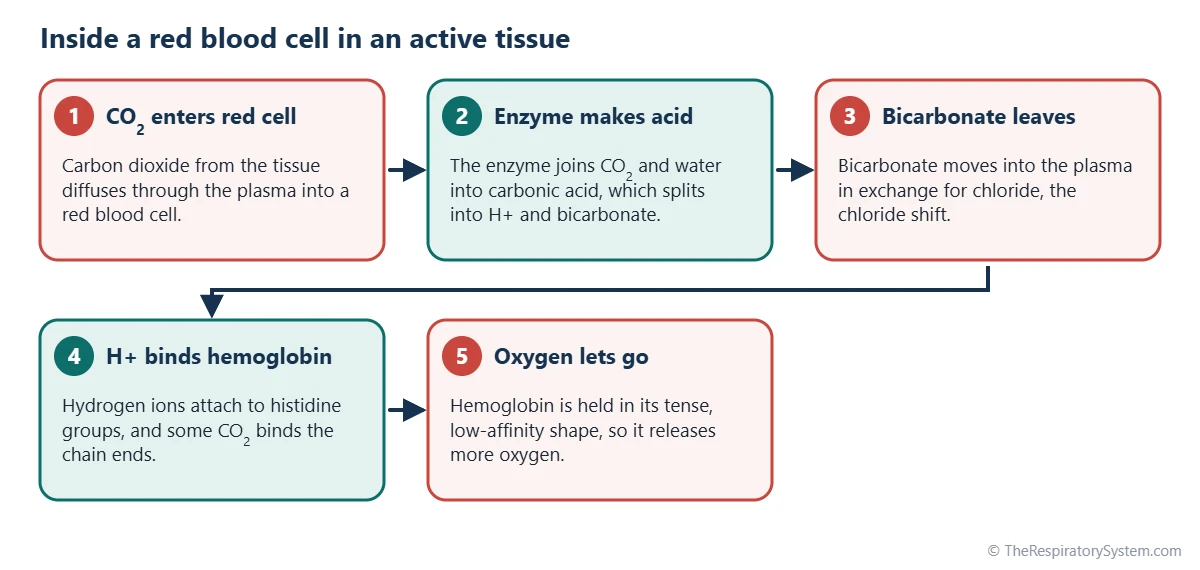
The Bohr effect works through a chain of reactions inside the red blood cell: carbon dioxide from the tissues is turned into acid, the acid binds hemoglobin, and hemoglobin releases oxygen. The steps below follow one red blood cell as it passes a working tissue.
- Carbon dioxide enters. Cells release carbon dioxide from cellular respiration, and it diffuses into the passing red blood cells.
- Acid forms. The enzyme carbonic anhydrase joins carbon dioxide and water into carbonic acid, which splits into a hydrogen ion and a bicarbonate ion.
- Bicarbonate leaves. Bicarbonate moves out into the plasma in exchange for chloride, a swap known as the chloride shift, which lets the reaction keep running.
- Hemoglobin binds the acid. The hydrogen ions attach to hemoglobin, which stabilizes its T state.
- Oxygen is released. Hemoglobin's grip loosens, and extra oxygen diffuses out of the capillary into the tissue.
The right shift and P50
Physiologists measure oxygen affinity with the P50, the oxygen pressure at which hemoglobin is half saturated. In normal adult blood at pH 7.4 and body temperature, the P50 is about 26 to 27 mmHg. When carbon dioxide rises or pH falls, the P50 rises, the curve moves to the right, and more oxygen is given up at the same tissue oxygen pressure. Temperature and a red cell compound called 2,3-bisphosphoglycerate (2,3-BPG) shift the curve in a similar way, but they are separate effects, as the table below shows.
| Change in the blood | Curve shift | Effect on oxygen | Part of the Bohr effect? |
|---|---|---|---|
| Higher carbon dioxide (PCO2) | Right | Released more easily | Yes |
| Lower pH (more hydrogen ions) | Right | Released more easily | Yes |
| Lower carbon dioxide (PCO2) | Left | Held more tightly | Yes, the effect in reverse |
| Higher pH (fewer hydrogen ions) | Left | Held more tightly | Yes, the effect in reverse |
| Higher temperature | Right | Released more easily | No, a separate temperature effect |
| Lower temperature | Left | Held more tightly | No, a separate temperature effect |
| More 2,3-BPG in red cells | Right | Released more easily | No, a separate red cell compound |
| Fetal hemoglobin | Left | Held more tightly | No, a different type of hemoglobin |
| Carbon monoxide present | Left | Held more tightly by the remaining sites | No, a separate binding effect |
| Source: Typical adult physiology, our editors | |||
Where Does the Bohr Effect Happen in the Body?
The Bohr effect happens wherever red blood cells meet a change in carbon dioxide or acid, so it works in the systemic capillaries of the tissues and works in reverse in the pulmonary capillaries of the lungs. The same molecule simply responds to its surroundings in each place.
In the tissues
In the capillaries of muscles, the brain and other organs, carbon dioxide is high and pH is slightly lower, so hemoglobin unloads oxygen. This is the main stage of internal respiration. A hard-working muscle makes more carbon dioxide, more acid such as lactic acid, and more heat, so its capillary blood gives up an even larger share of its oxygen.
In the lungs
In the lungs, carbon dioxide diffuses out of the blood into the alveoli and is breathed out. As carbon dioxide and hydrogen ions leave hemoglobin, its oxygen affinity rises again, which helps it load oxygen during gas exchange. Some textbooks call this the reverse Bohr effect, although it is the same effect running in the opposite direction.
At the placenta
Before birth, the Bohr effect acts on both sides of the placenta at once. Maternal blood picks up carbon dioxide from the fetus and releases oxygen more easily, while fetal blood loses carbon dioxide and binds oxygen more tightly. This is known as the double Bohr effect, and it adds to the higher oxygen affinity that fetal hemoglobin already has.
What Is the Function of the Bohr Effect?
The function of the Bohr effect is to match oxygen delivery to each tissue's need, unloading more oxygen where cells are most active and loading it more efficiently in the lungs. It is an automatic, local control that needs no input from the brain.
At rest, blood leaving the lungs is about 97 to 98% saturated with oxygen, and blood returning from the body is still about 75% saturated. That leftover oxygen is a reserve. When a muscle starts working, its rising carbon dioxide and acid push hemoglobin to release a much larger share of that reserve. Together with faster breathing and a faster heart, this is why exercise can raise oxygen use many times over.
The Bohr effect also ties oxygen transport to carbon dioxide transport and to blood pH. By soaking up hydrogen ions, hemoglobin acts as a buffer, which limits the change in blood acidity as carbon dioxide is carried away. This links the effect to the wider role of breathing in homeostasis, and to the chemoreceptors that adjust breathing to carbon dioxide and pH.
Haldane Effect vs Bohr Effect: What Is the Difference?
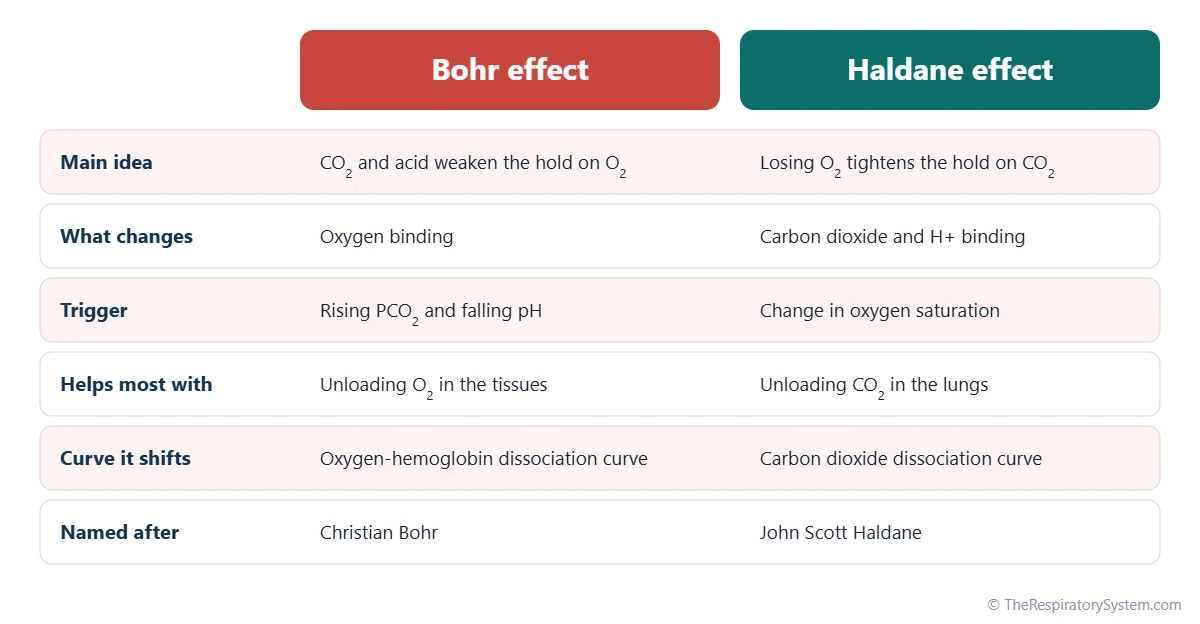
The Bohr effect describes how carbon dioxide and acid change hemoglobin's hold on oxygen, while the Haldane effect describes how oxygen changes hemoglobin's hold on carbon dioxide and hydrogen ions. They are two sides of the same molecular switch between the T and R states.
In the tissues, the Bohr effect helps oxygen leave hemoglobin, and the newly deoxygenated hemoglobin, through the Haldane effect, takes up more carbon dioxide and hydrogen ions. In the lungs the order reverses: oxygen binding drives carbon dioxide off hemoglobin through the Haldane effect, and losing that carbon dioxide raises oxygen affinity through the Bohr effect. Our page on the Haldane effect covers the carbon dioxide side in detail, and the diagram below sets the two effects side by side.
Common Conditions That Affect the Bohr Effect
The Bohr effect itself is not a disease, but conditions that change blood carbon dioxide or pH shift hemoglobin's oxygen affinity through it. Our respiratory diseases section explains the conditions themselves.
- Respiratory acidosis: when breathing cannot clear carbon dioxide, as in hypoventilation or advanced COPD, blood pH falls and the curve shifts right.
- Respiratory alkalosis: fast, deep breathing lowers carbon dioxide, raises pH and shifts the curve left, so hemoglobin holds oxygen more tightly.
- Metabolic acidosis: acids from other causes, such as diabetic ketoacidosis, also shift the curve to the right.
- High altitude: extra breathing in thin air causes alkalosis at first, and over days the body raises its 2,3-BPG level, which shifts the curve back to the right; see breathing at high altitude.
- Carbon monoxide poisoning: carbon monoxide shifts the curve left by a different mechanism, which is one reason it starves tissues of oxygen.
Low blood oxygen from any cause is covered on our hypoxia and hypoxemia page.
Key Facts
- The Bohr effect is the fall in hemoglobin's oxygen affinity caused by more carbon dioxide or a lower blood pH.
- It shifts the oxygen-hemoglobin dissociation curve to the right and raises the P50 above its normal value of about 26 to 27 mmHg.
- Christian Bohr, Karl Hasselbalch and August Krogh described the effect in 1904.
- Hydrogen ions bind histidine groups on hemoglobin, and carbon dioxide forms carbamino groups; both hold hemoglobin in its low-affinity tense state.
- The enzyme carbonic anhydrase in red blood cells turns carbon dioxide into hydrogen ions and bicarbonate, which drives the effect.
- In the lungs, losing carbon dioxide raises oxygen affinity again, which helps hemoglobin load oxygen during gas exchange.
- The Haldane effect is its mirror image: oxygen binding lowers hemoglobin's hold on carbon dioxide.
Quick Quiz: Test What You Know About the Bohr Effect
6 questions. Tap an answer to check it.
What does the Bohr effect do to hemoglobin's oxygen affinity?
More carbon dioxide or acid lowers hemoglobin's oxygen affinity, so oxygen is released more easily.
Which way does the Bohr effect shift the oxygen-hemoglobin dissociation curve in active tissue?
Higher carbon dioxide and lower pH shift the curve to the right, raising the P50.
Which enzyme in red blood cells produces the hydrogen ions behind the Bohr effect?
Carbonic anhydrase joins carbon dioxide and water into carbonic acid, which splits into hydrogen ions and bicarbonate.
Who first described the Bohr effect, in 1904?
Christian Bohr, father of the physicist Niels Bohr, described it with Hasselbalch and Krogh.
What happens to hemoglobin's oxygen affinity in the lungs as carbon dioxide is breathed out?
Losing carbon dioxide and hydrogen ions raises the affinity, which helps hemoglobin load oxygen.
Which change shifts the curve to the right but is NOT part of the Bohr effect?
Temperature shifts the curve too, but the Bohr effect refers only to carbon dioxide and pH.
Frequently Asked Questions
Is the Bohr effect a left shift or a right shift?
In working tissues the Bohr effect is a right shift of the oxygen-hemoglobin dissociation curve. Rising carbon dioxide and falling pH move the curve to the right, so hemoglobin is less saturated at the same oxygen pressure and gives oxygen away more easily. In the lungs, where carbon dioxide falls and pH rises, the same effect works as a left shift that favors oxygen loading.
Does myoglobin show a Bohr effect?
Myoglobin, the oxygen-storing protein in muscle, shows almost no Bohr effect. It is a single protein chain with one heme group, so it cannot switch between the tense and relaxed states that four-chain hemoglobin uses. Its oxygen binding curve is a simple hyperbola rather than an S shape, and it stays high in affinity, which suits its job of holding oxygen inside muscle cells until it is needed.
What is the double Bohr effect?
The double Bohr effect happens at the placenta. Carbon dioxide passes from fetal blood to maternal blood, so the maternal blood becomes more acidic and releases oxygen more easily, while the fetal blood becomes less acidic and binds oxygen more tightly. Both shifts favor oxygen moving from mother to fetus, adding to the naturally higher oxygen affinity of fetal hemoglobin.
How does the Bohr effect help during exercise?
Exercising muscles produce more carbon dioxide, more acid and more heat. All three lower hemoglobin's oxygen affinity in the muscle capillaries, so each passing red blood cell gives up a larger share of its oxygen than it would at rest. This extra unloading works alongside faster breathing and a faster heartbeat to meet the muscle's higher oxygen demand.
What is the Root effect?
The Root effect is an exaggerated version of the Bohr effect found in the hemoglobin of many fish. In acid conditions, Root effect hemoglobin cannot become fully saturated even at very high oxygen pressures, so it dumps a large amount of oxygen. Fish use special glands that release acid into the blood to drive oxygen into the swim bladder and into the retina of the eye.
How is the chloride shift related to the Bohr effect?
The chloride shift supports the Bohr effect. When carbonic anhydrase turns carbon dioxide into hydrogen ions and bicarbonate, the bicarbonate leaves the red blood cell in exchange for chloride ions. Removing bicarbonate keeps the reaction moving forward, so more hydrogen ions are made and bound by hemoglobin, which lowers its oxygen affinity and frees more oxygen for the tissues.
Does the Bohr effect change how much oxygen the blood can carry?
No. In human blood the Bohr effect changes how tightly hemoglobin holds oxygen, not how much oxygen it can carry in total. At a high enough oxygen pressure, as in the lungs, hemoglobin still becomes almost fully saturated. The effect matters most at the lower oxygen pressures found in the tissues, where a small shift in affinity releases a noticeably larger amount of oxygen.
Why is the Bohr effect important for the body?
The Bohr effect sends oxygen where it is needed without any signal from the brain. Tissues that work harder make more carbon dioxide and acid, and those same products make hemoglobin release more oxygen nearby. It also helps the blood buffer acid and links oxygen transport with carbon dioxide removal, keeping both gases moving in the right direction.
Keep Exploring


