At a Glance
The respiratory system maintains homeostasis mainly by controlling carbon dioxide: when blood CO2 rises and pH falls, chemoreceptors signal the brainstem to increase breathing, which removes CO2 and brings pH back toward its normal range of 7.35 to 7.45. The same feedback keeps arterial oxygen within its normal range and works within minutes, while the kidneys fine-tune pH over hours to days.
- Main job
- Keeps blood oxygen, carbon dioxide and pH within narrow, stable ranges
- Control type
- Negative feedback through the brainstem breathing centers
- Sensors
- Central chemoreceptors in the medulla and peripheral chemoreceptors in the carotid and aortic bodies
- Effectors
- Diaphragm and intercostal muscles, which change the rate and depth of breathing
- Key numbers
- Arterial pH about 7.35 to 7.45; arterial PCO2 about 35 to 45 mmHg
- Works with
- Kidneys (pH), circulatory system (gas transport), nervous system (control)
On this page
- How Does the Respiratory System Maintain Homeostasis?
- What Is Homeostatic Control of Breathing?
- How Does Breathing Control Blood pH?
- How Does the Respiratory System Keep Oxygen Levels Stable?
- How Does the Respiratory System Maintain Homeostasis During Exercise?
- What Else Does the Respiratory System Do for Homeostasis?
- Key Facts
- FAQ
How Does the Respiratory System Maintain Homeostasis?
The respiratory system maintains homeostasis by matching breathing to the body's needs so that arterial oxygen, carbon dioxide and pH stay almost constant, whether you are asleep, talking or running. Homeostasis is the body's ability to keep its internal conditions stable while the outside world and our activity levels change.
Every cell burns fuel with oxygen and makes carbon dioxide, as explained on our page about why we need oxygen. If breathing did not keep pace, oxygen would run short within minutes and carbon dioxide would build up and turn the blood acidic. Breathing therefore has three homeostatic targets:
- Oxygen: enough is loaded in the alveoli to keep hemoglobin almost fully saturated.
- Carbon dioxide: it is removed as fast as the tissues make it, so its level in arterial blood stays steady.
- pH: because carbon dioxide forms an acid in water, removing it keeps the blood from becoming too acidic.
Explained simply
Your body works like a house with a thermostat, except the thermostat watches carbon dioxide instead of temperature. When carbon dioxide creeps up, the brain turns breathing up. When it drops, the brain turns breathing down.
What Is Homeostatic Control of Breathing?
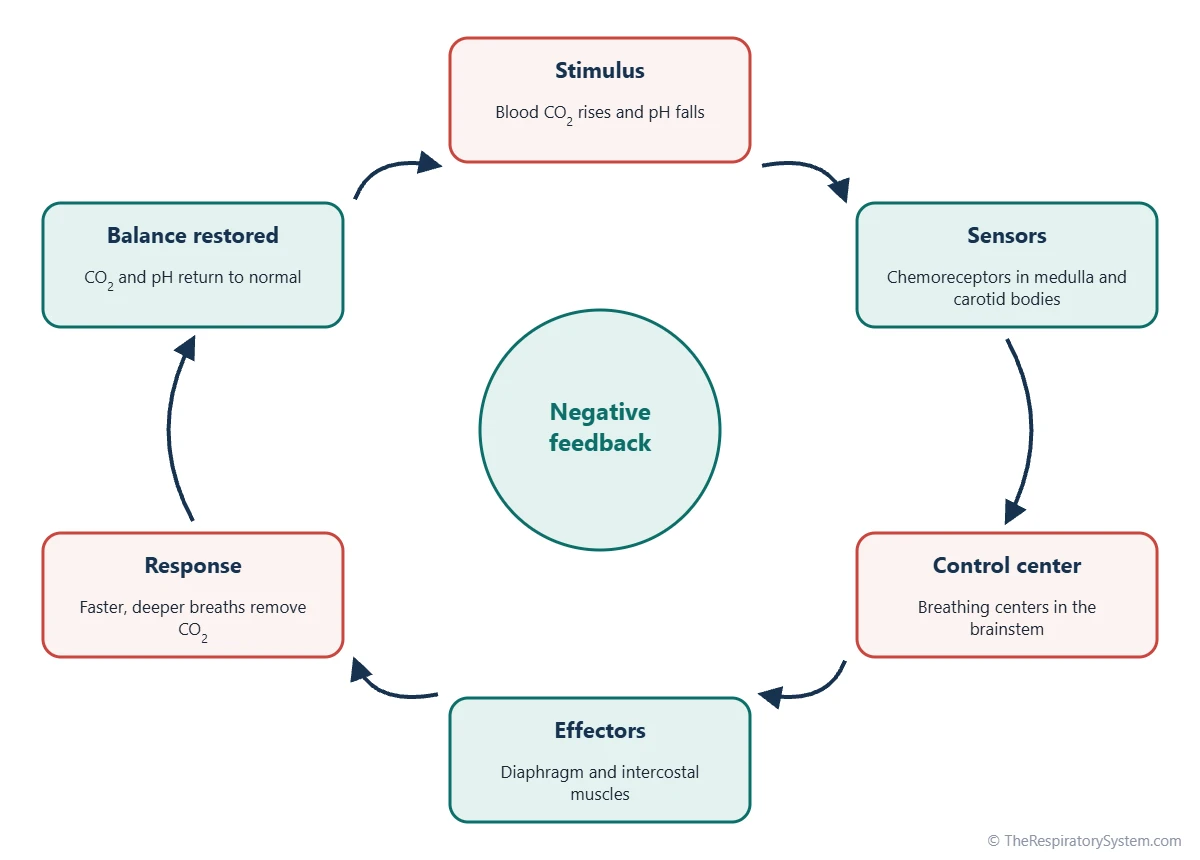
Homeostatic control of breathing is the negative feedback loop in which sensors detect changes in blood gases, the brainstem compares them with a set point, and the breathing muscles change ventilation to undo the change. It is called negative feedback because the response always pushes the variable back in the opposite direction of the disturbance. Full details of the neural circuits are on our control of breathing page.
- Stimulus: carbon dioxide rises in the blood, for example during exercise or a breath hold.
- Sensors: respiratory chemoreceptors detect it. Central chemoreceptors near the surface of the medulla respond to the acid that carbon dioxide forms in the cerebrospinal fluid, while peripheral chemoreceptors in the carotid and aortic bodies respond to blood CO2, pH and low oxygen.
- Control center: breathing centers in the medulla oblongata and pons raise the rate and strength of their signals.
- Effectors: the phrenic nerve drives the diaphragm, and intercostal nerves drive the intercostal muscles.
- Response: deeper, faster breaths wash carbon dioxide out of the alveoli, and the blood level falls back toward normal.
Under normal conditions, carbon dioxide is by far the strongest driver of breathing. Stretch receptors in the airways add a protective brake on very deep breaths, known as the Hering-Breuer reflex.
How Does Breathing Control Blood pH?
Breathing controls blood pH by setting how much carbon dioxide stays in the blood, because carbon dioxide reacts with water to form carbonic acid, which releases hydrogen ions. The reaction, sped up by the enzyme carbonic anhydrase in red blood cells, is: CO2 + H2O ⇌ H2CO3 ⇌ H+ + HCO3-.
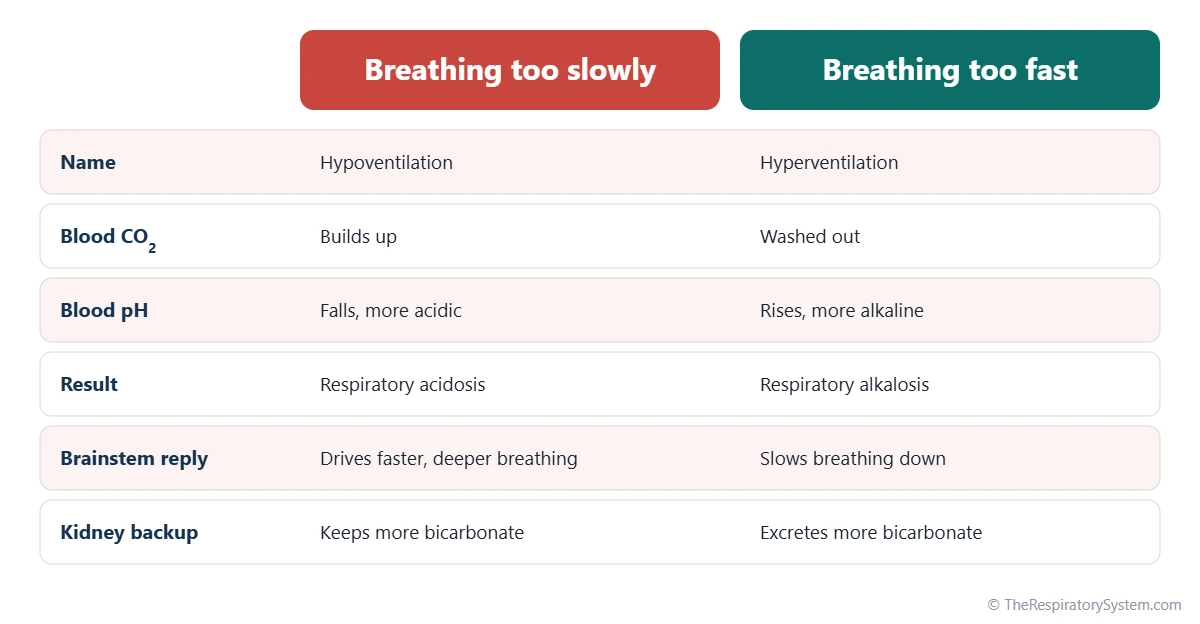
When breathing slows, carbon dioxide builds up, the reaction shifts to the right, and more hydrogen ions make the blood more acidic. When breathing speeds up, carbon dioxide is blown off, the reaction shifts to the left, and the blood becomes more alkaline. Both extremes are explained on our page about hyperventilation and hypoventilation, and the chemistry of carrying CO2 is covered under carbon dioxide transport.
Lungs and kidneys share the work
The lungs and the kidneys form the body's two-part pH control. The lungs act within minutes by changing how much carbon dioxide is breathed out, while the kidneys act over hours to days by keeping or excreting bicarbonate and hydrogen ions. When one system is strained, the other compensates, a process called respiratory or renal compensation.
| Variable | Typical normal range (adult) | Main sensor | How breathing corrects it |
|---|---|---|---|
| Arterial carbon dioxide (PaCO2) | About 35 to 45 mmHg | Central and peripheral chemoreceptors | Faster, deeper breathing when it rises; slower breathing when it falls |
| Arterial blood pH | About 7.35 to 7.45 | Central and peripheral chemoreceptors | More CO2 is breathed out when pH falls, less when it rises |
| Arterial oxygen (PaO2) | About 75 to 100 mmHg | Peripheral chemoreceptors (carotid bodies) | Ventilation rises sharply when it falls below about 60 mmHg |
| Oxygen saturation (SpO2) | About 95 to 100% | Follows arterial oxygen | Kept high as long as the alveoli are well ventilated |
| Plasma bicarbonate | About 22 to 26 mEq/L | Regulated mainly by the kidneys | Breathing changes CO2 to balance any shift in bicarbonate |
| Resting respiratory rate | About 12 to 20 breaths per minute | Set by brainstem breathing centers | Adjusted up or down to match CO2 production |
| Lung inflation | Normal tidal breaths | Stretch receptors in the airways | Very deep breaths are cut short by the Hering-Breuer reflex |
| Source: Typical healthy adult values at sea level, our editors | |||
How Does the Respiratory System Keep Oxygen Levels Stable?
The respiratory system keeps oxygen levels stable mostly by keeping the alveoli well ventilated, and it has a backup alarm in the carotid bodies that raises breathing sharply when arterial oxygen falls a long way. Normal arterial oxygen pressure is about 75 to 100 mmHg, and hemoglobin stays about 95 to 100% saturated, a value measured as oxygen saturation.
Because of the S-shaped oxygen-hemoglobin dissociation curve, hemoglobin stays nearly full even when oxygen pressure drops a little, so small dips need no response. The peripheral chemoreceptors react strongly only when arterial oxygen pressure falls below about 60 mmHg, which is where saturation begins to drop steeply. This explains why oxygen is a weaker everyday signal than carbon dioxide.
A good example is breathing at high altitude. Thin air lowers arterial oxygen, the carotid bodies raise ventilation within minutes, and over days the kidneys release more erythropoietin, which increases red blood cell production and the blood's ability to carry oxygen, as described under oxygen transport.
How Does the Respiratory System Maintain Homeostasis During Exercise?
During exercise, the respiratory system maintains homeostasis by raising ventilation in step with the muscles' oxygen use and carbon dioxide output, so that arterial oxygen and carbon dioxide stay close to their resting values during moderate effort. Breathing gets deeper first and then faster, and the respiratory rate can more than double.
Remarkably, breathing rises at the very start of exercise, before blood gases have had time to change. Signals from the motor cortex and from receptors in moving joints and muscles act as a feedforward control, and the chemoreceptor feedback loop then fine-tunes the response. During very hard exercise, lactic acid adds extra acid to the blood, and breathing increases even more to blow off carbon dioxide and limit the fall in pH. The training changes behind this are covered on our page on exercise and the respiratory system.
What Else Does the Respiratory System Do for Homeostasis?
Besides controlling blood gases and pH, the respiratory system helps keep body temperature, water balance, blood pressure and defenses against infection in balance. These roles are shared with other organs, as shown on our page about the respiratory system and other body systems.
- Temperature and water: the nose warms and moistens inhaled air, and each exhaled breath carries away some heat and water vapor.
- Defense: the cilia and mucus of the airways trap and sweep out particles and microbes, and alveolar macrophages clear what reaches the air sacs.
- Blood pressure: enzymes on the lining of the lung capillaries convert angiotensin I into angiotensin II, a hormone that helps regulate blood pressure.
- Circulation: pressure changes in the chest during breathing help draw venous blood back to the heart, one of many links described under the respiratory and circulatory system.
When homeostasis fails
Lung and airway diseases can disturb this balance. In advanced COPD some people retain carbon dioxide, and in sleep apnea breathing pauses during sleep cause repeated dips in oxygen. Our respiratory diseases section explains these conditions, and anyone with ongoing breathing symptoms should see a doctor.
Key Facts
- The respiratory system maintains homeostasis by keeping blood oxygen, carbon dioxide and pH within narrow ranges.
- Breathing is controlled by negative feedback: chemoreceptors sense the blood, the brainstem responds, and the breathing muscles act.
- Carbon dioxide, not oxygen, is the main everyday driver of breathing.
- Normal arterial blood pH is about 7.35 to 7.45, and normal arterial PCO2 is about 35 to 45 mmHg.
- The lungs correct pH within minutes by changing CO2 output; the kidneys correct it over hours to days.
- Peripheral chemoreceptors respond strongly only when arterial oxygen pressure falls below about 60 mmHg.
- During moderate exercise, arterial oxygen and carbon dioxide stay close to resting values because ventilation rises in step with demand.
Frequently Asked Questions
What is the respiratory system's role in homeostasis?
Its role is to keep the gases and acid level of the blood stable. The lungs load oxygen into the blood and remove carbon dioxide at the rate the tissues produce it, and by controlling carbon dioxide they control blood pH. The system also helps with temperature and water balance, defense against inhaled germs, and blood pressure through the activation of angiotensin II in the lung capillaries.
What is a respiratory system homeostasis example?
A simple example is climbing stairs. Your leg muscles produce more carbon dioxide, which raises the level in your blood and lowers its pH slightly. Chemoreceptors detect the change, the brainstem sends stronger signals to the diaphragm and rib muscles, and you breathe faster and deeper. The extra carbon dioxide is breathed out, and when you stop climbing, breathing settles back to normal.
How does the respiratory system maintain homeostasis, simple version?
In simple terms, your brain keeps checking how much carbon dioxide is in your blood. If there is too much, it makes you breathe faster and deeper to get rid of it. If there is too little, it slows your breathing. This keeps the blood from becoming too acidic or too alkaline, and it keeps oxygen coming in at the rate your body uses it.
Which body systems work with the respiratory system to maintain homeostasis?
The circulatory system carries oxygen and carbon dioxide between the lungs and the tissues. The nervous system sets the rhythm and depth of breathing through the brainstem and the phrenic and intercostal nerves. The urinary system, through the kidneys, works alongside the lungs to control blood pH, and the muscular system provides the diaphragm and rib muscles that move air.
Is respiratory homeostasis negative or positive feedback?
It is negative feedback. Any change in blood carbon dioxide, pH or oxygen triggers a response that pushes the value back toward normal, rather than amplifying the change. Positive feedback, in which a response strengthens the original change, is rare in the body and is not how breathing is regulated. The breathing loop runs continuously, even during sleep, without any conscious effort.
Why is carbon dioxide more important than oxygen in controlling breathing?
Carbon dioxide changes blood pH directly, and even small rises are detected quickly by the central chemoreceptors, so it gives a sensitive, constant signal. Oxygen, by contrast, is carried by hemoglobin that stays nearly saturated across a wide range of oxygen pressures. The body only needs to react strongly to oxygen when it falls a long way, which is why the oxygen alarm acts as a backup.
What happens when the respiratory system fails to maintain homeostasis?
When breathing cannot keep up, carbon dioxide builds up and oxygen falls, a state called respiratory failure. The blood becomes more acidic, and the brain and heart, which depend on a steady oxygen supply, are affected first. It can result from lung disease, weak breathing muscles, airway blockage or depressed brainstem activity. Doctors treat it as a medical emergency.
Keep Exploring


