At a Glance
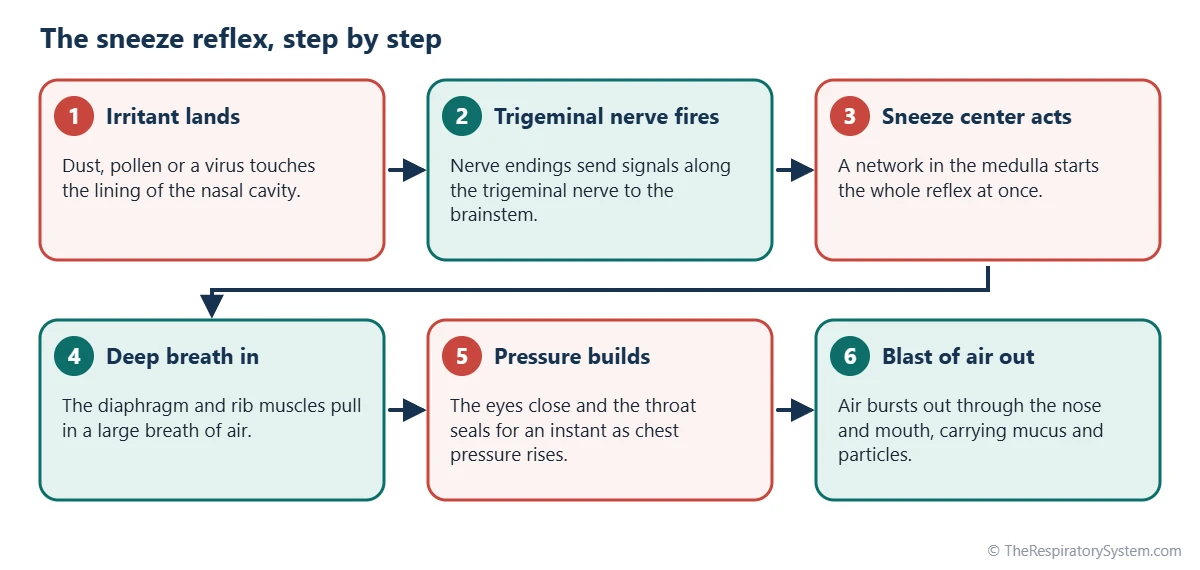
We sneeze to expel irritants from the nasal cavity. Irritation of trigeminal nerve endings in the nasal lining sends signals to a sneeze center in the medulla of the brainstem, which coordinates a deep inhalation, a brief build-up of pressure in the chest and an explosive exhalation through the nose and mouth that sweeps particles and mucus out of the airway.
- Type
- Involuntary protective reflex of the upper airway
- Trigger
- Irritated nasal lining: dust, pollen, viruses, strong smells, and bright light in some people
- Sensory nerve
- Trigeminal nerve (cranial nerve V), through branches that supply the nasal lining
- Control center
- Sneeze center in the medulla of the brainstem
- Muscles used
- Diaphragm, intercostal and abdominal muscles, plus muscles of the face, throat and eyelids
- Sister reflex
- Cough reflex, which clears the larynx, trachea and bronchi instead of the nose
On this page
Why Do We Sneeze?
We sneeze because the body needs a fast way to throw unwanted material out of the nose before it travels deeper into the airways. The nose is the first stop for every breath, so it meets dust, pollen, smoke, microbes and cold, dry air all day long.
Most of the time the nose handles these quietly. Hairs in the nostrils trap large particles, and a sticky layer of mucus moved by tiny beating hairs carries smaller ones toward the throat, as explained on our cilia and mucus page. When something irritates the lining faster than this slow cleaning system can cope, the sneeze reflex takes over and clears the passage in a fraction of a second.
Explained simply: a sneeze is the nose's emergency flush. Your body takes a big breath, holds it for an instant, and then fires it out so hard that whatever was bothering the inside of your nose is blown away.
What Is the Sneeze Reflex Pathway?
The sneeze reflex pathway runs from sensory nerve endings in the nasal lining, along the trigeminal nerve to a sneeze center in the brainstem, and back out through motor nerves to the breathing, throat and face muscles. Scientists usually split it into two phases.
The nasal (sensory) phase
The lining of the nasal cavity is packed with free nerve endings. They belong mainly to two divisions of the trigeminal nerve: the ophthalmic division, through the anterior ethmoidal nerve at the front and top of the cavity, and the maxillary division, through the nasal nerves farther back. When these endings are stimulated, many people feel a tickle or itch before anything else happens. If the signal is strong enough, it crosses a threshold and the reflex is set off.
The respiratory (motor) phase
Once triggered, the sneeze runs like a fixed program. The breathing centers of the brainstem take charge of the timing, and the sequence is:
- A deep, quick inhalation, driven by the diaphragm and the external intercostal muscles.
- A brief pause in which the eyes close and the throat and glottis close for an instant, so pressure builds in the chest.
- A sudden, forceful exhalation powered by the internal intercostal and abdominal muscles.
- The soft palate and tongue shift so that part of the blast is sent through the nose and part through the mouth.
The motor side uses several nerves at once: the phrenic nerve to the diaphragm, spinal nerves to the rib and belly muscles, and cranial nerves to the face, palate and larynx.
| Part of the reflex | Structure | What it does |
|---|---|---|
| Receptors | Free nerve endings in the nasal lining | Detect particles, chemicals and swelling |
| Sensory nerve (front) | Anterior ethmoidal nerve, ophthalmic division of the trigeminal nerve | Carries signals from the front and roof of the nasal cavity |
| Sensory nerve (back) | Nasal branches of the maxillary division of the trigeminal nerve | Carries signals from the back and sides of the cavity |
| Control center | Sneeze center in the medulla of the brainstem | Decides when the threshold is reached and starts the program |
| Breath in | Diaphragm and external intercostal muscles | Pull in a deep, fast breath |
| Pressure build-up | Glottis, soft palate and tongue | Briefly seal the airway so chest pressure rises |
| Blast out | Internal intercostal and abdominal muscles | Force air out of the lungs at high speed |
| Eye closure | Eyelid muscles supplied by the facial nerve | Shut the eyes for the length of the sneeze |
| Nasal glands | Glands of the nasal lining | Release watery fluid that helps wash particles out |
| Source: Typical physiology, our editors | ||
What Makes You Sneeze?
Anything that stimulates the nerve endings of the nasal lining strongly enough can make you sneeze, from a speck of dust to a sudden change in light.
Dust, pollen and strong smells
Physical particles, pollen grains, pepper, smoke and sharp odors act directly on the nerve endings. In people with allergies, pollen or pet dander also makes immune cells called mast cells release histamine, a chemical that excites the same nerves and makes the lining swell and leak fluid.
Why do we sneeze when we have a cold?
A cold virus infects the cells of the nasal lining and causes inflammation. The inflamed tissue releases chemical signals that make the nerve endings more sensitive, and the glands produce extra mucus. The result is frequent sneezing that helps push mucus out, and it also launches virus-laden droplets into the air, which is one way colds spread.
Why do we sneeze when we look at the sun?
Some people sneeze when they step into bright light. This is called the photic sneeze reflex, and it often runs in families. The exact wiring is not proven, but the leading idea is that strong signals from the optic nerve spill over into nearby trigeminal pathways in the brainstem, so the brain reads bright light as a nasal irritant.
Sneezing after eating
Spicy or hot food can trigger a runny nose and sometimes sneezing, because the same trigeminal nerve also carries signals from the mouth. A few people sneeze after a very large meal, a rare reflex that seems to be linked to a full, stretched stomach.
What Happens in the Body During a Sneeze?
During a sneeze, the whole breathing system works together for about a second: the lungs fill, pressure rises, and air leaves the airway at high speed. Several things happen at the same moment.
- The eyes close. The eyelid muscles contract as part of the reflex, controlled by the facial nerve.
- The chest squeezes. The abdominal and internal intercostal muscles push the diaphragm up and pull the ribs down, as described on our muscles of respiration page.
- The throat directs the air. The soft palate, the uvula and the back of the tongue decide how much air goes through the nose and how much through the mouth.
- The nose releases fluid. Glands in the lining add watery secretions that help carry particles out.
A sneeze expels a spray of droplets of many sizes. The large drops fall quickly, while the finest ones can stay in the air for some time. This is why sneezing matters for the spread of colds and flu, even though its job in the body is cleaning.
How Is a Sneeze Different From a Cough?
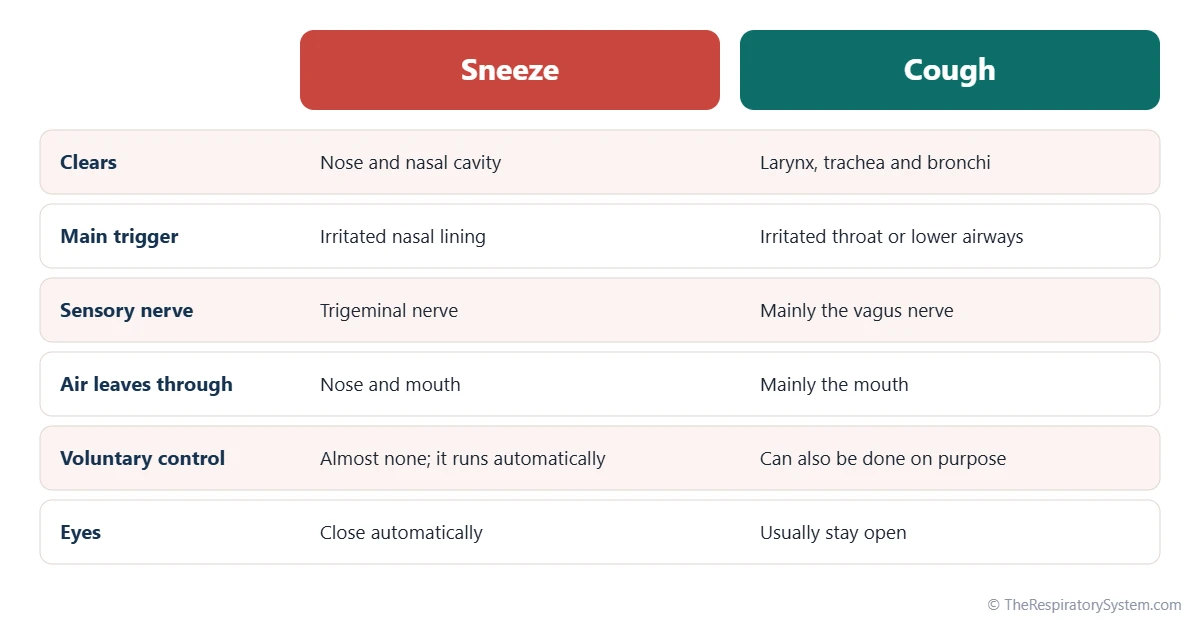
A sneeze clears the nose, while a cough clears the throat and the airways below it. Both are protective reflexes that use a deep breath and a forced exhalation, but they start in different places and use different sensory nerves.
The cough reflex is triggered by irritation of the larynx, trachea and bronchi, and its signals travel mainly along the vagus nerve. A sneeze starts in the nasal lining and uses the trigeminal nerve. You can also cough on purpose, but you cannot really start or fully stop a true sneeze by will, because it runs almost entirely as an automatic program.
Which Parts of the Respiratory System Take Part in a Sneeze?
A sneeze involves the upper airway that detects the irritant, the brainstem that runs the reflex, and the breathing muscles that power it. In the upper airway, the nasal conchae and the walls of the nasal cavity carry most of the sensitive nerve endings, and the pharynx forms the shared passage where air is split between the nose and the mouth.
Lower down, the glottis briefly closes and then opens as the blast begins, and the lungs supply the large volume of air. The diaphragm and the intercostal muscles provide the force.
Frequent sneezing is a common sign of colds, allergic rhinitis and sinusitis, which are covered with other conditions on our respiratory diseases page. Sneezing that comes with fever, facial pain or symptoms that do not settle is a reason to see a doctor.
Key Facts
- A sneeze is an involuntary reflex that clears irritants from the nasal cavity.
- The sensory signal travels along the trigeminal nerve, the main nerve of feeling in the face and nose.
- A sneeze center in the medulla of the brainstem coordinates the deep breath in and the forceful breath out.
- The eyes close automatically during a sneeze because the eyelid muscles are part of the reflex.
- Some people sneeze in bright light, a trait called the photic sneeze reflex that often runs in families.
- A cough clears the lower airways through the vagus nerve, while a sneeze clears the nose through the trigeminal nerve, as compared on our cough reflex page.
Frequently Asked Questions
Why do we close our eyes when we sneeze?
Closing the eyes is built into the sneeze reflex itself. The same brainstem program that powers the breath also sends signals through the facial nerve to the muscles around the eyes. The popular idea that your eyes could pop out if they stayed open is a myth; the eyeballs are not pushed out by the pressure of a sneeze.
Does your heart stop when you sneeze?
No, the heart does not stop during a sneeze. The deep breath and the sudden rise and fall of pressure in the chest can briefly change how much blood returns to the heart, so the timing of one or two beats may shift slightly. The heart keeps beating normally through the whole sneeze.
Why do some people sneeze several times in a row?
A single sneeze does not always remove the irritant, or the nerve endings stay excited after the first blast. The reflex then fires again until the signal drops below the threshold. How many sneezes a person tends to have in a row varies from one person to another and seems to be partly a personal pattern.
Why does sneezing come with a runny nose?
Sneezing and a runny nose share the same cause: irritation or inflammation of the nasal lining. The nerve endings that trigger the sneeze also trigger the glands of the lining to release watery fluid, and allergies or infections add swelling and extra mucus. The fluid helps wash particles and germs toward the nostrils and the throat.
Why can't you sneeze in your sleep?
During sleep, and especially during dream sleep, the brain dampens incoming sensory signals and relaxes most muscles. A tickle in the nose is less likely to reach the trigger threshold, so the sneeze reflex rarely fires. If an irritant is strong enough, a person usually wakes up first and then sneezes.
Do animals sneeze too?
Yes. Many mammals and birds sneeze, including dogs, cats, horses and chickens, and the purpose is the same: clearing the nose. Some animals also use sneezes socially. Dogs often make soft sneezes during play, and researchers studying African wild dogs found that sneezes seemed to work like votes when the pack decided whether to set off on a hunt.
How far can the droplets from a sneeze travel?
The heavier drops from a sneeze fall to the ground within a short distance, but the smallest droplets form a fine cloud that can drift much farther and hang in the air for a while. How far they go depends on the force of the sneeze, room air currents, temperature and humidity, which is why covering a sneeze reduces the spread of germs.
Keep Exploring


