At a Glance
A hiccup is an involuntary spasm of the diaphragm and the inspiratory rib muscles, followed about 35 milliseconds later by sudden closure of the glottis, which cuts off the inflowing air and makes the hic sound. It is a reflex that runs through the vagus and phrenic nerves and a control network in the brainstem; common triggers are a stretched stomach, carbonated drinks, alcohol and swallowed air. Hiccups have no clear purpose in adults, and one leading idea is that they are a leftover of the gill breathing of ancestral animals.
- What it is
- Sudden involuntary contraction of the diaphragm, ended by the glottis snapping shut
- Medical name
- Singultus
- Nerves involved
- Vagus nerve and phrenic nerve, plus sympathetic fibers from the chest
- Control center
- A reflex network in the brainstem, close to the breathing centers
- Common triggers
- Large meals, eating fast, fizzy drinks, alcohol, swallowed air, excitement
- Purpose
- Unknown in adults; possibly an evolutionary leftover or a help to nursing babies
On this page
Why Do We Hiccup?
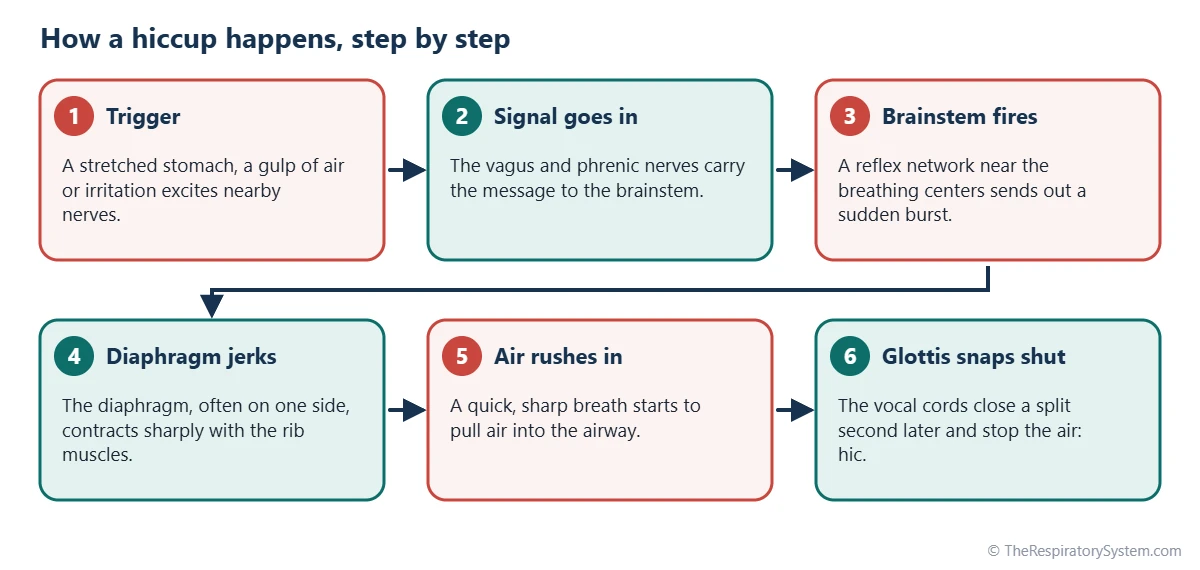
We hiccup because a reflex makes the diaphragm jerk downward without warning, and the vocal cords then close so quickly that the breath is stopped almost as soon as it starts. The trigger is usually irritation of the nerves that supply the diaphragm, the stomach or the esophagus.
The deeper question, what hiccups are for, has no settled answer. In adults they seem to do nothing useful. Researchers suspect they are a reflex left over from an earlier stage of development or of evolution, which is explored in the evolution section below.
Hiccups belong to the same group of automatic breathing reflexes as sneezing, yawning and coughing, all of which are part of respiratory physiology. What sets the hiccup apart is that it is a breath that starts and is then blocked by the body's own reflex.
Explained simply: a hiccup is a sudden, tiny gasp that your body starts by itself. Your breathing muscle tugs, air starts to rush in, and a door in your throat slams shut. The slam is the hic you hear.
What Happens in the Body During a Hiccup?
During a hiccup the diaphragm and the muscles that lift the ribs contract sharply, as in a quick breath in, and then the glottis closes about 35 milliseconds later. The air that has just started to flow hits the closed vocal cords, which produces the sound and a small jolt in the chest.
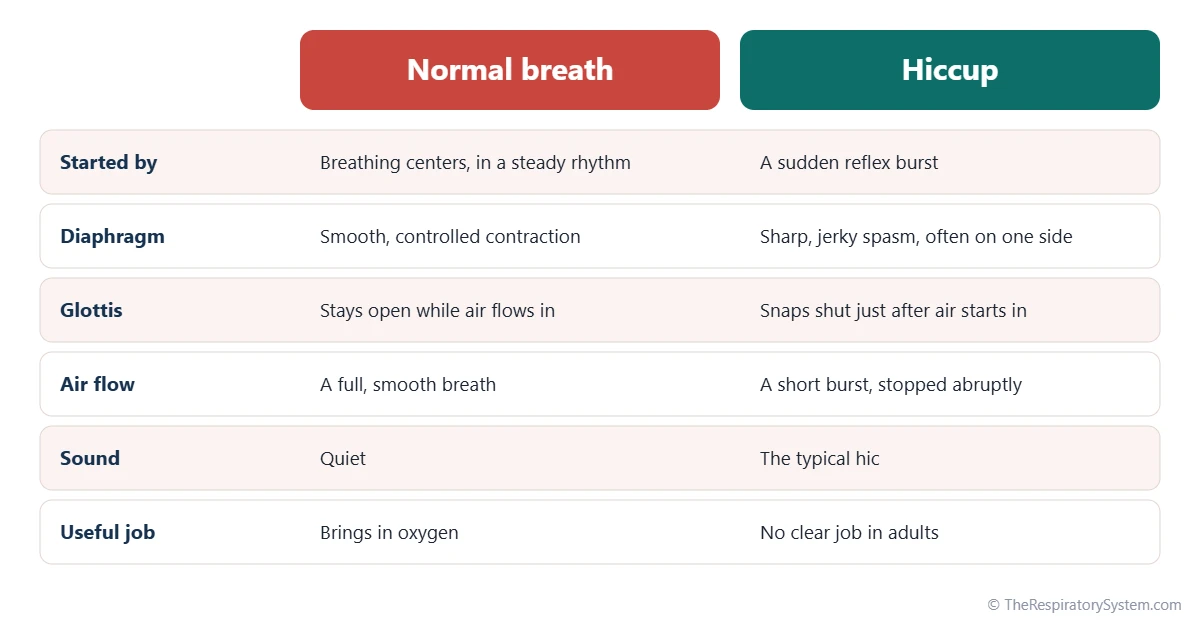
A normal breath is very different. In ordinary inhalation and exhalation, the diaphragm contracts smoothly in a steady rhythm set by the breathing centers, and the glottis stays open so air flows freely into the lungs. In a hiccup, the contraction is a short, jerky spasm, and it often involves only one side of the diaphragm, more commonly the left.
Hiccups usually come in bouts. Once a bout starts, the hiccups tend to repeat at a fairly regular rhythm for a few minutes and then stop on their own. Because the glottis shuts each time, very little air actually enters the lungs during a hiccup.
What Causes Hiccups in the Body? The Hiccup Reflex Arc
Hiccups are caused by a reflex arc with three parts: sensory nerves that pick up irritation, a control network in the brainstem, and motor nerves that make the diaphragm and glottis act.
- Sensory side: the vagus nerve carries signals from the esophagus, stomach and other organs in the chest and abdomen; the phrenic nerve carries some sensation from the diaphragm and the linings around it; sympathetic fibers from the middle and lower chest add input.
- Central part: a network in the brainstem near the breathing centers that are described on our control of breathing page receives the signals and produces the hiccup burst. There is no single, sharply defined hiccup center.
- Motor side: the phrenic nerve makes the diaphragm contract, nerves to the intercostal muscles lift the ribs, and the recurrent laryngeal nerve, a branch of the vagus, closes the glottis.
Because the vagus and phrenic nerves run past the esophagus, heart, lungs and stomach, irritation almost anywhere along their path can start the reflex. This explains why so many different things can cause hiccups.
| Part of the reflex | Structure | Role in a hiccup |
|---|---|---|
| Sensory input | Vagus nerve | Carries irritation signals from the esophagus, stomach and chest organs |
| Sensory input | Phrenic nerve (sensory fibers) | Carries sensation from the diaphragm and the linings around it |
| Sensory input | Sympathetic fibers from the chest | Add signals from organs of the chest and upper abdomen |
| Control | Brainstem network near the breathing centers | Produces the sudden hiccup burst |
| Motor output | Phrenic nerve (motor fibers) | Makes the diaphragm contract sharply, often on one side |
| Motor output | Nerves to the intercostal muscles | Lift the ribs at the same moment |
| Motor output | Recurrent laryngeal nerve | Closes the glottis about 35 milliseconds after the spasm starts |
| Result | Vocal cords and glottis | Stop the inflowing air and make the hic sound |
| Source: Typical physiology, our editors | ||
What Triggers Hiccups?
Most everyday hiccups are triggered by a stretched stomach or irritation of the esophagus, both of which excite the nerves of the hiccup reflex. The stomach lies just under the diaphragm, and the esophagus passes through it at the esophageal hiatus, so these organs and the breathing muscle are close neighbors.
Common triggers include:
- eating a large meal or eating very quickly
- fizzy drinks, which release gas and stretch the stomach
- swallowing air while eating, drinking or chewing gum
- sudden temperature changes, such as very hot food followed by a cold drink
- excitement, stress or a burst of laughter
Why do we hiccup when drunk?
Alcohol can irritate the lining of the esophagus and stomach, and drinks are often fizzy or taken in large gulps, which stretches the stomach. Alcohol also dulls the brain's normal control over reflexes, which may make it easier for the hiccup reflex to fire.
Why Do We Hiccup? What Evolution Suggests
The leading evolutionary idea is that hiccups are a leftover of the breathing pattern used by ancestral animals that breathed with gills. Tadpoles and some air-breathing fish move water over their gills while closing the glottis so water does not flood the lungs, a motor pattern that looks much like a hiccup.
Supporters of this idea point out that the hiccup program sits in the brainstem, close to the oldest breathing circuits, and that it switches on very early in development. Babies hiccup in the womb during the first trimester, before they make regular breathing movements.
What causes hiccups in babies?
Babies hiccup much more often than adults, especially after feeding. A second hypothesis says this is the reflex's real job: a hiccup during or after nursing may help move swallowed air out of the stomach, leaving more room for milk. Both ideas are still debated, and neither has been proven.
Hiccups are not unique to humans. Other mammals, including cats, dogs and rats, also hiccup, which supports the view that the reflex is old and widely shared.
Which Parts of the Respiratory System Are Involved in Hiccups?
A hiccup involves the diaphragm and the rib muscles that power the breath, the larynx that cuts it off, and the nerves that link them. The diaphragm and the external intercostals are the same muscles of respiration used in every normal breath, and the phrenic nerve is their main motor nerve.
The sound comes from the larynx, where the vocal cords slam together to close the glottis. Nearby structures matter too: the esophagus, which runs behind the trachea and through the diaphragm, and the stomach under the diaphragm are the most common sources of the irritating signals.
Most hiccups are harmless and stop within minutes. Hiccups that last longer than 48 hours are called persistent, and those lasting more than a month are called intractable; these long bouts can be linked to other conditions, some of which are covered on our respiratory diseases page. Hiccups that do not go away within two days are a reason to see a doctor.
Key Facts
- A hiccup is a sudden, involuntary contraction of the diaphragm followed by closure of the glottis.
- The glottis closes about 35 milliseconds after the spasm begins, which makes the hic sound.
- The hiccup reflex runs through the vagus nerve, the phrenic nerve and a network in the brainstem.
- A stretched stomach, fizzy drinks, alcohol and swallowed air are the most common triggers.
- Babies hiccup in the womb during the first trimester, before regular breathing movements begin.
- Hiccups lasting more than 48 hours are called persistent, and those lasting more than a month are called intractable.
- One leading idea links hiccups to the gill breathing of tadpoles and ancestral fish.
Frequently Asked Questions
What does the word hiccup mean?
Hiccup is an imitative word: it copies the sound the closing glottis makes. An older spelling, hiccough, looks as if it is related to coughing, but it is simply a variant spelling of the same word. Doctors use the term singultus, from a Latin word linked to catching the breath while sobbing.
Do fish hiccup?
Fish do not hiccup the way people do, but they are part of the evolution story. In tadpoles and some air-breathing fish, the brainstem drives water over the gills while the glottis closes to protect the lungs. The motor pattern of a human hiccup looks so similar that some researchers think our hiccups are an echo of that ancient gill breathing.
Why do hiccups often come in a steady rhythm?
Once the reflex is switched on, the brainstem network that drives it tends to repeat its output at regular intervals, much like the circuits that set the rhythm of ordinary breathing. The bout continues until the triggering signals fade or the network is reset, which is why hiccups usually stop on their own after a few minutes.
Can hiccups happen during sleep?
Ordinary short bouts of hiccups usually fade when a person falls asleep, because the brain becomes less responsive to many reflex triggers. Long-lasting hiccups, however, can continue during sleep and may wake a person up. Hiccups that keep going through the night are one of the signs that separate long-lasting hiccups from the everyday kind.
Are hiccups bad for babies?
Hiccups are very common in babies and are usually harmless. Newborns hiccup often, especially after feeding, and many babies do not seem bothered by them. Their hiccup reflex is very active from before birth, which is one reason some scientists think the reflex may have a job in early life, such as helping clear air from the stomach.
Do other animals get hiccups?
Yes. Many mammals hiccup, including cats, dogs, horses and rats, and young animals seem to hiccup more than adults, just as human babies do. The reflex has been studied in laboratory animals to find which nerves and brain areas control it, and the results match the human reflex arc through the vagus nerve, phrenic nerve and brainstem.
Is a hiccup the same as a burp?
No. A hiccup is a breathing reflex: the diaphragm pulls air in and the glottis stops it. A burp, or belch, is gas escaping upward from the stomach through the esophagus and out of the mouth. The two can appear together, because a stomach stretched by gas can trigger hiccups, but they involve different passages and muscles.
Keep Exploring


