At a Glance
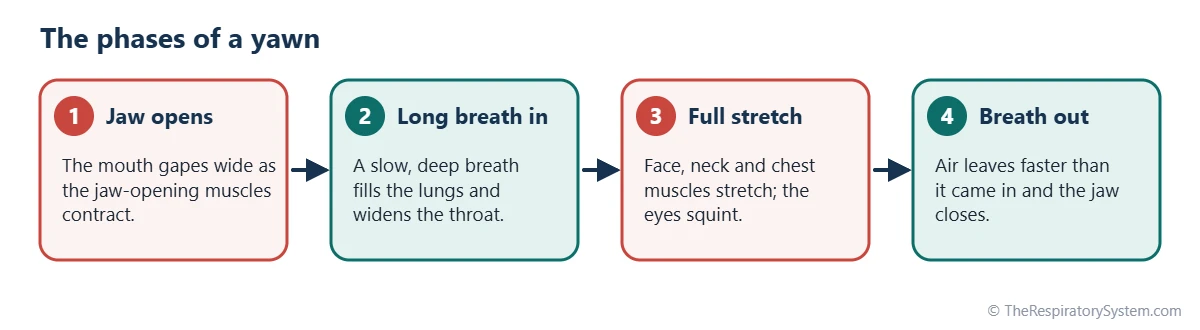
The exact reason we yawn is still debated. A yawn is an involuntary reflex lasting several seconds: a wide opening of the mouth with a long, deep inhalation, a short peak in which the face and throat muscles stretch, and a quicker exhalation. The main hypotheses are brain cooling, a shift between states such as sleep and waking, and social communication; the old idea that yawning brings in extra oxygen is not supported by experiments.
- Type
- Involuntary reflex that can also be triggered socially
- Cause
- Still debated; leading ideas are brain cooling, state change and social signaling
- When it happens
- Before sleep, after waking, during boredom, and after seeing someone else yawn
- Muscles used
- Jaw-opening muscles, diaphragm, intercostal muscles, throat and face muscles
- Control
- Networks in the brainstem and the hypothalamus
- Contagious?
- Yes, in many adults: seeing, hearing or even reading about a yawn can start one
On this page
Why Do We Yawn?
The honest answer is that nobody knows for certain why we yawn. Researchers agree on what happens during a yawn, but the purpose of the reflex is still an open question, and several explanations compete.
What is known is that yawning is ancient and widespread. Nearly all mammals yawn, and so do many birds, reptiles and fish. Babies yawn before they are born, and adults yawn most often in the hour before sleep and just after waking. Any explanation has to fit all of these facts, which is one reason the debate is not settled.
A yawn is part of the wider story of respiratory physiology because it is, among other things, an unusually deep breath. But unlike an ordinary breath, it is not controlled by the need for oxygen. The control of breathing that keeps blood gases steady works on its own schedule, while yawns follow sleepiness, boredom and social cues.
Explained simply: a yawn is a big, slow stretch of the mouth, throat and chest that your brain starts by itself. Scientists can describe every step of it, but they are still arguing about what it is for.
What Happens in the Body When You Yawn?
A yawn has three phases: a long breath in with the mouth opening wide, a short peak when the muscles are fully stretched, and a quicker breath out as the jaw closes. A typical yawn lasts about six seconds, and once it starts it is very hard to stop halfway.
- Breath in: jaw-opening muscles pull the mouth wide while the diaphragm moves far down and the intercostal muscles lift the ribs, so the lungs take in much more air than in a normal breath.
- Throat opening: the pharynx widens, the larynx moves down, and the vocal cords spread far apart.
- Peak: the eyes squint, the face and neck muscles stretch, and many people stretch their arms at the same time.
- Breath out: the air leaves faster than it came in, the jaw closes, and the muscles relax.
Several side effects come from the same stretch. The squeezing of the face can press on the tear glands so the eyes water, and muscles of the soft palate can open the auditory tubes, which is why the ears sometimes pop.
| Body part | What it does during a yawn | Effect you notice |
|---|---|---|
| Jaw-opening muscles | Pull the lower jaw down as far as it will go | The wide gape of the mouth |
| Diaphragm | Contracts strongly and moves far down | A long, deep breath in |
| External intercostal muscles | Lift and widen the rib cage | The chest expands more than usual |
| Pharynx | Widens as the throat muscles stretch | A feeling of the throat opening |
| Larynx and vocal cords | The larynx drops and the vocal cords spread apart | Air flows in freely; a sound may escape on the way out |
| Face and eyelid muscles | Contract and squeeze around the eyes | Squinting and watery eyes |
| Soft palate muscles | Can open the auditory tubes to the middle ear | Ears may pop or sound muffled |
| Brainstem and hypothalamus | Start and time the reflex | The yawn runs to the end once begun |
| Source: Typical physiology, our editors | ||
What Are the Main Theories About Why We Yawn?
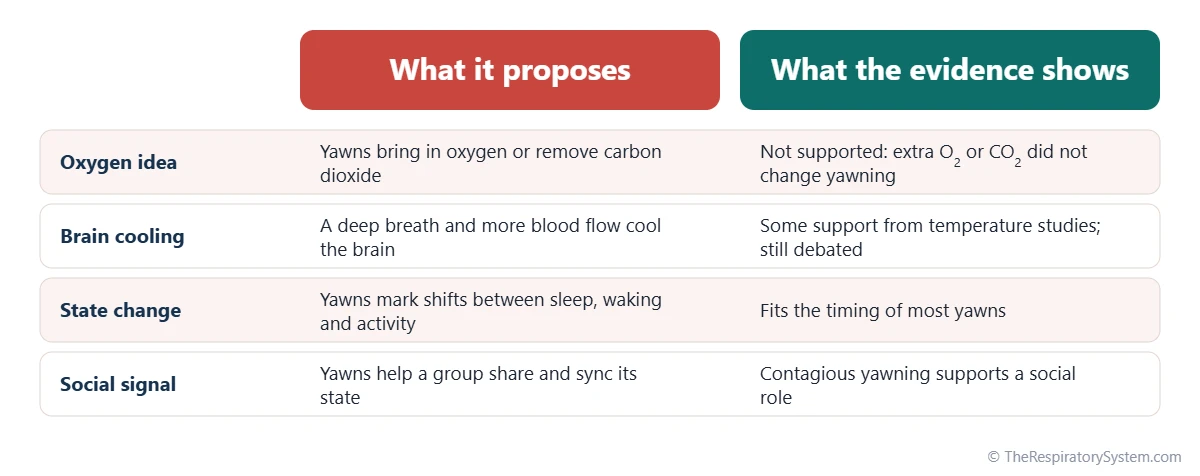
The four best-known theories say that yawning raises oxygen, cools the brain, marks a change in alertness, or sends a social signal, and only the last three are still taken seriously.
The oxygen idea (not supported)
The oldest explanation is that we yawn to take in oxygen or get rid of carbon dioxide. Experiments in the 1980s tested this by having people breathe air with extra oxygen or extra carbon dioxide, and their yawning rate did not change. Exercise, which raises the body's oxygen use sharply, does not make people yawn more either. The page on why we need oxygen explains how oxygen supply is really controlled.
Brain cooling
This theory says a yawn brings cooler air into the mouth and nose and increases blood flow through the face and skull, which may help carry heat away from the brain. Some studies found that people yawn more when the outside air is moderately warm than when it is very hot or cold, which fits the idea, but it remains under debate.
State change and alertness
Yawns cluster at moments when the brain is shifting from one state to another: falling asleep, waking up, getting bored, or getting ready for action. One idea is that the stretch and deep breath help the body move between these states.
Social signal
Because yawns spread from person to person, many researchers think they also help a group share its state, for example signaling that it is time to rest.
Why Do We Yawn When We Are Tired?
We yawn when we are tired because yawning is closely tied to the brain's sleep and wake cycle, although why the two are linked is part of the same unsettled question. Yawns are most frequent in the late evening and in the first hour after waking, the two daily turning points between sleep and wakefulness.
Boredom produces yawns for a similar reason: it is a low-alertness state. Interestingly, people also yawn in situations that are not sleepy at all, such as athletes before a race or performers before going on stage. This supports the idea that yawns mark a change of state rather than tiredness alone.
Networks in the brainstem and the hypothalamus, using chemical messengers such as dopamine and oxytocin, are known to take part in starting a yawn, which links yawning to the same brain regions that manage sleep, arousal and hormone release.
Why Is Yawning Contagious?
Yawning is contagious because the brain responds to other people's yawns with a yawn of its own, most likely as a form of social mirroring, although the exact mechanism is still being studied. Seeing a yawn, hearing one, or even reading about yawning can be enough to start one.
Contagious yawning is not present at birth. Babies yawn spontaneously from the start, but catching yawns from others usually appears only in early childhood, around age four or five, when children are also learning to read other people's feelings. Studies have found that adults catch yawns more easily from family and close friends than from strangers, which links contagious yawning to social closeness and empathy.
Some animals catch yawns too. Chimpanzees catch yawns from other chimpanzees, and pet dogs have been reported to yawn after watching their owners yawn.
Which Parts of the Respiratory System Take Part in a Yawn?
A yawn uses the airway from the mouth to the lungs and the muscles that move air through it. The mouth and the oral cavity open widely, the pharynx and the nasopharynx stretch, and the larynx drops so that the open glottis lets a large volume of air pass.
The inhalation and exhalation of a yawn use the same muscles as ordinary breathing, only much harder: the diaphragm and external intercostals for the breath in, and the elastic recoil of the lungs and chest for the breath out.
Yawning belongs to a small family of breathing reflexes with different triggers. A sneeze clears the nose, a cough clears the lower airways, and a hiccup is a sudden spasm of the diaphragm. A yawn is the only one of these that is regularly triggered by seeing someone else do it.
Key Facts
- The reason we yawn is still debated; scientists know how a yawn works better than why it happens.
- A typical yawn lasts about six seconds and includes a long breath in, a stretched peak and a quicker breath out.
- Breathing extra oxygen or extra carbon dioxide does not change how often people yawn, so yawning is not a fix for low oxygen.
- During a yawn the pharynx widens, the larynx drops and the vocal cords spread wide apart.
- Babies yawn before birth, but contagious yawning usually appears only around age four or five.
- People catch yawns more easily from family and friends than from strangers.
- Yawning, sneezing and hiccuping are separate reflexes with different triggers and nerves.
Frequently Asked Questions
Why is yawning contagious but not sneezing?
A sneeze is started by a physical irritant touching the nasal lining, so seeing someone sneeze does nothing to your own nose. A yawn is started from inside the brain, by states such as sleepiness and by social cues, so watching another person yawn can trigger the same reflex. That difference in trigger explains why only yawning spreads.
Is yawning a sign of low oxygen?
Usually not. Experiments that changed the oxygen and carbon dioxide in the air people breathed did not change how often they yawned, and the body controls oxygen supply through chemoreceptors and the breathing rate instead. Ordinary yawning is linked to sleepiness, boredom and seeing others yawn, not to the oxygen level of the blood.
Do babies yawn before they are born?
Yes. Ultrasound scans show that babies yawn in the womb, with yawns seen as early as the end of the first trimester. Newborns yawn often in their first days. Spontaneous yawning is therefore present from the very start of life, while catching yawns from other people develops years later, in early childhood.
Why do our eyes water when we yawn?
During a yawn the muscles around the eyes squeeze tightly and the face stretches. This pressure pushes on the tear glands and the small tear sacs near the inner corners of the eyes, so tears are squeezed out onto the surface. The eyes are not crying in the emotional sense; the watering is a mechanical side effect of the stretch.
Why do your ears pop when you yawn?
The muscles of the soft palate that tighten during a yawn can pull open the auditory tubes, the narrow channels that connect the back of the nose to the middle ears. When a tube opens, air pressure on both sides of the eardrum evens out, which you hear as a pop. Swallowing can open the same tubes.
Do animals yawn?
Yes. Almost all mammals yawn, including cats, dogs, horses and primates, and yawning has also been seen in birds, reptiles and fish. In some monkeys a wide yawn showing the teeth seems to work as a display or threat. Contagious yawning is far rarer and has been reported mostly in social species such as chimpanzees and dogs.
What does yawning a lot mean?
In most people, yawning a lot simply reflects sleepiness, boredom, a late night or being around others who yawn. Because yawns follow the sleep and wake cycle, poor or short sleep tends to increase them. Frequent yawning that comes without tiredness, or together with other new symptoms, is a reason to see a doctor.
Keep Exploring


