At a Glance
The vocal cords (vocal folds) are two folds of tissue in the larynx that run from the inside of the thyroid cartilage in front to the arytenoid cartilages at the back. In adults they are typically about 17 to 25 mm long in men and about 12.5 to 17.5 mm in women; they open for breathing, close during swallowing and coughing, and vibrate to produce the voice.
- Location
- Inside the larynx, behind the Adam's apple, at the level called the glottis
- Also called
- Vocal folds, true vocal cords; the pair above them are the false vocal cords (vestibular folds)
- Made of
- Stratified squamous epithelium, layered lamina propria with the vocal ligament, and the vocalis muscle
- Length
- About 17 to 25 mm in adult men and 12.5 to 17.5 mm in adult women
- Nerve supply
- Recurrent laryngeal nerve for most muscles; external laryngeal nerve for the cricothyroid
- Part of
- Larynx (voice box), upper respiratory tract
On this page
What Are the Vocal Cords?
The vocal cords are a pair of soft, flexible folds inside the larynx that can open, close and vibrate, and they are the source of the human voice. Anatomists prefer the name vocal folds, because they are not loose strings but ledges of tissue that jut in from the side walls of the airway.
Every breath passes between them. The gap they leave is called the rima glottidis, and the folds plus that gap together make up the glottis. Because they guard the entrance to the trachea, the vocal cords are both a voice organ and a working part of the airway.
Larynx vs vocal cords
The larynx is the whole voice box, a frame of nine laryngeal cartilages with its muscles, ligaments and lining, while the vocal cords are just one pair of folds inside it. In other words, the vocal cords are part of the larynx, in the same way that strings are part of a guitar.
Explained simply
Imagine two curtains hung across a doorway. When you breathe they are pulled apart so air can pass. When you speak they are drawn together, and air pushing through makes their edges flutter and buzz. When you swallow they are shut tight, like a door locked against food.
Where Are the Vocal Cords Located?
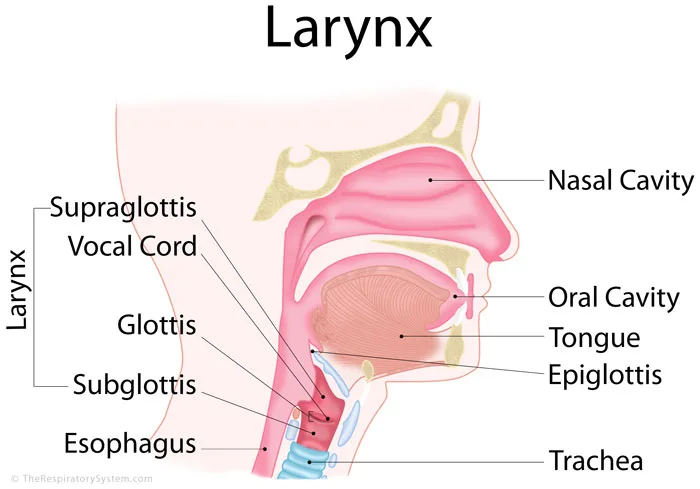
The vocal cords are located in the middle of the larynx, directly behind the Adam's apple, where they stretch from front to back across the airway at the level of the glottis. They lie below the epiglottis and the false vocal cords and above the subglottis, the short space that leads down into the trachea.
Each fold attaches in front to the inner surface of the thyroid cartilage, close to the midline, where the two folds meet at a point called the anterior commissure. At the back, each one ends on the vocal process of an arytenoid cartilage, which can rotate and slide. The front of each fold therefore stays fixed, and the back swings open and shut like a gate on a hinge.
Seen from above with a mirror or a camera, the two folds form a V, with its point at the front. Between the true vocal cords and the false ones above sits a small side pocket on each side called the laryngeal ventricle. In adults the glottis is the narrowest part of the airway.
Vocal Cords Anatomy: What Are They Made Of?
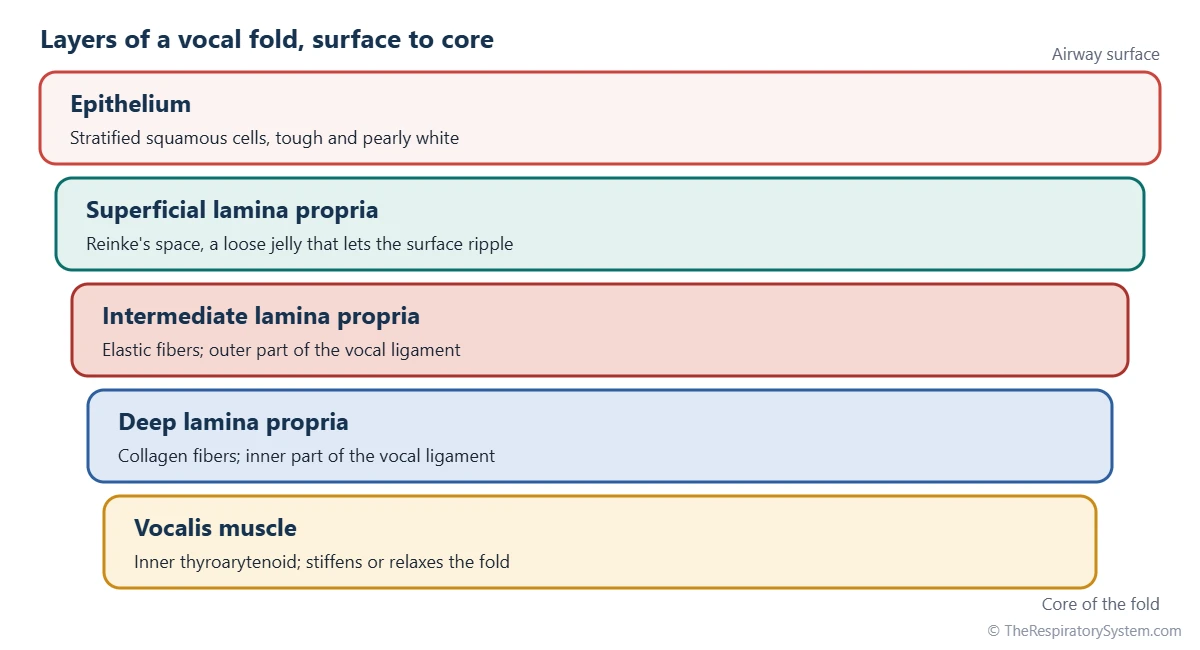
Each vocal cord is made of a thin surface epithelium, a layered connective tissue called the lamina propria and, at its core, the vocalis muscle, arranged so that a loose outer cover can ripple over a firmer body. This layered design is what lets the folds vibrate hundreds of times a second without tearing.
The layers
- Epithelium: a non-keratinized stratified squamous layer, tougher than the ciliated respiratory epithelium lining most of the airway, which gives the folds their pearly white look.
- Superficial lamina propria: a loose, jelly-like layer, also called Reinke's space, that lets the surface slide and wave freely.
- Intermediate and deep lamina propria: layers rich in elastic and then collagen fibers that together form the vocal ligament.
- Vocalis muscle: the inner part of the thyroarytenoid muscle, which stiffens or slackens the fold.
Muscles, nerves and blood supply
The small intrinsic muscles of the larynx move the arytenoid and thyroid cartilages to open, close, stretch and shorten the folds. All of them are supplied by the recurrent laryngeal nerve except the cricothyroid muscle, which is supplied by the external branch of the superior laryngeal nerve. Blood reaches the folds through the superior and inferior laryngeal arteries, branches of the thyroid arteries, and the true folds have very few lymph vessels.
| Part | What it is | Role |
|---|---|---|
| Epithelium | Non-keratinized stratified squamous epithelium | Tough surface that withstands constant collision during vibration |
| Superficial lamina propria (Reinke's space) | Loose, jelly-like connective tissue | Lets the surface ripple in a wave over the deeper layers |
| Intermediate lamina propria | Layer rich in elastic fibers | Gives the fold its spring; part of the vocal ligament |
| Deep lamina propria | Layer rich in collagen fibers | Gives strength; part of the vocal ligament |
| Vocalis muscle | Inner part of the thyroarytenoid muscle | Stiffens or slackens the body of the fold |
| Anterior commissure | Front meeting point of the two folds | Fixed anchor on the inside of the thyroid cartilage |
| Vocal process | Forward projection of the arytenoid cartilage | Back anchor that moves to open and close the fold |
| Rima glottidis | Gap between the two vocal folds | Air passage; narrowest part of the adult airway |
| Laryngeal ventricle | Side pocket between true and false folds | Collects mucus that lubricates the true folds |
| Vestibular fold | False vocal cord above the true fold | Helps seal the airway; does not normally vibrate |
| Source: Typical adult anatomy, our editors | ||
What Is the Function of the Vocal Cords?
The vocal cords have three main functions: they open to let air in and out during breathing, they close to protect the lower airway, and they vibrate to produce voice for speech and singing. Their function in the respiratory system comes first; voice is a later use of the same valve.
Vocal cords function in the respiratory system
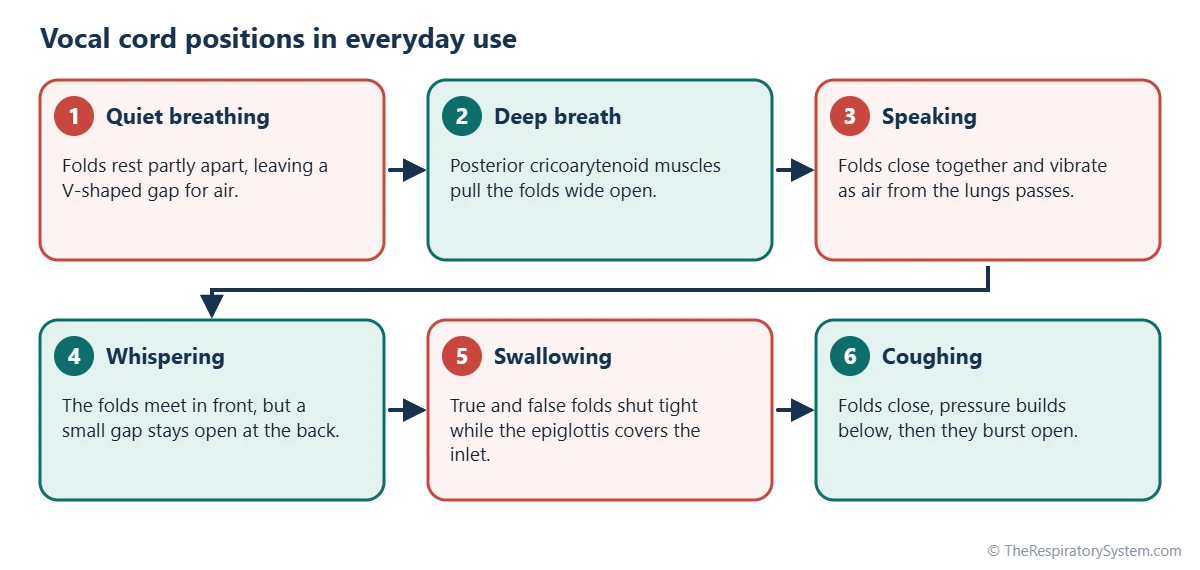
During quiet breathing the folds rest partly apart. With each breath in they widen slightly, and during a deep or forceful breath the posterior cricoarytenoid muscles pull them wide open to lower resistance to airflow. During breathing out they drift a little closer together, which slows the outflow of air. Through these small movements the vocal cords help control how fast air enters and leaves the lungs.
Protecting the airway
When you swallow, the vocal cords close tightly together with the false vocal cords and the epiglottis, so food and drink are steered into the esophagus instead of the trachea. They also make a cough possible: the folds shut, pressure builds in the chest, and then they burst open to blast out mucus or a foreign particle. Holding the folds closed also fixes the chest when lifting something heavy.
Vocal folds function in speech
To make voice, the folds are brought together and air from the lungs pushes them apart; their elasticity and the drop in pressure between them pull them back, and the cycle repeats, producing a buzzing sound. A typical adult male speaking voice vibrates around 100 to 150 times per second, and a female voice around 180 to 250 times. The throat, mouth and nose then shape that buzz into words, as explained on our page on how the voice is produced.
What Do the False Vocal Cords (Vestibular Folds) Do?
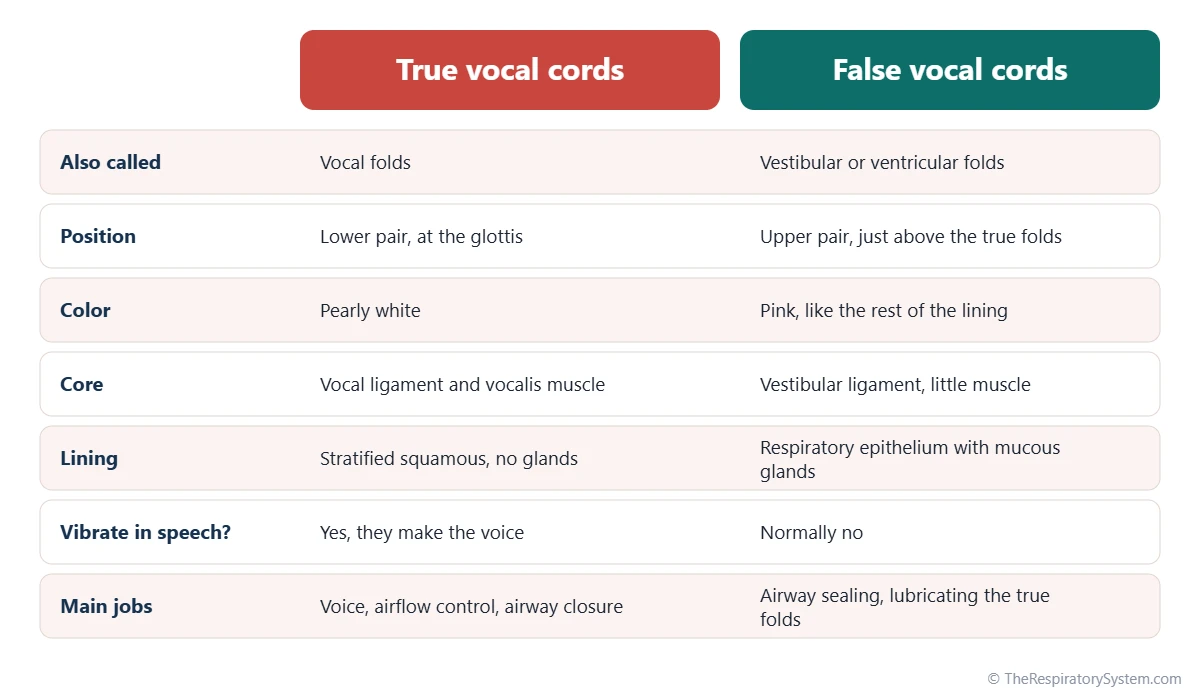
The false vocal cords, or vestibular folds, are a second, thicker pair of folds just above the true vocal cords whose main function is to help seal the airway and to keep the true folds moist; they do not normally vibrate in speech. They contain the vestibular ligament and only a little muscle.
Each vestibular fold is lined with respiratory epithelium and contains many mucous glands. Their secretions drain into the laryngeal ventricles and coat the true vocal cords, which have no glands of their own and need constant lubrication to vibrate smoothly. During swallowing, coughing and straining, the false folds close as a second barrier above the true ones.
In some styles of singing, such as certain kinds of throat singing, the false folds can be made to vibrate on purpose and produce a rough, low sound. In ordinary speech, voice made with the false folds is a sign that the true folds are not closing properly.
How Do the Vocal Cords Change With Age?
The vocal cords are short and high in the neck in infants, grow quickly at puberty, especially in boys, and become thinner and less elastic in older age, which is why the voice changes across life. Their length is the main reason adult men usually have deeper voices than women and children.
At puberty the male larynx enlarges, the thyroid cartilage forms a visible Adam's apple and the vocal cords become longer and thicker, so the pitch drops by roughly an octave; the voice can crack while the muscles adjust. Girls' vocal cords also grow, but less, and their pitch drops only a little. In older adults the vocalis muscle can thin and the folds may bow slightly, making the voice weaker or breathier, a change sometimes called presbyphonia.
Common Conditions That Affect the Vocal Cords
Most conditions of the vocal cords cause hoarseness, a change in the voice, or noisy breathing, and they range from short-term swelling to lasting nerve damage. Our respiratory diseases section covers airway conditions, and hoarseness that lasts more than a few weeks is a reason to see a doctor.
- Laryngitis: inflammation and swelling of the folds, often from a cold or voice strain.
- Vocal cord nodules: small, firm bumps on both folds, usually from heavy voice use, at the point where the folds strike hardest.
- Polyps and cysts: soft growths, usually on one fold, that stop the edges from meeting cleanly.
- Reinke's edema: fluid swelling of the superficial lamina propria, strongly linked to smoking, which lowers the voice.
- Vocal cord paralysis: loss of movement of one or both folds after damage to the recurrent laryngeal nerve; the left nerve, which loops down around the aorta, is affected more often.
- Vocal cord dysfunction: the folds close when they should open during breathing in, which can be mistaken for asthma.
- Laryngeal cancer: the glottis is the most common site of cancer of the larynx, and tobacco smoke is the main risk factor.
Key Facts
- The vocal cords are two folds inside the larynx that open for breathing, close for swallowing and vibrate for voice.
- They run from the thyroid cartilage in front to the arytenoid cartilages at the back, behind the Adam's apple.
- Adult vocal cords are typically about 17 to 25 mm long in men and 12.5 to 17.5 mm in women.
- The gap between the folds, the rima glottidis, is the narrowest part of the adult airway.
- The false vocal cords above them help seal the airway and supply mucus but do not normally vibrate.
- All muscles that move the folds are supplied by the recurrent laryngeal nerve except the cricothyroid.
- At puberty the male vocal cords lengthen and thicken, lowering the voice by roughly an octave; see how the voice is produced.
Quick Quiz: Test What You Know About the Vocal Cords
6 questions. Tap an answer to check it.
Which cartilages hold the back ends of the vocal cords?
Each vocal cord ends at the back on the vocal process of an arytenoid cartilage, which rotates and slides to open and close the fold.
What is the gap between the two vocal cords called?
The opening between the vocal folds is the rima glottidis; the folds and the gap together form the glottis.
Which muscle is the only one that opens the vocal cords?
The posterior cricoarytenoid turns the arytenoids outward, pulling the vocal cords apart; the other intrinsic muscles close or tense them.
What type of epithelium covers the true vocal cords?
The true folds are covered by non-keratinized stratified squamous epithelium, which withstands the constant rubbing of vibration.
What is the main job of the false vocal cords?
The vestibular folds help close the airway during swallowing and straining, and their glands keep the true vocal cords moist.
Which nerve supplies most of the muscles that move the vocal cords?
The recurrent laryngeal nerve, a branch of the vagus, supplies all intrinsic laryngeal muscles except the cricothyroid.
Frequently Asked Questions
Are the vocal cords part of the respiratory system?
Yes. The vocal cords sit inside the larynx, which is part of the upper respiratory tract, and every breath passes between them. Their first job is respiratory: they open to let air in and out, adjust airflow and close to keep food and liquid out of the trachea and lungs. Producing the voice is an extra job built on top of that breathing valve.
Why are they called vocal folds instead of vocal cords?
The older name, vocal cords, suggests loose strings stretched across the throat, like the strings of an instrument. In reality each one is a fold of tissue that sticks out from the side wall of the larynx and has layers of epithelium, connective tissue and muscle. Anatomists and voice specialists therefore prefer vocal folds, though both names mean the same structure.
Do the vocal cords vibrate when you whisper?
No. In a whisper the front parts of the vocal cords come close together but do not vibrate, and a small gap usually stays open between the arytenoid cartilages at the back. Air rushing through this narrow gap makes a hissing, noisy sound instead of a buzzing tone, and the mouth and tongue shape that noise into words.
Why does a boy's voice crack during puberty?
During puberty the larynx grows quickly and the vocal cords become longer and thicker within a few years. The muscles that control their tension take time to adjust to the new size, so the voice can jump suddenly between the old higher pitch and the new lower one. These cracks fade once the larynx stops growing and control settles.
Can you see your own vocal cords?
Not without special tools. The vocal cords lie deep in the throat, below the base of the tongue and behind the epiglottis, so they cannot be seen by looking into the mouth. Doctors view them with a small angled mirror held at the back of the throat or with a thin camera passed through the nose or mouth, a procedure called laryngoscopy.
Do men and women have different vocal cords?
The structure is the same, but the size differs. Adult men's vocal cords are usually about 17 to 25 mm long and thicker, while women's are usually about 12.5 to 17.5 mm. Longer, heavier folds vibrate more slowly, which is the main reason men's voices are typically lower. The difference develops at puberty, when the male larynx grows more.
What happens to the vocal cords when you hold your breath?
When you hold your breath with an open throat, the vocal cords can stay apart while the breathing muscles simply stop. When you hold your breath hard, for example while lifting or straining, the true and false vocal cords close tightly. This locks air in the chest and makes the trunk rigid, the same closure used just before a cough.
Why do the vocal cords look white?
The true vocal cords look pearly white because their surface is covered by stratified squamous epithelium and there are relatively few blood vessels just beneath it. The rest of the larynx, including the false vocal cords, is lined with pinker respiratory epithelium that has a richer blood supply. Redness of the true folds is a sign of irritation or inflammation.
Keep Exploring


