At a Glance
The Haldane effect means that oxygen binding lowers hemoglobin's affinity for carbon dioxide and hydrogen ions. In the lungs, oxygenation of hemoglobin releases carbamino carbon dioxide and hydrogen ions, which turn bicarbonate back into carbon dioxide for exhalation; in the tissues, deoxygenated hemoglobin loads more carbon dioxide. It was described in 1914 by Christiansen, Douglas and Haldane.
- Type
- Property of hemoglobin in blood gas transport
- Function
- Boosts carbon dioxide loading in the tissues and unloading in the lungs
- Where
- Red blood cells in the systemic and pulmonary capillaries
- Mechanism
- Deoxyhemoglobin forms more carbamino compounds and buffers more hydrogen ions
- Counterpart
- Bohr effect (carbon dioxide and acid lower oxygen affinity)
- Part of
- Carbon dioxide transport, gas exchange
On this page
- What Is the Haldane Effect?
- Where Does the Haldane Effect Happen?
- How Does the Haldane Effect Work With Hemoglobin?
- What Is the Function of the Haldane Effect in Respiration?
- Haldane Effect vs Bohr Effect
- Haldane Effect and the Carbon Dioxide Dissociation Curve
- Common Conditions Linked to the Haldane Effect
- Key Facts
- Quiz
- FAQ
What Is the Haldane Effect?
The Haldane effect is the change in how much carbon dioxide blood can carry depending on how much oxygen its hemoglobin holds: the less oxygen bound, the more carbon dioxide the blood takes up. It is a key part of carbon dioxide transport in the blood and an entry in our respiratory system glossary.
The effect was described in 1914 by Johanne Christiansen, Claude Gordon Douglas and John Scott Haldane, working in Oxford, and it carries Haldane's name. In physiology terms, the Haldane effect is the influence of hemoglobin oxygenation on the carbon dioxide content of blood at any given carbon dioxide pressure.
What is the Haldane effect in simple terms?
Think of hemoglobin as a delivery truck with two kinds of cargo. While the truck is full of oxygen, it has little room for carbon dioxide. When it drops off oxygen at the body's cells, room opens up, so it loads extra carbon dioxide. Back in the lungs, it loads oxygen again and has to dump its carbon dioxide, which you then breathe out.
Where Does the Haldane Effect Happen?
The Haldane effect happens inside red blood cells, in two places: the systemic capillaries of the body's tissues and the pulmonary capillaries around the alveoli. It works in opposite directions in the two places.
- In the tissues: during internal respiration, hemoglobin unloads oxygen to the cells, and the deoxygenated hemoglobin now picks up more of the carbon dioxide those cells produce.
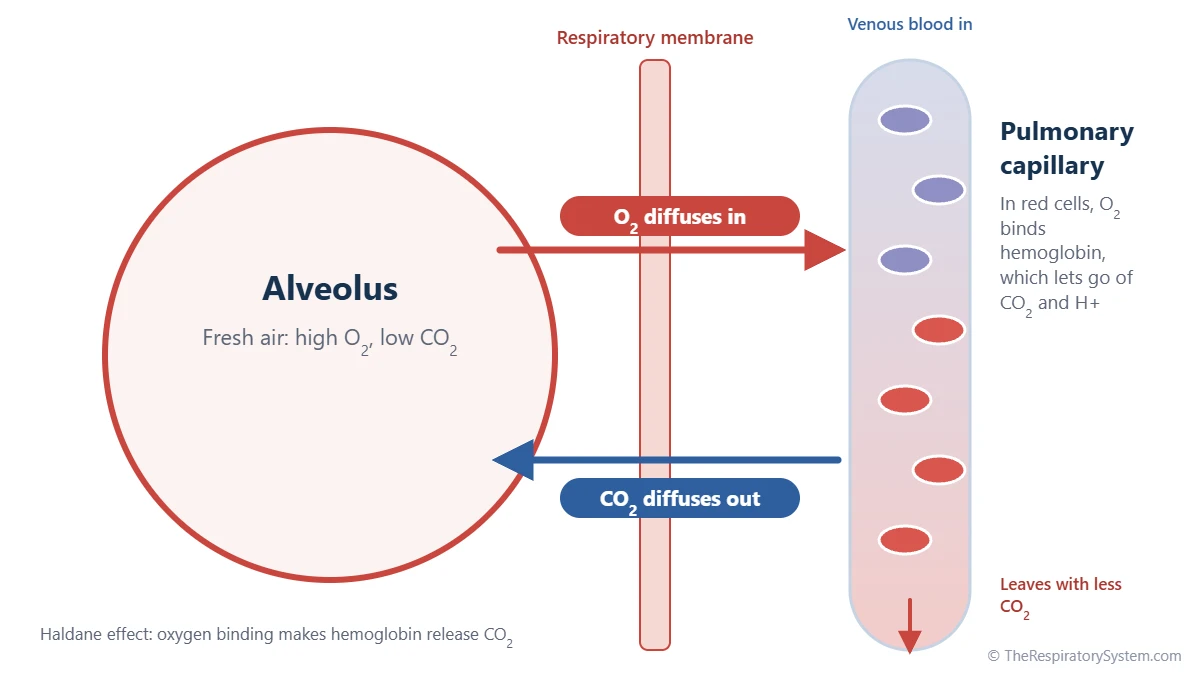
- In the lungs: during external respiration, oxygen crosses the respiratory membrane and binds hemoglobin, which forces carbon dioxide out of the blood and into the alveolar air.
The two sites are linked by the pulmonary circulation and the systemic circulation, so each red blood cell repeats the cycle on every lap of the body. The difference between these two kinds of respiration is explained in external and internal respiration.
How Does the Haldane Effect Work With Hemoglobin?
The Haldane effect works because deoxygenated hemoglobin binds carbon dioxide and hydrogen ions more strongly than oxygenated hemoglobin. Hemoglobin changes shape when oxygen binds, and that change affects two separate ways of carrying carbon dioxide.
1. Carbamino compounds
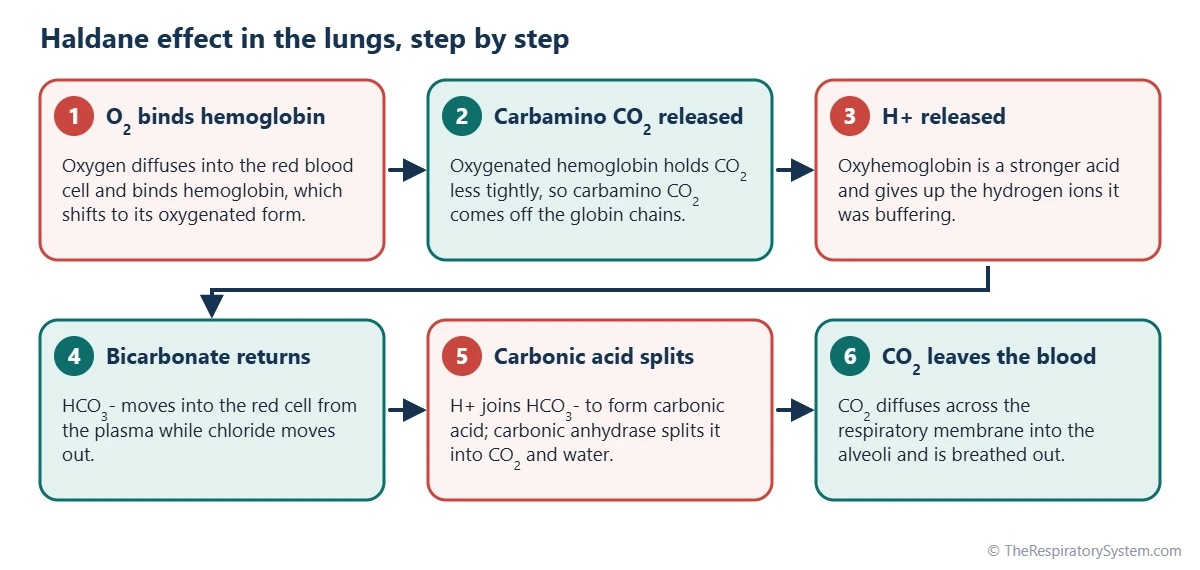
Carbon dioxide can attach directly to the amino groups at the ends of hemoglobin's globin chains, forming carbaminohemoglobin. Deoxyhemoglobin forms these carbamino compounds much more readily than oxyhemoglobin. When oxygen binds in the lungs, the carbamino carbon dioxide falls off.
2. Buffering of hydrogen ions
Most carbon dioxide travels as bicarbonate. Inside red blood cells, the enzyme carbonic anhydrase turns carbon dioxide and water into carbonic acid, which splits into hydrogen ions and bicarbonate. Deoxyhemoglobin is a weaker acid than oxyhemoglobin, so it soaks up more of these hydrogen ions, which keeps the reaction running toward bicarbonate and lets the blood hold more carbon dioxide.
Reversal in the lungs
When hemoglobin is oxygenated, it becomes a stronger acid and releases its hydrogen ions. These combine with bicarbonate that moves back into the red cell from the plasma, in exchange for chloride, to form carbonic acid, which carbonic anhydrase splits into water and carbon dioxide. The carbon dioxide then diffuses into the alveoli.
| Feature | In the tissues (systemic capillaries) | In the lungs (pulmonary capillaries) |
|---|---|---|
| Hemoglobin state | Gives up oxygen and becomes deoxyhemoglobin | Takes up oxygen and becomes oxyhemoglobin |
| Affinity for carbon dioxide | Rises | Falls |
| Carbamino compounds | Form more readily on the globin chains | Break down and release carbon dioxide |
| Hydrogen ion buffering | Deoxyhemoglobin accepts more hydrogen ions | Oxyhemoglobin releases hydrogen ions |
| Bicarbonate | More is made and moves out into the plasma | Moves back into red cells and becomes carbon dioxide again |
| Chloride shift | Chloride moves into the red cells | Chloride moves out of the red cells |
| Carbonic anhydrase reaction | Carbon dioxide and water form carbonic acid | Carbonic acid splits into carbon dioxide and water |
| Net effect on carbon dioxide | Blood loads more carbon dioxide | Blood unloads more carbon dioxide |
| Linked Bohr effect | Carbon dioxide and acid help release oxygen | Loss of carbon dioxide and acid helps load oxygen |
| Source: Standard physiology, our editors | ||
What Is the Function of the Haldane Effect in Respiration?
The function of the Haldane effect in respiration is to make carbon dioxide exchange more efficient, so the blood can collect and release more carbon dioxide for the same small change in carbon dioxide pressure. It couples oxygen delivery and carbon dioxide removal into one smooth process.
- Bigger carbon dioxide loading: tissues that use the most oxygen leave the most deoxygenated hemoglobin behind, so the blood automatically takes up more of their carbon dioxide.
- Bigger carbon dioxide unloading: in the lungs, oxygen binding helps push carbon dioxide out, so gas exchange clears it without needing a large pressure gradient.
- Smaller swings in acidity: by buffering hydrogen ions, deoxyhemoglobin limits how much venous blood becomes acidic, which supports acid-base homeostasis.
- Matching supply to demand: during exercise, working muscles extract more oxygen, and the extra deoxygenated hemoglobin helps carry away their extra carbon dioxide, as described in how exercise affects the respiratory system.
The carbon dioxide itself comes from cellular respiration in the mitochondria, so the Haldane effect is the link between the cells' waste and the lungs' exhaust.
Haldane Effect vs Bohr Effect
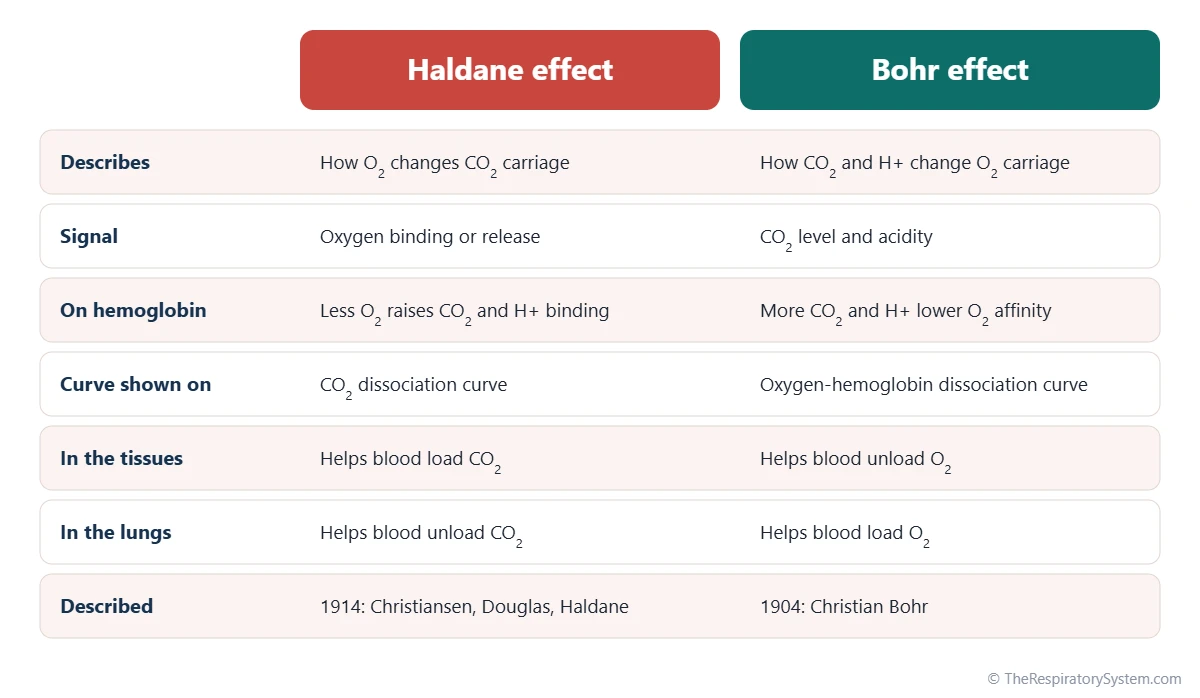
The Haldane effect describes how oxygen changes hemoglobin's grip on carbon dioxide and hydrogen ions, while the Bohr effect describes how carbon dioxide and hydrogen ions change hemoglobin's grip on oxygen. They are two sides of the same molecular behavior.
Both effects arise because hemoglobin switches between a low-oxygen-affinity shape and a high-oxygen-affinity shape. The Bohr effect is usually shown as a shift of the oxygen-hemoglobin dissociation curve and mainly helps oxygen delivery, which is covered in oxygen transport. The Haldane effect is shown on the carbon dioxide dissociation curve and mainly helps carbon dioxide removal.
Haldane Effect and the Carbon Dioxide Dissociation Curve
On a carbon dioxide dissociation curve, the Haldane effect appears as two separate curves: the curve for deoxygenated blood lies above the curve for oxygenated blood. At any given carbon dioxide pressure, deoxygenated blood holds more carbon dioxide.
The curve plots the total carbon dioxide content of blood against its carbon dioxide partial pressure. Unlike the S-shaped oxygen curve, it is fairly straight over the normal range. As blood moves from the tissues to the lungs, it does not slide along a single curve: it drops from the higher deoxygenated curve toward the lower oxygenated curve. That jump between curves is the extra carbon dioxide the Haldane effect releases, on top of what the small fall in carbon dioxide pressure alone would release.
Common Conditions Linked to the Haldane Effect
The Haldane effect is a normal property of healthy blood, but it becomes important in conditions where carbon dioxide removal is already strained. Wider lung disorders are covered in our respiratory diseases section.
- Chronic carbon dioxide retention: in some people with severe COPD who already retain carbon dioxide, breathing a high concentration of oxygen can raise blood carbon dioxide further. Physiologists explain this mainly through changes in ventilation-perfusion matching, with the Haldane effect adding to it as more oxygenated hemoglobin gives up carbon dioxide.
- Anemia: with less hemoglobin in the blood, less carbon dioxide can be carried by this route, although the body usually compensates.
- Low blood oxygen: in hypoxemia, more hemoglobin stays deoxygenated, which shifts the balance of carbon dioxide carriage in the blood.
Blood gas tests that measure oxygen, carbon dioxide and pH are interpreted by doctors with these effects in mind.
Key Facts
- The Haldane effect means deoxygenated blood can carry more carbon dioxide than oxygenated blood at the same carbon dioxide pressure.
- It was described in 1914 by Christiansen, Douglas and Haldane.
- Deoxyhemoglobin forms more carbamino compounds and buffers more hydrogen ions than oxyhemoglobin.
- In the lungs, oxygen binding releases carbon dioxide from hemoglobin and from bicarbonate, helping gas exchange.
- It is the mirror image of the Bohr effect, which describes how carbon dioxide and acid lower hemoglobin's oxygen affinity.
- On a carbon dioxide dissociation curve, the curve for deoxygenated blood lies above the curve for oxygenated blood.
Quick Quiz: Test What You Know About the Haldane Effect
6 questions. Tap an answer to check it.
What does the Haldane effect describe?
The Haldane effect is the effect of hemoglobin oxygenation on carbon dioxide carriage; the reverse is the Bohr effect.
Which blood can carry more carbon dioxide at the same carbon dioxide pressure?
Deoxygenated hemoglobin forms more carbamino compounds and buffers more hydrogen ions, so it holds more carbon dioxide.
Where does the Haldane effect help unload carbon dioxide?
In the lungs, oxygen binding to hemoglobin pushes carbon dioxide out of the blood into the alveoli.
Which enzyme in red blood cells converts carbonic acid back into carbon dioxide and water?
Carbonic anhydrase speeds up the reaction in both directions inside red blood cells.
What is carbaminohemoglobin?
Carbon dioxide binds the terminal amino groups of the globin chains, more readily when hemoglobin is deoxygenated.
Which scientists described the Haldane effect in 1914?
Johanne Christiansen, Claude Gordon Douglas and John Scott Haldane reported it in 1914.
Frequently Asked Questions
What is the Haldane effect in simple terms?
In simple terms, hemoglobin cannot hold on tightly to both oxygen and carbon dioxide at the same time. When it carries a lot of oxygen, it lets go of carbon dioxide, and when it gives oxygen away, it grabs more carbon dioxide. That is why blood picks up carbon dioxide in the body's tissues and releases it in the lungs so efficiently.
What is the difference between the Bohr effect and the Haldane effect?
The Bohr effect is about oxygen: more carbon dioxide and acid make hemoglobin release oxygen more easily, which helps deliver oxygen to working tissues. The Haldane effect is about carbon dioxide: more oxygen makes hemoglobin release carbon dioxide and hydrogen ions, which helps unload carbon dioxide in the lungs. Each describes one gas affecting how hemoglobin carries the other.
Why is the Haldane effect important?
It allows the blood to move large amounts of carbon dioxide with only a small difference in carbon dioxide pressure between the tissues and the lungs. Without it, the blood would need a much bigger pressure difference to carry away the carbon dioxide the body makes. It also links oxygen use to carbon dioxide removal, so busy tissues are cleared faster.
Does the Haldane effect involve bicarbonate?
Yes. Most carbon dioxide in the blood is carried as bicarbonate, made inside red blood cells by carbonic anhydrase. Deoxygenated hemoglobin takes up the hydrogen ions released in that reaction, which allows more bicarbonate to form in the tissues. In the lungs, oxygenated hemoglobin releases hydrogen ions that turn bicarbonate back into carbon dioxide for exhalation.
Is the Haldane effect related to the chloride shift?
Yes, they work together. As bicarbonate forms in red blood cells in the tissues, it moves out into the plasma in exchange for chloride ions, which is the chloride shift. In the lungs, the shift reverses: bicarbonate moves back into the red cells and chloride moves out, so the bicarbonate can be turned back into carbon dioxide and exhaled.
Who was John Scott Haldane?
John Scott Haldane was a Scottish physiologist who worked at Oxford in the late 1800s and early 1900s. He studied breathing, the effects of carbon dioxide and carbon monoxide, decompression in divers and air quality in mines. Together with Johanne Christiansen and Claude Gordon Douglas, he described the effect of oxygen on carbon dioxide carriage that now bears his name.
Does the Haldane effect change during exercise?
The effect itself works the same way, but exercise makes it more useful. Working muscles take more oxygen from the blood, so more hemoglobin becomes deoxygenated in their capillaries. That deoxygenated hemoglobin can carry more of the extra carbon dioxide the muscles produce. In the lungs, rapid reoxygenation then releases that carbon dioxide for exhalation.
What is the carbon dioxide dissociation curve?
The carbon dioxide dissociation curve is a graph of how much carbon dioxide blood contains at different carbon dioxide pressures. It is much straighter than the oxygen curve over the normal range. Because of the Haldane effect, it is drawn as two lines, one for oxygenated and one for deoxygenated blood, with the deoxygenated line higher.
Keep Exploring


