At a Glance
The main respiratory system organs are the nose and nasal cavity, the pharynx (throat), the larynx (voice box), the trachea (windpipe), the bronchi and bronchioles, and the two lungs, which hold about 300 to 500 million alveoli where gas exchange happens. The diaphragm is the main breathing muscle that powers airflow through these organs.
- Upper tract organs
- Nose and nasal cavity, paranasal sinuses, pharynx, larynx
- Lower tract organs
- Trachea, bronchi, bronchioles, alveoli and the two lungs
- Main organ
- The lungs, where oxygen and carbon dioxide are exchanged
- Main muscle
- Diaphragm, helped by the intercostal muscles between the ribs
- Key job
- Bring oxygen into the blood and remove carbon dioxide
- Works with
- Circulatory, muscular and nervous systems
On this page
- What Are the Organs of the Respiratory System?
- Which Organs Are in the Upper Respiratory Tract?
- Which Organs Are in the Lower Respiratory Tract?
- What Is the Main Organ of the Respiratory System?
- Which Muscles and Structures Help the Respiratory Organs Work?
- How Do the Respiratory Organs Work Together?
- How Do the Respiratory Organs Work With Other Organs?
- Common Conditions That Affect the Respiratory Organs
- Key Facts
- FAQ
What Are the Organs of the Respiratory System?
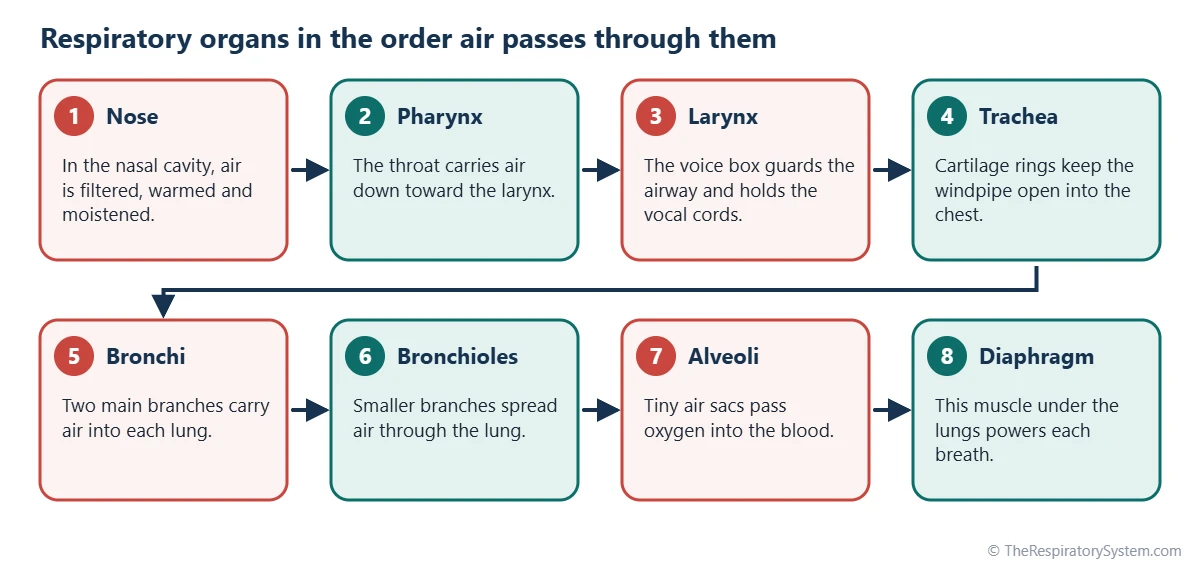
The organs of the respiratory system are a connected chain of air passages and the lungs they lead to, listed here in the order air passes through them. Each organ has its own job, but all of them share one goal: getting fresh air to the alveoli and stale air back out.
- Nose and nasal cavity: the main entrance for air, where it is filtered, warmed and moistened.
- Paranasal sinuses: air-filled spaces in the skull bones that open into the nasal cavity.
- Pharynx: the throat, a shared passage for air and food.
- Larynx: the voice box, which guards the airway and makes sound.
- Trachea: the windpipe, a stiff tube held open by cartilage rings.
- Bronchi: the branches that carry air into each lung.
- Bronchioles: small airways without cartilage that spread air through the lung.
- Alveoli: tiny air sacs where gas exchange takes place.
- Lungs: the two spongy organs that hold the bronchial tree and the alveoli.
The diaphragm is not an air passage, but it is usually listed with the respiratory organs because its contractions drive every quiet breath.
Explained simply
Picture the respiratory organs as an upside-down tree. The nose and throat are the roots that take in air, the trachea is the trunk, the bronchi and bronchioles are the branches, and the alveoli are millions of leaves where the real work happens. The diaphragm under the tree acts like a pump that pulls air down into the branches and pushes it back out.
| Organ | Tract | Location | Main function |
|---|---|---|---|
| Nose and nasal cavity | Upper | Middle of the face, above the roof of the mouth | Filters, warms and moistens air; contains smell receptors |
| Paranasal sinuses | Upper | Inside the frontal, maxillary, ethmoid and sphenoid bones | Lighten the skull, add mucus, help voice resonance |
| Pharynx (throat) | Upper | Behind the nose and mouth, down to the larynx | Carries air to the larynx and food to the esophagus |
| Larynx (voice box) | Upper (lowest part) | Front of the neck, above the trachea | Protects the airway and produces the voice |
| Epiglottis | Upper | Top of the larynx, behind the tongue | Covers the airway opening during swallowing |
| Trachea (windpipe) | Lower | Neck and upper chest, in front of the esophagus | Keeps an open tube from the larynx to the bronchi |
| Bronchi | Lower | From the carina into each lung | Carry air into the lungs and their lobes |
| Bronchioles | Lower | Inside the lungs | Spread air through the lung and adjust airflow |
| Alveoli | Lower | At the ends of the airways in both lungs | Exchange oxygen and carbon dioxide with the blood |
| Lungs | Lower | Chest cavity, on either side of the heart | House the airways and alveoli; site of gas exchange |
| Diaphragm | Breathing muscle | Floor of the chest cavity, below the lungs | Contracts to pull air into the lungs |
| Source: Typical adult anatomy, our editors | |||
Which Organs Are in the Upper Respiratory Tract?
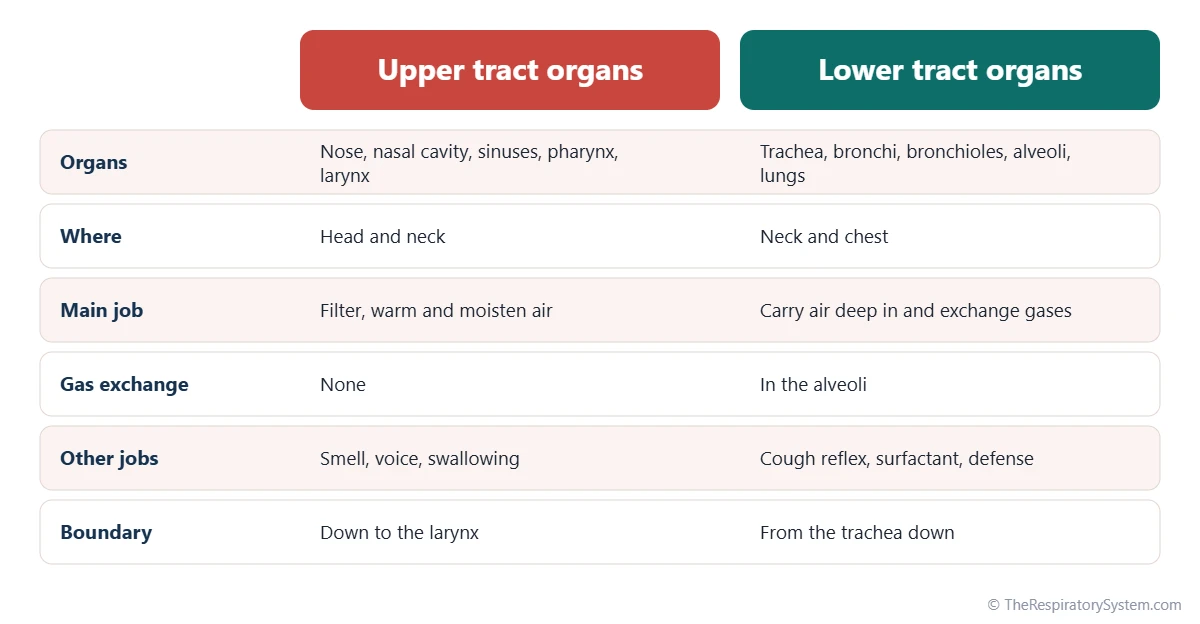
The upper respiratory tract is made of the organs above the trachea: the nose and nasal cavity, the paranasal sinuses, the pharynx and the larynx. Their main job is to prepare the air before it reaches the delicate lungs. The upper respiratory tract section covers each of them in detail.
Nose and nasal cavity
Air enters through the two nostrils into the nasal cavity, which is split into left and right halves by the nasal septum. Three curved shelves of bone on each side wall, the nasal conchae, stir the air so it touches the warm, moist lining. Hairs and sticky mucus trap dust, and a small patch of tissue in the roof of the cavity detects odors for the sense of smell.
Paranasal sinuses
Four pairs of sinuses (frontal, maxillary, ethmoid and sphenoid) are lined with the same mucous membrane as the nose. They make the skull lighter, add mucus to the nasal cavity and help give the voice its resonance.
Pharynx
The pharynx is a muscular tube about 12 to 13 centimeters long behind the nose and mouth. It has three parts, the nasopharynx, oropharynx and laryngopharynx, and carries both air and swallowed food. The tonsils and adenoids in its walls watch for germs.
Larynx
The larynx sits in the front of the neck, built from nine cartilages joined by muscles and ligaments. It holds the vocal cords, which vibrate to make the voice, and the epiglottis, a flap that tips over the airway during swallowing so food goes into the esophagus instead.
Which Organs Are in the Lower Respiratory Tract?
The lower respiratory tract includes the organs below the larynx: the trachea, the bronchi, the bronchioles, the alveoli and the lungs that contain them. These organs deliver air deep into the chest and carry out gas exchange, as explained on the lower respiratory tract page.
Trachea
The trachea is a tube about 10 to 12 centimeters long that runs from the larynx into the chest. It is held open by 16 to 20 C-shaped rings of hyaline cartilage, with the open side of each ring facing backward against the esophagus. At its lower end, a ridge called the carina marks where it divides in two.
Bronchi
The right and left main bronchi carry air into each lung. The right main bronchus is shorter, wider and more vertical, which is why inhaled objects more often lodge on the right. Inside the lungs the bronchi split into lobar and then segmental branches, each serving a defined part of the lung, as shown on the bronchial tree page.
Bronchioles
Bronchioles are the smaller branches that follow the bronchi. They have no cartilage, but a ring of smooth muscle lets them narrow or widen to adjust airflow. The last purely air-carrying branches are the terminal bronchioles; after them come respiratory bronchioles with the first alveoli budding from their walls.
Alveoli
The alveoli are microscopic air sacs clustered at the ends of the airways, about 300 to 500 million in an adult. Their walls, made mostly of flat type I pneumocytes, are wrapped in capillaries, and type II cells release surfactant that keeps the sacs from collapsing.
What Is the Main Organ of the Respiratory System?
The main organ of the respiratory system is the pair of lungs, because they hold the alveoli where oxygen enters the blood and carbon dioxide leaves it. Every other respiratory organ exists to bring air to the lungs or to move it in and out.
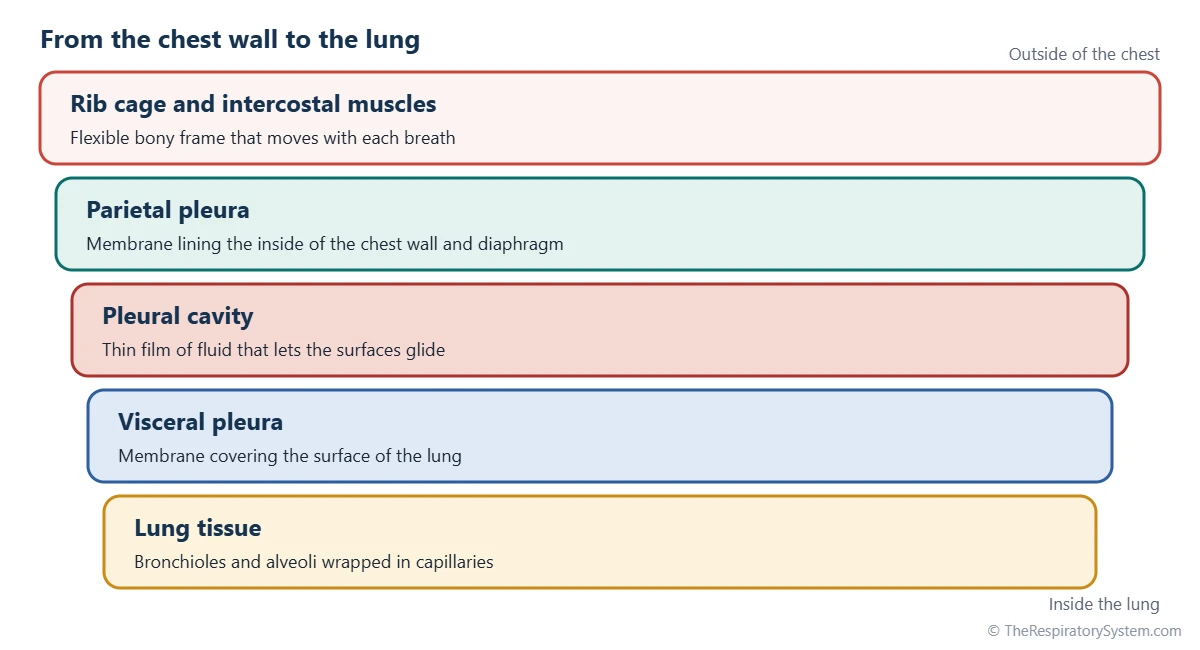
The lungs fill most of the chest cavity on either side of the heart. The right lung has three lobes, while the left lung has two and a notch that makes room for the heart. Each lung is wrapped in a double membrane, the pleura, with a thin film of fluid between its layers that lets the lungs glide against the chest wall. Air, blood vessels and nerves enter each lung at its hilum.
Lung tissue is light and spongy because most of its volume is air. Blood reaches it from two sources: the pulmonary arteries bring oxygen-poor blood for gas exchange, and small bronchial arteries feed the lung tissue itself.
Which Muscles and Structures Help the Respiratory Organs Work?
The respiratory organs cannot move air on their own; the diaphragm, the intercostal muscles, the rib cage and the pleura do that work. The lungs have no skeletal muscle in their walls, so they expand only when the chest around them expands.
- Diaphragm: a dome-shaped sheet of muscle under the lungs. When it contracts it flattens, making the chest taller and pulling air in. It is controlled by the phrenic nerve.
- Intercostal muscles: the external intercostals lift the ribs up and out during inhalation; the internal intercostals help pull them down during forced exhalation.
- Rib cage: 12 pairs of ribs, the sternum and the spine form a protective, flexible frame around the lungs and heart.
- Pleura and pleural fluid: the fluid film acts like a seal, so when the chest wall moves outward the lungs are drawn with it.
During hard breathing, accessory muscles in the neck and chest join in, and the abdominal muscles help push air out. The full list is on the muscles of respiration page, and the movements themselves are described in mechanics of breathing.
How Do the Respiratory Organs Work Together?
The respiratory organs work together as two zones: a conducting zone that cleans and carries air, and a respiratory zone where gas exchange takes place. The conducting zone runs from the nose to the terminal bronchioles; the respiratory zone runs from the respiratory bronchioles to the alveoli, as compared on the conducting zone vs respiratory zone page.
In one quiet breath, the diaphragm contracts and the chest widens, so pressure inside the lungs drops below the air pressure outside. Air flows in through the nose, down the pharynx, past the larynx and through the trachea and bronchi into the alveoli. There, oxygen diffuses into the blood and carbon dioxide diffuses out, as detailed in gas exchange in the lungs. When the diaphragm relaxes, the elastic lungs recoil and push the used air back out along the same route.
All along the conducting zone, a lining of ciliated cells and mucus, the respiratory epithelium, traps particles and sweeps them toward the throat. The step-by-step route of a single breath is traced on our pathway of air page, and the broader jobs of these organs are covered in respiratory system functions.
How Do the Respiratory Organs Work With Other Organs?
The respiratory organs depend on the heart, blood vessels, brain and muscles to do their job. The heart pumps oxygen-poor blood to the lungs and sends oxygen-rich blood to the body, a partnership described on the respiratory and circulatory system page.
The brainstem sets the rhythm of breathing and sends signals to the diaphragm, while sensors in the blood vessels and brain track carbon dioxide and oxygen levels, as explained in control of breathing. The pharynx is shared with the digestive system, and the kidneys work with the lungs to keep the blood's acid balance steady. The full picture is on how the respiratory system works with other body systems.
Common Conditions That Affect the Respiratory Organs
Each respiratory organ has conditions that mainly affect it, ranging from short-lived infections of the upper tract to long-term diseases of the lungs. Our respiratory diseases section explains them in more depth, and anyone with breathing symptoms should see a doctor.
- Nose and sinuses: the common cold and sinusitis inflame the lining and block drainage.
- Pharynx and larynx: pharyngitis and laryngitis cause a sore throat or a hoarse voice.
- Bronchi and bronchioles: asthma narrows the airways, and bronchitis inflames them.
- Alveoli and lungs: pneumonia fills air sacs with fluid, and COPD damages airways and alveolar walls over many years.
Key Facts
- The main respiratory organs are the nose, pharynx, larynx, trachea, bronchi, bronchioles, alveoli and lungs, powered by the diaphragm.
- The lower edge of the larynx, at the cricoid cartilage, is the usual boundary between the upper and lower respiratory tract.
- The trachea is about 10 to 12 centimeters long and held open by 16 to 20 C-shaped cartilage rings.
- The right lung has three lobes and the left lung has two, leaving space for the heart.
- An adult has about 300 to 500 million alveoli, the only places in the respiratory tract where gas exchange happens.
- The lungs contain no skeletal muscle; the diaphragm and intercostal muscles expand the chest to draw air in.
- The pharynx is shared by the respiratory and digestive systems, and the epiglottis keeps food out of the airway.
Frequently Asked Questions
How many organs are in the respiratory system?
There is no single official count, because some books treat the nose and nasal cavity or the bronchi and bronchioles as one organ. A common list has about nine to ten: the nose and nasal cavity, paranasal sinuses, pharynx, larynx, trachea, bronchi, bronchioles, alveoli and the two lungs, with the diaphragm often added as the main breathing muscle.
Is the diaphragm a respiratory organ?
The diaphragm is a skeletal muscle, not an air passage, but it is usually grouped with the respiratory organs because it does most of the work of quiet breathing. When it contracts it flattens and pulls air into the lungs; when it relaxes, air flows back out. Strictly speaking, it is part of both the muscular and respiratory systems.
Is the mouth part of the respiratory system?
The mouth, or oral cavity, belongs mainly to the digestive system, but it serves as a backup airway. Air can enter through the mouth when the nose is blocked or during hard exercise, and it then joins the normal route at the oropharynx. Mouth breathing skips the filtering, warming and moistening that the nasal cavity provides.
What is the largest organ of the respiratory system?
The lungs are by far the largest respiratory organs. Together they fill most of the chest cavity, from just above the collarbones down to the diaphragm, and their total capacity in an average adult man is about 6 liters of air, somewhat less in women. The right lung is slightly larger than the left, which shares space with the heart.
Which respiratory organ produces sound?
The larynx, or voice box, produces sound. Air pushed up from the lungs makes the vocal cords vibrate, and the pitch changes as muscles tighten or loosen them. The pharynx, mouth, nose and sinuses then shape and amplify that sound into speech, which is why a blocked nose changes how a voice sounds.
Which organ filters the air we breathe?
The nose and nasal cavity do most of the filtering. Hairs near the nostrils catch large particles, and sticky mucus on the nasal lining traps smaller dust and germs. Farther down, the mucus-coated lining of the trachea and bronchi catches what slips past, and tiny hair-like cilia sweep it up to the throat to be swallowed or coughed out.
Is the heart part of the respiratory system?
No. The heart belongs to the circulatory system, but it works so closely with the lungs that the two are often studied together. The right side of the heart pumps oxygen-poor blood to the lungs, and the left side pumps the newly oxygenated blood to the rest of the body. Without the heart, the oxygen picked up in the lungs would never reach the cells.
Do the respiratory organs have jobs other than breathing?
Yes. The nose contains receptors for smell, and the larynx produces the voice. The airways trap and clear germs and dust, and the lungs help keep the blood's acid level steady by removing carbon dioxide. The lungs also filter small clots from the blood and convert a hormone involved in blood pressure control.
Keep Exploring


