At a Glance
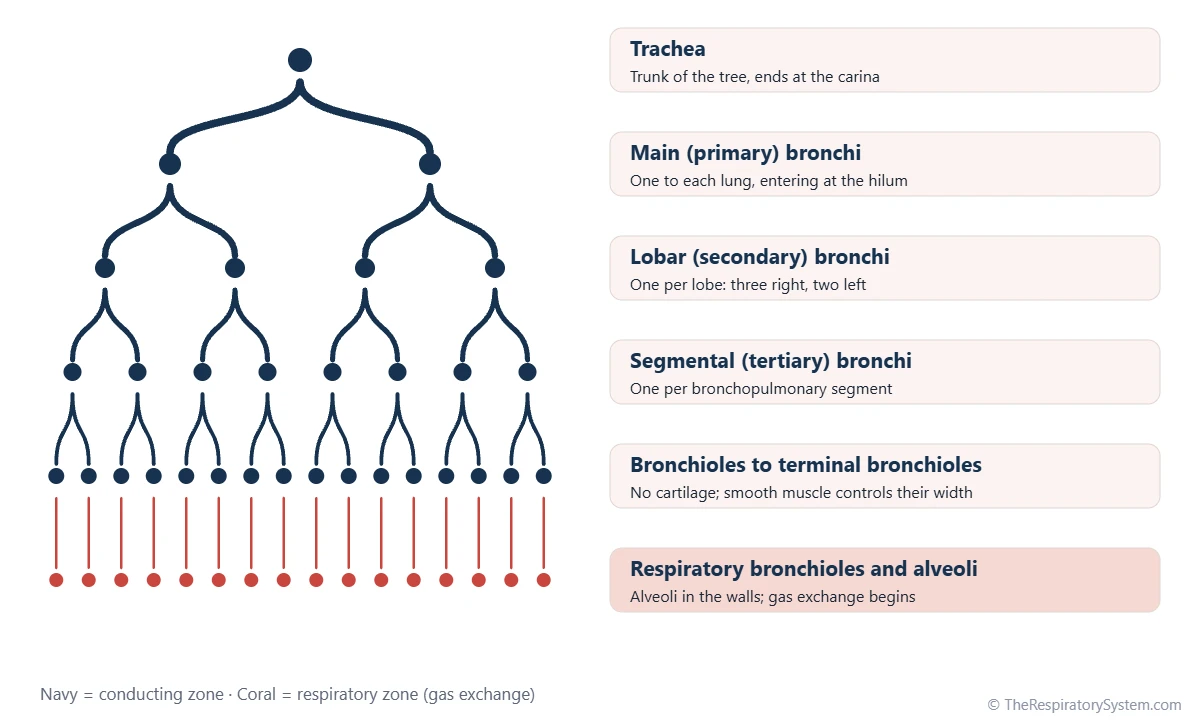
The bronchial tree is the network of airways inside the lungs that starts where the trachea splits into the right and left main bronchi and branches about 23 times, through lobar bronchi, segmental bronchi and bronchioles, down to the alveolar sacs. Its first 16 or so generations only conduct, warm, moisten and clean the air; the last branches take part in gas exchange.
- Location
- Inside both lungs, starting at the carina behind the sternal angle and spreading to the lung edges
- Starts at
- The bifurcation of the trachea into the right and left main bronchi
- Ends at
- Respiratory bronchioles, alveolar ducts and alveolar sacs
- Branching
- About 23 generations of branching from the trachea to the alveolar sacs
- Function
- Conducts, warms, humidifies and filters air, then delivers it to the gas exchange surface
- Part of
- Lower respiratory tract; with the trachea it is called the tracheobronchial tree
On this page
- What Is the Bronchial Tree?
- Where Is the Bronchial Tree Found?
- Bronchial Tree Anatomy: What Are Its Branches?
- What Does the Bronchial Tree Do?
- How Is the Right Bronchial Tree Different From the Left?
- What Supplies the Bronchial Tree With Blood and Nerves?
- Common Conditions That Affect the Bronchial Tree
- Key Facts
- Quiz
- FAQ
What Is the Bronchial Tree?
The bronchial tree is the complete set of air passages that branch out from the end of the trachea to the smallest airways deep inside the lungs. Like a tree turned upside down, it has a single trunk, a few thick limbs, many smaller branches and a huge number of fine twigs, each one narrower and shorter than the one before.
Bronchial tree, tracheobronchial tree and respiratory tree
These three names overlap. The tracheobronchial tree includes the trachea as its trunk plus every bronchus and bronchiole below it. The bronchial tree, in the strict sense, starts at the two main bronchi. The respiratory tree is a looser term that some textbooks use for all the airways together, sometimes including the upper airways. On this page we follow the bronchial tree from the main bronchi to the alveoli, which is how most anatomy courses teach it.
Explained simply
Picture a garden hose that splits into two hoses, each of which splits into two more, and so on, more than twenty times over. By the end you would have millions of tiny tubes reaching into every corner of a sponge. The bronchial tree works the same way, so that fresh air can reach every one of the hundreds of millions of air sacs in your lungs.
Where Is the Bronchial Tree Found?
The bronchial tree is found inside the chest, beginning at the carina, where the trachea divides behind the sternal angle, and filling the inside of both lungs out to just beneath their outer surface. Only the first part of the tree, the two main bronchi, lies outside the lungs.
The trachea ends at a ridge of cartilage called the carina, roughly at the level of the fourth to fifth thoracic vertebrae. From there the right and left main bronchi run downward and outward through the mediastinum and enter each lung at its hilum, together with the pulmonary arteries and veins. Once inside, the branches follow the lobes and segments of each lung, so that every bronchopulmonary segment has its own airway and its own branch of the pulmonary artery.
Because the lungs fill most of the thoracic cavity, the bronchial tree spreads from the apex of each lung, just above the collarbone, down to the base resting on the diaphragm.
Bronchial Tree Anatomy: What Are Its Branches?
The bronchial tree branches in a fixed order: main (primary) bronchi, lobar (secondary) bronchi, segmental (tertiary) bronchi, smaller bronchi, bronchioles, terminal bronchioles, respiratory bronchioles, alveolar ducts and alveolar sacs. Anatomists count each division as one generation, with the trachea as generation 0 and the alveolar sacs at about generation 23.
- Main bronchi. The right main bronchus is shorter, wider and more vertical than the left, which is longer and more horizontal because it passes under the arch of the aorta and beside the heart. The bronchi page describes both in detail.
- Lobar bronchi. One for each lobe: three on the right (upper, middle and lower) and two on the left (upper and lower), matching the lung lobes.
- Segmental bronchi. Each lobar bronchus divides into segmental bronchi, usually 10 on the right and 8 to 10 on the left, one for each bronchopulmonary segment.
- Smaller bronchi. Several more generations of ever smaller bronchi follow, still supported by plates of cartilage.
- Bronchioles. Once the airways lose their cartilage, usually below about 1 mm across, they are called bronchioles. Each one supplies a pulmonary lobule.
- Terminal bronchioles. The last purely air-conducting airways.
- Respiratory bronchioles, alveolar ducts and alveolar sacs. The first airways with alveoli in their walls, described on the terminal and respiratory bronchioles and alveolar ducts and sacs pages.
How the wall changes along the tree
As the branches get smaller, their walls change in a regular way. C-shaped cartilage rings in the main bronchi give way to irregular cartilage plates in the smaller bronchi and then disappear in the bronchioles. Smooth muscle becomes relatively more prominent, so the bronchioles can narrow or widen easily. The lining changes from tall, ciliated respiratory epithelium with many mucus-making goblet cells to a single layer of short cuboidal cells, including club cells, in the terminal bronchioles. The table below sums up these changes.
Bronchial tree anatomy in bronchoscopy
Doctors can look directly into the bronchial tree with a bronchoscope, a thin tube with a camera passed through the nose or mouth and the trachea. Through it they can see the carina, both main bronchi and the openings of the lobar and segmental bronchi, which are named after the segments they supply. The smaller bronchioles are too narrow to be seen this way.
| Level | Generation | Cartilage | Lining | Zone |
|---|---|---|---|---|
| Trachea | 0 | 16 to 20 C-shaped rings | Ciliated pseudostratified columnar with goblet cells | Conducting |
| Main (primary) bronchi | 1 | C-shaped rings | Ciliated pseudostratified columnar with goblet cells | Conducting |
| Lobar (secondary) bronchi | 2 | Irregular plates | Ciliated pseudostratified columnar | Conducting |
| Segmental (tertiary) bronchi | 3 | Irregular plates | Ciliated pseudostratified columnar | Conducting |
| Smaller bronchi | 4 onward, several generations | Small, scattered plates | Ciliated columnar, fewer goblet cells | Conducting |
| Bronchioles | After the last cartilage | None | Ciliated simple columnar to cuboidal | Conducting |
| Terminal bronchioles | About 16 | None | Simple cuboidal with club cells | Conducting |
| Respiratory bronchioles | About 17 to 19 | None | Simple cuboidal, interrupted by alveoli | Respiratory |
| Alveolar ducts | About 20 to 22 | None | Mostly alveolar openings | Respiratory |
| Alveolar sacs | About 23 | None | Type I and type II pneumocytes | Respiratory |
| Source: Typical adult values, our editors | ||||
What Does the Bronchial Tree Do?
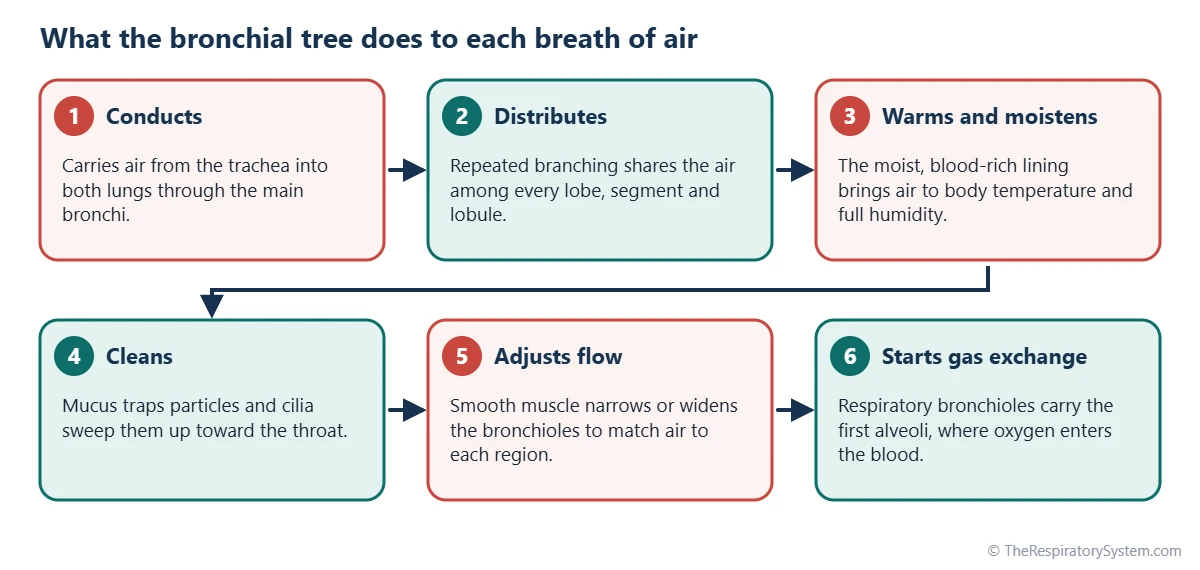
The bronchial tree carries air between the trachea and the alveoli, and on the way it warms, humidifies and cleans that air and spreads it evenly through both lungs. Its last branches also start the work of gas exchange.
- Conducting air. The tree is the main route of the pathway of air into and out of the lungs. Air in the airways down to the terminal bronchioles takes no part in gas exchange and makes up most of the anatomical dead space, about 150 mL in an adult.
- Distributing air. Repeated branching delivers air to every lobe, segment and lobule, so that fresh air reaches all of the alveoli.
- Conditioning air. The moist, blood-rich lining finishes warming the air to body temperature and saturating it with water vapor before it reaches the delicate air sacs.
- Cleaning air. Mucus traps dust and microbes, and beating cilia sweep it upward toward the throat, a system described on the cilia and mucus page. The cough reflex clears anything the cilia cannot.
- Adjusting airflow. Smooth muscle in the walls can narrow or widen the airways to control how air is shared between regions.
- Gas exchange. From the respiratory bronchioles onward, alveoli appear in the walls and gas exchange begins.
Bronchial tree function in the respiratory system
The split between the two jobs of the tree is so important that physiologists divide it into a conducting zone and a respiratory zone, compared side by side on our conducting zone vs respiratory zone page. Because each generation has many more branches than the one before, the total cross-sectional area of the airways grows enormously toward the alveoli. As a result, air moves quickly in the large bronchi but slows almost to a stop in the smallest airways, where gases spread mainly by diffusion.
How Is the Right Bronchial Tree Different From the Left?
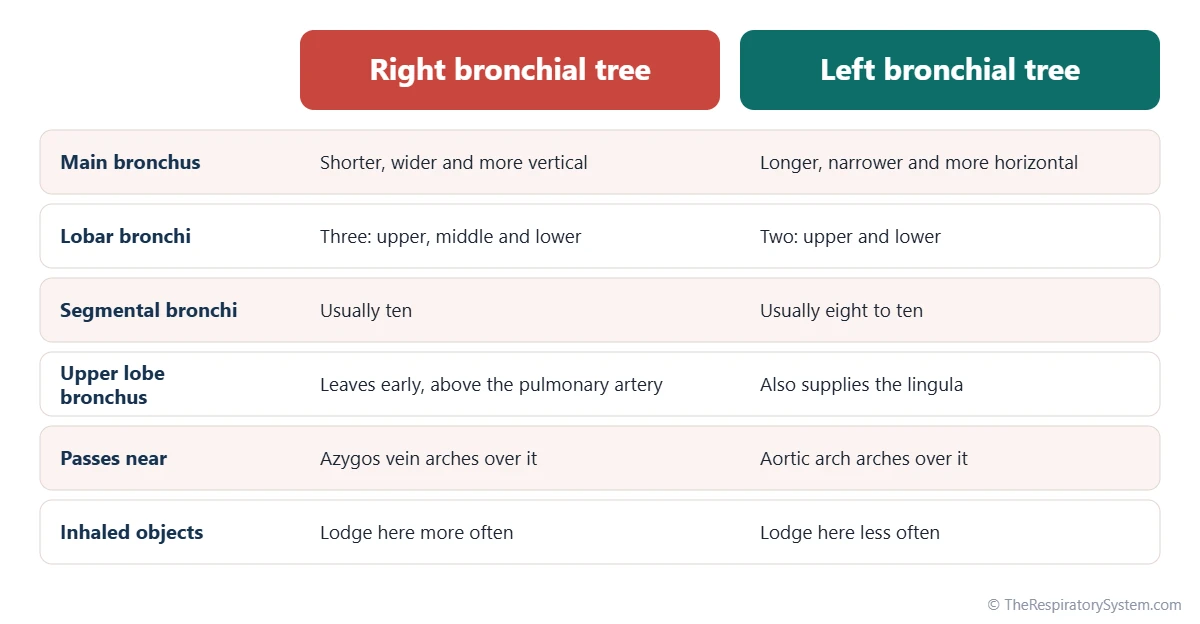
The right bronchial tree has a shorter, wider and more vertical main bronchus and three lobar bronchi, while the left has a longer, narrower and more horizontal main bronchus and only two lobar bronchi. These differences follow from the shape of the lungs: the heart bulges to the left, so the left lung is smaller and has two lobes, while the right lung has three.
On the right, the upper lobe bronchus leaves the main bronchus very early, even before it enters the lung, and lies above the right pulmonary artery. The rest of the right main bronchus, sometimes called the bronchus intermedius, continues downward to give off the middle and lower lobe bronchi. On the left, the upper lobe bronchus also supplies the lingula, a tongue-shaped part of the upper lobe that matches the right middle lobe.
The steeper course of the right main bronchus explains why a small object that is accidentally inhaled more often lodges on the right side, usually in the right main or lower lobe bronchus.
What Supplies the Bronchial Tree With Blood and Nerves?
The walls of the bronchial tree are fed by the bronchial arteries, small branches of the thoracic aorta, and controlled by the autonomic nerves of the pulmonary plexus. This is separate from the much larger pulmonary circulation, which brings blood to the alveoli only for gas exchange.
Blood supply
The bronchial arteries run along the back of the bronchi and branch with them as far as the terminal bronchioles, carrying oxygen-rich blood to the airway walls, their glands and the connective tissue of the lung. Some of the blood returns through bronchial veins, and some drains into the pulmonary veins.
Nerve supply
Parasympathetic fibers from the vagus nerve narrow the airways and increase mucus secretion, while sympathetic fibers relax the smooth muscle and widen them. Sensory fibers detect irritants and stretch, triggering coughing and reflexes such as the Hering-Breuer reflex.
Development
The whole tree grows from a single lung bud that sprouts from the front of the embryonic foregut early in pregnancy. The bud divides over and over, and the branching pattern of the conducting airways is laid down well before birth, while alveoli keep forming through childhood, as explained on the respiratory system development page.
Common Conditions That Affect the Bronchial Tree
Most conditions of the bronchial tree narrow, inflame, block or permanently widen its airways, which makes air harder to move in and out. Our respiratory diseases section covers each in more depth, and anyone with ongoing cough or breathlessness should see a doctor.
- Asthma: long-term inflammation makes the bronchi and bronchioles overreact, so their smooth muscle tightens and their lining swells.
- Bronchitis: inflammation of the bronchial lining with extra mucus, either short-lived after an infection or long-lasting, as in COPD.
- Bronchiectasis: parts of the tree become permanently widened and scarred, so mucus pools in them.
- Cystic fibrosis: an inherited condition that makes mucus thick and sticky, clogging the smaller airways.
- Bronchiolitis: a viral infection of the bronchioles, most common in infants.
- Inhaled foreign bodies: small objects can block a bronchus, more often on the right.
- Lung cancer: many lung cancers start in the lining of the bronchi.
Key Facts
- The bronchial tree begins where the trachea divides at the carina into the right and left main bronchi.
- It branches about 23 times, from the trachea (generation 0) to the alveolar sacs (about generation 23).
- The right lung has three lobar bronchi and the left has two, one for each lobe.
- Airways lose their cartilage when they become bronchioles, usually below about 1 mm across.
- The airways down to the terminal bronchioles only conduct air and form the anatomical dead space of about 150 mL.
- Gas exchange starts in the respiratory bronchioles, where the first alveoli appear in the airway walls.
- The walls of the tree get their own blood from the bronchial arteries, separate from the pulmonary circulation.
Quick Quiz: Test What You Know About the Bronchial Tree
6 questions. Tap an answer to check it.
Where does the bronchial tree begin?
The trachea ends at the carina, where it splits into the right and left main bronchi, the first branches of the bronchial tree.
How many lobar (secondary) bronchi does the left lung have?
The left lung has two lobes, upper and lower, so it has two lobar bronchi. The right lung has three.
What is the main structural difference between bronchi and bronchioles?
Bronchi are supported by cartilage rings or plates; bronchioles have none and rely on smooth muscle and elastic fibers.
In which part of the bronchial tree does gas exchange begin?
Respiratory bronchioles are the first airways with alveoli in their walls. Everything above them only conducts air.
Why do inhaled objects more often lodge in the right main bronchus?
The right main bronchus continues the line of the trachea more directly and is wider, so falling objects tend to enter it.
Which vessels supply oxygen-rich blood to the walls of the bronchial tree?
The bronchial arteries, small branches of the thoracic aorta, nourish the airway walls; the pulmonary arteries bring blood for gas exchange.
Frequently Asked Questions
What is the tracheobronchial tree?
The tracheobronchial tree is the trachea together with all the bronchi and bronchioles that branch from it. It is the same branching system as the bronchial tree, with the trachea added as its trunk. Doctors often use the term when describing bronchoscopy or imaging, because the trachea and bronchi are examined together as one continuous set of airways.
What is the respiratory tree?
Respiratory tree is an informal name for the branching airways of the lungs. Most textbooks use it to mean the same thing as the tracheobronchial tree, from the trachea down to the alveoli, though some include the nose, pharynx and larynx as well. Because the meaning varies, anatomy courses usually prefer the more precise terms bronchial tree and tracheobronchial tree.
How many bronchioles are in the lungs?
Each lung contains many thousands of bronchioles. Estimates for the number of terminal bronchioles in both lungs together are in the tens of thousands, and each one leads to several generations of respiratory bronchioles and alveolar ducts. The exact count varies between people and depends on how the airways are measured, so textbooks usually describe the branching by generation rather than by number.
Is the bronchial tree part of the upper or lower respiratory tract?
The bronchial tree is part of the lower respiratory tract. The lower tract begins below the larynx and includes the trachea, the bronchial tree and the lungs with their alveoli. The upper respiratory tract is made up of the nose, nasal cavity, sinuses, pharynx and larynx, which warm and filter air before it reaches the trachea and bronchi.
Can the bronchial tree be seen on an X-ray?
On an ordinary chest X-ray the airways are hard to see, because they are filled with air just like the lung tissue around them. The trachea and main bronchi show as darker bands, but the smaller branches usually do not. A CT scan shows the bronchi in much more detail, and a bronchoscope lets doctors look directly inside the larger airways.
Do the bronchi and bronchioles grow after birth?
Yes. The branching pattern of the conducting airways is complete before birth, but the airways keep getting longer and wider as the chest grows through childhood and adolescence. New alveoli also continue to form for several years after birth. By adulthood the airways have reached their full size, and with aging the supporting elastic tissue slowly weakens.
What is the difference between the bronchial tree and the lungs?
The bronchial tree is the system of air tubes, while the lungs are the whole organs that contain it. Each lung is made of the bronchial tree plus the alveoli, blood vessels, lymph vessels, nerves and connective tissue packed around the branches, all wrapped in the pleura. The tree is the plumbing that carries air; the alveoli are where the lungs exchange gases.
Why is it called a tree?
It is called a tree because its shape looks like an upside-down tree. The trachea forms the trunk, the main bronchi are the two largest limbs, and the branches keep dividing into smaller and smaller twigs, the bronchioles, which end in clusters of alveoli like leaves. Anatomists noticed the likeness centuries ago, and the name has been used ever since.
Keep Exploring


