At a Glance
An average healthy adult can hold their breath for about 30 to 90 seconds at rest. The breath hold ends at the breaking point, when rising carbon dioxide stimulates chemoreceptors and the brainstem forces a breath. Trained competitive freedivers have held their breath for more than 11 minutes under supervision, but breath-hold practice in water is dangerous because it can cause sudden loss of consciousness.
- Typical adult
- About 30 to 90 seconds at rest
- What ends it
- Rising carbon dioxide sensed by chemoreceptors (the breaking point)
- Control
- Voluntary at first, then overridden by the brainstem breathing centers
- Underwater
- The diving reflex slows the heart and narrows limb blood vessels
- Main danger
- Fainting from low oxygen, which in water can lead to drowning
- Part of
- Control of breathing and respiratory physiology
On this page
- How Long Can a Human Hold Their Breath on Average?
- What Happens in Your Body When You Hold Your Breath?
- Why Can't You Hold Your Breath Forever?
- How Long Can You Hold Your Breath Before You Pass Out?
- How Long Can a Human Hold Their Breath Underwater?
- What Is the World Record for Holding Your Breath?
- Key Facts
- FAQ
How Long Can a Human Hold Their Breath on Average?
On average, a healthy adult who has not trained for it can hold their breath for about 30 to 90 seconds while sitting still, and a few people reach around two minutes. The exact time varies widely from person to person and from one attempt to the next.
Several things explain the spread. People with larger lungs hold more air, which is both an oxygen store and a space that dilutes the carbon dioxide made during the hold, as described under lung volumes and capacities. A calm state and a low metabolic rate both mean that oxygen is used and carbon dioxide is made more slowly. People also differ in how sensitive their respiratory chemoreceptors are to carbon dioxide and in how well they tolerate the uncomfortable urge to breathe.
Any activity shortens the hold sharply, because working muscles burn oxygen and release carbon dioxide much faster than resting ones. Children, older adults and people with heart or lung disease generally have shorter breath-hold times.
What Happens in Your Body When You Hold Your Breath?
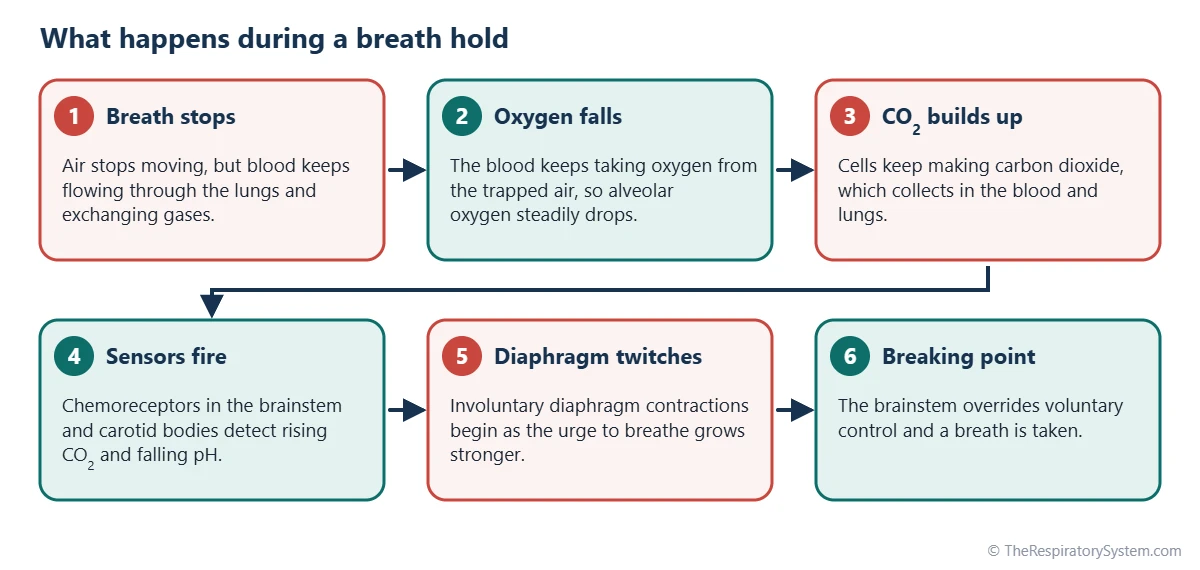
When you hold your breath, air stops moving in and out, but blood keeps flowing through the lungs, so oxygen in the trapped air keeps falling and carbon dioxide in the lungs and blood keeps rising. Your cells do not pause their work, so the gases they use and produce keep changing with every heartbeat.
- Gas exchange continues: the blood keeps drawing oxygen from the air in the alveoli, so alveolar oxygen drops steadily, as explained on our gas exchange page.
- Carbon dioxide accumulates: cells keep producing it as they burn fuel, and with no fresh air to carry it away, its level climbs in the blood and lungs. The chemistry is covered under carbon dioxide transport.
- The blood turns slightly acidic: extra carbon dioxide forms carbonic acid, which lowers blood pH.
- Oxygen saturation holds, then drops: because of the S-shaped oxygen-hemoglobin dissociation curve, hemoglobin stays nearly full at first and then falls faster once oxygen pressure gets low.
Explained simply
Holding your breath is like closing the windows of a busy room. Nobody notices for a while, but the fresh air slowly gets used up and the stale air builds up. In your body, the stale air, carbon dioxide, is what sets off the alarm first.
Why Can't You Hold Your Breath Forever?
You cannot hold your breath forever because the brainstem eventually overrides voluntary control and forces a breath, a moment physiologists call the breaking point. Breathing is one of the few body functions under both voluntary and automatic control, and the automatic system always wins in the end, as described on our control of breathing page.
The main trigger is carbon dioxide. Central chemoreceptors in the medulla sense the acid that carbon dioxide forms in the fluid around the brain, while peripheral chemoreceptors in the carotid and aortic bodies sense rising carbon dioxide and falling oxygen in the blood. Their combined signal grows stronger every second of the hold.
Many people feel the hold in two phases. First comes an easy phase with little discomfort. Then, as the urge builds, the diaphragm starts to make involuntary contractions, rhythmic jerks of the chest and throat that are the breathing centers trying to start a breath. The breaking point follows, and the person breathes whether they intend to or not.
| Phase | What changes in the body | What the person notices |
|---|---|---|
| Start of the hold | Air stops moving, but blood keeps exchanging gases with the air in the lungs | Nothing unusual |
| Easy phase | Alveolar oxygen falls and carbon dioxide rises steadily | Little or no discomfort |
| Rising urge | Chemoreceptors detect more carbon dioxide and a lower blood pH | A growing urge to breathe |
| Struggle phase | Breathing centers fire against the voluntary hold | Involuntary diaphragm contractions in the chest and throat |
| Breaking point | Brainstem drive overrides voluntary control | A breath is taken, often a gasp |
| Deepening hypoxia | Arterial oxygen falls toward levels the brain cannot tolerate | Possible confusion or vision changes, sometimes with no warning at all |
| Loss of consciousness | Oxygen supply to the brain is too low to keep it awake | On land breathing restarts automatically; in water it can lead to drowning |
| Source: General human physiology, our editors | ||
How Long Can You Hold Your Breath Before You Pass Out?
On land, a healthy person holding their breath voluntarily almost always reaches the breaking point and breathes before oxygen falls low enough to cause fainting. If someone does pass out, the voluntary hold ends with consciousness, and the brainstem restarts normal breathing automatically.
Fainting happens when the oxygen supply to the brain falls too low, a state called hypoxia. The brain uses a large share of the body's oxygen and has almost no reserve, which is why it is the first organ to fail, as explained on our page about why we need oxygen. Brain cells begin to be damaged after a few minutes without any oxygen, which is why a blocked airway is an emergency.
Why low oxygen can arrive without warning
The urge to breathe tracks carbon dioxide, not oxygen. Rapid over-breathing before a breath hold lowers carbon dioxide without adding meaningful oxygen, a state described under hyperventilation and hypoventilation. The warning signal then comes late, and oxygen can fall to fainting levels before the urge to breathe is strong. This mechanism is behind many blackouts in water.
How Long Can a Human Hold Their Breath Underwater?
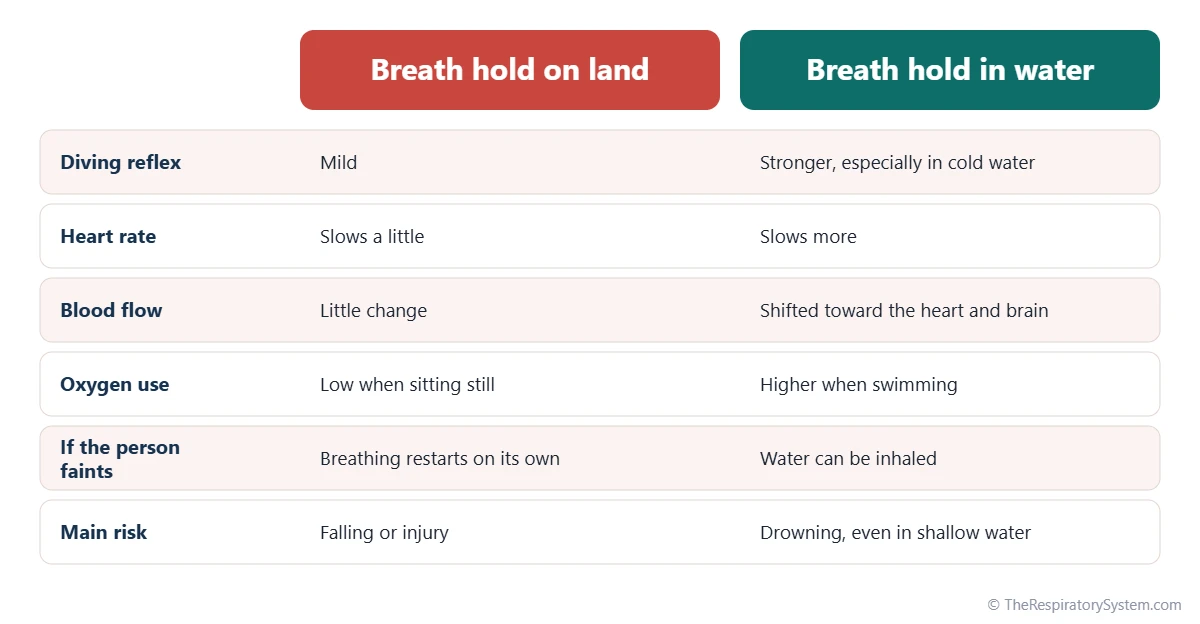
Underwater, most people hold their breath for a similar time as on land, roughly 30 seconds to a minute or so, and often less, because swimming uses oxygen quickly and cold water adds stress. Putting the face in water does trigger the mammalian diving reflex, which helps the body save oxygen.
The diving reflex is set off mainly by cold water on the face combined with breath holding. Its effects include:
- Slower heart rate: the heart beats more slowly, which lowers its own oxygen use.
- Narrowed blood vessels: vessels in the arms, legs and skin constrict, keeping more oxygen-rich blood for the heart and brain.
- Spleen contraction: the spleen squeezes stored red blood cells into the circulation, slightly raising the blood's oxygen-carrying capacity.
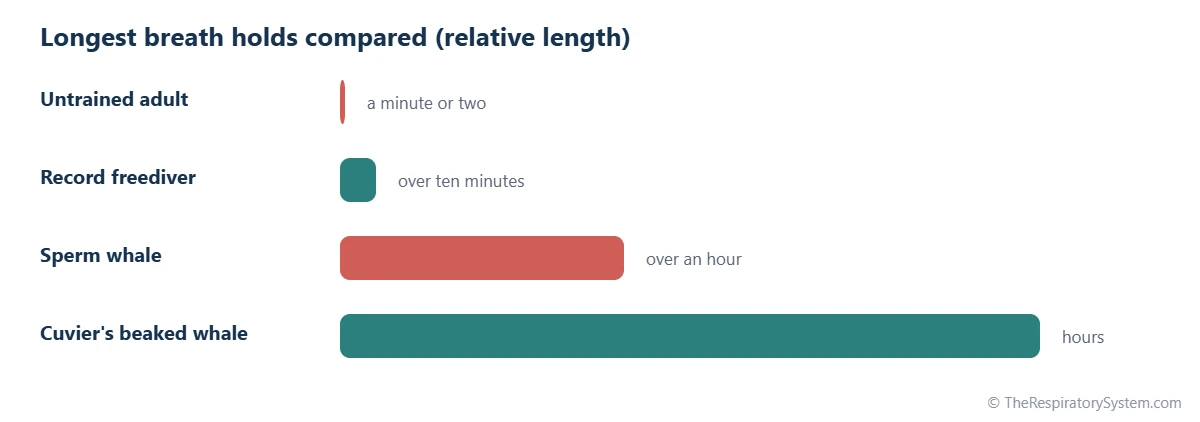
Seals, dolphins and whales have a far stronger version of this reflex, plus extra blood and muscle oxygen stores, as described under how whales and dolphins breathe. Breath-hold practice in water is dangerous for anyone, even strong swimmers in shallow water, because a person can lose consciousness without warning and drown.
What Is the World Record for Holding Your Breath?
The world records for a static breath hold, floating face down in a pool, are held by elite competitive freedivers and are well over 11 minutes on ordinary air. In separate record attempts in which the person breathed pure oxygen beforehand, breath holds of more than 20 minutes have been recorded.
These results come from a tiny group of athletes after years of training, under close watch by safety divers and medical staff, and they say little about what an ordinary person's body can safely do. Their long times reflect large lungs, a strong diving reflex, a lowered sensitivity to carbon dioxide and very low oxygen use while floating still. Even at this level, loss of consciousness during attempts is a known risk.
The oxygen-assisted records are longer because breathing pure oxygen replaces most of the nitrogen in the lungs with oxygen, enlarging the store the body can draw on. A large vital capacity helps for the same reason, but carbon dioxide still accumulates, and the breaking point still comes.
Key Facts
- Most healthy adults can hold their breath for about 30 to 90 seconds at rest.
- A breath hold ends at the breaking point, when rising carbon dioxide drives the brainstem to force a breath.
- During a breath hold, gas exchange continues, so oxygen in the lungs falls while carbon dioxide rises.
- The urge to breathe is triggered mainly by carbon dioxide, sensed by chemoreceptors, not by low oxygen.
- Cold water on the face triggers the diving reflex, which slows the heart and narrows blood vessels in the limbs.
- Elite freedivers have recorded static breath holds of more than 11 minutes under close supervision.
- Breath-hold practice in water is dangerous because loss of consciousness can come without warning.
Frequently Asked Questions
How long can you hold your breath before you die?
In a voluntary breath hold on land, a healthy person cannot hold their breath until they die, because the brainstem forces a breath at the breaking point or after fainting. The real danger comes when breathing is blocked by something else, such as choking or drowning. Then the brain is starved of oxygen, and brain cells begin to be damaged after a few minutes.
Does your heart rate change when you hold your breath?
Yes. A breath hold usually slows the heart a little, as part of the diving reflex, and the slowing is much stronger when the face is in cold water. At the same time, blood vessels in the limbs and skin narrow, so blood pressure tends to rise as the hold goes on. These changes save oxygen for the heart and brain, and they reverse within moments once normal breathing restarts.
Why do you feel the urge to breathe when holding your breath?
The urge comes mainly from carbon dioxide building up in the blood. Carbon dioxide forms carbonic acid, and chemoreceptors in the brainstem and in the carotid and aortic bodies detect the falling pH. They send stronger and stronger signals to the breathing centers, which you feel as air hunger. Low oxygen adds to the signal, but only later, once it has fallen a long way.
What is shallow water blackout?
Shallow water blackout is a sudden loss of consciousness underwater caused by low oxygen in the brain during a breath hold. It often happens without warning, because the urge to breathe, which tracks carbon dioxide, has not yet become strong. Once unconscious, the person may inhale water and drown, even in a shallow pool. It can affect fit, experienced swimmers, which is why breath-holding games in water are dangerous.
Does lung size affect how long you can hold your breath?
Yes, partly. Larger lungs hold more air, so they store more oxygen and give the carbon dioxide made during the hold more room before it reaches a high level. That is one reason taller people and some athletes have longer breath-hold times. Lung size is only one factor, though: oxygen use, carbon dioxide sensitivity and the strength of the diving reflex matter just as much.
Why can whales and seals hold their breath so much longer than humans?
Diving mammals store far more oxygen than we do, mostly in their blood and muscles rather than their lungs. They have more blood, more hemoglobin and very high levels of myoglobin, the oxygen-binding protein of muscle. During a dive, a powerful diving reflex slows the heart and shuts down blood flow to organs that can wait, saving oxygen for the brain and heart.
Why do we hold our breath when we swallow?
Breathing stops for a moment during every swallow so that food and liquid can pass into the esophagus rather than the airway. While the pause lasts, the larynx rises, the epiglottis folds over its entrance and the vocal folds close. Breathing usually resumes with a breath out, which helps clear any crumbs from the entrance to the airway. The whole sequence is automatic and takes about a second.
Keep Exploring


